
Commercial Real Estate for Beginners

I'm Tyler Cauble. Nashville native. I've been full-time in commercial real estate since I was 21, and I went straight into CRE from day one. I never did residential. No rental houses, no flips, no "made the jump" story. Commercial from the start.
My first commercial building was 1100 Old Hickory Blvd, right here in Middle Tennessee. Bought it for $575K, put a little money into it, leased it to two tenants, and sold it for $740K. Small deal. But it's the same playbook I use now on $18 million acquisitions, just at a scale a beginner can actually start with. Forced appreciation through income, then exit when the numbers work.
What I do now splits into three buckets.
Brokerage. The Cauble Group is my firm. My team and I have closed hundreds of millions of dollars of commercial real estate across Tennessee and the rest of the country.
Development. Through Hamilton Development, we've acquired more than 2.1 million square feet of commercial property since 2019. Two projects worth naming. The Wash, a 6-bay adaptive reuse food hall at 1101 McKennie in East Nashville, won ULI Nashville's 2023 Excellence in Development Award. And Madison Square, an $18 million, 33-acre acquisition in Madison, Tennessee, where we're master-planning a new downtown center for the community with up to 3.75 million square feet and roughly a thousand residences approved.
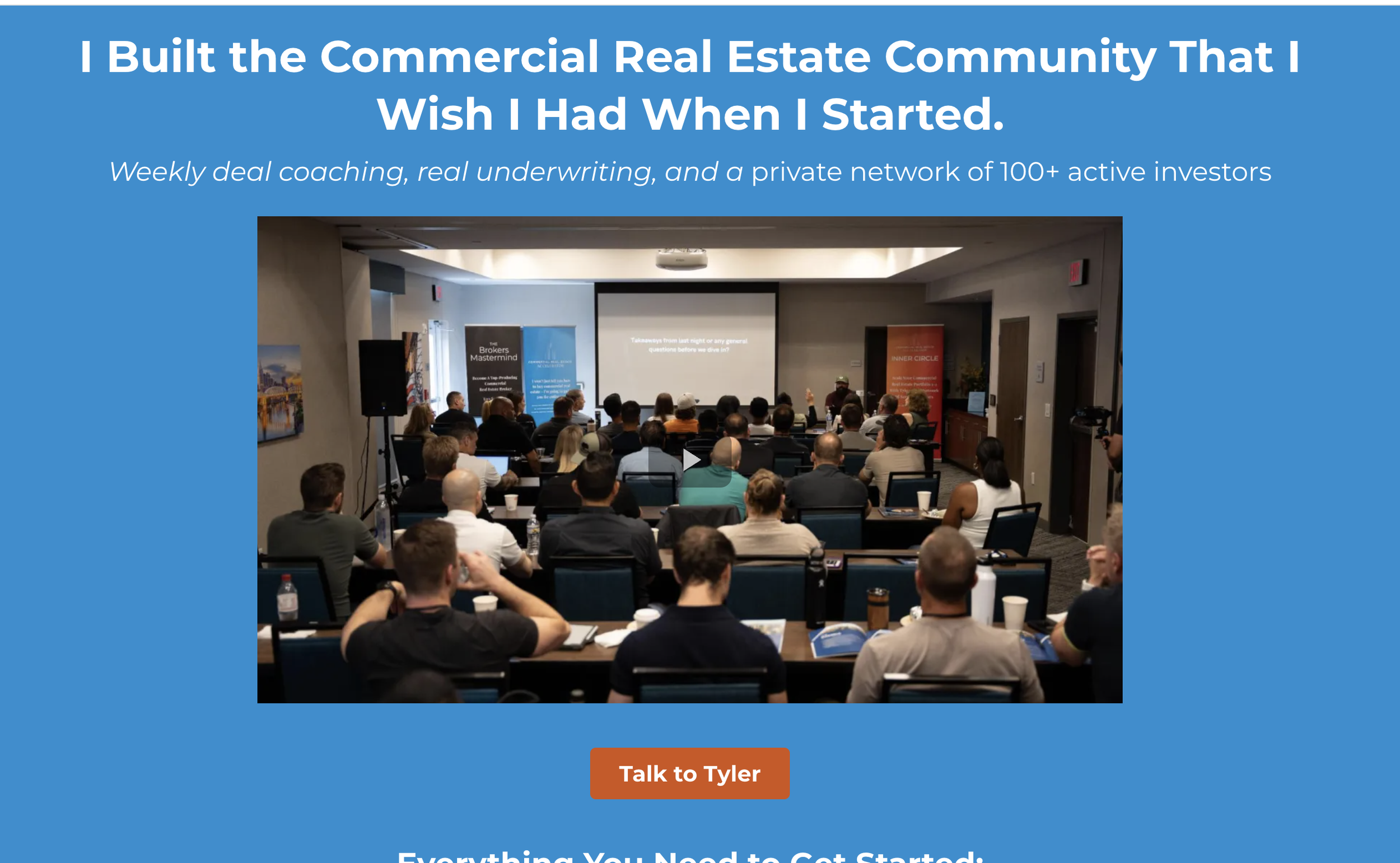
Coaching. I've personally walked hundreds of investors through their first commercial real estate deal, and 150-plus of them are active in my mastermind right now.
On top of all that, I wrote the best-seller Open for Business: The Insider's Guide to Leasing Commercial Real Estate, and I'm currently writing a second book, I Won't Evict Single Moms, about my philosophy of investing. I publish free to YouTube at @tylercauble (700-plus videos, 3.9 million-plus views). And I host free weekly Office Hours. Show up, ask questions, get real answers.
This page is the starting point I wish I'd had. If you're trying to figure out whether commercial real estate is right for you, what to learn first, and how to actually get into a deal, start here.
What Commercial Real Estate Actually Is (and What It's Not)
Commercial real estate is any property used to make money rather than to live in. That's the honest one-sentence definition. Retail strip centers, industrial warehouses, office buildings, self-storage, mixed-use infill projects, apartment buildings over four units. All of it is commercial real estate.
Here's the part most residential investors miss when they start looking at CRE. Commercial real estate is valued on income, not comparable sales. A three-bedroom house is worth whatever the house next door sold for. A five-tenant flex warehouse is worth its Net Operating Income divided by the market cap rate. That single difference changes everything. It means you can force appreciation by increasing NOI (raising rents, cutting expenses, adding tenants), and the value goes up mathematically. You're not waiting for the market to come to you.
That's the reason I've never owned a rental house, and I'm not shy about saying it. Rental houses don't scale. You're stuck with whatever the house is worth when comps sell. In commercial, the spreadsheet is the comp. I'd rather own one 20,000 square foot flex building than ten single-family rentals, and I think most beginners should too, once they understand how the numbers work.
The 1% rule that dominates residential investing is also dumb for commercial. It's a heuristic that doesn't translate. Commercial deals are about cap rates, debt service coverage, and forced value creation, not "does monthly rent equal 1% of the purchase price." If somebody tries to sell you a CRE deal based on the 1% rule, you're getting a residential pitch dressed up in commercial clothes.
Is Commercial Real Estate a Good Investment for Beginners?
Honest answer. It depends on what you're optimizing for.

If you want slow, steady, dividend-style monthly checks from day one with as little risk as possible, commercial real estate probably isn't your fastest path. You'd be better off in a net-lease property with a creditworthy tenant and a long lease, and even that carries real risk when the tenant vacates.
If you want to build equity aggressively through forced appreciation and you're willing to do the work (market research, underwriting, tenant conversations, repositioning), commercial real estate is one of the best vehicles I know. It's how I've built my own portfolio. It's how the vast majority of the 150-plus Accelerator members are building theirs.
Here's the way I think about it. Cash flow chasing will keep you busy. Forced appreciation builds equity. Beginners default to cash flow because it feels safer (money hitting the account every month). But equity is where real wealth gets made, and equity in CRE comes from the work you put in to raise rents, cut expenses, and hold through the cycle. Both matter. The right deal has both. If I had to pick one to optimize for as a beginner, I'd pick equity every time.
The Asset Classes, A Quick Tour
Commercial real estate isn't one thing. It's six or seven distinct businesses that happen to share the label. Different tenants, different leases, different math. Here's the beginner-friendly version.
Industrial. Warehouses, distribution, light manufacturing, flex space. My favorite starter asset class for most beginners. Leases are simple (often NNN, where the tenant pays taxes, insurance, and maintenance), tenants stay for long terms, and operating costs are low. Industrial has been the strongest-performing asset class in CRE for years. See my full guide on industrial real estate and investing in industrial.
Flex space. A hybrid of industrial warehouse and office. Small tenant footprints, usually 1,500 to 5,000 square feet each, often with multiple tenants under one roof. Often the easiest first deal for new investors. One of my Accelerator members, Matt Barbaccia, bought his first flex warehouse with effectively zero of his own money down. That's not normal, but it's possible when you learn how the financing actually works. More on flex here.
Retail. Strip centers, single-tenant net-lease (dollar stores, drive-thru coffee, dentists, QSR), and mixed-use ground-floor retail. The deal is simple to underwrite once you understand the tenant. The trap is picking the wrong tenant. Retail is picky.
Multifamily. Apartment buildings over four units. Massive asset class, massive competition, and most people overpay right now because multifamily is the asset class everyone learned about from BiggerPockets. It's not bad. It's just crowded.
Office. I wouldn't start here right now. Office is in a structural repricing cycle driven by remote work, and most markets haven't found bottom. There are deals to be had, but they're not for first-timers.
Mixed-use. Ground floor retail plus upper-floor residential or office. Great for urban infill (like a lot of what we build in Nashville), harder to finance, more complex to operate.
Self-storage, mobile home parks, and other "niche" categories. Great returns when done right, but the learning curve is steep and the inefficiency that made them great a decade ago is mostly gone.
My recommendation for most beginners: start with flex space or small multi-tenant industrial. Simple leases, forgiving tenants, sensible financing, and room to force value through rent bumps and tenant mix.
How Commercial Real Estate Investing Actually Works
At a mechanical level, a commercial real estate deal has four moving parts. Price, income, financing, and your exit. Master those four and you can underwrite anything.
Price. What you pay. Set by the market, but negotiable based on what the property actually produces. This is where most beginners get stuck, because they trust the seller's pro forma. Never trust the seller's pro forma. The seller's pro forma is a sales document, not an underwriting document.
Income. Net Operating Income, or NOI. Gross rent minus operating expenses (taxes, insurance, maintenance, property management, utilities, vacancy allowance). This is the number every commercial real estate deal ultimately revolves around.
Financing. Typically a commercial bank loan at 65% to 75% loan-to-value, with a personal guarantee, at rates roughly 1 to 2 percentage points above residential. Sometimes SBA 7(a) or 504 for owner-users. Sometimes bridge debt for value-add. The financing structure affects your returns more than almost any other decision.
Exit. Sell, refinance, or hold. Most of my deals are "hold with a refinance at year three to five to pull equity back out." That's what a good value-add deal enables.
The framework I use on every deal is what I call Backwards Underwriting. Start with market rent per square foot. Multiply by square footage to get gross rent. Subtract realistic operating expenses to get NOI. Divide by the market cap rate to get stabilized value. Subtract your improvements, closing costs, and desired profit to get your max offer price. Work backwards from the exit, not forwards from the asking price. It's the single most valuable thing I teach inside the Accelerator, and it's how I price every deal I look at before I ever call the broker.
Here's what that looks like with actual numbers. Say you're looking at a 10,000 square foot flex warehouse. Market rent in the area is $12 per square foot on a NNN lease.
Gross rent. 10,000 sq ft × $12 = $120,000 per year.
Operating expenses. Even on NNN leases you still carry vacancy allowance, property management, and reserves. Say $18,000 for this deal.
NOI. $120,000 − $18,000 = $102,000.
Stabilized value at market cap rate. If comparable flex is trading at an 8% cap rate, $102,000 ÷ 0.08 = $1,275,000.
Subtract your costs and your profit. Tenant improvements and light renovation: $75,000. Closing costs: $25,000. Profit you want to earn on the deal: $175,000.
Max offer. $1,275,000 − $75,000 − $25,000 − $175,000 = $1,000,000.
If the seller's asking $1.2M, you already know you're either negotiating hard or passing. If they're asking $950K, you know you're sprinting to the closing table. Either way, you priced the deal before you ever picked up the phone. That's the whole point.
You can run this same math on any deal you're looking at using my free Deal Analyzer. It's a proper underwriting tool, not a spreadsheet you have to decode. Plug in the inputs, get detailed outputs in seconds. For quick one-off math (cap rate, NOI, debt service, DSCR, cash-on-cash), I also keep a set of free commercial real estate calculators on the site.
Returns in CRE come from three levers working together. Cash flow (the NOI left over after debt service). Loan paydown (your tenants are paying down your mortgage). And forced appreciation (increasing NOI or decreasing the cap rate, both of which increase value). A good value-add deal hits all three.
The Three Ways to Learn Commercial Real Estate from Me
I've built the education side of what I do as a ladder. Free content first, then a self-paced course, then done-with-me coaching. Start wherever fits you today, and move up whenever you're ready for the next step.
Tier 1. YouTube and Office Hours. Free. Subscribe to @tylercauble on YouTube. 700-plus videos, 3.9 million views, and every topic on this page covered somewhere in the archive. Office Hours are my live, recurring Q&A sessions. Free to join. Bring a question, get a direct answer. If you're not sure whether CRE is for you yet, start here and go deep for a few weeks before you spend a dollar.
Tier 2. The Beginner's Guide to Commercial Real Estate Investing. My self-paced course built for new investors. Everything on this page at a deeper level, plus the spreadsheets and frameworks I use, plus real deal examples. Good fit if you've decided CRE is the path and you want a structured curriculum to follow on your own time. See the full courses page for what's included.
Tier 3. The CRE Accelerator. My done-with-me mastermind at crecentral.com. This is where 150-plus members work directly with me on their deals. Real-time feedback, weekly calls, underwriting support, and a community of serious operators. Good fit if you're ready to actually buy this year and you want a coach in the room instead of a video you watch alone. Learn more on the coaching page.
Three paths. Same destination. Jump in wherever feels right today, and you can always level up from there.
Your First 90 Days in Commercial Real Estate
Every new investor asks me the same thing. "What do I do first?" Here's the actual roadmap.
Days 1 to 30. Learn the language. Read my CRE glossary. Watch enough YouTube to understand cap rates, NOI, loan-to-value, debt service coverage ratio, tenant improvement allowances, and the three main lease types (NNN, MG, FSG). The goal isn't mastery. The goal is fluency, so when a broker sends you a deal, you understand the email.
Days 31 to 60. Pick a market and an asset class. Don't pick six. Pick one. For most beginners I recommend either flex or small multi-tenant industrial in a market within an hour of where you live. Drive the market. Look at every for-sale sign. Call three commercial brokers who work that asset class in that market and tell them you're looking. Brokers who don't know you don't send you deals. Make yourself known.
Days 61 to 90. Underwrite real deals. Run every deal through my free Deal Analyzer using the Backwards Underwriting framework from Section 4. For quick standalone math (cap rate, DSCR, cash-on-cash), the free commercial real estate calculators are faster. Underwrite five deals a week minimum, even if you don't offer on any of them. The skill you're building is price intuition. After 20 or 30 deals, you'll know within a few seconds whether a price is reasonable. That's when you start making offers. See how to buy your first commercial property for the offer-through-closing walkthrough.
This sequence sounds slow. It isn't. Most people who fail at commercial real estate fail because they skipped one of these steps, not because they were unlucky. Doing the first 90 days right is what makes the rest of it work.
Common Beginner Mistakes (and How to Avoid Them)
After watching 150-plus Accelerator members go through their first deal, the same mistakes come up over and over. Here are the big five.
Trusting the seller's pro forma. The seller's pro forma is a marketing document. Always rebuild it from scratch. Pull actual rent rolls, actual tax bills, actual expenses from the trailing twelve months. If the seller won't provide those, walk.
Obsessing over cash flow, ignoring forced appreciation. Every beginner spreadsheet is designed around "how much money will this put in my pocket every month." Cash flow matters, but it's the smaller lever. Forced appreciation through increasing NOI is where real wealth gets built. Don't pick deals that pay you well today and can't grow.
Skipping the rent roll review. The rent roll tells you who your tenants are, when their leases expire, and what rent they're paying. It's the single most important document in a CRE deal. Most beginners glance at it. Read it line by line.
Buying in a market they don't know. Out-of-state deals look great in a spreadsheet and bad in person. If you've never driven the market, don't buy there for your first deal. Learn one market well before you diversify.
Waiting too long to make their first offer. This is the one I see most. Most people talk themselves out of their first deal. They don't fail at it. They spend two years "getting ready" and never write an offer. Write the offer. Worst case, it gets rejected. You learn more from a rejected offer than from another six months of reading.
Frequently Asked Questions
-
Start by picking one asset class (flex space or small industrial is easiest) and one market you can drive to. Spend 30 days learning the vocabulary, 30 days meeting brokers and touring properties, and 30 days underwriting real deals. After 90 days you're ready to make your first offer. Don't try to learn all of CRE at once. Go one asset class deep first.
-
For the right investor, yes. Commercial real estate rewards people who can force appreciation through increasing income and decreasing expenses. It's a slower wealth-building vehicle than equities in a bull market, but it's more controllable, more tax-advantaged, and uses bank leverage that public markets don't. It's a great investment if you're willing to learn underwriting. It's a rough one if you're just buying on vibes.
-
You buy an income-producing property, usually with 25% to 35% down and a commercial bank loan. The tenants pay rent, the rent covers the mortgage plus expenses plus a profit, and you increase the property's value by increasing its Net Operating Income. After a few years you either sell (and take a gain), refinance (and pull equity out tax-deferred), or hold for cash flow and loan paydown.
-
Less than most people think. Small flex or industrial deals can be had for under $1 million, which means $250K to $350K down. SBA loans can cut that to 10% down for owner-users. Creative structures (seller financing, partners, joint ventures) can lower your cash requirement further. One Accelerator member closed his first flex warehouse with effectively zero of his own money in the deal.
-
Flex space or small multi-tenant industrial. Leases are simple (usually NNN), tenants are commercial businesses with longer-term horizons, operating complexity is low, and the math is transparent. Retail and multifamily have more competition and thinner margins for beginners. Office is in a structural repricing right now and isn't where I'd start.
-
Yes, but not easily and not often. The most common paths are seller financing (owner carries part of the purchase price), bringing in partners who provide the equity in exchange for a share, house-hacking a small mixed-use property with an SBA 504 loan, or wholesaling (which I don't recommend for most people). Zero-down deals exist. They're earned, not lucky.
-
From starting-to-learn to closing, most people take six to twelve months if they're working a day job and doing CRE on the side. The first 90 days are learning and relationship-building. The next 90 days are typically spent making offers that don't get accepted. The deal that closes usually comes somewhere between offer number five and offer number twenty. This is normal. Keep swinging.
-
No. You do not need a license to buy, hold, or sell commercial real estate as an investor or principal. You only need a license to represent other people in transactions (acting as a broker or agent). Plenty of successful commercial real estate investors have never held a license. Plenty of others (including me) chose to get licensed for access to MLS, broker networks, and commissions on their own deals.
Pick your starting point.
Three ways to learn commercial real estate from me. Start wherever fits you today, and you can always move up when you're ready.
Subscribe to @tylercauble for 600-plus videos and join Office Hours live.
Self-paced course with the frameworks, spreadsheets, and real deals I use.
Work directly with me and 150-plus other operators inside the Accelerator.