
Can Architecture Students Help Save This Abandoned Mill?
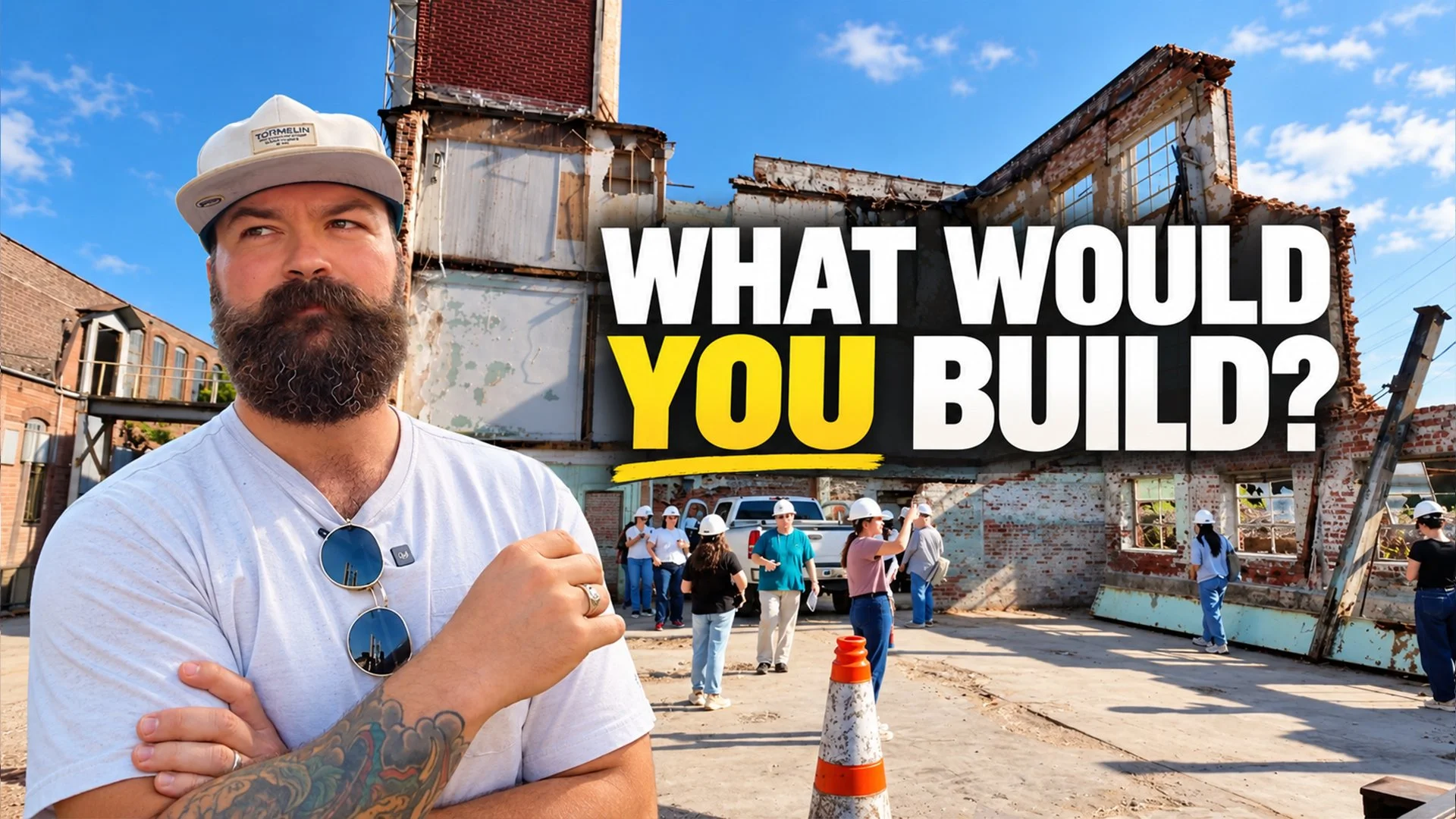
I brought 20 architecture students from the University of Tennessee at Chattanooga to Peerless Mill, a 1.5 million square foot historic mill campus in Rossville, Georgia that we're bringing back to life. They walked the buildings for the first time and pitched what this place could become. If a good idea comes out of this design charrette, there's a real chance we build it. This is Part 1.
Key Takeaways:
The design charrette is intended to generate real, potentially implementable ideas for Peerless Mill—not just an academic exercise.
Historic preservation matters. Students suggested a museum or dedicated history space, and Tyler said the goal is to preserve the site’s character.
The site is vast: about 32 acres, 29 buildings, and 1.5 million square feet, including substantial underground areas.
Development will be phased over about 20 years and funded by revenue from each stage, so ideas need to be financially viable.
Potential uses discussed included a marketplace or food hall, dance studio, speakeasy, event space, and a brewery, distillery, or bar.
Environmental cleanup is required: many buildings have lead paint and asbestos, and a small contaminated soil area needs remediation.
The main challenge is balancing ambitious design ideas with what tenants and the project can support financially.
Speaker 1
What is your intention in letting UTC do this project? Like, do you could you see yourself actually using some of our projects, or are you just letting them do it? If
Tyler Cauble
there's cool ideas that come out of this, like we're very interested in doing them. What haven't told them yet is if a good idea comes out of this design charrette, we're going to implement it. 20 architecture students are going to walk in and see it in a completely different way, and I want to know what that looks like. I'm currently in Chattanooga. Drove in this morning to meet with the University of Tennessee at Chattanooga and Preserve Chattanooga, who are working with architecture students at the university to design a project at Peerless Mill. So this is one of the spaces that I'm going to be showing the students that they get to work on. My idea for this is something along the lines of like a really cool marketplace, farmers market, food hall, something where we could activate a lot of small businesses that want to give people a destination, but I also don't want to influence their thoughts and what they want to do. So I'm not really going to tell them that when we first get started. I want to see what it's like for them to be walking through this space for the first time. What are they saying? What are they thinking? With so many buildings that we have on site, there's so many different directions that we could really be taking at every single step of the way. But when somebody else is coming through, they're looking at it for the first time. They're coming up with ideas that makes it so much easier for me to continue focusing on the stuff that I'm already focusing on, and then taking their ideas and implementing those as well simultaneously. Let's tour the property with the students from the University of Tennessee at Chattanooga. Let's see what ideas they came up with. So this is Peerless Mill. It's a pretty big project. So it's 29 buildings on about 32 acres. It's one and a half million square feet. Pretty decent portion of that is underground, and we actually haven't even explored it yet, which is really interesting. There were actually more than 29 buildings at one point. You can see here we just had to demo one. A storm hit, and unfortunately, it just it wasn't salvageable. Two owners ago, the guy got into a fight with the city, dragged an HVAC unit across the roof, threw it at the cops. It was pretty nice, little dramatic scene, I guess. So there's plenty of things that y'all could look at from that perspective of how could we utilize indoor outdoor space right there, which I think would be really neat. You know, food trucks, some sort of vendor setup, something like that that would be neat. I think we're going to be using it for parking in the meantime. Underneath the smokestacks is where we're planning on having a brewery, distillery, or some kind of really cool, unique bar. If you guys go to peerlessmill.com. You'll be able to see some of our plans for now. I don't want to influence y'all's you know investigation too much, but the one question I do have before we get started that I would like to hear from you guys, just based on the research that you've done and what you guys have seen so far, what would y'all want to do with the space?
Speaker 1
I think it's pretty important to make sure that the history of this place is still here. Like, I mean, it's an industrial mill, so we can't really do much with like a cloth type of artwork thing, furnwise. But I don't know. I think it's pretty important to keep artwork at least, and maybe consider a museum as.
Tyler Cauble
Yeah. So, so you don't think we should tear anything down?
Speaker 1
I mean, I'm not saying that. I'm just saying that it's important to have at least a space that's designated to the history of this place.
Tyler Cauble
Yeah, I agree. I'm just messing with you. Like we we don't want to tear anything down. We want to preserve everything here, which is the far more expensive choice to make. But also, y'all know this from the design perspective. You can't build this back today with that level of character. You can try, but it it and it almost worked, but in most cases it doesn't. And there's a lot of stuff here that you wouldn't build back today because it it wouldn't make any financial or economical sense to do that. But everything that you see here, we're aiming to preserve. I mean, this entire town was built because of this mill. That's why it's in the center. All of the houses are built around it. People used to just walk to work in the '60s. When it closed, it was pretty devastating. They employed over 3,000 workers at its peak, and there's about 4,000 people that live in Rossville today. So you can imagine every single person that lived here was impacted by the factory closing.
Speaker 2
Have you run into like health hazard issues like asbestos or lead paint or.
Tyler Cauble
Good question. Absolutely. Yeah. I mean, so with it being built over 50 years before you know people even discovered asbestos was bad, during the Georgia Brownfield program, we did a phase one, we did a phase two. They drill holes on site. They they test the soils. So fortunately, so far we know there's lead paint and asbestos in just about every building. That's very manageable. We do have a 10 foot by 10 foot area of soil that has arsenic in it and some other heavy metals that we have to get remediated. But all things considered, a 10 foot by 10 foot area of 100 square feet out of 32 acres, I'll take that. That like robin's egg teal color, we had no idea that that existed in here until we demoed it. That contrast with the red brick, we're like, okay, well, I think the building just gave us our brand colors. Yes,
Speaker 2
yes. You know, just saying we really like it. I
Tyler Cauble
love it. You couldn't pick like a cooler color combination. That's one thing that I like to do as well. Is is kind of let the property tell you what it wants to be, and then if y'all want to come this way, this is one of my favorite rooms. So you can tell they actually used to have another smokestack up there. It was kind of wild. At some point, they removed that.
Speaker 2
Is this where you want the brewery?
Tyler Cauble
Yes. So this this building here, and then this little outdoor space over here, so you can see that's the railroad spur. But this is where they would bring all the coal in, right here.
Speaker 2
On the train.
Tyler Cauble
Yep. Yeah. So they pull the train, they'd back it in, and they'd unload everything right there, and then they use they pump the water in from that pond over there to generate all the the steam electricity. There's a pretty good chance that whatever you guys come up with, we're probably going to use them.
Speaker 2
Okay, that was going to be my next question. Yeah. Like, how much of our work are you guys actually planning on?
Tyler Cauble
I think it just depends on the ideas. So no pressure. So we we think this will be a 20-year project.
Speaker 2
A 20-year.
Tyler Cauble
Yeah. So we didn't raise private equity. We didn't bring in a big bank as a partner. We wanted to take our time with it, so that we'd be very intentional on a phase-by-phase basis. Which means every building that we do has to generate enough revenue for to pay for the next phase. So we started with a 359-unit self-storage facility, and that actually paid for a lot of new infrastructure to come down the alleyway, so that's why we've got that trench right there. All new fire and water lines, and so that will help pay for you know the the leasing offices in the next phase, and then the leasing offices. Hopefully, we'll be able to get a few leases done, and start doing little spaces here and there. This was used as a wood shop right up until we bought
Speaker 3
it.
Tyler Cauble
Yeah. I mean, we're kind of open to just about anything. Obviously, I'm not going to do like a advanced check cashing store. We're not going to do a vape shop. But I mean, pretty much anything is is on the table right now.
Speaker 2
The one with the tunnel, there's like those that big room, and then there's a room to the side. Um, I grew up dancing, so yeah, I'm just looking at it as like this is a huge dance studio.
Tyler Cauble
Could be a great dance studio.
Speaker 2
I agree, and with the tall ceilings as well. I also thought like down in those basements, like a speakeasy could be really cool.
Tyler Cauble
Speakeasy would be awesome. We've talked to a group about a shooting range because it's underground and it's you've got about 100 yards, so it'd be a pretty big indoor shooting range. That'd be
Speaker 2
like something that isn't really intending at all.
Tyler Cauble
Right. There's nothing like that around here.
Speaker 2
Maybe ballroom too.
Tyler Cauble
Everything that you've seen so far is just one corner of this property. To show them what it looks like on the other side of the work, we had to get in cars and drive. With the self storage, it's the cheapest thing that we could do that would generate enough revenue to be significant. Yeah,
Speaker 2
that makes sense. And I mean, it's such an expansive space.
Tyler Cauble
Oh, it's kind of perfect for it. Stuff
Speaker 2
like this.
Tyler Cauble
Yeah, and when we did a study on it, there's you know a lack of self-storage in this area, which I know some people probably find surprising.
Speaker 2
Are they like varying in size or they
Tyler Cauble
are everything from like a five by five to a 10 by 20, maybe? I think we're like 30% below market.
Speaker 1
How much was it to get it to this state?
Tyler Cauble
1.6 7 million. Was just pretty cheap, all things considered. Does this kind of like help you guys envision what it could become? I know it's hard sometimes looking at like a dirty, dark building with broken windows and you know trying to imagine what it could become. But this is basically what that looked like. I mean, it was we had to have the whole thing pressure washed, basically cleaned up multiple times. It was covered in lead paint. I don't think that we found any asbestos here, which was kind of nice. But this is what it can look like, and this is only with half power. So we still haven't gotten our transformer yet from EPB. So not all the lights are on. The HVAC is not running. We can kind of maintain the old historic adaptive reuse. You know, kind of lean into what it was, but make it new. right, everybody just left. It's been a long morning, couple hours to walk through, and to be honest with you, we didn't even cover probably more than 25% of the site, which is crazy to think about. We heard coffee shops, we heard dance studios, we heard outdoor marketplaces. I'm really excited to see what this team comes up with. As a student, could you think of anything cooler than to get to work on actual projects for your thesis? There's a pretty big push and pull in the real world between what an architect wants to design and what a developer can actually finance. What will a tenant pay? Because that's the biggest thing. If a tenant is not willing to pay for it, we can't justify spending that money anyway. So, what do you guys think? Do you think we're going to get some really cool ideas that we'll actually be able to implement at the mill? I hope so. All right, we just pulled up to Peerless Mill for day two with the students at the University of Tennessee at Chattanooga.
Speaker 1
You put some sort of projector screen or mini stage over there. So you're
Tyler Cauble
saying turn that whole wall right there into a big screen projector. Yeah,
Tyler Cauble
that's definitely one we would do. All of the mentors are going to come through, and they are going to critique the plans, the ideas.
I brought 20 architecture students from the University of Tennessee at Chattanooga to Peerless Mill, a 1.5 million square foot historic mill campus in Rossville, Georgia that we're bringing back to life. They walked the buildings for the first time and pitched what this place could become. If a good idea comes out of this design charrette, there's a real chance we build it. This is Part 1.