
The spreadsheet finally has competition
For years, underwriting a commercial deal meant one thing: a spreadsheet you either built yourself or inherited from someone who left the firm. It worked. It still works. But a spreadsheet doesn't stop you from typing a number into the wrong cell, it doesn't remember which of your forty deals is stuck in due diligence, and it can't read a rent roll for you at midnight. A wave of software has shown up to fix exactly those gaps, and in 2026 the question isn't whether to use a tool -- it's which one actually fits the way you invest.
I've watched a lot of investors buy a platform built for a hundred-person acquisitions team and then wonder why it feels like flying a jet to the grocery store. Most of the well-funded tools in this space are aimed at institutions. If you're a single investor, a broker, or a small shop underwriting your own deals, a lot of that horsepower is horsepower you'll pay for and never touch. So below is an honest look at the main options, who each one is really built for, and where the money actually goes.
The short version: the big-name platforms are built and priced for institutional teams. If you're underwriting your own deals, you want a tool aimed at your seat -- not an enterprise contract you'd use a fraction of.
What commercial real estate underwriting software is supposed to do
Before comparing names, it helps to agree on what the category even means. Good underwriting software should take a property's income and expenses, layer in your financing, and return the numbers that decide a deal -- net operating income, cap rate, cash-on-cash return, debt service coverage, and internal rate of return -- fast enough that you can screen a deal before you lose it. That is the floor.
The better tools go further in three directions. They pull data in for you (parsing a rent roll or an operating statement instead of making you retype it), they track a deal from first look through closing so nothing falls through the cracks, and they let more than one person work the same deal without emailing versions back and forth. Where the platforms genuinely differ is who they built those features for, and how much they charge to get them.
What good underwriting software calculates
The five numbers that actually decide a deal, every time you screen one.
NOI
Net operating income
Cap Rate
Yield at the price
Cash-on-Cash
Return on cash in
DSCR
Can it cover the loan
IRR
Return over the hold
The main players in 2026
Cactus
Cactus (trycactus.com) markets itself to "ambitious real estate teams," and that is an accurate read of the product. It leans hard on AI to parse documents and speed up analysis, and it is clearly built for firms doing real volume. If you have a team and a pipeline big enough that document processing is your bottleneck, it is a serious option. The pricing isn't public, which tells you most of what you need to know about who they expect to be selling to -- this is a talk-to-sales, book-a-demo kind of purchase, not a swipe-your-card-and-start one.
Archer
Archer (archer.re) is multifamily underwriting, parsing, and comps in one place, and it is aimed squarely at institutional multifamily buyers. If apartments are all you do and you're competing on speed against other well-capitalized groups, the comps and underwriting automation are strong. But that focus cuts both ways. If your deals wander across retail, office, industrial, and the occasional mixed-use building the way most of the deals I see do, a multifamily-only engine is going to feel narrow. Pricing, again, is a conversation rather than a page on the site.
Cash Flow Portal
Cash Flow Portal is best known as syndication software -- raising and managing capital from investors -- and it has bolted AI-automated underwriting onto that. For a syndicator who is already using it to run an investor room, having underwriting in the same place is convenient. If you're not syndicating, though, you'd be buying a capital-raising platform to get at an underwriting feature, which is a lot of product to carry for one job.
PropRise
PropRise (proprise.ai) is an AI-first data and underwriting platform, heavy on pulling market and property data into the analysis. It is newer and data-forward, and if your edge comes from chewing on large amounts of market data, that is the angle it plays. As with the others in this tier, it is built and priced for teams, not for the individual buyer trying to underwrite the strip center down the street.
CRE Central Pro
CRE Central Pro is the one I built, so read this section knowing that -- I'm not going to pretend otherwise. I built it because everything above is aimed at institutions, and the individual investor and the small brokerage kept getting left with a spreadsheet or a six-figure enterprise contract and nothing in between. Pro is underwriting for the person doing the deal themselves. The Deal Analyzer runs your cap rate, NOI, cash-on-cash, and debt coverage as you type. A deal pipeline tracks every property from first look to close. A due diligence tracker keeps your checklist honest, and a cost estimator sanity-checks the build-out before you commit. It is $99 a month, the price is on the page, and there is a 7-day demo of the Deal Analyzer you can run a real deal through before you subscribe.
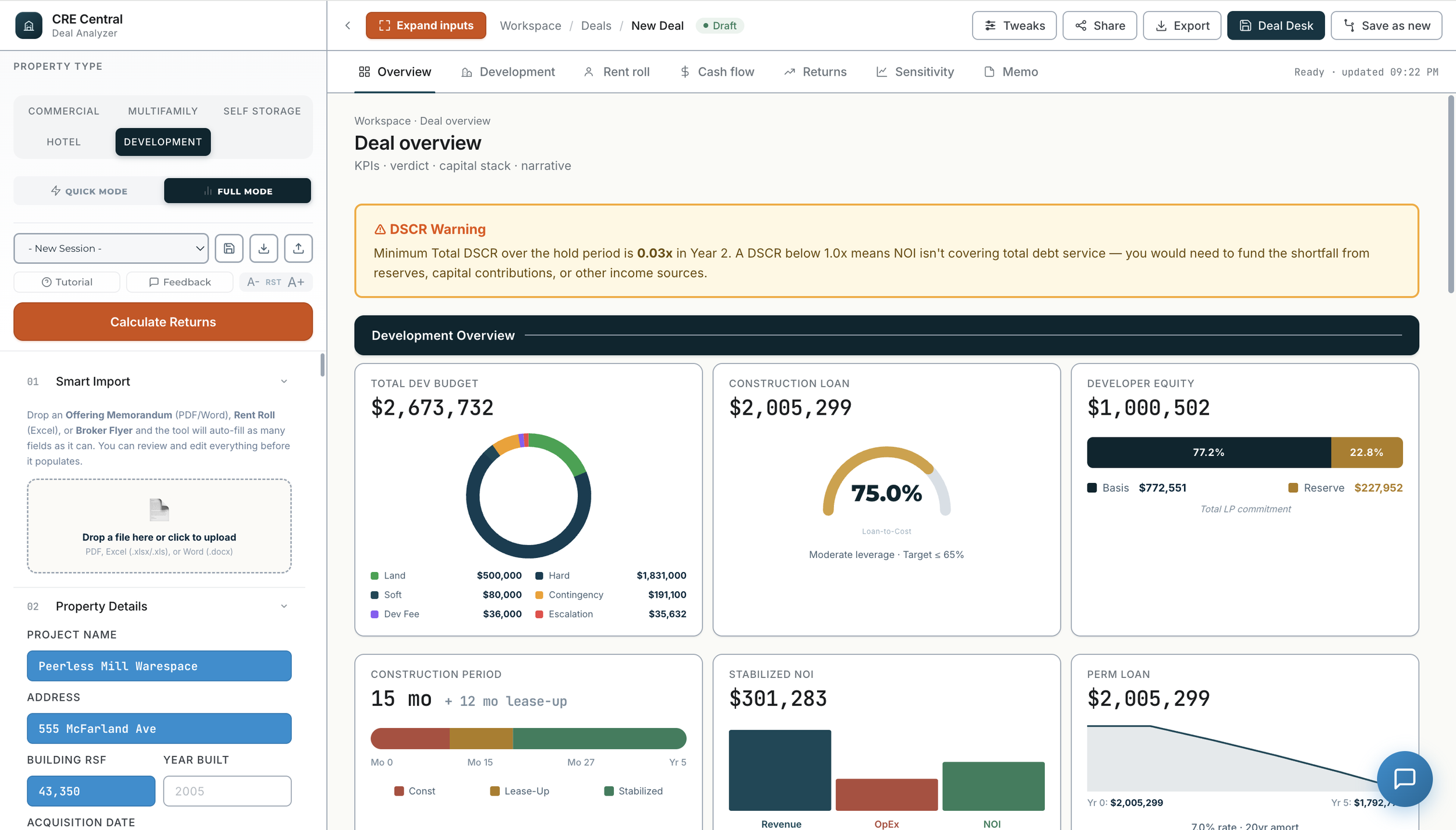
To be fair about it: if you're an institutional multifamily shop underwriting two hundred units a week, Archer or Cactus will out-muscle a tool built for the individual investor, and you should buy the one that fits your volume. Pro is for the other ninety percent of the market -- the buyer, the broker, the small team who wants to underwrite a deal properly without hiring an analyst or learning a platform designed for one.
| Software | Built for | Strength | Pricing |
|---|---|---|---|
| Cactus | Real estate teams doing volume | AI document parsing & analysis | Not public (demo) |
| Archer | Institutional multifamily | Multifamily comps & underwriting | Not public (demo) |
| Cash Flow Portal | Syndicators raising capital | Syndication + automated underwriting | Tiered (syndication suite) |
| PropRise | Data-driven teams | AI-first market data | Not public (demo) |
| CRE Central Pro | Individual investors, brokers & small teams | Underwriting + pipeline + due diligence, one place | $99/mo + Deal Analyzer |
Pricing shown is what each company publishes as of 2026; “not public” means the price is quoted after a sales demo.
How to actually choose
Two questions settle most of this, and neither one is about features. The first is who is doing the underwriting. A hundred-person acquisitions team and a solo investor have almost nothing in common in what they need from software, and buying up the org chart is the most common and most expensive mistake in this category. Match the tool to your actual seat, not the seat you imagine having in five years.
The second question is what the deal really needs to know, which comes down to the return math. A tool that spits out a cap rate is fine for a first glance, but the deals that get away or blow up are the ones where the cash-on-cash and the debt coverage were never stress-tested. Whatever you pick, make sure it lets you raise the vacancy, bump the interest rate, and drop the rent, then watch what happens to your return before you write the offer. That is the whole job. If you want to see how those numbers fit together first, my guide on commercial real estate underwriting walks through the process by hand, and the piece on how to analyze a commercial real estate deal covers the metrics that matter most.
And the last thing worth saying out loud: watch the pricing. Most of this category hides its number behind a demo, and a hidden price is almost always a big one. Decide what you can actually spend before you get talked up the tiers.
Try the Deal Analyzer free for 7 days
Run a real deal through the Commercial Deal Analyzer, then step up to Pro when you're ready to manage the whole pipeline in one place.
Try the Deal Analyzer (7-Day Demo) Explore CRE Central ProFrequently asked questions
What is commercial real estate underwriting software?
It is a tool that takes a property's income, expenses, and financing and calculates the metrics that decide a deal -- NOI, cap rate, cash-on-cash return, and debt service coverage -- while tracking the deal from first look through closing. It replaces the manual spreadsheet most investors have used for years.
What's the best underwriting software for an individual investor or broker?
Most of the well-known platforms are built and priced for institutional teams. For a solo investor or small brokerage, a tool aimed at your seat -- like CRE Central Pro at $99 a month, with a 7-day demo to start -- fits better than an enterprise platform you'd use a fraction of.
Is there a free trial of underwriting software?
Yes, for the core analysis. You can run a full deal through the Commercial Deal Analyzer without paying, then step up to a paid plan when you need pipeline tracking and due diligence on top of the underwriting.
Do I still need a spreadsheet?
You can keep one, and plenty of good investors do. But a spreadsheet won't parse a rent roll, remember your pipeline, or stop a typo from killing your math, and those are the exact places deals go wrong.
The right tool is the one built for how you actually invest. If that is your own deals and a real pipeline rather than an institutional volume machine, start with the Deal Analyzer, and when you're ready to run your whole pipeline in one place, that is what CRE Central Pro was built for.