
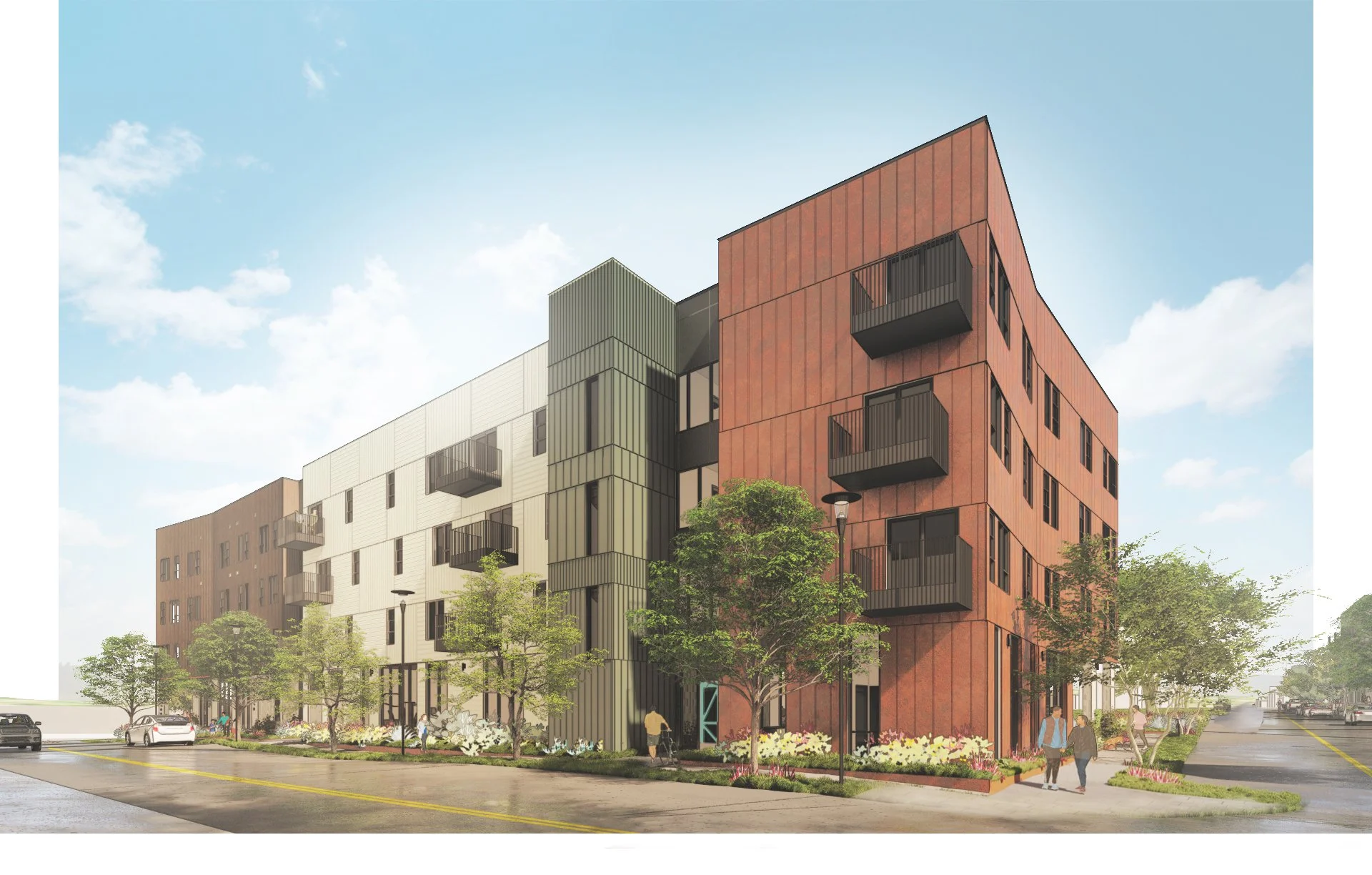
Commercial real estate underwriting is the process of analyzing a property's financial performance to determine whether the deal is worth buying. It means building a model that captures the purchase costs, the financing structure, the rent roll, the operating expenses, the tax benefits, and the exit strategy, then comparing the projected returns against your target hurdle rates. If the deal pencils, you offer. If it doesn't, you pass.
The four numbers that drive every commercial underwriting decision are net operating income (NOI), cap rate, debt service coverage ratio (DSCR), and cash-on-cash return. Get those four right and you'll know within 15 minutes whether a deal works.
I've been doing this since 2013, and the difference between investors who succeed and investors who lose their shirts comes down to one thing: they know how to underwrite. In this guide I'm going to walk you through the complete underwriting process - what each number means, how to calculate it, why it matters, the common mistakes, and a real KFC triple net lease deal I underwrote here in Nashville so you can see the whole thing in action.
If you're brand new to commercial real estate, our complete guide to commercial real estate investing covers the broader context. Then come back here for the underwriting deep dive.
Already know the framework? Jump straight to the tool.
Prefer to watch? I walked through this exact deal on video:
In This Article
What Is Commercial Real Estate Underwriting?
The 4 Numbers Every Underwriter Must Know
Step-by-Step: How to Underwrite a Commercial Deal
Run Your Deal Through the Free Analyzer
Real Deal Walkthrough: Underwriting a KFC NNN Lease
What Is Commercial Real Estate Underwriting?
Commercial real estate underwriting is the financial analysis process of determining whether a commercial property is worth buying based on its income, expenses, financing structure, and projected returns. Think of it as building a financial model that answers one question: does this deal hit my target returns?
If you're coming from residential real estate, you might think analyzing a deal means checking the Zestimate and running some quick math on rental income. Commercial underwriting is a completely different animal.
Residential real estate is valued based on comparable sales - what similar houses sold for nearby. Commercial real estate is valued based on income - how much money the property produces. That's a fundamental difference, and it's why underwriting matters so much. You're not buying square footage. You're buying a cash flow stream.
A complete commercial underwriting model captures:
- Purchase costs: Purchase price, closing costs, immediate capex, working capital reserves
- Financing structure: Loan amount, interest rate, term, amortization, balloon date, recourse vs non-recourse
- Rent roll: Every tenant, every lease term, every renewal option, every escalation clause
- Operating expenses: Taxes, insurance, management, maintenance, utilities, vacancy, reserves
- Tax benefits: Depreciation, cost segregation, bonus depreciation, 1031 exchange potential
- Exit strategy: Hold period, exit cap rate, projected NOI at sale, transaction costs
From that model, you derive the four key return metrics - NOI, cap rate, DSCR, and cash-on-cash - which tell you whether the deal pencils.
The 4 Numbers Every Underwriter Must Know
Master these four numbers and you'll be ahead of 95% of new commercial investors. Each one tells you something different about the deal, and you need all four to make an informed decision.
The 4 Core Underwriting Numbers
NOI
Income - OpEx
The foundation
CAP RATE
NOI ÷ Price
Unleveraged yield
DSCR
NOI ÷ Debt
Lender's filter
CASH-ON-CASH
Cash ÷ Equity
Your real return
1. Net Operating Income (NOI)
Net operating income (NOI) is a property's annual income after operating expenses but before debt service, capital expenditures, depreciation, and income taxes. It's the single most important number in commercial real estate. Every other metric is calculated from NOI.
The formula: NOI = Gross Income - Operating Expenses
Operating expenses include property taxes, insurance, property management fees, repairs and maintenance, utilities (if landlord-paid), trash, landscaping, vacancy/credit loss, and capital reserves. They do NOT include the mortgage payment, capex projects, depreciation, or income taxes.
Real example: a 20-unit apartment building generates $480,000 in annual gross rent. Operating expenses run $192,000 (40% of gross). NOI is $288,000. That's the number you use for every other calculation.
The trap most new investors fall into: trusting the broker's pro forma NOI instead of calculating from actual trailing-12-month financials. Always work from T-12 actuals when you're underwriting an acquisition. Pro forma is what the building could do. T-12 is what it actually does. The gap between them is your value-add opportunity, but you don't get to pay the seller for it.
2. Cap Rate
Cap rate (capitalization rate) is the unleveraged annual return a property produces, expressed as NOI divided by purchase price. It tells you what return you'd earn if you bought the property in all cash.
The formula: Cap Rate = NOI ÷ Property Value
Cap rate is how commercial real estate gets priced. When you have NOI, the market cap rate tells you what the property is worth. When you have a listing price, the cap rate tells you the return. It's the price-discovery formula for commercial real estate.
For the full cap rate deep dive - including what's a good cap rate by asset class, cap rate vs interest rate, and how to use cap rate when buying vs selling - read our complete guide to commercial real estate cap rates.
3. Debt Service Coverage Ratio (DSCR)
Debt service coverage ratio (DSCR) is the ratio of NOI to annual debt service. It tells lenders whether the property generates enough income to cover the mortgage payments. This is the single biggest gating factor on commercial financing.
The formula: DSCR = NOI ÷ Annual Debt Service
A DSCR of 1.00 means the property's NOI exactly covers the mortgage payment - no margin of safety. A 1.25 DSCR means NOI is 25% higher than debt service, giving the lender (and you) breathing room.
Typical lender requirements in 2026:
- 1.20-1.25 minimum: most commercial lenders for stabilized assets
- 1.25-1.35 preferred: what gets you the best rates
- 1.35-1.50: agency multifamily (Fannie / Freddie)
- 1.40+: hospitality, value-add, and higher-risk deals
If your DSCR is below 1.20, you're either going to get rejected by the lender, forced to put more equity down to reduce the loan size, or pushed to a higher-rate alternative lender. Always calculate DSCR before you approach a lender.
4. Cash-on-Cash Return
Cash-on-cash return is the annual cash flow you actually receive divided by the equity you put into the deal. Unlike cap rate (which is unleveraged), cash-on-cash includes the impact of your mortgage. It's the most accurate measure of what you're actually earning on your money in year one.
The formula: Cash-on-Cash Return = Annual Cash Flow After Debt Service ÷ Cash Invested
Real example: you put $500,000 down on a $2M building. NOI is $140,000. Annual debt service is $108,000. Cash flow is $32,000 ($140,000 NOI - $108,000 debt service). Your cash-on-cash return is 6.4% ($32,000 ÷ $500,000).
What's a "good" cash-on-cash return? Targets vary by strategy:
- Stabilized core deals: 5-8% cash-on-cash is typical
- Value-add deals: 8-12% post-stabilization is the target
- Opportunistic / development: 12%+ with significant execution risk
Cash-on-cash return goes up when you use more leverage (positive leverage scenario). It goes down or negative when borrowing costs exceed the cap rate (negative leverage). It's also a snapshot - it doesn't account for principal paydown, appreciation, or tax benefits. For the full picture, you need IRR.
One more number that matters: IRR (internal rate of return). IRR is the time-weighted return on your investment over the full hold period. It accounts for the purchase, ongoing cash flow, NOI growth, principal paydown, and the sale. Sophisticated investors care most about IRR because it includes when you get your money back, not just how much.
Step-by-Step: How to Underwrite a Commercial Deal
Here's the process I run on every deal I look at. It takes 15-30 minutes once you've done it a few times.
Step 1: Gather the financial data. Get the trailing-12-month operating statement, the current rent roll, lease abstracts for the top tenants, recent capital expenditures, property tax bill, and insurance quote. If the broker won't provide T-12 actuals, that's information in itself.
Step 2: Calculate gross potential income. Add up the annual base rent from every lease at current contract rates. Then add expense reimbursements (CAM, taxes, insurance pass-throughs) and any other income (parking, storage, late fees, etc.).
Step 3: Subtract vacancy and credit loss. Even fully-leased buildings underwrite to 3-5% economic vacancy. If actual vacancy is higher, use the higher number.
Step 4: Subtract operating expenses to get NOI. Use T-12 actuals, not pro forma. Add a 5-10% reserve for replacement capex (roof, HVAC, parking lot) even if the seller didn't.
Step 5: Calculate the cap rate. NOI ÷ purchase price. Compare to market cap rates for the asset class. If it's tighter than market, the seller is asking too much. If it's wider, find out why.
Step 6: Build the financing assumptions. Down payment %, interest rate, term, amortization, balloon. Get a real quote from a commercial mortgage broker - don't guess.
Step 7: Calculate DSCR. NOI ÷ annual debt service. If it's below 1.20-1.25, you'll need to put more cash down to make it work.
Step 8: Calculate cash-on-cash return. Annual cash flow after debt service ÷ total cash invested (down payment + closing costs + immediate capex + reserves).
Step 9: Project NOI growth and exit value. Assume realistic rent growth (2-3% annually for stabilized assets, more aggressive for value-add). Project NOI at the exit year. Apply an exit cap rate (typically 25-50 basis points higher than your acquisition cap to be conservative). Calculate sale proceeds net of closing costs.
Step 10: Calculate IRR. Plot the year-1 to year-N cash flows plus the exit sale proceeds. IRR is the discount rate that makes the NPV equal zero. Excel does this automatically with the IRR() function. Compare to your target hurdle rate (typically 12-18% for direct CRE).
That's the framework. The math is the same whether you do it in a spreadsheet, on a napkin, or in the tool below. What matters is doing it every time.
Run Your Deal Through the Free Analyzer
Below is the same free Deal Analyzer I use to do quick screens on real listings. Plug in your numbers — purchase price, NOI, financing assumptions — and it'll calculate cap rate, DSCR, cash-on-cash, IRR, and exit value the same way we just walked through above. Save your work, export a PDF, and you've got a real first-pass underwrite in under 10 minutes.
Need real numbers to plug in? Run your underwriting on a real deal — Active Nashville commercial listings from The Cauble Group include properties across every asset class. Pull a listing, run the numbers below, and see what makes sense for your situation.
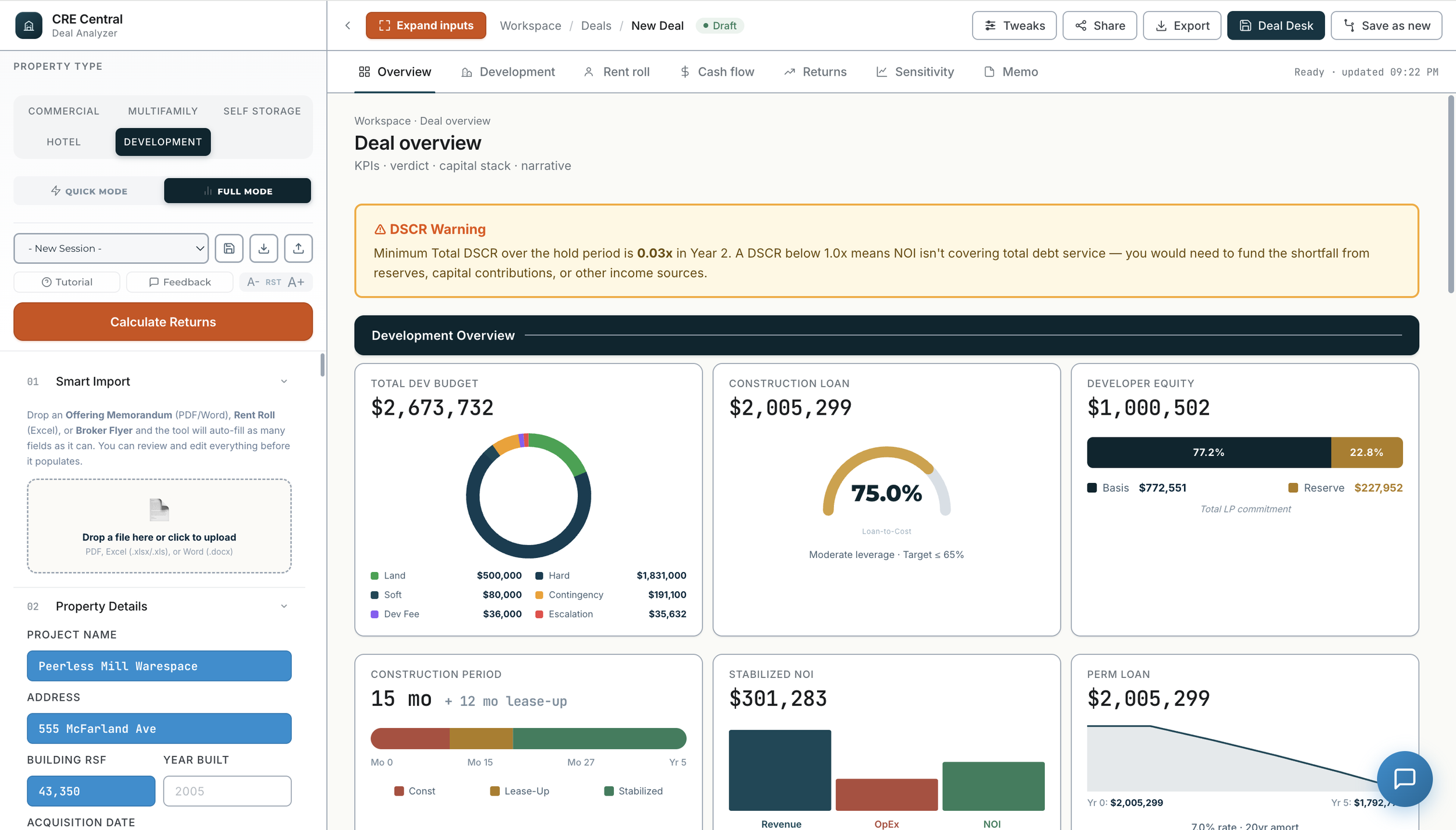
Want a deeper toolkit? The deal analysis toolkit includes Excel templates, or upgrade to the member-tier underwriting tool inside the CRE Accelerator for multifamily, self-storage, hotel, and development underwriting.
Real Deal Walkthrough: Underwriting a KFC NNN Lease
Let me walk you through this whole process using a real deal that's actively on the market right now: a single-tenant KFC on an absolute triple net lease, here in Nashville. Here are the basics:
The KFC Deal, At a Glance
$3.4M
Purchase Price
$195K
Annual NOI
5.75%
Cap Rate
19 yrs
Lease Remaining
Building size: 4,549 SF
Built: 2005, renovated 2009
Lease structure: Absolute NNN (tenant pays everything)
Annual rent bumps: 1.5%
NOI per SF: $42.93
At 5.75%, this is a relatively low return, which is typical for credit-tenant triple net deals. Because this is an absolute net lease, the underwriting is actually pretty straightforward. KFC pays for everything - taxes, insurance, maintenance. My operating expenses are essentially zero. That's the beauty of NNN investing, but it also means the returns are more modest.
The Financing Changes Everything
Here's where it gets interesting. I assumed 30% down, a 6.75% interest rate, and a 10-year loan term. No lender holdback, no interest-only period, no refinance scenario. This isn't a value-add play. It's basically buying a bond that's backed by commercial property with the credit of KFC behind it.
My target? An 8% annualized cash-on-cash return and a 12% IRR. That 12% might sound low, and it is from my perspective - I typically do value-add deals targeting much higher returns. But for a completely passive, hands-off investment, it's reasonable.
Here's what the underwriting told me: this deal doesn't pencil at $3.396 million. To hit those return targets, I'd need to pay $1.7 million max. That's a massive gap.
And the year one cash flow? Negative $16,000. I'm actually losing money the first year just to carry the mortgage.
But Wait - Look at the Tax Benefits
Before you write this deal off entirely, here's where understanding commercial real estate tax benefits becomes critical.
I ran a cost segregation study on this deal. At a 37% tax bracket, my estimated tax savings in year one is $198,000. So yes, I'm losing $16,000 in cash flow, but I'm getting $198,000 back on my taxes. And my loan balance drops about $100,000 from principal paydown between year one and year two.
For $17,000 out of pocket, I'm getting $198,000 in tax savings plus $100,000 in equity paydown. That's the kind of math that makes experienced investors pay attention, especially if you're sitting on a 1031 exchange and need to place capital somewhere.
Stress Testing: What Actually Makes This Deal Work?
Here's the real power of CRE underwriting. Once you have your model built, you can start pulling levers to see what works.
At the asking price of $3.396 million, my projected IRR at a 10-year exit is only about 6%. Not attractive. But then I start asking questions:
What if I drop the price to $3 million? Still only a 9.2% IRR. Better, but not where I want to be.
What about the debt service coverage ratio? At the asking price, I'm at a 1.05x DSCR. I can tell you right now, without even picking up the phone, a lender is not going to fund this deal. They're going to want at least 1.25x.
So what does that mean? I need to bring more cash. At 60% LTV instead of 70%, I get to a 1.22x DSCR in year one, hitting 1.24x in year two and 1.26x in year three. A lender might work with me on that given the credit of KFC and a brand new 19-year lease. And now I'm looking at $35,815 in positive cash flow that first year.
See how this works? The underwriting doesn't just tell you "good deal" or "bad deal." It shows you exactly which levers to pull to make it work, or confirms that it simply can't work at any reasonable terms.
How to Stress Test a Deal
Sophisticated investors and lenders don't accept a single underwriting case. They expect to see a bear case, a base case, and a bull case. Here's how to build them:
Base case. Your most-likely scenario based on actual trailing 12-month performance, realistic market rent growth (2-3% for most asset classes), market-typical operating expenses, and an exit cap rate 25-50 bps higher than your entry cap.
Bull case. What if everything goes right? Rent growth at 4-5%, operating expenses contained, exit at the same cap rate (or tighter if you're projecting market improvement), and faster lease-up than projected.
Bear case. What if everything goes wrong? Flat rent growth, operating expense inflation at 5%, exit cap rate 100 bps wider than entry, a major tenant doesn't renew, vacancy doubles. If your bear case still produces a positive (even if low) IRR, you have margin of safety. If it shows you losing money, you need to either renegotiate or pass.
Sensitivity analysis. Build a sensitivity table that shows how IRR changes with cap rate (entry and exit), rent growth, and vacancy. If small changes to your assumptions destroy the deal, that tells you the deal is fragile. If small changes barely move the IRR, the deal is robust.
This is what separates investors who hold through downturns from investors who lose properties in downturns. Build the stress test before you sign the contract, not after.
Common Underwriting Mistakes
After years of underwriting deals and watching investors get into trouble, here are the mistakes I see most often:
Mistake 1: Underwriting to pro forma instead of T-12 actuals. Brokers love to show "stabilized" cap rates that assume every unit is leased at market, vacancy drops to 3%, and expenses stay flat. That's not a real cap rate. Always work from actuals.
Mistake 2: Forgetting reserves and capex. Real NOI accounts for replacement reserves (roof, HVAC, parking lot). Sellers often show NOI without reserves, inflating the number. Bake in 5-10% of gross income for reserves.
Mistake 3: Ignoring tenant concentration risk. A 7-cap building with one tenant doing 80% of NOI is not the same as a 7-cap building with 10 staggered tenants. Concentration is risk that should be priced in.
Mistake 4: Not checking DSCR before approaching a lender. If your DSCR is below 1.25x, you'll either get rejected or forced to restructure the deal. Run this number first, not last.
Mistake 5: Confusing cap rate with cash-on-cash return. Cap rate is unleveraged. Cash-on-cash is leveraged. Two different metrics. A new investor saying "I want a 10% cap rate" usually means they want 10% cash-on-cash, which is completely different math.
Mistake 6: Skipping tax benefits. Cost segregation can turn a deal that looks marginal on cash flow into a strong performer when you factor in depreciation savings. Ignoring this leaves money on the table.
Mistake 7: Skipping the stress test. If you only model one case, you don't actually understand the deal. You need bear, base, and bull cases.
Mistake 8: Not underwriting enough deals. The investors who can spot a deal in 15 minutes have underwritten hundreds. The investors who can't tell good from bad have underwritten three. Practice every day.
Underwriting Tools and Resources
Here are the tools I use and recommend for commercial real estate underwriting, from free to professional-grade:
Free - Quick screens: Our free commercial calculators include a cap rate calculator, rent-per-SF calculator, TI allowance calculator, and a quick deal screener. Run cap rate math on any listing in 30 seconds.
Free - Full underwriting: Our Deal Analyzer handles multi-year cash flows, IRR projections, exit value, sensitivity analysis. The same tool I use to underwrite real deals at The Cauble Group.
Free - Spreadsheets and templates: The Deal Analysis Toolkit has the actual Excel models we use, including one-page screening templates and full multi-year pro formas.
Paid - Production templates: Our underwriting models on the resources page include dedicated Excel models for office, retail, industrial, multifamily, and single-tenant NNN.
Premium - Coaching: Inside the CRE Accelerator, members get the member-tier Deal Analyzer plus live underwriting calls where I walk through real deals each week.
If you've been following my channel, you know I did a 30 Deals in 30 Days underwriting challenge where I went live and underwrote a deal every single day. Go check out the playlist on my YouTube channel - it'll show you the full process of how I pull information together and actually run the numbers in real time.
Underwriting FAQ
What is commercial real estate underwriting?
Commercial real estate underwriting is the financial analysis process used to evaluate whether a commercial property is worth buying. It involves building a model that captures purchase costs, financing, the rent roll, operating expenses, tax benefits, and exit strategy, then comparing projected returns against target hurdle rates.
What is NOI in real estate?
NOI (net operating income) is a property's annual income after operating expenses but before debt service, capital expenditures, depreciation, and income taxes. The formula is NOI = Gross Income - Operating Expenses. It's the foundation of every commercial real estate valuation.
How do you calculate NOI?
Start with annual gross income (base rent plus expense reimbursements plus other income). Subtract economic vacancy (typically 3-5%). Then subtract operating expenses (taxes, insurance, management, maintenance, utilities, reserves). What's left is NOI. Do not include mortgage payments, capital expenditures, depreciation, or income taxes.
What is DSCR in commercial real estate?
DSCR (debt service coverage ratio) is the ratio of NOI to annual debt service, calculated as DSCR = NOI ÷ Annual Debt Service. It measures whether a property's income covers its mortgage payments. Most commercial lenders require a minimum DSCR of 1.20-1.25x for stabilized assets. Agency multifamily loans typically require 1.25-1.35x.
What's a good DSCR?
A DSCR of 1.25x or higher is considered solid for most stabilized commercial real estate. 1.20x is typically the minimum lenders will fund. 1.35x or higher gets you the best rates. Below 1.20x, you'll need to put more equity down to reduce the loan size or pursue an alternative lender at higher rates.
What's a good cash-on-cash return?
Target cash-on-cash returns vary by strategy. Stabilized core deals typically produce 5-8%. Value-add deals target 8-12% post-stabilization. Opportunistic and development deals target 12% or higher with significantly more execution risk. Below 5% on a leveraged stabilized deal, you're not being compensated for the risk.
What's the difference between cap rate and cash-on-cash return?
Cap rate is the unleveraged return on the total purchase price (NOI ÷ price). Cash-on-cash is the leveraged return on the actual cash you invest (cash flow ÷ equity). On financed deals, cash-on-cash will be higher than cap rate if you have positive leverage (cap rate higher than borrowing rate) and lower if you have negative leverage.
What's the difference between underwriting commercial vs residential real estate?
Residential real estate is valued based on comparable sales of similar properties. Commercial real estate is valued based on income - the NOI the property produces divided by the market cap rate. Commercial underwriting also involves more rigorous analysis of lease structures, tenant credit, operating expenses, and exit strategies than residential.
How long does it take to underwrite a commercial deal?
A quick initial screen takes 15-30 minutes once you have a process. Full underwriting on a deal you're seriously pursuing - including building stress test scenarios, getting financing quotes, and modeling sensitivity tables - typically takes 4-8 hours. The more deals you underwrite, the faster you get.
Should I use pro forma or trailing-12-month financials when underwriting?
Always start with trailing-12-month actuals (T-12). Pro forma numbers represent what the property could earn under optimal conditions, but you're paying for what it actually earns today. Use pro forma to model upside potential and value-add scenarios, but never base your acquisition price on pro forma NOI.
Key Takeaways
Master 4 numbers: NOI, cap rate, DSCR, and cash-on-cash return. Get those right and you're ahead of 95% of new commercial investors.
Always underwrite to T-12 actuals, not pro forma. The gap between them is your value-add opportunity, but you don't get to pay the seller for it.
Check DSCR before approaching a lender. Below 1.25x, you'll either be rejected or forced to restructure the deal.
Don't ignore tax benefits. Cost segregation can turn a marginal cash-flow deal into a strong performer when depreciation savings are included.
Stress test every deal. Bear, base, and bull cases. If your bear case shows you losing money, you need to renegotiate or pass.
Practice every day. Pull up a deal on Crexi. Run the numbers. The more deals you underwrite, the faster you'll recognize what works.
For more deal walkthroughs, market commentary, and underwriting tutorials, check out the Tyler Cauble YouTube channel and The Commercial Real Estate Investor Podcast.
Want to learn to underwrite and close commercial deals like a pro?
Learn About the CRE AcceleratorTyler's step-by-step program for building your commercial real estate portfolio.
Run the ratios lenders live by: The DSCR Calculator, the Loan-to-Value Calculator, the Debt Yield Calculator, the Break-Even Ratio Calculator, and the Commercial Mortgage Calculator.
Ready to underwrite your own deal? Run the whole property in the free Commercial Deal Analyzer, then step up to CRE Central Pro to track it from first look to the closing table.