
![Types of Commercial Real Estate: The 5 You Need to Know [infographic]](https://images.squarespace-cdn.com/content/v1/5c115fec9d5abbba78a23c93/1589898106427-LHGARUDVW8C4MM43HANX/image-asset.jpeg)
5 Types of Commercial Real Estate Property
We all know that commercial real estate is an incredible investment.
But did you know there are actually 5 different types of commercial real estate?
Here are the different property types you should know before you start investing:
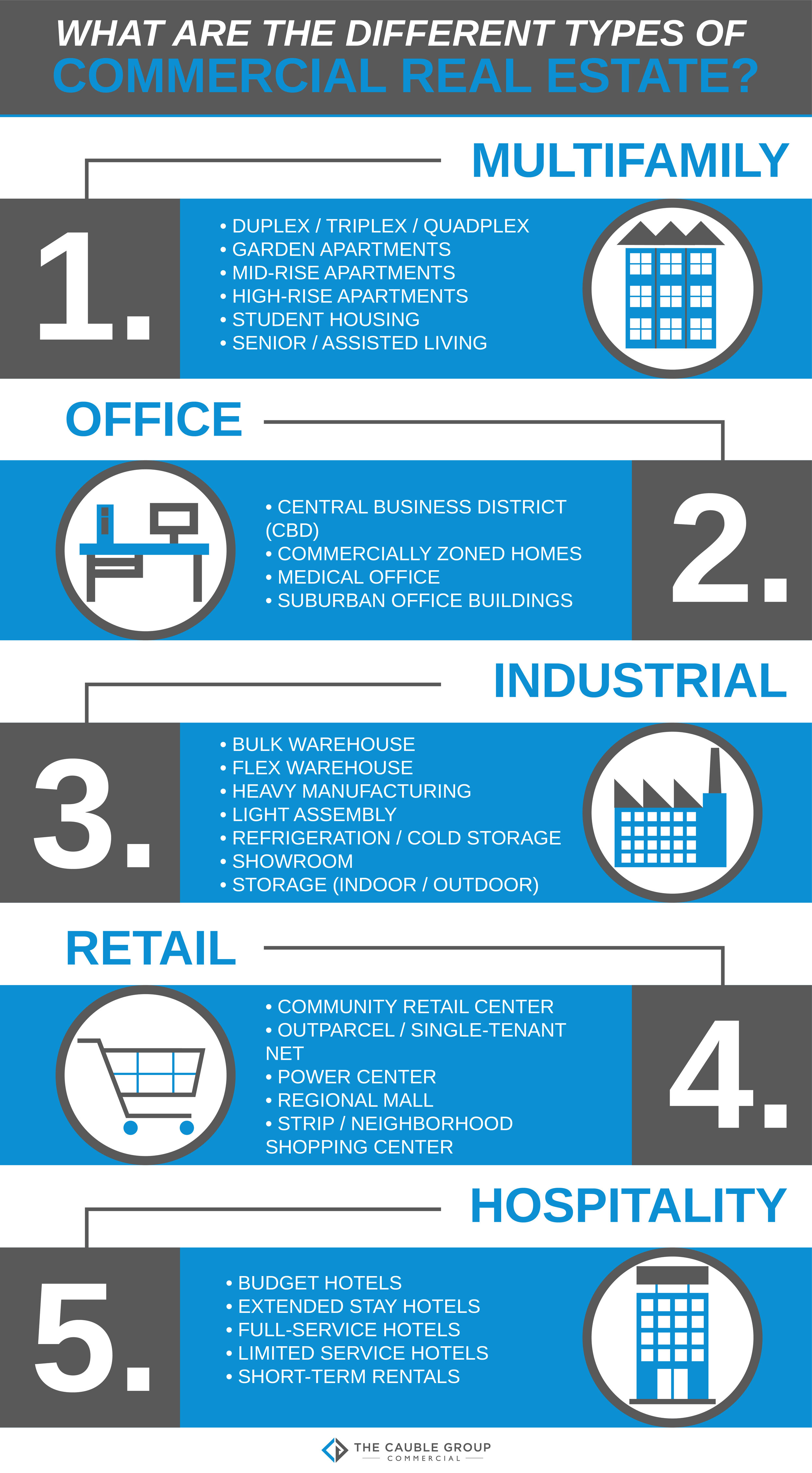
1. Multifamily
Multifamily real estate provides housing units for multiple tenants.
There are several different types of multifamily properties, which can range from two units in a duplex to hundreds of units in a garden-style apartment complex.
Multifamily is a good first-step into commercial investing for those with residential experience since the tenant base is similar.
2. Office
Office buildings provide space for professional services companies to operate.
These investments, like multifamily, are often classified further as Class A, Class B, and Class C property based on their condition.
Office is one of the more capital-intensive investments in commercial real estate.
But, because of the sheer size and scale of the projects, they often have the highest valuations.
3. Industrial
Industrial real estate houses mostly manufacturing and distribution companies.
This type can range from a small flex space for your local electrician to massive regional distribution centers for e-commerce.
It’s certainly not sexy, but industrial can be one of the most stable investments in the commercial world.
4. Retail
Retail properties satisfy all of a consumer’s in-person shopping needs.
These properties will range from your local neighborhood market to indoor shopping malls with hundreds of retailers.
While it has suffered over the last economic cycle, certain sub-types of retail still prove to be strong investments.
5. Hospitality
Hospitality services the needs of both business and leisure travelers.
You can find hospitality in a motel at the interstate exit or the most luxurious of Ritz-Carlton’s in the world.
Tourism is a major driver of hospitality real estate, so this asset can see massive ups and downs with the economic environment.
Final Thoughts
So there you have it for the 5 types of commercial real estate.
Whether you’re looking to become an active or passive real estate investor, there’s a certainly an asset type for you.
Happy investing!
Share This Article:

About The Author:
Tyler Cauble, Founder & President of The Cauble Group, is a commercial real estate broker and investor based in East Nashville. He’s the best selling author of Open for Business: The Insider’s Guide to Leasing Commercial Real Estate and has focused his career on serving commercial real estate investors as a board member for the Real Estate Investors of Nashville. Learn more at www.TylerCauble.com
Your buildout budget is probably off by six figures. Not off by a little. Off by enough to blow up a deal you just spent three weeks underwriting.