
The Strategy Confusion Problem
If you spend enough time in commercial real estate, you’ll notice something strange.
Every strategy sounds convincing.
Buy multifamily - it’s recession resistant.
Buy industrial - e-commerce is unstoppable.
Buy retail - high yields.
Buy triple-net - passive and predictable.
Develop ground-up - create equity.
Value-add - force appreciation.
The advice never stops.
And for most investors - especially those trying to scale - that creates a quiet kind of paralysis. Too many asset classes. Too many opinions. Too many people confidently explaining why their strategy is the right one.
But here’s the uncomfortable truth:
The problem isn’t deal selection.
It’s strategic confusion.
Most investors are choosing assets before they’ve chosen a strategy. They’re asking, “What should I buy?” instead of asking, “What kind of investor am I trying to become?”
And that’s where a surprising comparison becomes useful.
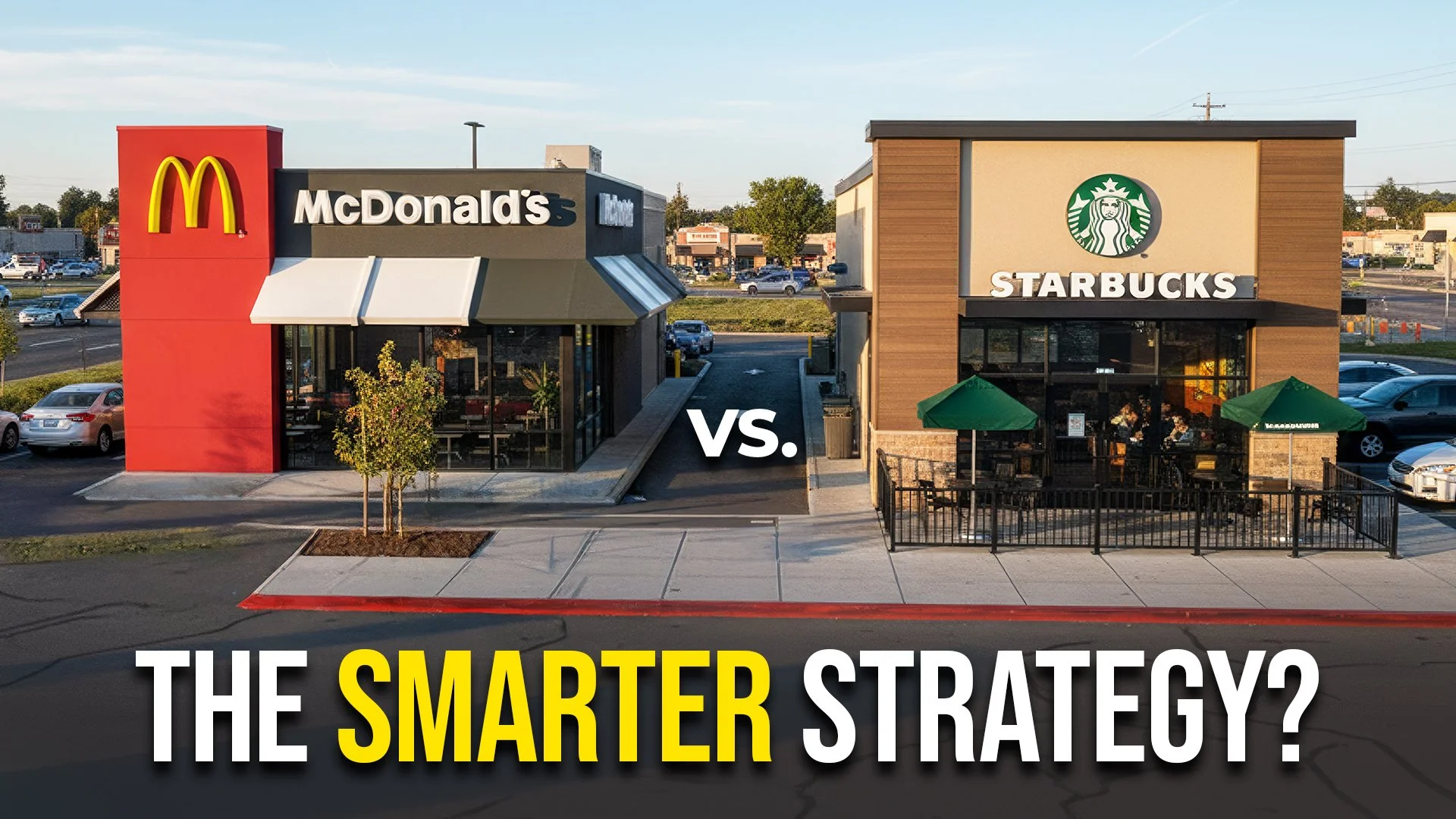
McDonald’s and Starbucks built global empires using completely opposite real estate strategies.
McDonald’s owns the land.
Starbucks leases almost everything.
One optimized for control.
The other optimized for flexibility.
Both won.
So the real question isn’t which strategy is better.
The real question is this:
What does their difference teach us about how to think as investors?
Because great investors don’t copy companies.
They copy frameworks.
And this month, we’re breaking down one of the most important frameworks in commercial real estate:
Control vs. Flexibility.
Before you choose your next asset class, you need to choose your strategy.
Let’s start with the paradox.

The Paradox: Two Opposite Strategies, Same Outcome
At first glance, McDonald’s and Starbucks appear to have followed entirely different paths in real estate.
McDonald’s built its empire by owning the land beneath its restaurants. Over time, the company became as much a real estate business as a food brand. It purchased strategic parcels, developed locations, and then leased those sites back to franchisees. The real estate created predictable, durable cash flow and long-term control. Ownership anchored the business.
Starbucks took the opposite approach. Rather than tying up capital in land, it chose to lease the vast majority of its locations. That decision allowed the company to deploy capital into brand expansion, market penetration, and operational growth instead of property acquisition. Leasing gave Starbucks the ability to move quickly, test markets, exit underperforming locations, and scale with agility.
One company optimized for control and permanence.
The other optimized for speed and flexibility.
And yet, both became global empires.
That’s the paradox.
If ownership is so powerful, how did a leasing model also win? If flexibility is so valuable, why did long-term control prove equally effective?
The answer isn’t that one strategy is superior. It’s that each strategy was deeply aligned with the company’s priorities, capital structure, and competitive advantage at the time.
McDonald’s built a system that emphasized durability and wealth preservation. Starbucks built a system that emphasized velocity and optionality. Neither copied the other. Each made decisions that reinforced its broader strategy.
This is where most investors go wrong.
They see a successful outcome and attempt to copy the visible tactic - “own the land” or “stay asset-light” - without understanding the underlying alignment that made the strategy effective.
The real lesson isn’t about burgers or coffee.
It’s about clarity.
Because in real estate, success rarely comes from choosing the objectively “best” structure. It comes from choosing the structure that fits your stage, your capital base, and your long-term intent.
And to see that clearly, we need to look at each model more closely - starting with McDonald’s and the power of control.

McDonald’s: The Power of Control
McDonald’s understood something early that many investors take years to learn: control compounds.
While the public often thinks of McDonald’s as a fast-food company, its long-term advantage has always been rooted in real estate. By owning the land under most of its locations, McDonald’s created a structural advantage that extended far beyond selling hamburgers.
Ownership gave the company durability.
Instead of being exposed to rising rents or shifting landlord priorities, McDonald’s controlled its sites. It could lease to franchisees, structure long-term agreements, and anchor predictable cash flow to tangible assets. The land itself became a stabilizing force. Even if a specific operator underperformed, the underlying real estate retained value.
That kind of control changes how you think.
When you own the dirt, you think in decades, not quarters. You focus on location quality, long-term appreciation, and downside protection. You are less concerned with rapid expansion and more concerned with structural strength.
This model prioritizes stability over speed.
It assumes that long-term ownership of prime locations will create wealth through compounding. Over time, rent from franchisees flows upward, equity builds quietly, and the company benefits from both operating income and real estate appreciation.
For investors, this represents a very specific mindset.
It’s the mindset of wealth preservation and control. The goal is not to move quickly through markets, but to anchor capital into durable assets. It is optimized for predictability. It values permanence. It sacrifices flexibility in exchange for long-term security.
There is nothing flashy about this approach.
But it is powerful.
And importantly, it requires a certain stage of capital and patience. Owning real estate ties up capital. It slows velocity. It demands discipline and a long time horizon.
That worked for McDonald’s because control was aligned with its broader strategy.
The mistake investors make is assuming that owning the land is inherently superior.
It isn’t superior.
It’s aligned.
And to see the other side of that alignment, we have to look at Starbucks — and the power of flexibility.

Starbucks: The Power of Flexibility
If McDonald’s built its empire on control, Starbucks built its on velocity.
From the beginning, Starbucks made a deliberate choice: avoid tying up capital in land ownership. Instead of buying the dirt beneath its stores, the company leased the vast majority of its locations. That decision wasn’t accidental or short-sighted. It was strategic.
Leasing allowed Starbucks to move quickly.
By keeping capital liquid, the company could expand into new markets without the friction of land acquisition. It could test cities, refine site selection, and scale across geographies at a pace that ownership would have slowed. If a location underperformed, it had options. If a market shifted, it could adapt.
Flexibility became a competitive advantage.
Where McDonald’s optimized for permanence, Starbucks optimized for growth. The capital that might have been tied up in real estate instead fueled brand development, operational infrastructure, and rapid market penetration. Speed mattered more than control.
And in its stage of growth, that trade-off made sense.
Leasing carries different risks than ownership. You relinquish long-term control over the site. You accept exposure to rising rents. You give up potential appreciation. But in exchange, you preserve capital velocity and optionality - two powerful levers in expansion.
For investors, this model represents a different mindset entirely.
It prioritizes learning speed over permanence. It values adaptability over durability. It assumes that capital is most productive when it is moving, not anchored.
This is the philosophy behind investors who focus on shorter holds, development cycles, repositioning plays, or strategies that allow capital to turn over more frequently. It requires agility and comfort with change. It demands sharper execution because you are not relying on long-term ownership to smooth out mistakes.
Again, the key insight is alignment.
Starbucks did not lease because leasing is universally better. It leased because flexibility aligned with its growth objectives and capital strategy at the time.
And when you place Starbucks next to McDonald’s, the comparison becomes instructive.
Two opposite approaches.
Two wildly successful outcomes.
Which brings us back to the real question investors need to ask:
Not “Which strategy is better?”
But “Which strategy fits where I am right now?”

The Investor Mistake: Asking the Wrong Question
Once you see the contrast between McDonald’s and Starbucks, the instinct is to pick a side.
Control feels safer.
Flexibility feels smarter.
And that’s where most investors go wrong.
They treat strategy like a debate to win instead of a decision to align.
The most common question I hear is:
“Which strategy is better?”
But that question assumes there is a universally correct answer.
There isn’t.
McDonald’s model works beautifully if you have the capital, patience, and long-term orientation to support it. Starbucks’ model works powerfully if your advantage lies in speed, market penetration, and capital velocity.
The problem begins when investors try to borrow a strategy that doesn’t match their stage.
An early-stage investor with limited capital trying to build a portfolio entirely around long-term, low-yield, stabilized assets may stall their growth before they ever build skill. On the other hand, a late-stage investor seeking predictable income who continues chasing aggressive value-add projects may introduce unnecessary volatility into a portfolio that no longer needs it.
The mistake isn’t choosing ownership or leasing.
The mistake is choosing without context.
Every strategy carries trade-offs. Control sacrifices speed. Flexibility sacrifices permanence. Stability compresses upside. Velocity increases exposure.
Great investors understand those trade-offs and choose intentionally.
They ask better questions:
What stage am I in?
What does my capital base allow?
Where is my real competitive advantage?
Am I optimizing for growth or preservation?
Once those answers are clear, the strategy becomes obvious.
And here’s the key principle that sits underneath everything we’ve discussed:
Strategy must come before asset selection.
Before you decide on multifamily, retail, industrial, development, or net lease, you need to decide whether you are building for control or for flexibility.
Because if you reverse that order - if you choose the asset first and try to retrofit a strategy around it — confusion follows.
The companies that win don’t imitate tactics.
They align structure with intent.
And investors who learn to do the same move from chasing deals to building portfolios with purpose.

Applying the Framework to Your Own Portfolio
Understanding the difference between control and flexibility is useful. Applying it to your own investing journey is what creates clarity.
Most investors move through distinct stages, whether they recognize it or not. The strategy that fits one stage often becomes inefficient - or even risky in another.
In the early stage, flexibility tends to matter more than permanence. When you are still building skill, relationships, and confidence, speed of learning becomes a competitive advantage. Smaller deals, shorter holds, repositioning plays, or strategies that allow capital to recycle can accelerate growth. The focus is not just on cash flow - it’s on competence. You are buying reps. You are learning how to source, underwrite, negotiate, and operate. In this phase, capital velocity often outweighs long-term control.
As you move into the operator stage, the equation shifts. Experience reduces execution risk. You begin to understand how to create value intentionally rather than relying on market momentum. Control starts to matter more because you know how to use it. This is where forced appreciation, strategic ownership, and longer-term holds can compound meaningfully. You are no longer just participating in the market - you are shaping outcomes.
Then there is the late stage, where stability and predictability become priorities. Once wealth has been created, preservation becomes strategic. At this point, durability often outweighs growth. Long-term leases, stabilized assets, and controlled environments provide consistency. The goal is no longer aggressive scaling - it’s protecting what has already been built.
None of these stages is superior to the others.
They simply require different trade-offs.
The investor mistake is trying to apply a late-stage preservation strategy while still in an early-stage growth phase. Or continuing to chase high-velocity expansion when your objective has shifted to stability.
McDonald’s and Starbucks made different decisions because they were optimizing for different priorities.
The real takeaway isn’t to copy either company.
It’s to diagnose your own stage with honesty.
Are you building skill or preserving wealth?
Do you need speed or control?
Are you compounding capital or protecting it?
Once you answer those questions, asset selection becomes much easier.
Because the right deal isn’t the one that looks impressive on paper.
It’s the one that fits where you are.

Copy the Thinking, Not the Brand
It’s easy to look at McDonald’s and conclude that owning real estate is the superior model. It’s just as easy to look at Starbucks and argue that capital-light flexibility is smarter.
Both arguments miss the point.
Neither company won because of a tactic. They won because their real estate strategy reinforced their broader business model. The structure supported the mission. The trade-offs were intentional.
That’s what great investors do.
They don’t copy outcomes.
They don’t chase what’s popular.
They don’t select assets based on consensus.
They choose a strategy first - and then select assets that reinforce it.
If you try to scale aggressively while structuring your portfolio for long-term preservation, friction shows up. If you try to preserve wealth while deploying capital into high-volatility growth plays, tension builds. Misalignment creates confusion.
Alignment creates clarity.
Once you decide whether you are optimizing for control or flexibility, durability or velocity, preservation or expansion, decisions become simpler. Deals either fit the strategy - or they don’t.
That clarity eliminates noise.
It becomes easier to say no.
It becomes easier to stay patient.
It becomes easier to avoid copying someone else’s highlight reel.
The real lesson from McDonald’s and Starbucks isn’t about burgers or coffee.
It’s about intentionality.
Before you choose your next asset class, choose your strategy.
Because the wrong strategy executed perfectly still underperforms.
The right strategy, aligned with your stage and strengths, compounds quietly over time.
And that’s how empires are actually built.
For those interested in delving deeper into commercial real estate investing, check out our course offerings. The courses provide in-depth insights, real-world case studies, and practical strategies to help you navigate the complexities of commercial real estate and achieve success in your ventures. Whether you're a seasoned investor or just starting in the world of commercial real estate, there's always more to learn. Equip yourself with the knowledge and tools you need to thrive in commercial real estate!