
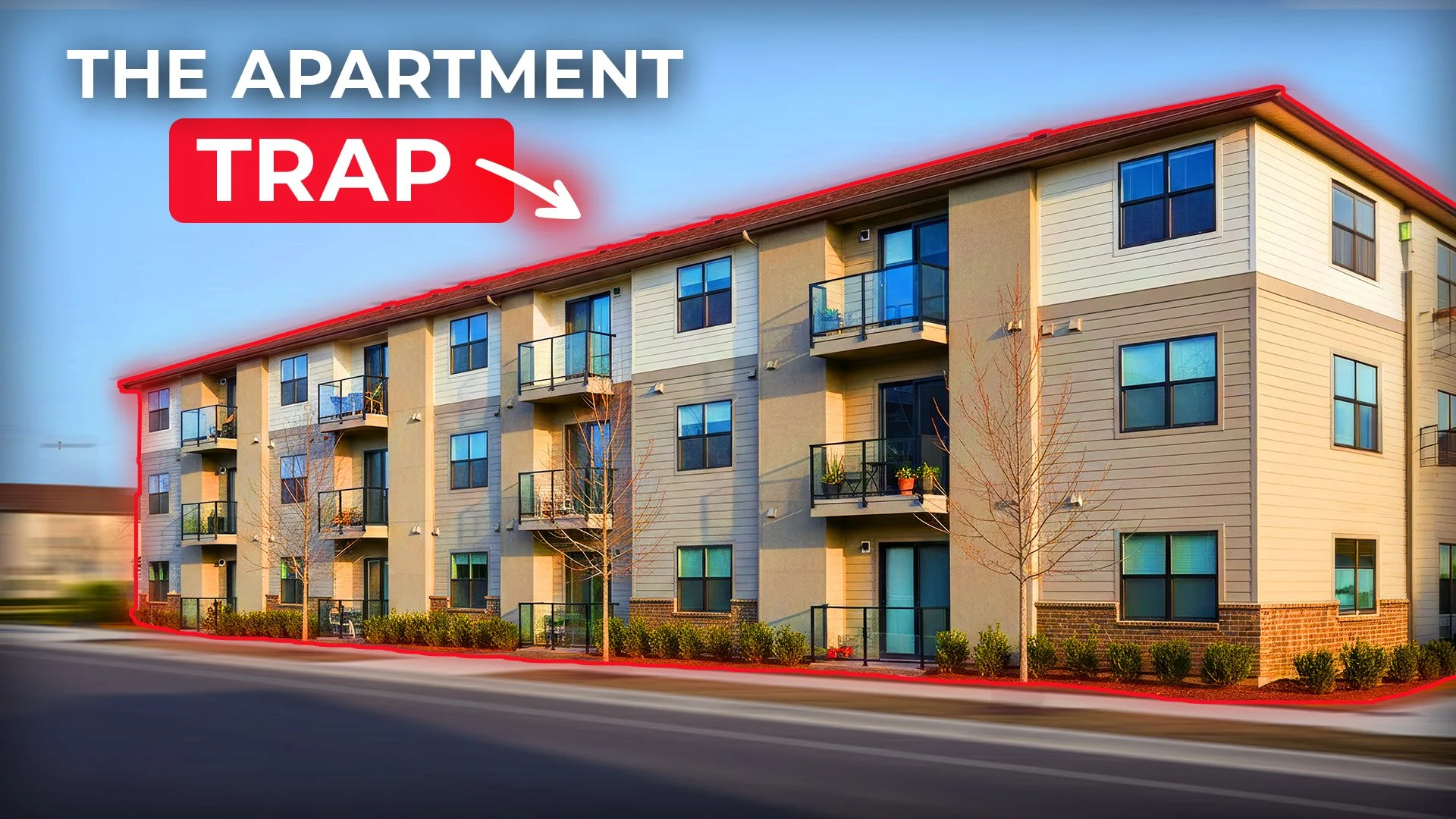
You Think Apartments Are a Safe Investment?
“Apartments are the safest path to financial freedom.”
But in today’s market, that belief could actually be holding you back.
In this week’s video, I sit down with Josh Friedenshon of Greenleaf Management—a friend and now business partner—who scaled to 4,000+ apartment units before making a bold move: selling off residential in 2018 and reinvesting into commercial real estate.
Here’s what we break down:
The 3 phases that broke the multifamily model — rising competition, eviction restrictions, and exploding expenses
Why today’s cap rates leave no margin for error
How he exited near the top and captured 4x–7x returns
Why smaller commercial deals now offer less competition and more predictability
If you still think apartments are the “safe” bet, you may want to think again.
Get commercial real estate coaching, courses, and community to jumpstart your investment journey over at CRE Central: www.crecentral.com
Key Takeaways:
Multifamily Isn’t “Safe” Anymore
The old playbook—buy, renovate, raise rents, refinance—worked when you had margin. Today’s compressed cap rates and higher debt costs leave almost no room for error. When everything has to go right, that’s not safety.
Competition Changed the Game
Institutional and out-of-state capital flooded major markets. Local operators who once competed with familiar players suddenly faced groups willing to pay far more—and accept thinner returns.
COVID Exposed the Fragility
Eviction restrictions and drops in economic occupancy crushed cash flow. When 20–30% of tenants aren’t paying, the model breaks. Debt coverage becomes the priority, not growth.
Expenses Are the Silent Killer
Insurance and property taxes have skyrocketed. Even strong operators can’t out-operate doubling insurance premiums and massive tax increases.
Timing Matters More Than Ego
Josh exited residential in 2018, before the cracks became obvious. Capturing 4x–7x returns and redeploying capital was a strategic move—not an emotional one.
Commercial Offers Control and Predictability
Fewer tenants. Longer leases. Less day-to-day “firefighting.” In many smaller commercial deals, there’s less competition and more ability to plan long-term capital expenses.



About Your Host:
Tyler Cauble, Founder & President of The Cauble Group, is a commercial real estate broker and investor based in East Nashville. He’s the best selling author of Open for Business: The Insider’s Guide to Leasing Commercial Real Estate and has focused his career on serving commercial real estate investors.
Episode Transcript:
Tyler Cauble 0:00
If you've spent any time around real estate investing, you've probably been told that apartments are the safest, surest path for you to get to financial freedom. What if that isn't true anymore, though? What if chasing multifamily right now could actually be the thing that is holding you back? I had a conversation with my good friend Josh fridenson of Greenleaf management. He's a buddy and now a business partner in our property management companies. And Josh got started in single family real estate nearly 20 years ago, just after the 2008 crash, he then went on to achieve every multifamily investors dream. Greenleaf scaled to over 4500 apartment units, but in 2018 made the decision to start selling off their residential assets. They got great returns in the process selling before everybody else started to realize that residential was on the way down. Now they reinvest that capital into commercial real estate. Here's how Josh built his residential empire.
Unknown Speaker 1:02
So we started buying apartments in 2010 and really started heavily buying apartments in really the
Speaker 1 1:08
2012 the 2015 range, and in between that, we bought about 4000 apartment units. You know, when we started buying multifamily, we were two guys in a truck, we I, we bought an eight unit, we bought an 11 unit, we bought a 16 unit, and we bought a 66 unit. And that's when things kind of got more formalized with us, and we needed to hire someone. We went from hiring our first person to hiring kind of our 80th person in like a 30 month period. We went from kind of what I just said, like 811, 1666, after that, we bought about 20 properties, between 50 and 200 units in like 30 months.
Tyler Cauble 1:45
Yeah, you heard that right. In a 30 month period, Josh's business increased nearly 20x the sheer scale alone is astounding. I know a ton of people like Josh who have made great money in residential though maybe not necessarily at that scale, but those times are over. The market has changed. In Josh's case, he bore witness to three changes, or as he calls them, phases in the market. The first was a massive influx of competition.
Speaker 1 2:11
And once 2018 hit, it was, it was getting more and more difficult to buy, and we were competing against people that were not our buddies in our market. Before that, it was, it was guys that we kind of knew down the street or the own next to us, like, Hey, are you bidding on this? Are we chasing that? And it all kind of this, like tight camaraderie of other apartment owners. And then all of a sudden, all this money started coming into Atlanta from New York and LA and overseas. And we didn't know these people, and they were, they were they were bidding significantly higher, and frankly, the brokers didn't know the meter either, and the brokers didn't know if they could trust them. And ultimately, what happened is, at first it wasn't trustworthy. Then someone gave them a chance, and they closed their first deal, then they closed their second deal, and after like, the 100th deal of kind of outside capital coming into Atlanta, we weren't competitive anymore. They were willing to pay more than we were willing to pay.
Tyler Cauble 3:03
So 2018 Josh is struggling to compete with outside investment. Then in 2020 he notices phase two, an inability to evict your tenants that aren't paying anything.
Speaker 1 3:14
Biggest thing that we saw coming out of covid, coming out of the inability to evict people, is softening of revenue. So when we had, you know, we had some apartment complexes that had 20 or 30% of non paying occupants, it just you can't operate without with an economic occupancy at 70% during that kind of covid era when evictions weren't allowed, and especially in the city of Atlanta, in Atlanta, which was, I would say, the most restrictive, with not allowing evictions for the longest period of time. This is when we saw economic occupancy, meaning the paying tenants dropped to give or take, 70, maybe 75% of the property when it was full, when it was all economically occupied, or maybe 95% plus when that happened, you know, we, we bought these properties basically vacant and boarded up, and when we renovated and leased them up, we owned most of them north of a nine cap rate. At that point we would cash out refi return all the capital investors have a long term fixed rate loan, normally alone in the mid 4% range for 10 years, and really just ride it out and make quarterly distributions. And it was, it was a win win for everyone involved, because we bought the property so inexpensively, because we were able to get such cheap financing, we're able to artificially, kind of keep rents a little bit lower than our competition. One thing that I
Tyler Cauble 4:33
think is important to note there, they bought at the right time. They held on to it, and everything went up in value around them. They continued to become more and more competitive while still getting really high returns, because everybody else is paying higher prices with higher debt, higher mortgages, and they had to charge higher rents to make it work. That's the great thing about real estate. It's like, buy it now sit on it and just wait. Everybody else around you is going to have to pay a higher. Price in the future.
Speaker 1 5:00
We weren't the New Kids on the Block buying at really high values. We had owned the properties for a while, and we didn't need to go turn the property again. We were happy say, let's say rents were 800 and but the guy next door to us needed 1000 we were happy doing annual increase to 850 we didn't have to go to 1000 so some of our properties were well under rented. But we were fine with that. When economic occupancy started dropping and we started seeing our revenues drop by 2025 on the high end, 30% we stopped having that luxury. And we stopped having the luxury of saying, Hey, we can improve things. We make things better. We can do kind of these expensive amenities, meaning that we had farms on some of our properties, we had extra staff on some of our properties. Just make the place nice or better. We started struggling on how to afford those things, and frankly, we had to cut back a lot of these programs because we couldn't afford our debt coverage ratio, basically the amount of net income over our over our loan payment. Otherwise we would be in low and we would be in loan trouble with Fannie and Freddie, so we had to basically change our operating platform. We couldn't be, I would say, as loose spending and as beneficial to the tenants as we have been historically.
Tyler Cauble 6:12
Now I want to expand a little bit on what Josh shared there. They had to cut back on expenditure and transform their operating platform, because if they continued as they were, they wouldn't be able to afford their debt service coverage ratio. If you start missing your debt coverage ratio, Fannie and Freddie will send warning letters. They're looking for you to get back above that 125, or one, three threshold, meaning that your net income is 30% higher than the mortgage payment with a rolling 12 month window. If you can't hit that, you're looking at special servicing and eventually foreclosure. That's why Josh had to cut the farms, the extra staff, all those tenant amenities, they simply couldn't afford to keep running those programs and still make their loan payments. The model no longer worked now that they could no longer find good deals and they couldn't evict bad tenants. There was one last phase, rising insurance costs.
Speaker 1 7:05
And then kind of, what, what happened, kind of on the tail end of all this that we're still living today is the rise of expenses. So yes, operational expenses rose, meaning maintenance, repair salaries. We saw, we saw those rise. And frankly, those were a little bit more controllable, meaning that we saw those rise in kind of the five to 10% annual rate. What was uncontrollable, and we're still battling today, that we're really just we don't have a great solution for is the rise of taxes and insurance on classy apartments. We've seen insurance just about double every year for the last five years, some of our insurance, you know, on properties, is pushing $1,000 a unit, up from about $200 a unit. Our property taxes ran from around $300 a unit, give or take in kind of the 2015 2016 range to now we're pushing 3000 $4,000 a year.
Tyler Cauble 7:58
So three phases destroyed the residential investor business model, and though some of those phases may be geographical or market specific, the principle applies to all residential real estate across the US. The cost of housing has inflated. Institutional finance has taken over the market in urban areas, and casual investors are driving up prices too. Everyone and their doctor and their grandmother does, and they probably have more money than you and I do real estate investors like Josh got caught in the middle. So what do you do when you're in a spot like that? Josh did what I recommended many other residential real estate investors do, and he started selling off those units, doing a 1031 exchange and reinvesting it all into commercial properties.
Speaker 1 8:39
We had all this 1031 money that we were selling our apartments into this incredible bull cycle, making four or five, sometimes 7x on our gains, and a lot of our investors wanted a 1031 exchange, but little bit of a caveat. We didn't want to take the same risk with our new money that we took with our old money.
Tyler Cauble 9:00
There's this undertone of real estate where it's like, Hey, you don't have any money. Go bet the farm. Go leverage to the gills, take all the risks in the world and make it happen. And I mean, it's a very tempting premise, but you'll make money in real estate if you're conservative too, and you're not necessarily taking those risks. So why not just go that way? It's far more difficult to come back from a million dollar loss than it is to just make some money. As one of my mentors once said, it's hard to go broke making a profit after completing that switch from residential to commercial, I asked Josh to compare and contrast investing and managing commercial properties versus residential. What were the differences that he saw? The first thing he noticed is the lack of firefighting.
Speaker 1 9:41
The building type is simpler. You don't have as many plumbing leaks as you have less kitchens or toilets. You don't have as many roof leaks because you have longer term roofs. You can long term plan for this. So the beautiful thing about the commercial world is you look at a building, you can get an engineer report, and the engineer report is. To tell you the needs assessment for every year for the next 10 years. And no, it's not 100% accurate, but even if it's 80% accurate, you can plan your capital expenditures for the next 10 years so you don't have the surprises versus a multifamily you have so much more wear and tear on the property because of the volume of people living in it, and the volume of people on you know, in the volume of kitchens, the volume HVACs that it's much more difficult to plan, because the human interface is the hard part. So think about a residential property that has one entrance index. You have a ton of cars going in and out of that gate or in and out of that driveway. That's going to wear on that pretty quickly, and you're gonna have to replace that asphalt or concrete in some short period of time, because the amount of volume of people using go over to commercial. Nobody's living there. They're only there in the work during the during the week. They're not there on the weekends. And frankly, per square foot, you have way less density of people using the space than you do in the residential world, so you can more accurately plan your capital expenditures.
Tyler Cauble 11:05
So having moved to commercial, Josh and his team now get more of a work life balance. Things don't literally or metaphorically burn overnight and require their immediate attention. The second benefit is that the majority of commercial property types at least the types that I typically recommend to investors and what you should get involved with are far simpler than residential. Now, the third benefit that Josh discovered is that commercial is significantly less competitive than residential. Is fast
Speaker 1 11:33
forward to today, when we're buying single story office, there's and flex industrial. Flex has some competition. You know, in the Atlanta market, we'll be competing against five to seven groups, single story office. We've been a lot of the predominant buyer in North Atlanta, so we're competing against two or three other groups, maybe. But we don't have that kind of outside flood of capital coming in, like what happened in multifamily that just blows the whole market up that you can no longer compete with.
Tyler Cauble 12:02
The big difference, though, with residential is that everybody and their grandmother listens to bigger pockets, and they're trying to buy duplexes and triplexes and quad plexes, all of the smaller, competitive stuff, the equivalent of those assets in commercial real estate, like your smaller neighborhood office building or a little three tennis strip center, you don't have a lot of competition there now, shopping centers, if we're getting into shopping malls and bigger things like that, yeah, you're going to be competing against private equity firms. But especially in that sub $5 million range, there's not a lot of bigger guys that are going to be buying deals in that range. So there's just a lot of opportunity there. Multi family really isn't as straightforward and safe as it's made out to be, especially when with today's cap rates, you're already gambling with razor thin margins. Everything has to go right now in commercial real estate. On the other hand, you've got a blue ocean, less competition, more room for finding the right deal that will make all of the effort worthwhile. Now, before you leave, if you're thinking, I'd love to start investing in commercial real estate, but I still wouldn't know where to start. That's why I started the CRE accelerator, mastermind. It's a step by step system that I wish I'd have when I first got started in commercial real estate. It's already helped hundreds of people, just like you, close their first deals way faster than they thought possible. But hey, if you're not ready for that, if you want to just learn more about how commercial real estate works. Check out this video next you.