
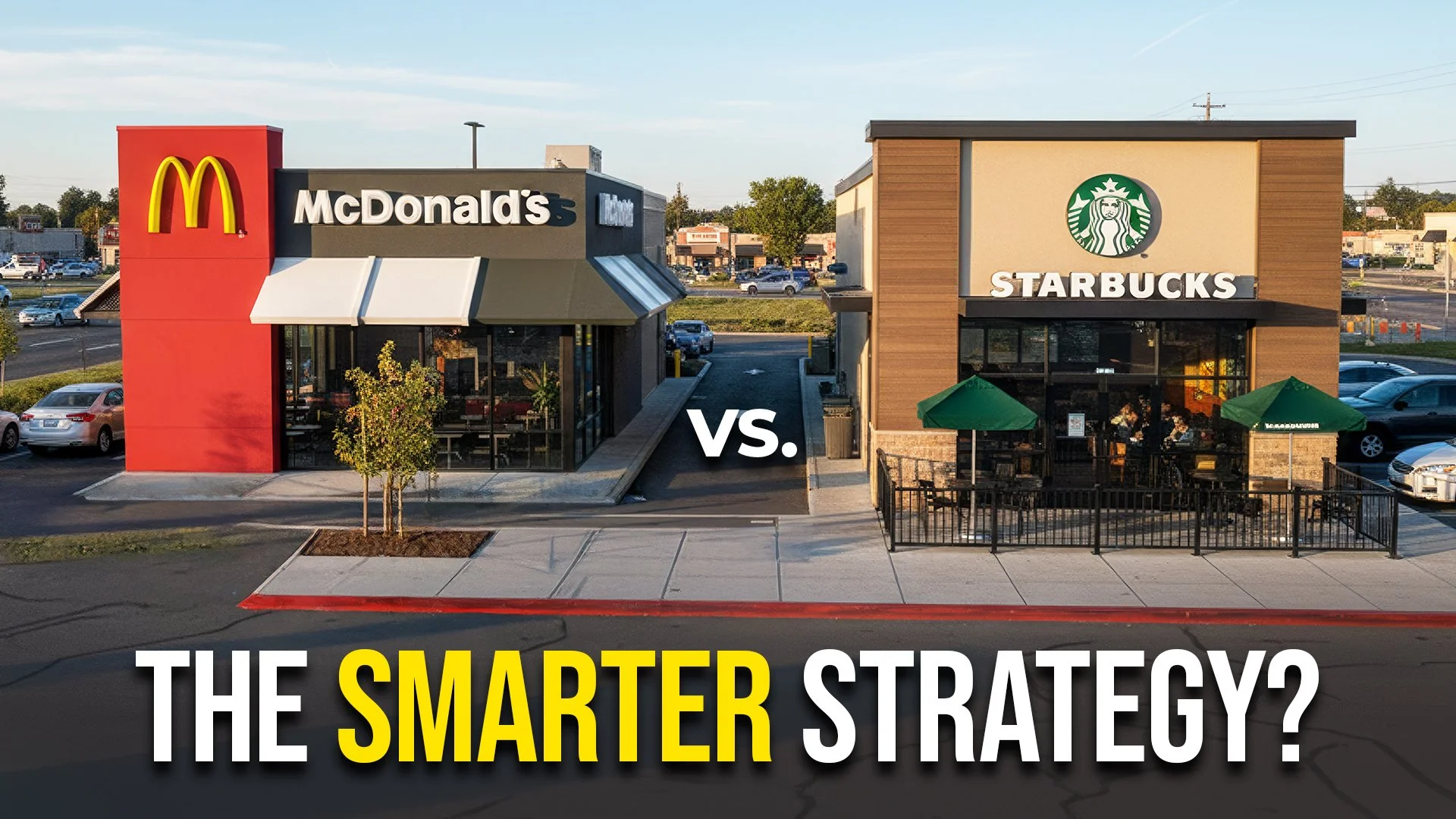
McDonalds owns their real estate. Why doesn’t Starbucks?
Why did Starbucks ignore the billion-dollar real estate playbook that made McDonald’s rich?
Ray Kroc built McDonald’s into a $40+ billion property empire by owning the land under his restaurants. Howard Schultz knew that strategy… and deliberately did the opposite.
In this video, I break down the hidden real estate war between McDonald’s and Starbucks — and how their opposite strategies created two very different kinds of wealth.
You’ll learn why Starbucks leases almost every store, how that unlocked explosive growth, and how that decision created one of the most attractive investments in commercial real estate today: owning the real estate behind a Starbucks.
If you’ve ever wondered how people make money owning Chipotles, Starbucks, and Chick-fil-A locations without running the business… this is the playbook.
Get commercial real estate coaching, courses, and community to jumpstart your investment journey over at CRE Central: www.crecentral.com
Key Takeaways:
McDonald's treats its business as a real estate venture, owning much of the land under its restaurants and leasing it back to franchisees, enabling stable cash flow and capital for expansion.
Starbucks, in contrast, leases nearly all its store locations, allowing rapid expansion, more flexible market entry, and the ability to invest in operations and marketing instead of property.
McDonald's strategy provides long-term stability and predictable returns, making it ideal for patient, long-term investors who value control.
Starbucks prioritizes speed, flexibility, and asset-light growth, which enables quicker market penetration and has proven effective for brand building and innovation.
For real estate investors, Starbucks is considered a high-quality, secure tenant offering predictable rental income via long-term leases, though it is best suited for those seeking passive income rather than active, hands-on investment.
Both companies’ approaches are successful but optimized for different goals: McDonald's for stability and control; Starbucks for speed and adaptability.
The conversation also included tips and insights for investors interested in buying Starbucks-leased properties.

About Your Host:
Tyler Cauble, Founder & President of The Cauble Group, is a commercial real estate broker and investor based in East Nashville. He’s the best selling author of Open for Business: The Insider’s Guide to Leasing Commercial Real Estate and has focused his career on serving commercial real estate investors.
Episode Transcript:
Tyler Cauble 0:00
I this episode of the commercial real estate investor podcast is brought to you by my cre accelerator mastermind, where you'll get access to my step by step investment blueprint, essentially a library of resources on how to invest in commercial real estate. You'll get connected to a supportive community of other commercial real estate investors that are doing projects just like you. You'll get personalized coaching and feedback from me every step of the way. Go to www.crecentral.com to learn more. In the mid 1950s Ray Kroc discovered the secret that would make him a billionaire. McDonald's wasn't a restaurant business, it was a real estate business that just happened to sell hamburgers by owning the land under every restaurant and leasing it back to the franchisees. Kroc unlocked steady cash flow control over expansion and predictable returns. Today, McDonald's owns 57% of the land under its 43,000 restaurants. Their property portfolio is worth $42 billion this motto is taught in every business school as the gold standard for franchise expansion. So here's the puzzle. Howard Schultz knew all of this when he started expanding Starbucks in the late 1980s he had the same goal as Croc, rapid expansion across America. He had investors ready to fund all of their property purchases, and yet he did the exact opposite. Starbucks has 41,000 stores worldwide and leases almost every single one. Why would Schultz deliberately ignore a proven billion dollar playbook? The answer lies in understanding what McDonald's strategy is actually optimized for
Speaker 1 1:50
tell me about the land, the land, the land, the buildings, how that whole aspect of it works.
Speaker 2 1:56
Oh, pretty simple, really. Franchisee finds a piece of land he likes, gets a lease, usually 20 years, takes our construction loan, throws up a building, and off he goes.
Speaker 1 2:07
So the operator selects the site, yeah, he picks the property, right? You provide the training, the system, the operational know how, and he's responsible for the rest. Is there a problem, a big one. You don't seem to realize what business you're in. You're not in the burger business. You're in the real estate business.
Tyler Cauble 2:30
With the help from his CFO, Harry J sonnenborn, Kroc discovered that he could make more money by changing his business model, owning the real estate and leasing it back to the franchisee. This shift is what led to Croc becoming a billionaire and McDonald's becoming one of the biggest brands on the planet. Up to this point, Croc was struggling to turn a profit on the 1.9% of sales he received from all of his franchises in his autobiography, the film is based on Kroc elaborates on what Harry told him, You don't build an empire off of a 1.4% cut of a 15 cent hamburger. You build it by owning the land upon which that burger is cooked. What you ought to be doing is buying up plots of land then turning around and leasing those lots to franchisees, who, as a condition of their deal are permitted to lease from you and you alone. Prior to this shift, growth was stunning, but as David sinra says in the founders podcast, the move provided two things that croc did not have.
Speaker 3 3:28
Number one, a steady upfront revenue stream, money flows in before the first stake is in the ground. And number two, greater capital for expansion, which in turn fuels further land acquisition, which in turn fuels further expansion that that right there is how they go at this point. They have maybe a few dozen McDonald's to by the time the book ends in 1977 to 4000 to today, 40,000
Tyler Cauble 3:55
today, McDonald's owns the land under most of its restaurants. Rent payments from the franchisees create the steady, predictable cash flow that made this model so powerful and gave McDonald's access to capital that accelerated their expansion, all in the back of a strategy of buying and then leasing real estate to franchisees. So then why on earth did Starbucks go in a completely different direction? Howard Schultz pursued the same rapid expansion that Ray Kroc did. The difference being the lever for growth was the complete opposite. Instead of buying the land, Schultz would lease it. Let me explain. Schultz opened his first espresso bar in 1986 which was actually called il jornale, which I'm sure I butchered. But by 1987 he'd expanded to 17 stores across Seattle after buying the retail side of a local coffee roaster and his previous employer, Starbucks, he merged the brands and kept the Starbucks name this new way of drinking coffee inspired by Italian espresso bars with an American twist. It's catching on. Schultz had attracted more than $3 million in investment to fund these expansions. Days convenient speed and cappuccinos, which were new to most Americans, were proving to be a hit, but Shultz wanted to continue expansion, and he required further rounds of investment to fund it. The question from investors was always the same, how can Starbucks defend its concept? Coffee is a commodity, and you might have been the first to bring cappuccino and lattes over to the US with any degree of success. But what's to stop industry giants like Maxwell House from just copying you time was of the essence. Starbucks provided an affordable luxury and experience unlike anyone else. Once they'd proven the concept, the goal was to be first to market in every market. It didn't matter whether they were the first Italian style coffee shop in the US, what mattered was that they were the first that their customer knew and liked. If they could get to market first and maintain that quality and consistency in each location, they'd become the number one brand and market leader. They were not going to do that at pace by tying up their capital into property ownership. All cash was required to fuel the pace of expansion at the best locations in each market, whilst maintaining that quality and consistency of each location. Chicago proved why this mattered. In October of 1987 Starbucks made a bold move, opening their first store outside the Pacific Northwest. In Chicago, they were entering a market with no existing specialty coffee culture, no brand awareness, and higher operating costs than Seattle for the first two years, those Chicago stores struggled, barely sustainable. Customers loved the coffee when they tried it, but there just weren't enough of them yet. The market had to be built from scratch. But here's the thing, because Starbucks was leasing, not owning, they could afford to wait it out. They weren't servicing property debt on top of operating losses, they could keep pouring capital into staff training, quality control and slowly building that customer base. By 1990 the stores turned a corner. The concept worked. It just needed time and sustained investment to build awareness in a cold market. If they had been locked into property ownership in Chicago while bleeding cash for two years, they wouldn't have had the flexibility or the capital to stay in the game. Then came Los Angeles in 1991 before Starbucks even opened their first la store, the Los Angeles Times named them the best coffee in America. They opened in the right neighborhoods, attracted the Hollywood crowd, and suddenly the opening of a new Starbucks became an event, photos, publicity, lines out the door. This is what the leasing enabled, the ability to cherry pick the absolute best locations in high value markets without tying up all of your capital in property acquisition, get in, prove the concept, build the brand and move to the next market while the iron was hot. By the early 90s, Starbucks had cracked the code target cities where they already had mail order customers built in advocates who had spread the work open in the best locations those cities offered, and let the brand do the heavy lifting. This was only possible because every dollar that could have gone into buying real estate in Chicago or LA instead went into opening the next market, completely the opposite of McDonald's. So what's the real estate principle to take away here? Trade offs. McDonald's is arguably better built for the long haul, because they control their destiny, but Starbucks, because of their strategy, were able to expand at two times the rate that McDonald's were. Both brands have a similar number of stores. Now let's break this down. Imagine each company invests $2 million for Starbucks. That money builds stores, it buys equipment and fuels coffee sales, producing an operating return near 18% McDonald's puts the same $2 million into real estate, generating a steady but lower 8% property return. The McDonald's strategy to own or control its real estate works because it enables the company to secure long term, predictable cash flows from their franchisees through rent and royalties returns that are lower, percentage wise, but higher in stability and duration. Owning its properties allows McDonald's to generate steady, inflation protected rental income and build long term asset value, rather than depending solely on restaurant operations. The Starbucks strategy, on the other hand, to stay asset light in retail real estate works because it enables them to fund store build outs, equipment, tech, product innovation, buybacks, areas that management views as higher return than owning property. Leasing gives Starbucks faster openings and easier exits or relocations across malls, high streets, airports and other landlord controlled venues that coffee shops commonly inhabit now I'm a commercial real estate investor. This channel is all about commercial real estate. So what does this mean for investors? For many, Starbucks represents the ideal tenant. They're blue chip like Chase Bank or Chick fil A or 711 perfect for investors who want secure cash flow without the headaches of. Tenant management. Now I personally don't have any Starbucks in my portfolio. So why is that? Well, because I'm an active investor. I am willing and eager to work on investments on a day to day basis. I'm willing to put in the time, the energy, the effort into creating value on my deals, but when I'm older and ready to retire, or just spend more time with my family or travel the world for years at a time, that's when I'll invest in something like a Starbucks. If that's the stage of life that you're in, one where you're looking for passive investments, owning a Starbucks might be something for you to consider. So how do these types of deals work? Well, here's your 30,000 foot overview, a developer who has already been pre selected by Starbucks and understands their needs, goes out, finds a site, packages it up, pitches it to Starbucks. Starbucks says yes, then that developer goes and builds it with a 15 year lease, typically in hand from Starbucks, which allows them to get their financing. Then as soon as it's completed and Starbucks is open and operating, the developer puts the property on the market to sell it as a single tenant, Net Lease investment based on a cap rate. Then you as the investor, come in and essentially buy a brand new 15 year lease with a brand new building. Now, not every deal is like this. Of course, you could go buy one that's also been there for five years already. So there are different ways of doing it, but in all cases, you as the investor, buy it, you notify Starbucks that you're the new landlord, and they send you rent every month Starbucks pays you. Now let's get into the finer details to understand what makes a Starbucks lease so valuable. I spoke with Evan Pulaski, Director at Blackgate partners, a real estate investment firm focused on the acquisition and operation of neighborhood strip centers nationwide. Evan knows retail inside and out, and he's been analyzing these deals for years.
Speaker 4 11:50
Starbucks loves the anywhere from the ground lease to the double net lease. So they very rarely, if ever, own their their actual real estate. So from an investor standpoint, love it, because you're getting great brand recognition credit behind the store, the understanding that they have a corporate real estate team running all the demographics, traffic counts, traffic patterns, access points to even put a store in that location. So you're as an investor, you can leverage their expertise and their business to maximize your investment in the real estate side.
Tyler Cauble 12:26
In other words, you're not just buying a property, you're buying Starbucks site selection experience, their corporate real estate team has already done all the work for you, the traffic counts, the demographics, access analysis, all baked into the location that you're acquiring. And unlike franchise chains, where you're betting on an individual operator, with Starbucks, you're getting a full corporate guarantee that credit strength translates directly into value. Evan makes the point on paper, a local tenant might offer $25 per square foot, while Starbucks only offers $20 face value, that $25 per square foot might seem like a better deal, but Starbucks arguably creates more value because of their credit, the renewals and the predictability of income that local tenant. There's a bit of risk that they go out of business and default before the lease is up with Starbucks, that risk is pretty negligible. Genuinely though, is this the kind of deal that you buy for cash flow or appreciation, or is it kind of just bragging rights?
Speaker 4 13:30
I'm sure there's a bragging rights person out there I would buy for cash flow. It is, in my opinion, the cash flow first and foremost, and your residual value, you can only really rely on the land side of the building.
Tyler Cauble 13:43
So why did Schulz ignore Ray kroc's billion dollar blueprint? Because great strategies aren't universal. Though, they had similar ambitions. They were selling a different product at a different time. McDonald's traded higher returns for control and stability. Starbucks traded control for speed and flexibility. Both won just differently and for investors, Starbucks's choice created an opportunity a fortune 500 tenant paying you rent on properties that they will never buy, steady, safe, predictable, perfect for when you're done chasing returns and ready to just collect checks. Your neighbor might own a Starbucks. Why don't you before you leave, if you're thinking all of that sounds great, I'd love to invest in a Starbucks, but I still don't know where to start. That's why I started the CRE accelerator mastermind. It's a step by step system that I wish I had had when I was first getting started in commercial real estate, and it's already helped people just like you, close their first deal way faster than they ever thought possible. This episode of the commercial real estate investor podcast is brought to you by my cre accelerator mastermind, where you'll get access to my step by step investor. And blueprint, essentially a library of resources on how to invest in commercial real estate. You'll get connected to a supportive community of other commercial real estate investors that are doing projects just like you. You'll get personalized coaching and feedback from me every step of the way. Go to www.crecentral.com to learn more.