Can data, media, and AI actually replace endless cold calls for commercial real estate brokers? Logan Freeman, co-founder of CRE Central in Kansas City, and Tyler Cauble, Nashville-based broker and developer, have built a brokerage model where they stop hunting and start capturing demand by following where capital is already moving — stacking $92M under contract/LOI and a $265M pipeline in one of the most volatile CRE cycles in modern history. Their Brokers Mastermind members are doing the same, from Jake Clark’s $8M Nashville deal with a six-figure commission, to multi‑million‑dollar land, industrial, and IOS transactions driven by niche authority instead of spray-and-pray prospecting.
367. 90% of Her Warehouse Deals Come from Social Media (Not Cold Calling)
Can social media actually close commercial real estate deals? Aviva Sonenreich, managing broker at Warehouse Hotline in Denver and host of the Commercial Real Estate Secrets podcast, built an audience of over 1 million followers talking about CRE on social media — and 90-95% of her deal flow now comes directly from her online presence, including a $9.5 million industrial sale that started from TikTok.
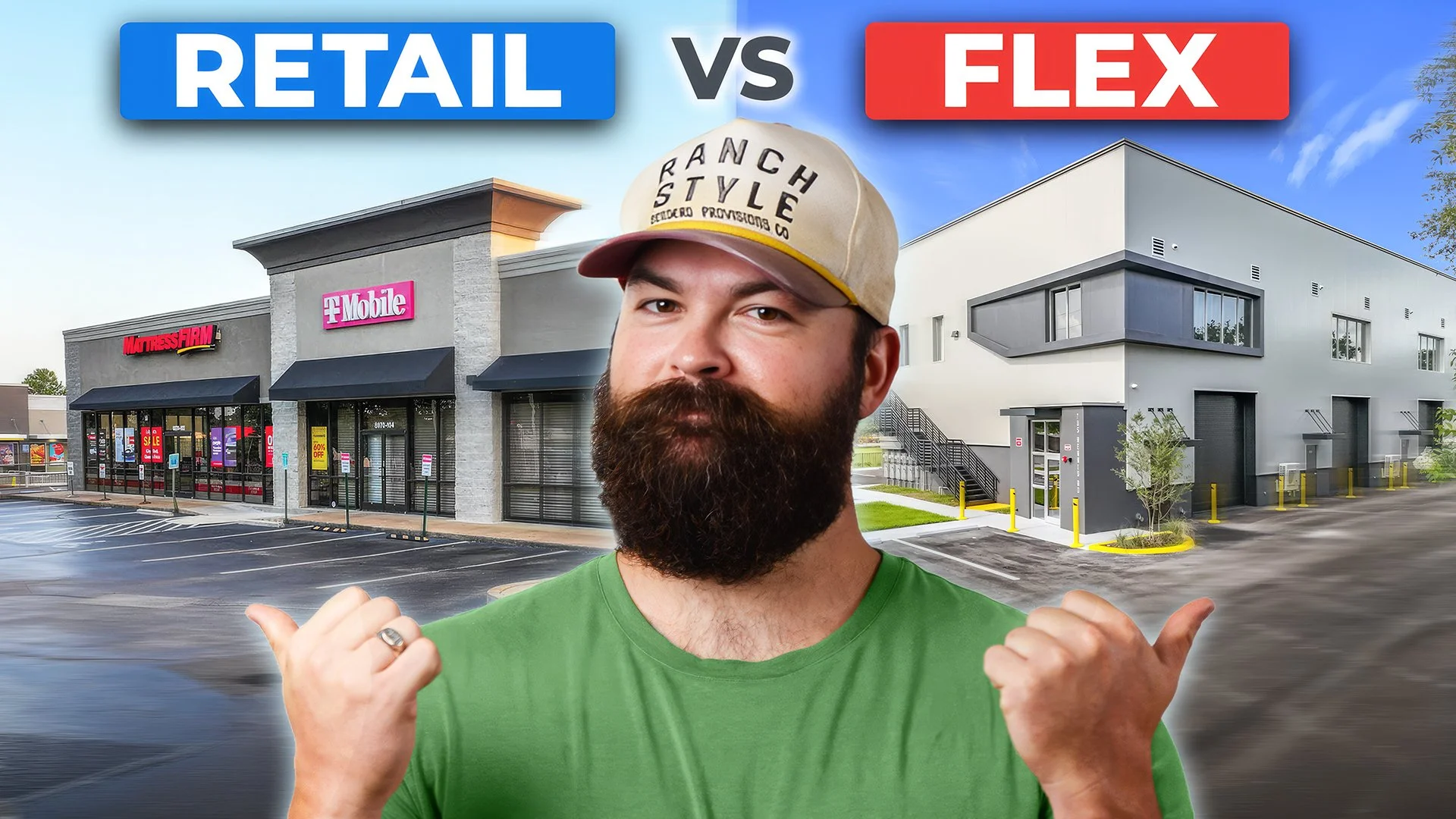
366. Will Retail Outperform Flex in 2026? | Office Hours
The asset class you’re probably driving past every single day might just be one of the best opportunities heading into 2026. It’s not what most people expect.
For years, flex and industrial have dominated the conversation. But right now, retail is quietly setting up for a strong run, backed by low new supply, stable vacancy, and renewed investor interest.
365. You're Broke Because You Chase Cashflow
Most real estate investors chase cash flow. Here's why that's keeping you broke. In this video, I'm breaking down the strategy that's helped me build wealth way faster than the traditional buy-and-hold approach — and why almost nobody in the residential world talks about it. I'll walk you through real deals I've done, including:
A 9-story building in Chattanooga we turned into a $2.2M profit (equal to 7 years of cash flow — in one deal)
A $435K retail building I flipped for nearly $200K in profit by doing one thing: signing a lease
A dirt lot we rezoned and flipped for a $1M gain, then 1031 exchanged into passive income
The truth is, you're not choosing between cash flow OR appreciation forever. You do value-add first to build your capital base — then you can afford to invest for cash flow later. If you're starting with little to nothing, this is the strategy that changes everything.
364. Why Underwriting is SO Important | Office Hours
Underwriting is one of the most important skills a commercial real estate investor can develop.
It is what separates investors who guess from investors who understand exactly how a deal will perform before they buy it. A property may look great on the surface, but until you run the numbers and test your assumptions, you do not actually know if the deal works.
363. Stop Writing Offers Like a Residential Investor - Do This Instead | Office Hours
Most investors coming from the residential world make the same mistake when they start pursuing commercial deals: they try to write offers the same way they would on a house.
In residential real estate, the contract is the offer. You submit it, tie the property up, and start negotiating from there.
Commercial real estate doesn’t work like that.
Before attorneys ever touch the deal… before a purchase and sale agreement is drafted… and before anyone spends thousands of dollars on legal work, sophisticated buyers and sellers start with something much simpler: the Letter of Intent (LOI).
362. Most developers go broke before they ever break ground with Meg Epstein
In this episode of Lessons Learned, Meg Epstein pulls back the curtain on what ground-up development really looks like when the wheels come off. A developer she invested with burned $1,000,000 on plans that didn’t pencil… and when the deal started falling apart, it escalated fast: subpoenas, legal threats, and a moment where it felt like everything she’d built could get wiped out overnight. Meg shares how she survived it, what she changed, and the business model she rebuilt afterward, including why chasing the “institutional” path can be a trap, why niche strategies win, and what it takes to keep your real estate business alive through a down cycle.
361. Backing Into an Offer Price on Vacant Commercial Property | Office Hours
A vacant commercial building isn’t a problem — it’s a pricing puzzle.
Most investors either lowball and lose the deal, or overpay because they don’t know how to value a property with no income. But vacancy doesn’t mean the building is worthless. It just means you have to price it based on what it will earn, not what it’s earning today.
360. If You Can’t Find Deals, This Is Probably Why - Do This Instead | Office Hours
If you can’t find good deals right now, it’s probably not the market.
It’s probably your filter.
Most investors say they “want a deal” but they don’t have a defined Buy Box, clear red flags, or a fast way to screen opportunities. So they chase everything, underwrite endlessly, and burn out before they ever submit an LOI.
359. You Think Apartments Are a Safe Investment?
“Apartments are the safest path to financial freedom.”
But in today’s market, that belief could actually be holding you back.
In this week’s video, I sit down with Josh Friedenshon of Greenleaf Management—a friend and now business partner—who scaled to 4,000+ apartment units before making a bold move: selling off residential in 2018 and reinvesting into commercial real estate.
358. Stop Investing in Real Estate for Cash Flow - Do This Instead | Office Hours
Stop investing in real estate for cash flow. It might be the very thing keeping you stuck.
“Passive income” sounds great. Who doesn’t want mailbox money? But if you are early in your investing journey, chasing 8 to 10 percent cash on cash returns could actually be slowing your growth instead of accelerating it.
What you need first is not cash flow. It is equity.
357. Using Energy Data to Find Vacant Buildings | Office Hours
What if the most distressed buildings in your market don’t look distressed at all?
Some of the best off-market deals never hit LoopNet. They don’t show up in broker chatter. And on paper, they look “occupied.”
But the lights tell a different story.
In this breakdown, I dive into a fascinating strategy investors are using to uncover hidden vacancy by analyzing something most people ignore: energy usage. By comparing reported occupancy to actual electricity and utility consumption, you can spot buildings that are quietly bleeding—long before the market catches on.
356. McDonalds owns their real estate. Why doesn’t Starbucks?
355. Waterfront Flex, Medical Office Boom, Multifamily Delinquencies, and More | The Deal Desk
Heading into 2026, a lot of investors are still operating like it’s 2019—assuming industrial will bail them out, multifamily will never crack, and Silicon Valley will somehow innovate its way past fundamentals. But markets don’t reward nostalgia. They reward awareness. If you’re holding real exposure in today’s CRE landscape—whether that’s flex, medical, industrial, or even legacy office—your edge won’t come from speed. It’ll come from knowing which signals actually matter before the institutional money prices it in.
Most investors hit this point and keep moving as if every cycle works the same. That’s how portfolios grow… and quietly destabilize. Because what separates those who compound through volatility from those who stall isn’t hustle. It’s structure—understanding where demand is forming, which sectors are insulated, how freight and logistics are shifting, and what rising delinquencies are really telling you about capital risk in 2026. If you want next year to work for you instead of happening to you, you need to stop treating headlines like entertainment and start treating them like strategy.
354. 10 Ways to Make Money from ONE Deal | Office Hours
Making real money in commercial real estate isn’t about finding ten different deals. It’s about learning how to get paid ten different ways on one deal. Most investors get stuck in the same cycle: grind to close, park the asset, and wait years for a payday that may or may not show up. Meanwhile, overhead keeps coming, momentum fades, and the business feels way harder than it needs to be. The truth is, if you structure your deals correctly, you can create income at closing, during the hold, and again on the exit—without needing a massive portfolio to survive.
The investors who last in this game aren’t just deal hunters. They’re deal architects. They understand that every transaction has multiple levers: brokerage, fees, operational cash flow, backend upside, and even debt positioning. You won’t stack all of them on every deal, but once you know the menu, you stop being reactive and start building predictable income around your acquisitions. That’s how you keep the lights on while your equity compounds in the background.
353. The Hidden Economics Behind Parking Lots
Most investors overlook one of the simplest and most profitable business models in commercial real estate: monetizing land.
In 2008, Chicago sold the rights to 36,000 parking meters for $1.15 billion. By 2025, the buyers had already collected every dollar back, plus roughly $500 million in profit, with decades of revenue still ahead. The city did not realize it was sitting on a land based cash flow machine.That deal is a clear reminder of a bigger truth in CRE. Some of the most boring properties quietly outperform the flashy ones.
351. Starting a Family Office | Office Hours
Starting a family office sounds like something reserved for billionaires, but the truth is the “family office mindset” kicks in way earlier than most people realize. If you’re sitting on a meaningful liquidity event, a paid-off asset, or even a few million in deployable cash, you’re already in the zone where strategy matters more than hustle. The problem is most investors hit that point and keep buying deals the same way they always have—reactive, scattered, and without a real portfolio blueprint. That’s how wealth gets built… and quietly leaks.
352. 2026 Trends, Trump's Ballroom, 50-Year Mortgage, and More | The Deal Desk
Heading into 2026, a lot of investors are still playing the same game they played in 2021: chasing whatever looks hot, reacting to headlines, and hoping the next deal fixes the last one. But markets don’t reward hustle forever. They reward positioning. If you’ve got real exposure in CRE—whether that’s a solid portfolio, meaningful liquidity, or even just a few good assets—you’re already at the point where strategy matters more than speed. The problem is most people hit that level and keep operating without a blueprint. That’s how returns get built… and quietly leak.
350. Let's Talk Flex Space | Office Hours
Flex space is heating up while most investors are still looking the other way. Headlines talk about industrial slowing, but small bay units between 2,000 and 6,000 square feet are leasing faster than they hit the market. Even older buildings in average locations are getting multiple offers. Years of underbuilding and redevelopment wiped out supply, yet the businesses that rely on these spaces never disappeared. Demand stayed strong. Inventory didn’t.