

Four years ago, I bought a 29-building campus in Rossville, Georgia, about 10 minutes south of downtown Chattanooga. It's 32 acres and 1.5 million square feet of former wool mill, and I paid $5.6 million for it. Run the math on that and it comes out to roughly $4 a square foot.
From Chaos to Clarity: Lessons From a Decade in Development

Meg Epstein didn’t set out to become a developer.
She started on the construction side—project managing ultra-high-end residential builds in California, the kind of homes where details matter, timelines stretch for years, and execution is everything. That job-site foundation gave her an operator’s mindset early: budgets are real, plans have consequences, and the smallest misstep can snowball fast.
When she moved to Nashville in 2016, she immediately saw opportunity where most people saw “no thanks”—especially along the river. While locals dismissed it as industrial and undesirable, Meg saw a future neighborhood: proximity to downtown, walkability, and an overlooked waterfront that felt obvious coming from markets like San Francisco.
But her real credibility wasn’t built in the easy wins—it was forged in the early deals where she had to figure things out in real time.
On her first major project, she entered as the financial partner to a developer, raised capital through cold outreach (not a built-in friends-and-family network), and quickly learned that the plan on paper doesn’t matter if the deal doesn’t pencil. When the original approach fell apart, she had to step into the developer seat midstream—scrapping work, restructuring the plan, and making high-stakes decisions under pressure.
That pattern—being forced into clarity when everything gets messy—became the theme of her next decade. She went on to build through multiple cycles, experience the “frothy” highs of 2022, and then endure the whiplash of rising rates, dried-up equity, and tough operational resets. And on the other side of that volatility, she rebuilt her business model with tighter focus, a leaner team, and a clearer definition of what she actually wants the business to support.
What Almost Breaking Taught One Developer About Success

Real estate stories almost always start the same way.
Someone buys a small property.
They scale quickly.
They raise capital.
They build a portfolio.
They “figure it out.”
Then comes the highlight reel — the exits, the cash flow, the passive income, the generational wealth.
What rarely gets shared is the moment when it almost fell apart.
The missed refinance window.
The lender call that didn’t go as planned.
The project that ran wildly over budget.
The sleepless nights wondering if one bad decision just unraveled five years of progress.
Because struggle doesn’t market well.
Smooth scaling does.
There’s a polished version of growth that makes success look linear — disciplined underwriting, steady expansion, clean transitions from one deal to the next. And while that version is more comfortable to tell, it leaves out something critical:
The pressure.
In reality, scaling in commercial real estate is rarely smooth. It’s lumpy. It’s volatile. It’s capital-intensive. And it often tests your assumptions before it rewards your ambition.
But here’s the part most people don’t understand:
The moments that almost break you are usually the moments that refine you.
There’s a difference between building momentum and building resilience.
Momentum feels like success.
Resilience is built in the moments when momentum disappears.
And sometimes the most important lessons in a developer’s career don’t come from the deals that worked.
They come from the one that almost didn’t.
In this post, we’re unpacking a conversation about what “almost breaking” teaches you — about leverage, risk, ego, timing, and the invisible structural flaws that success can temporarily hide.
Because there are lessons you simply cannot learn from books.
Only from pressure.
The 3 Forces Quietly Breaking the Multifamily Model

In the video at the center of this post, the argument isn’t “multifamily is dying.” It’s something more subtle - and far more important for serious investors.
Rather than fear-mongering or dramatic predictions, the video highlights that the multifamily investment model that dominated the last decade is quietly evolving. What used to be a relatively straightforward play — buy apartments, collect rents, refinance, repeat — is now being reshaped by forces beneath the surface that most investors don’t talk about enough. The narrative isn’t about fundamentals suddenly disappearing — demand for housing, rent rolls, and occupancy rates remain generally solid - but about what’s changed in capital markets, regulation, and operating economics that are redefining how returns get made today.
Instead of dramatic crashes or hype, the video shows a sector in transition - where the old assumptions about underwriting, leverage, and pricing power no longer hold as reliably as they once did. It’s a reality check rooted in structural shifts rather than emotion-driven narratives. And that’s important: this isn’t about condemning multifamily, it’s about understanding the new game being played.
That sets the stage for this post: not to scare you, but to explain what’s changing underneath the headlines - so you can see where risk is really hiding, and where opportunity still exists.
Is Multifamily Still The “Safest” Way To Invest
Why This Question Suddenly Matters Again
For the better part of a decade, “multifamily is the safest asset class” has been repeated so often it’s started to sound like a law of nature.
Need stability? Buy apartments.
Want recession resistance? Buy apartments.
People always need a place to live, right?
But over the last 24 months, that narrative has started to crack.
Interest rates doubled. Floating-rate debt crushed operators. Insurance premiums spiked. Cap rates expanded. Syndicators that looked like geniuses in 2021 suddenly found themselves handing properties back to lenders in 2023 and 2024.
So the question is back on the table:
Is multifamily still the “safest” way to invest?
And if you’re serious about building long-term wealth in commercial real estate — not just chasing trends — this question matters more than ever.
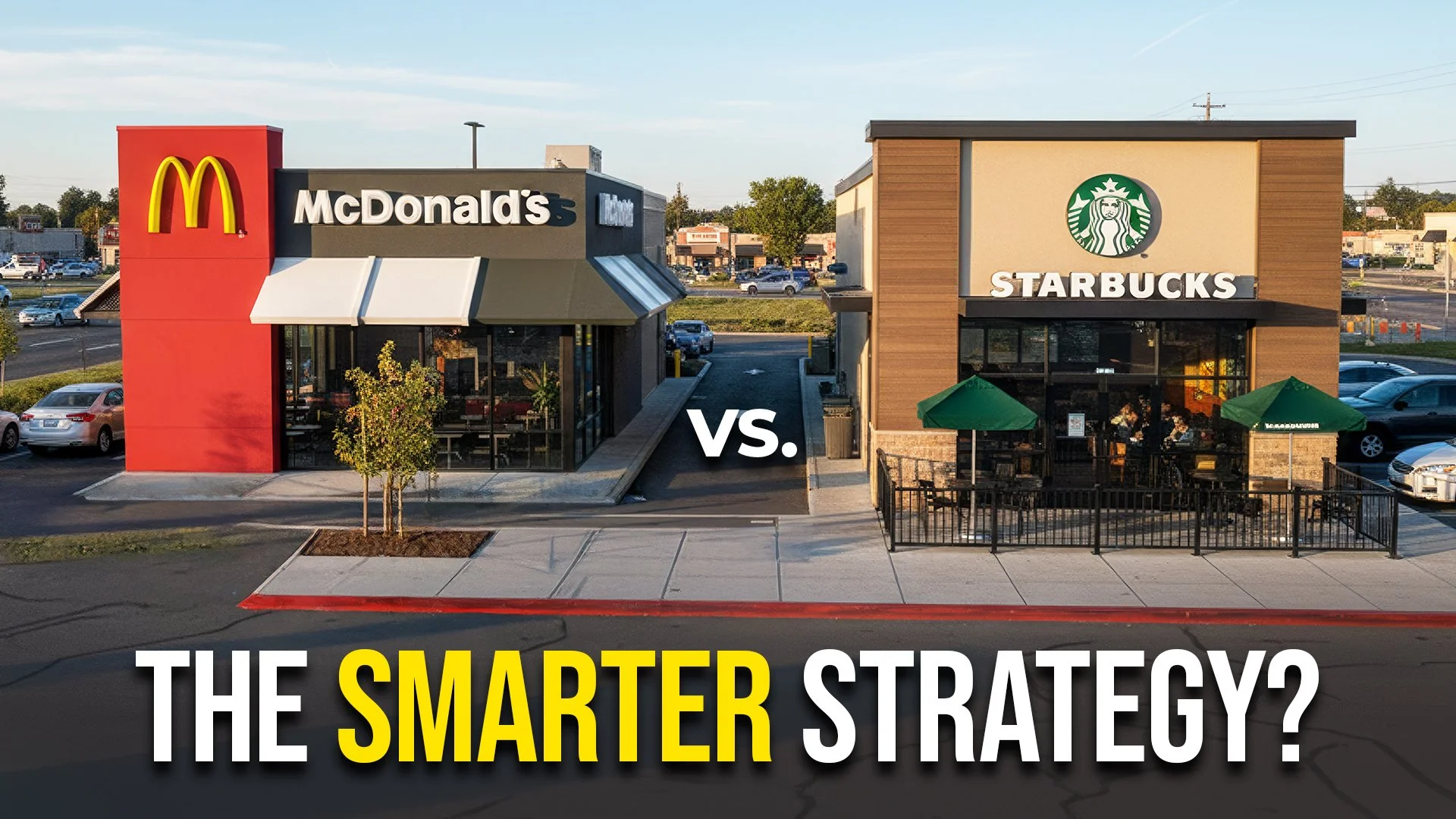
What McDonald’s vs Starbucks Teaches Real Estate Investors
If you spend enough time in commercial real estate, you’ll notice something strange.
Every strategy sounds convincing.
Buy multifamily - it’s recession resistant.
Buy industrial - e-commerce is unstoppable.
Buy retail - high yields.
Buy triple-net - passive and predictable.
Develop ground-up - create equity.
Value-add - force appreciation.
The advice never stops.
And for most investors - especially those trying to scale - that creates a quiet kind of paralysis. Too many asset classes. Too many opinions. Too many people confidently explaining why their strategy is the right one.
But here’s the uncomfortable truth:
The problem isn’t deal selection.
It’s strategic confusion.
Most investors are choosing assets before they’ve chosen a strategy. They’re asking, “What should I buy?” instead of asking, “What kind of investor am I trying to become?”
And that’s where a surprising comparison becomes useful.
McDonald’s and Starbucks built global empires using completely opposite real estate strategies.
McDonald’s owns the land.
Starbucks leases almost everything.
One optimized for control.
The other optimized for flexibility.
Both won.
So the real question isn’t which strategy is better.
The real question is this:
What does their difference teach us about how to think as investors?
Because great investors don’t copy companies.
They copy frameworks.
And this month, we’re breaking down one of the most important frameworks in commercial real estate:
Control vs. Flexibility.
Before you choose your next asset class, you need to choose your strategy.
Let’s start with the paradox.
The Most Profitable Real Estate You’re Not Thinking About

In 2008, the city of Chicago sold off the rights to 36,000 parking meters for $1.15 billion. At the time, officials praised it as a financial lifeline—a way to plug a massive budget deficit without raising property taxes. But by 2025, the investors behind that deal had already earned back every dollar… plus $500 million in profit. And the kicker? They still had 60 years left on the contract.
Chicago didn’t just lose out—it got absolutely fleeced.
This wasn’t a one-off oversight. It was a glaring case of what happens when institutional leaders misunderstand the quiet power of boring real estate. Because what looked like an outdated relic—coin-operated meters on slabs of city asphalt—turned out to be one of the most lucrative investments in modern American history.
But this story isn’t really about Chicago. It’s about the invisible empire that grew underneath America’s cities—parking lots, storage yards, fenced land—and the people who saw their value long before Wall Street did.
The investors who win in commercial real estate aren’t always the ones chasing the flashiest properties. They’re often the ones who ask the simplest question: “Can I charge rent on that?”
This is the story of how surplus land and painted asphalt built billion-dollar fortunes—and how the exact same principle is quietly shaping the next wave of wealth in commercial real estate.
The Most Overlooked Asset Class for Experienced Investors
If you’ve been investing for a while, you know the grind.
You’ve closed deals, managed contractors, worked through leases, and seen both wins and setbacks. Maybe you’ve owned single-family rentals, a few duplexes, or even some small commercial buildings. You understand the fundamentals: how to run numbers, navigate debt, and keep properties occupied.
But here’s a question that hits at a different level: are your investments giving you leverage or just more responsibility?
As your portfolio grows, so does the complexity. More tenants often mean more phone calls. Bigger buildings bring additional systems, staff, and liability. And while your equity might be growing on paper, your time can get stretched thin across too many directions.
That’s why more experienced investors are quietly shifting toward asset classes that offer something rare in commercial real estate: simplicity that still delivers strong returns.
Two of the most overlooked categories in this space are flex industrial and industrial outdoor storage (IOS).
They’re not flashy. You won’t find them in luxury investor decks or high-end brochures. But these properties produce solid returns, attract long-term tenants, and are surprisingly light on operational headaches. Best of all, they give seasoned investors a way to keep growing without being consumed by the demands of their portfolio.
In this post, we’ll walk through:
What makes flex and IOS so attractive
The numbers behind why they work
How they fit into a growing portfolio
And why they might be the most strategic asset class you haven’t explored yet
This is not about going bigger for the sake of scale. It’s about going smarter.
Because the goal is not more units. It’s more freedom.
The Long-Term Vision for Your CRE Portfolio: From Asset 1 to Legacy

“Most people think about their first deal. Few think about their last.”
That quote stuck with me the first time I heard it. It’s a reminder that in commercial real estate, the endgame matters just as much as your entry point. Too many investors pour all their energy into getting that first property across the finish line only to realize they never thought about where it was actually taking them.
Commercial real estate isn’t just about buying buildings. It’s about building something bigger than yourself: a business, a portfolio, a legacy. Without a clear vision, your investing journey can start to feel like spinning plates, one more deal, one more tenant, one more issue to solve. But with the right long-term strategy, every property becomes a stepping stone toward financial freedom, generational wealth, and impact.
This post isn’t about your next deal. It’s about your last one, the one that makes the whole journey worth it. Whether you’re on property one or property ten, this is your guide to thinking bigger and building a CRE portfolio that lasts.
Buying Property When Cap Rates LOWER Than Interest Rates??
Commercial real estate has long been a reliable vehicle for generating passive income, preserving wealth, and leveraging tax advantages. But what happens when the math doesn’t make sense—when cap rates fall below the interest rates you’d pay to finance a deal?
In today's high-rate environment, that's exactly what many investors are facing. With properties still trading at cap rates of 4–6% while borrowing costs sit at 7% or more, the numbers don’t pencil out as easily as they used to. For aspiring and seasoned investors alike, this raises a major question: How do you buy when the deal cash flows don’t work at face value?
Let’s break down what it means when cap rates are lower than interest rates—and five ways you can still acquire profitable commercial real estate in this tough climate.
How to Stress Test CRE Projections So You Don’t Get Burned

On paper, every deal looks like a winner—until reality hits.
If you’ve ever reviewed a commercial real estate (CRE) pitch deck, you’ve seen the same glowing numbers: 18% IRR, 8% cash-on-cash return, and an “attractive” 2x equity multiple in just five years. It’s hard not to be tempted. But as seasoned investors know, projections are just that—projections. And relying solely on optimistic pro formas can be the fastest way to get burned.
In the world of passive real estate investing, one of the most critical yet overlooked skills is learning how to stress-test a deal. While you may not be operating the property yourself, your capital is still at risk. And if you want to preserve and grow that capital over time, you can’t afford to take the sponsor’s numbers at face value.
That’s where stress-testing comes in.
This blog will walk you through the mindset, techniques, and real-world metrics you can use to evaluate whether a deal holds up when things don’t go as planned. We’ll show you how experienced limited partners (LPs) break down assumptions, test the limits of a deal’s performance, and make investment decisions based on realistic—not rosy—scenarios.
Because here’s the truth: markets shift, expenses rise, tenants leave, and financing gets tighter. And when that happens, the deal you thought would double your money might just return your principal—if you’re lucky.
By the end of this post, you’ll know how to:
Identify the most common areas where projections go wrong
Ask the right questions to sponsors about downside scenarios
Use simple tools to run stress tests—even if you’re not a spreadsheet wizard
Evaluate whether a deal is built to survive turbulence or only thrive in perfect conditions
This isn’t about fear—it’s about fortifying your investing approach. The best LPs are prepared, informed, and calm when markets wobble. And that preparation starts before the check is written.
So let’s dive in—and learn how to stress-test like a pro, so you never get caught off guard when the market delivers a curveball.
How to Pick the Best Passive Real Estate Investment Opportunities Like a Pro
If you’ve been exploring ways to grow your wealth while minimizing your time investment, passive commercial real estate could be the strategy you’ve been looking for. For many aspiring commercial real estate investors, the appeal lies in the ability to diversify, leverage expert operators, and build long-term income—all without becoming a landlord.
Yet, not all opportunities are created equal. For high-income professionals, entrepreneurs, and early-stage commercial investors, learning how to vet and select the right passive investment is where the real leverage lies.
The 5 Red Flags That Kill a Commercial Deal (Before It Even Starts)

In commercial real estate, not every deal is a good deal. In fact, some of the best investors will tell you their greatest wins weren’t properties they bought—they were the bad ones they walked away from.
New investors often get caught up in the excitement of chasing their first deal. They run the numbers, talk to brokers, and start imagining future cash flow. But here’s the hard truth: if you don’t know what red flags to look for, you risk wasting time, money, and energy on deals that were dead from the start.
The good news? Most bad deals announce themselves early—if you know what to watch out for.
In this post, we’ll break down the five biggest red flags that should make you pause, rethink, and possibly walk away before you waste weeks underwriting or thousands in due diligence.
Because in CRE, protecting your downside is just as important as chasing upside.
From Residential to Commercial: The 3 Mindset Shifts Every Investor Must Make

For many investors, residential real estate is the proving ground—it’s accessible, familiar, and relatively forgiving. You learn how to spot a deal, how to manage tenants, maybe even how to flip a property or two. But at some point, the ceiling becomes obvious.
You’re trading time for money. Your portfolio is scattered across single-family homes with razor-thin margins. And the dream of passive income still feels surprisingly… active.
That’s when commercial real estate starts to look like the next logical step. Bigger buildings, bigger profits, and—eventually—more freedom.
But here’s the truth: most residential investors struggle when they try to make the leap.
It’s not because they lack the hustle. It’s not because they don’t understand real estate. It’s because they bring the wrong mindset into the commercial world. The habits that helped them win in residential often become blind spots in commercial.
As Tyler says, “Commercial real estate isn’t easy—but it is simple. Once you know how to think like a commercial investor, the rest falls into place.”
This post breaks down the three biggest mindset shifts every residential investor must make to succeed in commercial real estate—and why embracing them is the key to scaling faster, safer, and smarter.
From Eyesore to Asset: Unlocking Wealth in Forgotten Buildings

Most investors walk past them without a second glance — the boarded-up strip centers, caved-in warehouses, and overgrown office buildings. They’re seen as too risky, too expensive, too far gone.
But in commercial real estate, the ugliest properties often hide the biggest opportunities.
Over the past few years, I’ve repositioned more than $75 million worth of forgotten and underperforming buildings — not by chasing perfect assets, but by creating value where others saw failure. One property in East Nashville with a collapsed roof generated over $600,000 in equity before construction even started. Another, a 9-story vacant tower in Chattanooga, went from liability to legacy.
This isn’t house flipping. This is commercial real estate — where value is built through vision, zoning, and execution.
In this post, I’ll walk you through:
Why abandoned buildings are the best-kept secret in commercial real estate
The 3-part framework I use to separate money pits from gold mines
And how you can start seeing upside where others only see problems
Let’s dig into how you turn an eyesore into an asset — and unlock serious wealth in the process.
Deal Flow 101: How to Build a Consistent Pipeline of Commercial Opportunities

If you’re serious about becoming a commercial real estate investor, there’s one habit you absolutely must develop: building consistent deal flow.
Without it, you’re not really in the game.
Too many new investors fall into the trap of chasing a single opportunity, analyzing it to death, and then sitting back waiting for the next one to magically appear. It doesn’t work like that. In commercial real estate, success isn’t about finding a deal—it’s about building a repeatable process that constantly puts the right kind of deals in front of you.
The best investors don’t stumble into great properties. They engineer their pipeline.
In this post, I’ll walk you through exactly how to do that—how to set your buy box, create broker relationships, generate off-market leads, and systematize your outreach so you’re reviewing 5–10 deals a week (not a month).
“If you’re only looking at five deals a month, you’re not in the game. The best investors are evaluating 50—and closing on 1.”
Let’s build your system.
How to Analyze a Flex Space Deal Like a Developer

If you’re an aspiring commercial real estate investor looking for your first deal, flex industrial might just be your most strategic entry point. Why? It’s simpler to build, easier to lease, and remarkably scalable—making it the ideal product type for investors transitioning out of residential or small business ownership.
But the key to succeeding with flex space is learning to analyze it the way a developer does—not just as a buyer chasing cash flow, but as someone who’s building long-term value from the ground up.
In this post, I’ll break down how to underwrite a flex deal like a developer, including:
What kinds of rents you can expect (and how to find them)
Realistic construction costs and budget planning
How to structure financing and think through your capital stack
How to gauge tenant demand and avoid sitting on vacant space
By the end, you’ll have a clear lens for evaluating flex space opportunities—and the confidence to pull the trigger on a profitable deal.
CRE Syndications in 2025: How Operators Are Adapting to Tighter Lending

Syndications have long been one of the most effective ways to get into commercial real estate—whether you’re an operator assembling a deal or a passive investor looking for cash flow and equity growth without the day-to-day management.
But 2025 isn’t the same playing field we saw just a few years ago. Interest rates remain elevated, lenders are pickier than ever, and deals that used to sail through underwriting are now hitting roadblocks. Loan-to-value ratios have been slashed. Debt service coverage requirements are stricter. And that’s forcing syndicators to rethink how they structure deals, raise capital, and set investor expectations.
This isn’t the death of syndication—it’s the evolution of it. The operators thriving right now are the ones who are adapting, getting creative with financing, and focusing on risk management over aggressive growth.
In this post, we’ll break down exactly how syndicators are adjusting to today’s lending climate, the new deal structures we’re seeing in the market, and what passive investors need to know before committing capital in 2025.
Scaling From Residential to Commercial the Smart Way

You’ve closed a few residential deals. Maybe a couple of flips, a duplex, even a fourplex you manage yourself. You’ve proven the model. You’ve built some equity. But you’re starting to feel it: the ceiling.
Managing more doors just means more tenants, more maintenance calls, and more risk concentrated in small assets. Cash flow is capped. Appreciation is unpredictable. And scaling up by stacking more single-family homes feels like working harder—not smarter.
That’s why more experienced investors are shifting gears and stepping into commercial real estate.
But here’s the truth: the leap from residential to commercial is bigger than it looks. The numbers are different. The underwriting is deeper. The stakes are higher. Done right, it can completely transform your portfolio—and your lifestyle. Done wrong, it can wipe out years of progress.
In this post, we’ll break down how to make the transition strategically—based on the smart moves outlined in the video “The Smart Way to Scale from Residential to Commercial Real Estate.” Whether you're eyeing your first small industrial building or a multi-tenant office space, this is your blueprint to scaling with confidence.
Private CRE Funds vs. REITs: Where the Wealthy Actually Invest

Not all real estate investments are created equal—and not all investors play the same game.
While everyday investors are buying shares of publicly traded REITs for a taste of passive income, the ultra-wealthy are moving differently. They’re not chasing dividend yields on the stock market. They’re going straight to the source: private commercial real estate funds.
These private vehicles offer something REITs simply can’t—direct access to income-producing properties, strategic control, stronger tax advantages, and returns that aren’t tied to market volatility. It’s how family offices and institutional investors build real wealth: by owning the kinds of assets you can drive by, walk through, and influence directly.
In this post, we’ll break down the key differences between REITs and private CRE funds, show you where the wealthy actually invest, and help you understand which path might better align with your long-term goals.