
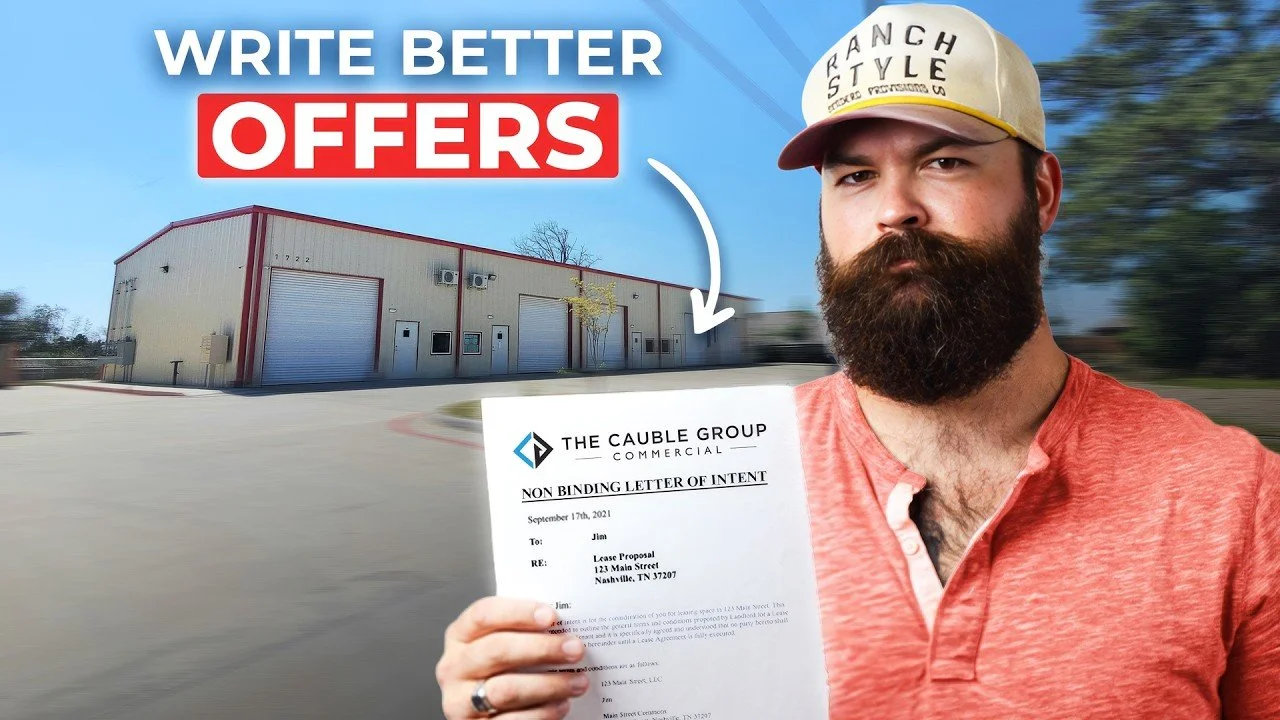
Stop Writing Offers Like a Residential Investor - Do This Instead | Office Hours
Most investors coming from the residential world make the same mistake when they start pursuing commercial deals: they try to write offers the same way they would on a house.
In residential real estate, the contract is the offer. You submit it, tie the property up, and start negotiating from there.
Commercial real estate doesn’t work like that.
Before attorneys ever touch the deal… before a purchase and sale agreement is drafted… and before anyone spends thousands of dollars on legal work, sophisticated buyers and sellers start with something much simpler: the Letter of Intent (LOI).
The LOI is where the real negotiation begins. It’s a simple, non-binding document that outlines the core terms of the deal—price, due diligence period, closing timeline, escrow, and key conditions—so both sides can agree on the fundamentals before moving forward.
And if you get this part wrong, the rest of the process becomes unnecessarily expensive, slow, and painful.
In this issue, we’re breaking down exactly how commercial investors structure Letters of Intent—what should be included, what mistakes to avoid, and how a well-written LOI can set the tone for the entire transaction.
Because in commercial real estate, the deal doesn’t start with the contract.
It starts with the LOI.
Get commercial real estate coaching, courses, and community to jumpstart your investment journey over at CRE Central: www.crecentral.com
Key Takeaways:
LOIs are non-binding but critical
They set the main business terms (price, timing, responsibilities) before you spend money on attorneys and full contracts.You must clearly state “non-binding”
Put non-binding language in multiple places, plus a paragraph saying it is only a basis for preparing a formal contract.Use “and/or affiliated assigns” for the buyer
This lets you assign the contract to a new entity later and helps manage liability without having to rewrite the deal.Due diligence is your escape hatch
During the DD period, you can terminate for almost any reason and get your earnest money back; after DD, you usually can still walk but lose the deposit.Commercial deals are priced on income and risk
You rely on NOI, actual financials, and realistic rent/expense assumptions, not “price per door” or emotional comps.Landlord–tenant responsibilities must be explicit
Spell out who handles roof, structure, HVAC, TIs, fees tied to the tenant’s specific use, and how much the tenant’s costs are capped, to avoid ugly surprises later.



About Your Host:
Tyler Cauble, Founder & President of The Cauble Group, is a commercial real estate broker and investor based in East Nashville. He’s the best selling author of Open for Business: The Insider’s Guide to Leasing Commercial Real Estate and has focused his career on serving commercial real estate investors.
Episode Transcript:
Tyler Cauble 0:00
This episode of the commercial real estate investor podcast is brought to you by my cre accelerator mastermind, where you'll get access to my step by step investment blueprint, essentially a library of resources on how to invest in commercial real estate. You'll get connected to a supportive community of other commercial real estate investors that are doing projects just like you. You'll get personalized coaching and feedback from me every step of the way. Go to www.crecentral.com to learn more. The Letter of Intent is an often overlooked piece of buying or selling commercial real estate, especially if you're transitioning from residential to commercial, because it's not typical in residential real estate for you to utilize the letter of intent today, I'm going to break down why it's so important. We're going to look at a couple, two or three sample letters of intent that I have, that we have actually used. I have, of course, redacted names and addresses to save the innocent. And we'll be diving into really some, some, you know, specific clauses that you shouldn't have, that you should have in every single letter of intent that you're using, because it's very important that you get this part of the process right before you get into the purchase and sale agreement. Welcome back to the commercial real estate investor podcast live from the cobble group Studios here in Nashville, Tennessee. I'm Tyler Cobble, your host, and today we are live with Office Hours where I go live every tuesday, 8:30am central standard time to answer your questions and teach you guys a little bit more about commercial real estate, especially if you're just getting started now the letter of intent. What is it? It's basically a non binding agreement, right? It's not a contract. The simplest way to explain a letter of intent is that it is a document where you are going to agree on the basic terms of the deal before you start spending any money on getting attorneys involved, on putting together Purchase and Sale agreements, on negotiating any of the finer points, because if you can't agree upon the items that are typically covered in a letter of intent, and again, we're going to go through a typical purchase letter of intent. We'll go through a four lease letter of intent. So if you're a landlord or you're a tenant, and then I'm actually going to go through a binding letter of intent, because typically, they're non binding, meaning they are not contracts. You can also have binding letters of intent. They're a little more rare. We typically don't utilize them, but I'll show you an example of a case where I have used one. They're very important. And you know, unlike residential real estate typically, like on the residential side, you want to just submit a contract, right? You want to tie that property up. You want to get it going. It doesn't work like that in commercial real estate. The negotiation process is a little bit slower, the conversations are a little bit slower, the transactions are slower. It is not nearly as fast paced as the residential world, and that can be very frustrating for a lot of residential real estate investors getting into this side of the space, but it's very intentional. We're talking about bigger transactions. We're talking about professional investors on both sides of the aisle. Typically, even if you're a business that's owner occupying you're going to be more sophisticated than somebody that's, you know, your average person selling a house. I will say not to say that residential real estate investors are not sophisticated, because that is four because that is far from from the case. And again, these are the terms that you must agree upon before you get anywhere else. Right? It's also a good kind of witness test. I guess you could look at it for how negotiations and how the process is going to go with that buyer or seller again, if it's just back and forth and back and forth, you guys can't agree on things, or it's getting argumentative. It's not going to get any better. When you guys get attorneys involved, you start spending money and making things happen. So typically, in my process, I'll go out. Let's say I'm a buyer. I'm looking to buy a piece of commercial real estate, I will go out and I will meet with the seller, right? We will tour the property. We'll have conversations, you know, over the phone, or with our brokers, or maybe it's just me and the you know, the seller directly going through all this, right? And then once we decide, like, Okay, I think that we can come to terms on this deal. That is when I will prepare a letter of intent. Some groups will have attorneys approve and put together the letters of intent. I don't think that that's necessarily appropriate at this stage. Now, obviously, before I sign a letter of intent, I will have my attorney sign off on it. Couple of reasons there. I just want my attorney to know. One, here's a deal that we're working on, but two, they're probably going to be putting together the purchase and sale agreement, right? So if there's anything crazy out of the ordinary, we're going to want them to know that ahead of time, so that they could maybe stop us at the non binding point. Portion of it before we have actually signed anything. Jitsu saying, let's go. Welcome jitsu. Good to see you. Pinewater properties, good morning. Good morning. Good to see you. Christian, what's going on, man? Good to see you in here. Good morning. Appreciate you guys joining me today. All right, let's, let's dive into this here real quick. We're up there we go. All right. So this is a sample purchase letter of intent. All right, this is the typical letter of intent that I would use whenever I am going through and buying a property. You can kind of see here. It's a little more formal, right? We've got the date up here we've got the, you know, the reference line regarding, you know, 123, Main Street, dear Jim. So Jim would be the seller. You know, this is a non binding Letterman tent. It's very important that you put non binding in multiple places. I will point that out as we're going through this, because you want to make sure that everybody is fully aware that this is non binding. Because there are states like the state of Tennessee, if you and I agree on something in writing, regardless of whether or not it is technically a contract, and we sign it if we agree to it in writing, that is a contract that can be treated like a contract in the court of law. So it's very important that you guys are laying this kind of stuff out, all right? We go into the premises. So approximately 1.49 acres across a couple of parcels. I like to lay out the the parcel identification numbers here as well. Sometimes, especially if you're buying raw land, it might be zero Main Street, right? Well, there's going to be a whole bunch of zero main streets, because typically, municipalities will look at raw land as not having an address, especially when it comes to commercial that may be somewhat common when it comes to residential. I don't think that it is, though, because these commercial properties can be subdivided into multiple different ways, so they don't typically like to address it until it is actually, you know, there's something there. So that's why the parcel identification numbers are very important. All right. We list out the seller, 123, Main Street LLC, then we have the buyer, Tyler Cobble and, or affiliated assigns. I have in parentheses there final entity to be determined. Why do we have Tyler Cobble and or affiliated signs now, sometimes I'll put it into a Holdings Company, like I have an LLC that we specifically use to go under contract for properties that is literally used for nothing else. It is just for that. You don't necessarily have to do that it can help with. You know, just liability for liability purposes, depending on on. I mean, things happen, right? You know, we have these conversations in the accelerator all the time, like, just prepare. You know, it sounds so silly, but you never know. I mean, I'm dealing with a guy right now where we tried to buy his property. It didn't work out very well. If we ended up dropping the property after we tried to renegotiate the deal, some things came to light that made the deal really, really, really not work, and I tried to renegotiate it, and he wouldn't budge. And so we dropped the contract, which was well within our rights, but now he's threatening to sue me for non performance, even though it's very clearly laid out in our purchase and sale agreement that we have the right to terminate the contract within this certain time period, right? So it's very important that you keep all that in mind. And of course, you guys know this, it's the United States of America. Anybody can sue anybody for anything, unfortunately, but the and or affiliated assigns is very, very important. I have that in there because I don't have the entity formed for this property yet, right? I'm not going to own it in my personal name. There's too much liability there for me. Of course, none of this is legal advice for you. I'm just walking you guys through how I typically do this. All right, the and or affiliated assigns allows me at the closing table, or at any time throughout the contract, to assign this contract to the entity that we create, all right? So, you know, the seller is 123, Main Street LLC. I typically put my properties in the address, like I affiliate the LLC with the address. So for example, you know, we might do 123, Main Street to LLC. That's just the easiest thing to do, because it's very easy to reference them, right? So I need to have the ability, as I'm going through this process, to be able to assign that contract to that entity. All right?
Tyler Cauble 9:32
Purchase Price, pretty straightforward, $3.2 million shall be paid by the buyer at closing. All funds shall be dispersed through escrow and applied towards the purchase of the property. Basically escrow. It's just going to be going to the 10 be going through the title company, all right, escrow, $50,000 to be placed at the offices of the title company within five business days. You can choose your title company. I have one title company that I work with. That is it. I will not work with anybody else. That title company has all of my information. They have handled all of my. Closings. They know how I like to do things. I will not work with anybody else's title company. That's a non negotiable for me. I don't really care about your feelings about that. Some people don't care. They'll go close with anybody. I had a deal get a little sideways probably four or five years ago now, where we ended up, my I brought in a different attorney than I typically use. He wanted to use a different title company than I typically use, and it was a total mess. And I will never do that again. Let's see due diligence period. Buyer shall have a period of 90 days. Of course, this is totally up to you, right? It could be 30 days. Could be 60 days. Totally depends on what you're looking to do following the execution of a mutually acceptable purchase and sale agreement to conduct all due diligence. All right? Will be this is very important. Buyers shall have the right to terminate the PSA at any time prior to the expiration of the due diligence period, and buyer's soul in absolute discretion. Now that doesn't mean that you can't terminate the contract after the due diligence period. Typically, you'll just lose your earnest money, right? So this escrow, the $50,000 that is refundable during the due diligence period, after that, I can't get that money back. All right, let's see, within 20 days of execution of the PSA, seller is going to deliver to buyer, and then I have all of these things listed out on this letter of intent, all right, current rent roll and all lease agreements, historical income and expense statements, balance sheets, bank statements. I want to know what has actually been going on with this property, because you guys are well aware. As you're getting in and investigating these properties, you're trying to wrap your mind around what's going on. If the seller is giving you a half assed rent roll. They're not giving you any t 12 expenses. You have no idea what's actually going on with the property. You're having to take the seller's word for it. Guess what? What's there's a book, I think it's called, buyers are liars and sellers are too. I think Richard Courtney wrote that one. He's a he's a real estate investor and agent here in Nashville, but it's true, like, buyers are liars and sellers are too Right? Like, even if it's unintentional, they're not going to tell you the truth. I want the hard evidence that is going to back up any claims that anybody is going to make. All right, we want to see copies of service contracts, event and vendor agreements, staffing and payroll obligations. That's, you know, the event, vendor agreements and staffing, payroll obligations, not typical, but maybe you're buying a food hall, or maybe you're buying an event venue, or maybe you're buying a hotel, something like that, where you need to understand what that looks like, title insurance policies, surveys, zoning documentation, environmental reports, if any, I basically Want any documentation that these guys have on this property. We look at architectural plans, construction documents, capital improvement records, any existing appraisals, property condition assessments or inspection reports, and, of course, insurance policies and claim history. I want to know if anything has happened on this property that you know maybe not be won't be obvious right off the bat. All right, there's a couple of questions in the chat. Let's get to those real quick. Ted is saying, Good morning. Do you ever use the 1% rule of thumb, meaning the purchase price is 1% of net income? Ted, no, I don't. You know. I know that the 1% rule is, is, you know, very common in residential and that's, that's typically 1% net income per month. If you can find commercial properties that are netting 1% per month, which is basically netting 12% per year, hell yeah, you should absolutely buy that. But no, we don't use that. Jitsu is saying, if the appraisal comes in lower from the lender, does the buyer have the right to back out if negotiations fall through absolutely you do. So when you are in the due diligence phase, you can back out for any reason. You can say, hey, you know, my dog ran out of food this morning, and I had to go to Petco to get some more. So I'm dropping the contract like you could back up for literally any reason that you want. Now you can still back out after the due diligence period, but you lose your earnest money even if the appraisal comes in lower. If you want the appraisal contingency to survive past the due diligence period, you have to call that out specifically. Do buyers do that in commercial real estate? Sure, I don't, because I am going to satisfy everything during that due diligence period. And I don't want anything hanging over anybody. I don't want to give the seller any sort of reason for hesitation to sign my agreement. If I can't figure out, you know, the appraisal, the value of the property, anything like that, within 90 days, or 60 to 90 days, depending on the due diligence period, then that's on me as the buyer. All right. Okay, closing date that shall occur on or before 30 days after the expiration of the of the due diligence period. So this is putting 90 days of due diligence, 30 days to close. So when you hear a commercial real estate investor or broker say, Oh yeah, the contract is 60 and 30, or it's 90 and 30, they're referencing. The due diligence period, the 60 or 90, and then the closing period, which would be 30 in both instances there. So essentially, after we have satisfied all of our due diligence, we then have up to 30 days to actually close on the property. The reason that that is super important is that your lender might still have stuff that they have to satisfy after you have already gone through through the due diligence, you may need to finalize things with your investors, whatever that is, right? So you'll have basically 30 days to finalize that and get it done. Now we do honor before, typically we're going almost all the way to the end of the 30 days, but we can close earlier if we want to. That gives us the option to have that by saying we, you know, closing shall occur on or before delivery conditions. This is very important. This is a big thing that is very different from the residential real estate world. Seller shall deliver the property in its current as is, whereas condition with all with all faults, and without representation or warranty of any kind, except as expressly set forth in the PSA. Now I like to buy my properties in as is, whereas condition. Sellers typically like to sell their properties in as is whereas condition. It doesn't matter what pops up throughout the process, if we find a crack in the foundation, that doesn't mean that the seller is now obligated to go and fix that before we close on it. Right? What that does mean, though, and how we typically handle that if we find a crack in the foundation, I'm going back to the seller. I'm saying, Here's what we found during our due diligence. Here's the cost to repair that. I want a credit at closing for this, and we will sign something for that, or I'll give them the option to fix it. Typically, you know, I would rather have it fixed on my own. That way I know that it was done, right? So I go for the credit at closing, it's a lot easier. What's going on? Kevin, good to see here, man, thanks for jumping on. All right, so you know, you can get into the delivery conditions, and say that, like seller shall repair any and all faults that are found. I think that that just gets a little too complicated. It starts off kind of an adversarial approach with the seller, and most sellers are probably not going to agree to that. It's just not traditional in commercial real estate, all right. But again, you're the buyer. You're presenting this letter of intent. You can ask for anything that you want. If the seller pulls up to the meeting with a really nice Bentley and you want that as part of the deal, put it in the letter of intent, seller shall deliver to buyer at closing their Bentley. Right? You can ask for stuff like that if you really want. I have literally seen things like that occur. It's pretty wild. But hey, everybody likes to negotiate a deal. So, I mean, it could be one of those things like, Hey, I'm not going to fix the foundation, but I will. I will sign over my Bentley. All right, cool. I'll take it whatever. I'll fix the foundation myself. That's totally fine. Okay, brokerage, both sides recognize that the cobble group represents the buyer and shall be paid a 3% commission for its representation by the seller at closing. If you have another, you know, broker involved, let's say you've got somebody representing the seller. You would obviously just modify this language here so that you would say, you know, the cobble group represents the buyer, and you know, the other brokerage represents the seller, and shall be paid, you know, 3% commissions respectively, right? So that each side is getting 3% or whatever you guys negotiate, right for the representation of the buyers and of the buyer and seller closer. All right, now this is very important offer deadline. The offer to purchase shall expire on Monday, December 8, 2025 at 5pm All right, if you're dealing with people that are out of market, you might put Central Standard Time, you know, just so that it's very clear which 5pm we're talking about, because you don't want somebody to argue. Well, I'm in California. I thought you meant 5pm California time, which is actually 7pm Nashville time. All right, so I like to have that in there. I don't want these to be open ended offers, right? Because if it's if it's open ended for too long, they may go shop it to somebody else and see if they can get a better offer. I typically give them, you know, three to five days to respond to this.
Tyler Cauble 19:13
Now this is just a form paragraph at the end, again, acknowledging that this is non binding, right? Buyer and seller agree and acknowledge that this proposal is not a contract, and then it is intended only as a basis for the preparation of a contract. This loi shall not be bonding, binding upon the prop, my gosh, upon the parties until a formal contract has been negotiated and executed. I mean, it's, it's basically just going further and further into, you know, hey, this isn't binding. Nobody can hold anybody liable or accountable for this. And then, of course, you have all groups sign the letter of intent. Really a formality. Some people try to not sign the letter of intent. I mean, you could get away with that if you don't want to. It's the basis for the preparation of a contract. I want both sides signing it. It just. Helps with record keeping as well. All right. Kevin is saying, Have you ever personally experienced for yourself or otherwise, where your investors don't deposit their money in before the closing period, and the deal falls through and you lose your escrow money? I mean, no, I've never personally experienced that. It absolutely can happen, you know? I mean, if you can't, if your investors sign documents saying that they're going to give you money, and they don't give you the money, and then you lose money because of that, you have a right to sue them, and they will have to pay your damages. So it's very important that you follow the right process to be able to do that. Now, is it a good thing to sue your investors? I don't know. I doubt it, but I mean, if somebody intentionally, like signs a document and then doesn't fund and fulfill their obligations. That's their contractual, legal obligation. They said that they were going to fund that money. That is why it's very important for you as the investor to make sure that you have enough cash on hand to be able to cover any shortfalls in that instance, all right, very, very, very important. MMC is saying, top of the day, good to see you. MMC, also, Kevin, also, can you make this a template available for us as well? All of these are available inside the mastermind. I don't think that we share any of them. You might be able to look up, like Letter of Intent template cobble on Google. I think we might have one available for download on the website. But other than that, they're all within the mastermind. Pine water is saying, Wait, so since it's your brokerage, you get the commission too. Hell yeah. It doesn't matter if it's my brokerage, I'm being represented by a broker that is working on this deal, right? So, you know, some people will try and say, Oh, well, you know, we're not going to pay the brokerage, you know, because they're, you know, you're, they're affiliated with the buyer. Okay, so if I go out and I hire a third party brokerage, you're fine paying them. It's still, you're still paying 3% I still have a broker representing me, either way. So, yeah, absolutely, that's, that's very typical. It's one of the first things that I ask on the front end. Because usually what I what I tell everybody, is like, I am representing an investment group. I I'm involved in that investment group, but I'm also a broker. It's the same as as you know, just because your contractor is an investor in the in your deal doesn't mean that they should do the construction for free, right? It's still work. It's still different, separate work that people have to, have to do. Okay? All right, so that is a for sale, like a purchase sample, letter of intent. Let's do one that's for lease. Okay, so we're just going to keep moving on with the 123, Main Street property here. This is a non binding letter of intent. All right, you'll notice that at the very top, it is the exact same format I have basically. I mean, it's templatized, right? We use the same style letter intent for every single property. All right. We go into the landlord, we name the tenant, we talk about the property here, the premises, plus or minus 200 rentable square feet, sweet to be determined. See Exhibit A. All right, so we have an exhibit in this one that is going to go into details on the actual site plan. So I'll show you guys that here in a minute. All right, use they may use the premises for a breakfast sandwich concept. Very important that you actually outline what the use is going to be. As you're getting into leases. You don't want to lease a space to somebody for a physical therapy office. They decide they don't like physical therapy anymore, and they decide to open up a vape shop. Right? Very, very important. Now, of course, all that's going to be covered in a lease as you are going through this, especially if you're on the landlord side, you're going to be using your form lease, all right, but calling out ahead of time, right? I would rather know in the Letter of Intent phase if somebody wants to open up a vape shop in their yoga studio or whatever it is, right? That's obviously crazy, but I have seen people try to get away with some really crazy things before term one year. This was a very short term lease. You can have that as 36 months, 60 months, five years, however long you want to do it. Base rent, $4,500 per month. All right. Percentage rent not applicable. I called that out in this one specifically, when you get into restaurants and smaller retail, percentage rent is not necessarily uncommon. It depends on the market that you're in. We don't typically charge a percentage rent. I think it's a massive headache, and I just don't like messing with it, because here's the thing, like percentage rent sounds good, but I to me, that's a landlord double dipping, like you're either getting paid rent or you're getting percentage rent, like base rent or percentage rent. You shouldn't participate in both. I can understand the argument for what? Oh, well, I'll have a lower base rent, and then I want a piece of the upside. But it's like, dude, if you're getting the rent that you need to make this work for you, and the business there is absolutely crushing it, and it's working for them, they're probably just going to stay. They're never going to leave. So. Why wouldn't you want to? I want my tenants making as much money as possible so that I can just get the rent that I want, right? I don't necessarily need to be greedy and take from their business too. That's my personal take on it, and I'm sure somebody will have a big problem with that, because they love percentage rent. I just think it's I think it's double dipping. I think it's ridiculous. Okay, delivery date estimated to be September 1, 2020 22 obviously, this is a very old temple template that I grabbed for you guys. Very important that you call that out, right, especially if it's new construction or if there's a current tenant in there. You want to make sure that you are addressing the dates. All right. Desi is saying, I love this. You are not advertising on loop net, why? I see you have crexi listings, but none on loop net, great question. Desi, I could not care less to give co star a single dollar of my money or my information ever. I don't like the company, and I also think that a lot of their information is not correct. When we were advertising on loop net, I used to, I used to have an account with them, up until six years ago. We haven't used co star loop net for six years. Is absolutely not necessary. I would have listings that would get like, 30,000 views and one inquiry. So I'm like, Well, you guys are trying to, you know, basically, say, like, Oh, look at how popular this is. Look at how many people we're getting in front of getting in front of you. If that's the case. And I know that my marketing is good. Like, we always take great photos, we have great descriptions. You know, I spent a lot of time on all of that. 30,000 views and one inquiry like the math just doesn't add up to me. There. Something doesn't seem right. Crexy is infinitely better, and I've really enjoyed working with them, and I actually like the team over there too. All right, rent commencement tenants obligations to pay base rent shall commence upon the delivery date. Obviously, you just want to tell everybody when they're going to start paying rent. Now you could have the rent commencement set 90 days after the delivery day, right? Maybe the tenant negotiates for some free rent period in order for them to get in there and work through you know, maybe they got to paint the walls and do their branding, move furniture. And maybe you just want to make sure that they get up, open and operating and have some money coming through the door before they start paying that rent. In this case, let's say we have a five year lease, and I do decide to give two or three months of free rent. Let's say three, three months of free rent. What I will do is, I will say you have a five year and three month lease, that way we still get a full five years out of the out of the lease. There utilities, landlords shall provide the least to the lease premises in sufficient capacity all utilities, including electric, gas, water and sewer, tenant will be responsible for installing tenants individual electrical service, plumbing and all other utility needs, if necessary, not provided by the landlord. So what this is saying is, I'm going to make sure that the utilities are there for you to tap into. You're responsible for literally everything else. I'm not messing with it. You have to set up all of that stuff. All right, let's see here we got Antonia is asking any other ways to get paid a commission if the landlord isn't cooperative. Working with a petroleum company currently that's being hesitant on the commission structure. Any advice one I would ask them, if not. I mean, it depends. Like, here's the thing, the Commission conversation is very complicated, because it could be the landlord's fault. It could be the broker's fault. It completely depends on what is actually going on here. Like, if you're going for a 3% commission on a $20 million deal, if I was the seller selling a $20 million property, absolutely not. Am I going to pay you a 3% commission? We'll give you $150,000
Tyler Cauble 28:41
all right? Like, we're going to like, we're gonna cap it now, if it's the if it's the landlord, just saying, Hey, you brought me a buyer, and you're gonna help me make a whole lot of money and go pound sand. I hope you don't make $1 out of this. That's crazy. That is 100% on the landlord. And so, you know, typically, like, the conversations that I'll have with my clients ahead of time is, you know, look, we're going to go after like the seller typically pays our commissions. Like that is very standard in this market. That is how it works. If they don't, I need you to be prepared to pay my commissions, or to negotiate with me and on my behalf, to have the seller pay those commissions. That is just, that's how the market works, right? I mean, you know, there's no standard commission structure in any sort of manner, but there are typical methods by which everybody operates. Typically, the seller pays those commissions, right? If they don't want to, you know, you got to have that conversation with those, with your buyer, of like, Hey, are we going to walk away? Are we going to negotiate this? Are you going to, you know, pay me. You know, what is that going to look like, right? Because, I mean, it's, it's ridiculous, I'll tell you this, landlords that don't pay commissions end up losing a lot of deals because brokers are incredibly greedy about their commissions, and not for bad reasons. Like, they only get paid commissions, right? They don't have base salaries, like they only get paid when a deal. Closes. So if I have a landlord that I know is not going to pay commissions or is difficult to deal with, or a seller, they're not their property is not getting shown anybody. We're not dealing with them. Because I'm not going to put that in front of a client. If it's going to be a terrible negotiation, my client's going to have to pay my commissions. It ends up just being a bad process. It's just not worth it, not worth it at all. So it's a very short sighted thing for those, those sellers to do, or landlords security deposit one month's base rent due upon full execution of a lease. Now you could also change this to one month's base rent plus triple net, or plus, you know, pass through expenses, which would be your triple net in this instance, this is a full service gross lease. So the base rent just includes everything. Advanced rent is one month's base rent due upon full execution of the letter of intent in order to reserve your Bay, which will be applied to the first month's rent invoice. This one was new construction, and so because of that, if you were reserving a bay, we were then taking it off the market and not leasing it to somebody else. So we had everybody paying upfront. When we were doing this deal, we would hold that if they decided to back out, they lost that money, right? There's basically a, you know, advance payment of rent. And that's also why I was very detailed with this letter of intent. You guys can see, we've got a couple more pages to go through for this. You know, four lease letter of intent. I wanted to make sure that everybody felt comfortable putting their $4,500 down. All right, tenant shall pay this is tenants plans. Tenant shall pay this at its expense and be responsible for having architectural and engineer drawings prepared for tenant improvements. That's on them. Tenants permits, they shall go through and do all of that. Okay, here's here's the landlord's work space shall be delivered in the condition as described in landlords shell construction drawings which are to be provided to tenant upon completion. This condition shall include a hood, vent, grease trap, three compartment sink and walk in cooler. So basically, we were making this space turnkey for the tenant, and then they were going to have to do everything above and beyond them, right? Tenant improvements. We weren't giving any tenant was, you know, 100% responsible for that. You can negotiate what the tenant improvements are going to be here, right? We're going to give you $20 a foot. We'll give you $50 a foot. You can talk about how that is going to be handled as well as you're going through that process all right. Meaning, when, when will it get paid? I don't want to just sign a lease and then give a tenant $20 a square foot and tenant improvements to go do whatever they want. Absolutely not. You're going to only spend that on improvements to the building. You can't spend that on furniture, furniture, fixtures and equipment. I don't want you to spend my money on, you know, your oven that doesn't give me anything. I want it spent on my space, right? So you can use it to build out additional bathrooms or sitting areas or a patio or whatever, right, something that improves the building. And then I also have mine structured to where I'm not paying you tenant improvement allowances until you have provided me proof of completion of the work and lien waivers from your contractors, meaning you have to pay for it up front. You have to pay for all of the construction costs. I will basically reimburse you at the end, once you have shown me that it's done, parking that shall be provided on a first come first served basis. You could also have exclusive parking rights for certain tenants. Sometimes tenants want, oh, I want two spaces because, you know, I'm the boss, and I want to be able to park right next to the building. Okay, you know, fine. I've never done that for myself at any of my properties. Like, I'm fine parking in the far side of the parking lot. I'd rather my tenants, you know, or other people customers have those better spaces, exclusive use we go into, which the exclusive uses of the property, right basically saying that this tenant will be the exclusive breakfast sandwich provider on the site. Right now, tenants want that. It's not necessarily in my best interest as a landlord to provide that, but I always do, because if they have an exclusive use as a breakfast I guess breakfast sandwich spot, I don't want to put another breakfast sandwich spot there, right? It's not going to be my best interest to put somebody that's just going to compete with my with my tenant, and also it's going to make my tenant feel really good that they're not going to have like crazy competition right there. Now I do get very specific with it. So notice how we said breakfast sandwich spot. That doesn't mean that we couldn't have a coffee shop that, you know, serves breakfast, right? I've had tenants try and like, for example, we had an Asian food concept that wanted an exclusive use on all Asian food. Well, if you're serving ramen, you're not competing against somebody that's serving sushi. Those are two very different types of food. But if I gave an Asian food exclusive to the ramen joint, I now can't do a sushi shop so very important that you think through that. All right, let's look at this fees. Talk about fees, impact fees, connection fees, tap fees, all. Of that kind of stuff. It's very important that you put into these agreements that any fees associated with the tenants specific use are the tenants costs. And so what I mean by that is like you might be building a building with no sprinkler system because you don't need it according to how you're going to do it. If that tenant decides, oh, we want an occupancy of 100 people or greater, which, you know, in Nashville, it's 99 or fewer. You don't need sprinklers. Once you hit 100 you have to have sprinklers. Well, if you don't have this called out in the lease, the tenant might have an argument. And it's not, it's not that it's a good argument. It's just that the tenant might have an argument, and then you're going to get into all sorts of issues over this that you know you as the landlord, should provide the infrastructure for their use, meaning you might have to come out of pocket now $150,000 for a sprinkler system, just because the tenant decided to do that. So what we say is, hey, anything that is triggered by your specific use you have to pay for if you need additional bathrooms because of your specific use, you have to pay for it all right condition of the premises. We just go into. You know how we're going to deliver everything, the structural integrity, roof fire prevention, alarm systems. We also talk about repairs and maintenance. Here's how we're going to handle repairs and maintenance throughout the term of the lease, landlord shall perform the repairs right or any necessary replacements to the roof and structural portions of the premises into repair, maintain service and light the common areas. Tenant shall perform all maintenance and repairs to all other building components that we didn't just talk about, including the building systems and improvements made by tenant to the interior of the leased premises. So basically, we as the landlord are going to be repairing and maintaining the roof and structural portions and the the light in the common areas. Tenant shall maintain basically everything else. We specifically call it HVAC, even though in that repairs and maintenance, we talk about how the tenant shall perform and maintenance and repairs to all building components and building systems that would include your HVAC system. I like to call it out specifically, because it can just get very complicated. We go into signage. How that's going to happen. Tenant shall pay for their own sign. Now that doesn't mean that we as the landlord won't build like a pylon or a monument sign, but you know their specific sign that is going to go on to that signage, they are responsible for paying for that. I'm not going to go down to Alpha graphics and buy a little sign for them, all right. They need to pay for them, but we do go through how and where they are permitted to place signage on the property. For this property specifically, we had specific hours of operation because of the way that it was set up. You probably aren't going to care, like in this office building, I couldn't care less if somebody's working in here at one in the morning or one in the afternoon. It doesn't matter to me. You can come and go. I don't care. But, you know, this was a food hall type of concept where we had a couple of different restaurants involved, and so you want everybody open at the same time. Otherwise, it just kind of creates a weird,
Tyler Cauble 38:03
I don't know, weird atmosphere, honestly, lease form we're going to use the landlord's lease form guarantee, a personal guarantee is required from all business partners with more than a 10% interest in the business, unless it's a corporation with sufficient assets to guarantee the lease. Obviously, Starbucks, like Howard Schultz is not going to come in and, you know, personally guarantee your lease. Starbucks will sign on that. But if you've got a local business, I want every single partner that has 10% of that business or more signing a personal guarantee on the lease, so that if this business fails, they are still personally liable to keep making those payments. And the reason I don't just accept one if there's three partners is because all three partners should be on that if that one partner is like the one that doesn't have any money, and the other two are investors, and they have all the money, I want those guys on the lease. I want to make sure that if this fails, that you're going to pay me financial statements we just go through. Hey, you know this letter of intent is subject to our review of your business financials and individual personal financial statements. That's not necessary to have in a letter of intent, but I like the tenant to know that like this here are the terms of the letter of intent. This is very dependent upon you having good financials. If you don't have good financials, I might need three months of advanced rent and one month of security deposit or something to that effect, right? There's, there's many different ways to go over that. Now, of course, we get into the brokerage clauses, again, very similar to how, you know, the last brokerage clause was handled in the purchase loi, and then, of course, business plan. I want to know what your business plan is, especially if you're a startup. I want to know that you've thought through all this, because we work with a lot of small businesses. All right, that was a couple letters of intent for us to dive into. Let's get to your questions. Kevin is saying, If I approach a lawyer with a template LOI or contract for review, particularly in the case of contract for review, would they typically charge significant. Less versus drafting the document themselves. I mean, yes, if you are having an attorney draft a letter of intent, they're billing you for their time, right? It might take them 30 minutes to put that letter of intent together, but they might have, like, a base amount that they're going to charge you no matter what. So even if they're 345, $100 an hour, you're probably not going to get a bill for 250, bucks to just put together a letter of intent. Letter of Intent. They may say, hey, it's a base of $1,000 or $1,500 for us to do this. All right. So very important for you to keep that in mind as you're going through this. Olivia, what's going on? Good to see you in here as a buyer. Am I drafting this loi as my broker? Is my lawyer? So great question. I would typically not have a lawyer doing simply because you're going to have to pay them for it. All right, I would draft it myself, but if you're not comfortable with that, and you are working with a broker, they can draft it on your behalf. Of course, it's going to be, you know, contingent upon your sign off and approval, so they can't take any liability for it. But yes, I typically draft my letters of intent myself. And look nowadays with, with AI, and you know, your your ability to use Claude and, you know, take my template, drop it in there. You know, you can, you can kind of get away with 90% of yourself. The nice thing about a letter of intent. It's non binding, so if you do screw it up, it's there's not really going to be a negative outcome. It may make it to where you can't negotiate a purchase and sale agreement, but you're not going to have any legal issues because of that. Kevin is saying, I almost feel like they have their own templates lying around, and thus the work is the same. I mean, dude, that's exactly what it is like. Most attorneys have templatized, you know, documents that they're using for 90% of what's going on. Here's the here's the thing. Now, you're not paying an attorney for those templates like I had to learn this. This was the frustrating thing about it. You're paying that attorney to think through 17 steps ahead of everything that could go wrong, so they're critically thinking about this deal with you and on your behalf. So it's not necessarily the letter of intent. It's okay have a conversation with me about this property. What are your goals with this property? Okay? Well, then we need to add in a clause here to make sure that we're reviewing the previous three years of tax returns so that we can figure out what's actually going on with the cash flow here, or whatever it is, right? Like, obviously, that's just a random example that I came up with on the fly. But there's a lot of reasons that you might want to dig a little bit further into it. And attorneys are just really dude. They've seen everything. For the most part, if you're working with an experienced attorney, which I always highly recommend, I've got great attorneys. I mean, it's, it's, you know, I've gone through some great attorneys over the years. I love working with the the two attorneys that I have right now. I mean, they're just awesome. Let's see pinewater is saying good little golden nugget, correct? See, it is. Yeah, I am. Let's just say I'm not going to give my money to co star, loop net, you know, I'm sure that they're fine. I don't know. You know, I haven't used their software in six years. I just didn't appreciate my interaction with the company. And that's, that's it. Olivia is saying, if you're submitting a low ball offer and the seller bites, but isn't interested in paying a 3% broker fee. Is it standard for them to opt out. How would you get your broker paid? That's tough. It's really tough. I would say the easiest thing for you to do at that point is to probably just negotiate with your broker on what they're going to do, right? Because you could kind of just say, hey, look, I'll take it from here, like, I'll pay you 1% for helping me get to this point, but I'll take everything from here on out that way. You don't have any, you know, additional responsibilities going forward, just negotiate with them to figure it out. The other thing is, too like, maybe they're the seller is not interested in paying a 3% broker fee, but maybe they'll agree to 1% or 2% or one and a half percent, whatever you guys can negotiate would obviously help. Yeah, Dylan is saying in Arizona, HVAC responsibility is tough with the landlords. They usually try and keep the tenant on the hook for replacing the unit if it fails. We prefer to build in language to cap the tenants cost at a certain dollar amount each year. But the owners don't always go for it. Dylan, that is exactly what I do. And I know that obviously I'm in I'm in Nashville, not Arizona. It's hot here. It is not like it is down there, but I actually voluntarily put into our lease agreements, especially if I have an older unit that I'm going to cap. It depends on the size of the unit, right? But let's say, for example, I'll cap our HVAC expenses on the tenants behalf to 1500 or $2,000 a year. All right. So that means the tenant is responsible for everything up to, let's say, $2,000 that year. So if the unit goes out again, they're capped at two grand if repairs and maintenance cost 1900 90. $9 it's 100% out of their pocket, but let's say they spend $2,500 on maintenance and repairs. Okay? Well, the first two grand is on the tenant. The next 500 is on me as the landlord, right? I think that's the right way to do it. I mean, look as a tenant, why should you step in and take full responsibility for a landlord's HVAC unit that is 10 years old, right? I fully agree that a tenant should be responsible for maintenance and repairs up to a certain extent they are using that HVAC unit. I as the landlord, and not like that is yours tenant throughout the term of your lease, so you should pay to maintain and repair it. But if you know? I mean, look, this is what really shaped my ideology around this. When I was earlier in my he's saying the rare ethical landlord. I appreciate that. Look, I want my businesses to succeed. I'm not here to screw over small businesses. I'll tell you. This story is exactly what cemented this ideology for me. I had just started the cobble group back in 2018 and I was I got a call from this girl who had just graduated Belmont, and she had been very successful in running a clothing boutique like Belmont has this really cool entrepreneurship program where they will allow you to incubate businesses at retail spots on campus. And so, you know, we've worked with several businesses that have grown out of that program. Really unbelievably cool. I got that, what an awesome opportunity. And she had been very successful. And so she decided to go open up her own, like physical store outside of that in Hillsborough village, right, which is a very popular retail area. Well, she was, you know, 2122 23 I can't remember how old she was. Very young. Had clearly never gone through a lease before, and she came into it with the mentality of, it's like an apartment lease, like, I can't negotiate this, right? So she just accepted the lease as is very unfortunate, because, by the way, if you don't know this, everything about a commercial lease is negotiable, almost everything right, like insurance, obviously not like there are insurance requirements that my lender will have that I can't move on. But there's a lot of things that we are willing to negotiate. She accepted full responsibility for that HVAC unit, and it was 14 years old. 13 years old. It was a very old HVAC unit, and I kid you not, and I swear this is how it always happens. Three months into her lease, that HVAC unit goes out, and she's just now trying to get started. She spent a bunch of money on inventory. She spent some money on build out. And you know, she's really just trying to squeak by, and then all of a sudden she gets a $15,000 bill, or a $20,000 bill. It was a big one. And so she called me, and she was asking, you know, hey, can you come in, help us negotiate this? Is there anything that we could do? And I was like, Look, I'll help you in any way that I can, but
Tyler Cauble 47:57
you are fully responsible for this, and the landlord was not a good I mean, it's, here's the thing, we could say that the landlord was not a good landlord, and I probably would say that, like, I morally just couldn't do what they did. But also contracts, a contract like, How can I be wrong for enforcing what you read inside? Right? It's just, it's a tough thing. They decided they were going to work with her, and she ended up having to shut her business down. So I don't like things like that. I want businesses to succeed, especially small businesses. I don't think that we have enough of them. And so that's why, you know, like, hey, we may have something in writing. We may have both agreed to it. It may be legally and contractually your obligation, but I might still be willing to work with it to try and figure it to try and figure it out in any sort of way. And I think that that is the mentality that we as landlords should really be taking to the table, because these are partnerships. We should, we should treat them as such. So awesome, guys. Well, I hope you all enjoyed this episode. I can't believe we went 20 minutes over. Typically, we're 25 to 30 minutes long. But I thought this was really important. I feel like the letter of intent is an oft overlooked aspect of commercial real estate, so hopefully this gave you a lot of takeaways. If you search letter of intent, you know, cobble on Google, I'm sure there is a download out there. I do have some sample letters of intent available for free on the website. They're probably not these exact ones, but we do have some that are very similar. So if you wanted to go and get those, you're welcome to grab them. Appreciate you guys for joining me. If you have any specific topics that you guys would love for me to dive into. You know, these office hours have been a lot of fun here recently, I've been more intentional about teaching you guys certain aspects of commercial real estate, instead of just taking your questions, which hopefully you guys have enjoyed as well. It seems like it sparks a lot of questions if you have specific topics, if you have specific questions that you would like for me to dive into, that you would like for me to teach or to explain or to help you out, let me know. Leave Leave comments underneath the video, obviously not in the live chat, because that disappears after this, but leave me a comment underneath the video and and I will get to it. I read every single comment. This is a one man show. I really enjoyed doing it with you guys, so appreciate you all for joining me. I'll see you guys next Tuesday, 8:30am Central Standard Time for office hours. Y'all have a good one. You episode of the commercial real estate investor podcast is brought to you by my cre accelerator mastermind, where you'll get access to my step by step investment blueprint, essentially a library of resources on how to invest in commercial real estate. You'll get connected to a supportive community of other commercial real estate investors that are doing projects just like you. You'll get personalized coaching and feedback from me every step of the way. Go to www.crecentral.com to learn more you.