
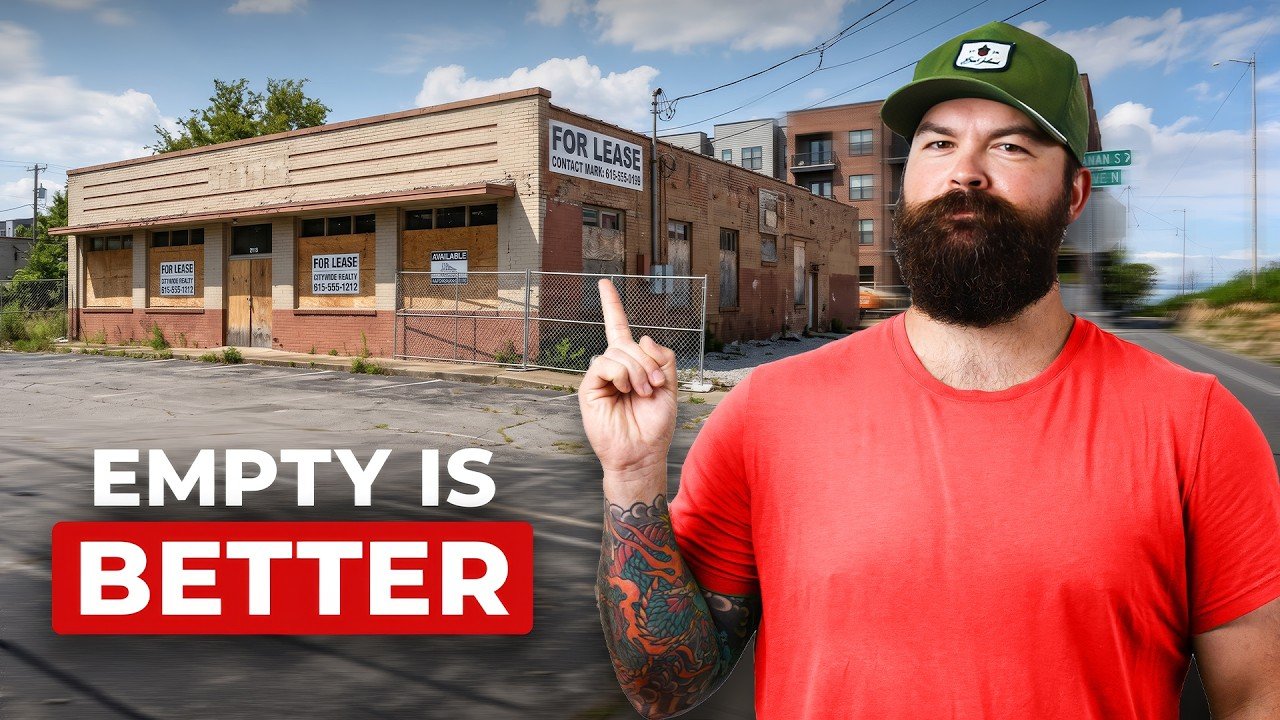
Why I'd Rather Buy an Empty Building Than a Full One Right Now
Everyone wants a fully-leased building. I'd rather have the empty one, and in this week's Office Hours, I'm going to show you exactly why. Vacant buildings scare most investors off. But in today's market, that vacancy is your biggest advantage: negotiating leverage, below-replacement-cost pricing, and a forced appreciation setup that a fully-leased deal can't match.
In this episode:
Why motivated sellers with empty buildings will give you terms a full building never would
The live underwriting walkthrough: how to figure out what a vacant building is actually worth once it's stabilized
What you need in your reserves to make this strategy work safely
Why record-low construction and tight vacancy rates make right now the best time to execute this play
The one thing that separates investors who make money on vacant deals from those who don't
Get commercial real estate coaching, courses, and community to jumpstart your investment journey over at CRE Central: www.crecentral.com
Key Takeaways:
Vacant buildings = more upside
You avoid paying a premium for someone else’s lease‑up work.
You create value through rehab + leasing (forced appreciation), not just clip coupons.
Stronger negotiating position
Vacant = motivated seller; you have more leverage on price, terms, and concessions.
Priced by $/sq ft, often at or below replacement cost.
Cleaner from a legal/lease standpoint
No legacy leases, estoppels, co‑tenancy clauses, or messy files to inherit.
You set your own lease standards from day one.
Market conditions favor existing vacant buildings
High rates + high construction costs = very little new supply.
Low national vacancy (≈4–5%) = strong demand for quality space that already exists.
Math can be dramatically better than stabilized deals
Example: All‑in at ~$928k vs. stabilized value at $1.85M → **$900k forced appreciation**.
Vacant strategy can create multiples more equity than buying fully stabilized for cash flow.
Vacancy risk must be planned for
Keep 6–12 months of operating costs in reserve (or financed/raised).
Underwrite 12–18 months to stabilize; don’t assume instant tenants.
Brokers and data are crucial
Good brokers (commission‑only) protect their time—bring serious deals and a clear buy box.
Use them for rent comps, TI norms, free rent, and realistic lease‑up timelines.
Strategy is for growth‑focused investors, not retirees
Best for those aiming to build wealth and scale a portfolio, not live off immediate cash flow.
Holding 3–7+ years lets you maximize NOI growth, tax benefits, and 1031 options.



About Your Host:
Tyler Cauble, Founder & President of The Cauble Group, is a commercial real estate broker and investor based in East Nashville. He’s the best selling author of Open for Business: The Insider’s Guide to Leasing Commercial Real Estate and has focused his career on serving commercial real estate investors.
Episode Transcript:
Tyler Cauble 0:00
This episode of the commercial real estate investor podcast is brought to you by my cre accelerator mastermind, where you'll get access to my step by step investment blueprint, essentially a library of resources on how to invest in commercial real estate. You'll get connected to a supportive community of other commercial real estate investors that are doing projects just like you, you'll get personalized coaching and feedback from me every step of the way. Go to www.crecentral.com to learn more. Many newer investors getting into commercial real estate think that buying a building with tenants already in place, already producing income is actually the best bet. And, yeah, I mean, I get it right? If you have a property that has income coming in, it's safe, right? It's going to cover the debt service. But if you want safe, why don't you just go buy treasury bills, right? You can get a 5% return you buy it, you never have to do anything with it. If you are getting into real estate, it's because you're doing it for the wealth building, for the cash flowing aspect of it, and buying properties that already have tenants, that are already stabilized are actually not the best bet. And so today we're going to be diving in why I would rather buy empty buildings than a full one, especially in today's market, despite all of the market uncertainty, despite everything that's going on in the world today, despite how popular the commercial real estate market has gotten over the last 10 to 15 years. Welcome back to the commercial real estate investor podcast. My name is Tyler Cobble. I am your host. Live here from the cobble group studios for office hours. This is where I go live. Answer your questions around commercial real estate, give you my thoughts on what's going on in the world of commercial real estate, and teach you guys a little bit about how to go out there and start building your own portfolios. So speaking of actually getting out there and buying empty buildings. Have a really exciting announcement to make today, and that is that we have released a completely new version of our underwriting software. You guys have got the deal analysis toolkit for me, right? A lot of y'all have gone out there, downloaded that, like 1000s of y'all, and it's got my underwriting spreadsheet. This is basically that on steroids. If you go to Tyler cobble.com/analyzer you will be able to go through and instead of having to do a spreadsheet, you can actually basically just put the inputs in on the left hand side, click Calculate, and it comes up with all of these beautiful charts. There is a tutorial on here, so you'll be able to go through it. But with this commercial, multifamily, self storage hotel development, we have quick back of napkin mode and a full mode. You were able to come down here and enter in all sorts of information on these deals, and then when it is done, let me just do a test deal so you guys can see,
Tyler Cauble 3:08
you calculate those returns, and there you have it. Obviously this one's not going to have any beautiful returns there, but look at that for a deal snapshot to have actual charts, actual numbers, a breakdown of what the payments are, the rehab, the NOI cash flows, and it actually be a nice, beautiful looking chart. Instead of simply spreadsheet material, this is substantially easier. You can actually expand these inputs here. Oh, that's not working on my screen. Let's pull let's refresh this. You can expand those inputs. You can collapse this, go all the way back into it. So if you are interested in utilizing that, it's completely free. Get out there. Test it out. Let me know what your thoughts are as you guys are going through this. Oh, that's what happened. My screen froze. Let me fix that. There we go. That's much better. So, yeah, check that out. Tyler cobble.com/analyzer, much better way of underwriting your deals. You know, spreadsheets have been one of those annoying things that we've always dealt with, just because that's how everybody has always done it. So we're not doing that anymore. So go check it out. It's free and it's awesome. Anyways, why I would rather buy an empty office building than a full one? When you are getting into real estate in general, there's going to be a lot of competition in certain aspects of the market, and you have way too many people that are actively out there looking for full buildings, right? They only want to buy buildings. They're already fully leased. They're already cash flowing. And that's great. If you have millions and millions of dollars. That's the only thing that you should do. Right? Because you can go buy a Starbucks at a five and a quarter cap rate, take advantage of the depreciation, get your five and a quarter percent return, or whatever it ends up being, depending on how you decide to leverage it, if you decide to do that at all, and you don't have to worry about it for 15 years. But most of us are not in that position. I'm not, and I certainly wasn't when I was first getting started, I had to go out there and create as much value as possible so that one, not only could I make money, but two, so that I could justify my investors being involved in the deals with me, right? Because they have to take a percent of the returns. I need to find these deals that make a lot of sense. When you buy something that is completely leased. You are paying a premium, right? You're paying like everybody else wants it. You are paying for all of the work that the seller has already done to get it to that point, right? You're rewarding somebody else for doing the work that you could theoretically do, right? You get no leverage as well. I mean, if somebody is selling a building that's full of tenants, they're they're not in a desperate position. They have income coming in. They clearly have a whole bunch of tenants. The property is probably doing just fine. They have the ability to sit and wait and hold out. So what I would say to that is that the safe feeling deal is often the most expensive one, right? That's why, when we look at all of these single tenant netleys deals with, you know, National Credit tenants like Walmart and Walgreens, Chick fil A, whatever it is, you're going to have these very low cap rates, very low returns, because they are such high quality tenants, there's they're very safe feeling right, because we know Chick Fil A's got a lot of locations, pretty good chances they're going to continue paying rent, because I buy the chicken sandwiches all the time, right? And so is clearly half the world. But there's not a lot of upside in that the juice has already been squeezed all right. Ted is saying good morning, good morning. Ted, welcome man, glad to have you here. Debra, good morning, good morning. Good morning morning. Jason Boomer, good morning, glad to have you guys here. Nick from is saying stellar content as usual. Nick from, I appreciate that. Thank you for being here. Happy to do it fun as always. Y'all feel free to jump into the live chat. I'd like to hear your comments, your opinions. I mean, are y'all looking for vacant buildings? Have y'all bought vacant buildings? Do they scare you? What are your thoughts there? So here's the thing, vacancy gives you negotiating power as a buyer.
Tyler Cauble 7:44
That is important no matter what kind of market, whether we're in a buyer's market or a seller's market, the more negotiating power you can have, the more leverage you can have as you are walking into these deals, the better terms, the better deal you are going to get right. So lower purchase price, right? Like, the nice thing about a vacant building is that you're pricing it based on the actual building, right? It's not based on the income. You can't put a cap rate on a vacant building, which means it's going to be worth a like, it's valued on a price per square foot basis. So that's how you're able to actually go out there and say, Okay, well, if it costs me $200 a foot to build this today, what would I be willing to pay for something that's vacant and already built? 130 bucks a foot depends on, obviously, how old it is, what condition it is, all of that kind of stuff. You can actually go out and find comps in the tax records for buildings that have sold that are vacant on a price per square foot basis, very easy to comp those. By the way. You're not having to guess at Cap rates. So these types of buildings typically trade at or below the replacement cost. So the replacement cost, like I said, is the cost that you would have to spend to build that building back today. So not only like you're getting a deal and you have something that's existing, we'll get into new construction here in a minute as well. Seller concessions are often way better on a vacant building, or at least far more negotiable than they might be with an owner again, that has a fully stabilized property. They're in no desperate situation to sell. So they may be willing to give you some ti allowances, some closing cost credits, they may be willing to extend due diligence, or even do a seller carry back right? Carry some of that debt for you. Never hurts right, to go into these situations and just ask, because they're typically willing to get pretty creative, right, if it gets them out of a deal that they're tired of being in. And look, not every seller is going to be in a desperate financial situation. They might just be in a desperate time situation or personal situation. Look. I'm retiring. I don't want to deal with this building anymore. I'm moving to, you know, Tennessee, from Florida to be near my grandkids. I don't want to deal with this property anymore. You never know, right? So there's all sorts of ways that or reasons that somebody might be willing to sell, and there's ways for you to negotiate that would make a win, win deal for both of you. Of course, another nice thing. We don't talk about this very often, but when you have a vacant building, clean title, right? You don't have to worry. I mean, this is there's a lot of legal work on the front end if you were buying a building. I mean, I kid you not when I when we bought the Madison Square shopping center, which is a 330,000 square foot retail center here in Nashville. When we bought that, I think that my legal bill was somewhere between like 75 and $150,000 I kid you not, because one we had 33 leases that we had to go through, which meant 33 estoppels, 33 leases. You know, it just on and on and on. It compounds. But then the leases were such a mess from the sellers that my team had to spend even more time going through and like finding one page from a lease and another leases scan in. I mean, it was a total mess. That stuff happens. It's not uncommon, especially, I mean, it's a Class C shopping center, the seller owned it for like, 30 years. That stuff happens, right? If you're buying a vacant building, you have to worry about any of that. No lease assignments, no estoppels, no CO tenancy clauses that you got to mess with, no leases that you have to inherit and now deal with that are a total pain in the ass, right? You actually get to come in there, set the standard for what you want to have moving forward, and hit the ground running. And the other thing is too like, look, when you've got a vacant building, a seller is trying to get rid of it, you get to set the terms. It doesn't matter if it's a seller's market now it's a buyer's market, right? The building's vacant. They don't have a whole lot of leverage. They don't have too much to offer. You get to come in and really make the terms that you want right closing timeline contingencies. That is all up to you. Here's the thing, keep this in mind, an empty an empty building is a motivated seller. A full building is not all right. Let's see here. Man, this is weird. I can't figure out why my program keeps freezing on the screen for me, I see. Sorry, guys.
Tyler Cauble 12:50
All right, you are buying right now what no one else can build like that is super important that it is so incredibly important as commercial real estate investors that you are keeping track of what new construction is coming online. All right, you want to know what is going on around the world and your industry. Because here's the thing, if you buy a vacant building and then all of a sudden, hundreds of new construction buildings go up around you, well, they're going to overbuild. They're going to have to drop their price. And now you as a used building are competing with new you don't want that, right? Nobody wants that. And so in a market like today, where interest rates are cost prohibitive, right, construction costs are cost per hood we talked about this last week, right? Construction costs have surged. I mean, according to JP Morgan, 50% tariff on steel, aluminum and copper. According to Collier's, 37% drop in new retail construction in 2026 and then Matthews, less than 5% national retail vacancy rate. So despite all of that, like there's no new construction going on, there is clearly such demand that we have less than 5% vacancy, and nobody's building. Nobody can actually fill that demand, fill that need. Which means, if you have a building that is existing today, and you are in a market with sub 5% vacancy, your chances of going out there and getting a lease executed, finding a tenant are very, very high, right? So you are actually buying a building that someone cannot replace at your cost, at your price, right? If it costs $200 a square foot to build it back today, and you can buy it for 130 put 20 bucks a foot, 30 bucks a foot into it, you are below replacement cost for a renovated existing building. That's not going to take you 18 to 24, months. To build. It's there. You get to renovate. It take six to 12 months. That's forced appreciation you were able to bake into your deals before you even do anything. So let's, let's talk about some of the numbers live. All right, let's look at like an 8000 square foot vacant strip center asking $800,000 right? Let's just say you pay $800,000 for it, zero rent at closing costs you $80,000 so 10% of the the purchase price in construction. So we'll call that a TI budget. Let's throw $50,000 $48,000 in a vacancy reserve. Your all in cost comes in at $928,000 for that. But that building. All right now, if we took that same building and we rented it for $18 a square foot, right, gives us a gross income of $144,000 a year. Take out 10% vacancy, 14,400 that gives us an noi of $129,600 right? This is a triple net lease structure. Obviously, the value at a 7% cap rate puts it at $1.85 million right? So we're talking about an all in cost for vacant $928,000 compared to a an all in cost stabilized of 1.85 what would you rather pay? Right? I mean, if we're talking about over $900,000 in forced appreciation just by buying a vacant building, fixing it up, signing a couple of leases, why would you be worried about being able to carry the debt service for a year while you're trying to find a tenant, right? I mean, there's a lot to be said for going out there and doing these deals and doing them right, raising the capital so that you can carry it and banking on the appreciation, not necessarily the, you know, whatever cash flow is going to be coming in on day one. I've never understood the the argument for cash flow, cash flow, cash flow, like we had a video that came out here pretty recently that I made the claim you're broke because you chase cash flow. And that is 100% true. The wealthiest real estate investors that I know do not invest for cash flow unless they are at retirement mode. They don't need it. If you're investing for cash flow, you're getting an 8% return, 10% return, 12% return.
Tyler Cauble 17:40
Chat. Out Your Boney, who's one of one of the members of the CRA accelerator mastermind. We just had a video with him that went on, an interview with him that went out last week. He bought a deal, sold his apartments, bought a deal in Grand Rapids, Michigan, day one, had 100,000 now it appraised for $100,000 more than what he paid for it. Great. All right, that's cool. So he bought it for 2 million. It's worth 2.1 awesome. Whatever, right? It's not a huge, huge bump. What is a huge, huge bump, though, is that he has a vacant suite in there that once he executes a lease at market rate, will add eight or $900,000 in value to that property. Go find me a lease that you could get done in six to 12 months that will pay you eight or $900,000 immediately. It doesn't really happen, right? So that's why, like, Yeah, I mean, cash was great, but if you don't need it, you can grow your portfolio substantially faster by doing literally anything else. All right, okay, the market right now makes this even better. So we've got some tailwinds that are all pointing in the same direction. One, as I mentioned earlier, record low construction. Once you lease it up, there's like nothing else that's coming around the corner that is going to compete with you, which means that you are going to be able to be more competitive on your rental rates and on your, you know, occupancy rates, then you probably have for a long, long time. All right? Service tenants are also expanding, like rapidly, right? It's the experiential type of service that you can't replace with E commerce. So think about urgent care, Pet Services, salons, fitness, they are all actively growing today, actively seeking multiple locations. We're actually working on a Pilates studio lease in my building right here. National vacancy four to 5% depending on the asset class, right? But, I mean, we're really not that much higher depending on what asset class you're looking at. And a lot of things are sub, you know, 3% in some areas, which is crazy. That means that, like, if you have a sub 5% vacancy rate. So essentially, what that means is that a space is vacant long enough for somebody to leave it move into the next space, and then somebody else is moving into that space. Like, it's there's like, as a as a commercial real estate broker, when you get into a market with a sub 5% vacancy, there's not a lot that you're actually able to do, because there's, like, there's not a lot of opportunity to get anything done. There's nothing available. We've got motivated sellers everywhere. Think about it. Five years ago, we've talked about this on the podcast before, but five years ago, it was 2021 buyers were able to get some incredible interest rates. I had a conversation with a winner about this, you know, this past week, who was talking about, you know, what that looks like for people that are, you know, refinancing, coming into a completely new debt. And in some cases, it's, it's doubling, the interest rate is doubling. Not as bad as it was a couple years ago. But think about that if you bought something in 2021, interest rates were, you know, sub five, maybe even close to 4% today, you're at seven. You know, we've seen some people get in the high fives, some people in the in the low sixes today. But it depends on where you are and what kind of asset you have, right? So that makes for motivated sellers. They have maturing loans that are going to be higher than what they underwrote. Right? Their cap rates are lower than what they underwrote, meaning there's not really a lot of room in this deal for them anymore. So with that rate pressure, they need to move. They need to sell these deals. Walk away, or they're going to do a cash in refi, which nobody likes to do. Come on. But you've never thought about that before, the cash in refi, right? That is something that we all want to avoid, if possible. So here's the thing, you're not just buying a building, you're buying into a supply constrained market, right? Basic economics, that is the beauty of this strategy.
Tyler Cauble 22:03
You are buying a building. It takes time, capital materials, to build something that would compete with you. We're talking about a year and a half to two years. You can buy it today, get it open, get it rented out, and it's cost prohibitive for anybody to go and build anything to compete with you, which means the only you know, the only assets you're gonna be competing against are the ones that are already existing in the market. And you can buy into a market where you already know your competition incredibly well. All right, so what do you need to pull this off? You're probably sitting there going, okay, Tyler, this is great. I love it. I think that vacant buildings are a great way to go. However, I've never leased up commercial real estate before. I don't know how to go about that process. How do I underwrite a vacant building? How do I figure out all of this stuff? Well, it's really not that difficult, actually, if you just know how to go about it, right? I mean, look, I've got over 700 videos on this channel at this point. You guys are more than welcome to dive into the podcast if you're on the go, vacancy is manageable, right? Like you can actually look into market data to figure out exactly how long it takes for these spaces to lease up. You can talk to brokers and get data to see what are people giving in tenant improvement allowances? What are spaces renting for? How long does it take? How much free rent do I need to give to these tenants? Right? You can talk to brokers and actually get that data, so you don't need to worry about going out and finding it and sourcing it for yourself. All right? What I would say, though, if you're going to start going out and buying vacant buildings, which I highly recommend, I highly recommend. I mean, it's almost exclusively what I do. We never buy anything stabilized. Because what's the point? I'm not I'm not trying to retire. If you're trying to retire, don't do this. This is a different this is a different strategy. You need to go buy Starbucks. If you are looking to build wealth and you are looking to scale a portfolio. Vacant buildings are the way to go. So go into these buildings. Go into these investments with a healthy vacancy reserve. All right, we're talking six to 12 months of operating costs liquid before you close. Non negotiable. If you cannot carry this property for six to 12 months without getting worried about it or without it becoming a problem. This is not the strategy for you. Now. You can go to your lenders. You can actually have them lend you the carry costs, right? So commercial real estate's a little bit different from residential or multifamily in the sense that, you know, lenders are willing to include your soft costs, your carry costs, your, you know, rehab, every all construction, everything into one loan, right? So that way you don't have to worry about bringing additional capital to the table to then pay your debt service for 12 months or 18 months, or whatever, one thing too, and I don't have this on my slide, but negotiate for interest only periods with your lender. They are more than happy to give that to you as you are going through a lease up period like this. If you are expecting it to take you 12 to 18 months to finish the rehab, get the tenants in, get some cash flow coming in, tell them, I need 18 months of interest only to make sure that we get this property up and stabilized and operating the right way. Most lenders have no problem doing that. They want you to be successful, right? They are your biggest partner in the deal. Make sure that you go into these deals and you can go use that analyzer that I was telling you guys about earlier. I mean, it's, it is? It blows spreadsheets out of the water. So Tyler cobble.com/analyzer, it's completely free for you guys. Make sure you go into it with a realistic lease up timeline. All right, so underwrite 12 to 18 months for stabilization, not day one. The only time, like, when we're going through deals in the accelerator, the only time that we ever, like, assume a day one income is if the buyer is either going to be owner occupying or they have a tenant that is willing to execute a lease today. Not like, Oh, I think that I can lease it before we deliver it. No, no. Like, if we have somebody that you're talking to that wants to sign something today, and then you can go and build it, then we will assume a day one income, right? Otherwise, we're assuming it's going to take us 12 to 18 months to stabilize this property. And by day one income, I don't mean like, as soon as you buy the property, despite the fact that you have to rehab it, you're making money. No, it's like day one. Once you deliver it with a certificate of occupancy to the tenant, that's when the income starts. All right, next thing you need is a broker in the market. I think that, I think that newer investors have a hard time understanding how to work with commercial real estate brokers. They're pretty simple and straightforward.
Tyler Cauble 26:46
Once you understand their motivations, commercial real estate brokers are commission only. They're commission only. They don't get paid a salary, at least the good ones don't. The good ones are straight commission All right, which means they have to be incredibly protective of their time and of the deals that they are sharing, because they only get paid if something closes. So if they take a deal to somebody that has no chance of closing it, they're just going to waste six months of their life not make any money, and it's not worth it, all right. So keep that in mind when you're talking to these brokers. So build relationships with them and give them actual opportunities. Give them feedback. If you decide to hire somebody else, tell them why, right? You need somebody who knows what's going on in the market to actively look for you. Whether that's for finding buildings, finding tenants, doesn't matter. They can also bring all of the data to the table to help you understand what you were looking at so much better, right? So take them out to lunch, follow up with them every couple of weeks, put your buy box in front of them. Make sure that they understand exactly what they need to be going and looking for on your behalf. And then, of course, the final item there patience. It all just takes a little bit of patience, right? Commercial real estate is not fast. If you think that this is a get rich quick scheme, move on, go join pace morbys sub two group, right? Like, this is a, this is not a scam type of investment. You can't just go out and, I mean, look, can you flip commercial real estate and make a quick buck? Sure? Like, I'm sure that that happens. We've done it before. That's not the investment thesis, though. Like, this is a long term deal, because if you hold it for three to five to seven years, that's when you're going to maximize your tax benefits. That's when you're going to maximize the amount of improvements that you can make, maximize the increase of net operating income, so you can then sell and do a 1031, exchange into something better, right? So be patient for it. Don't jump into a building just to jump into a building. Learn how to actually find deals. Learn how to actually analyze them, and then go out and buy the right property. Once, you like, learn how to find deals, which is one of the first things that we focus on in the mastermind, once you learn how to find deals, you see deals everywhere. I promise you that. Like I know for some of you all listening right now that that may sound crazy, it's like buying a new car, and then suddenly everybody else on the road has that same car, right? You see the deals everywhere. So then the problem actually becomes, how do I pick the right deal? How do I make sure that I'm moving forward on the right deal? So you have to be patient. So let's talk about this. Who makes more money? Two different scenarios here, same market, same building type, different entry points, a full like fully stabilized building. Buyer buys at 1.4 million already stabilized. Day one, cash flow, probably 678, percent, 8% day one, if they're lucky, actually upside at exit is going to be minimal. It's stabilized. So all that you can really do is. Is throw a cap rate onto the 3% annual increases in the net operating income, or really just the gross, the base rent. It's what you're hoping for, right? That's what you were hoping is going to happen, as you're going through this, that you are able to actually ride the increases in rent, just a little bit cap rate on there and make a little bit of money, right? You might create, what, $200,000 in equity, I don't know, not a lot if you buy an empty building, let's say it's $928,000 right? Because you're not paying the $500,000 premium for it being leased up takes you 12 to 18 months to lease it up. You have zero cash flow day one, your upside at your exit is significant, right? You could create up to 900 you could double the value. Like it's not uncommon. I've actually seen investors come in and triple the value of what they paid for it. Now, of course, they had to spend, you know,
Tyler Cauble 30:59
a few $100,000 on renovating the property, getting it leased up. But I mean, if you're talking about buying something for a million dollars, putting a few $100,000 into us, and now you're all out at 1.3 and then tripling the income, you're still walking away with a couple of million. That's not a bad deal, right? So the person who buys the empty building and leased it up in this scenario, made four times more equity, right? We're talking about $200,000 created by looking at a cap rate on some annual increases, versus actually getting in there and forcing the appreciation with new leases. This is why I've always loved this strategy like you just cannot do that anywhere else. Back in 2020 I bought a retail building from an owner occupant. He was tired of dealing with his partner. They wanted to shut the building down. We bought it. You guys have heard me tell this story before. I bought it off of a mailer. Actually, we send out mail. It works. Bought it for $435,000 he vacated. We cleaned it out. That was pretty much all we did with it. We didn't spend any money, all right, cleaned it out and signed a lease. Like, that's literally like, I know that sounds so ridiculous. All we did was sign a lease, we're talking about a piece of paper, just because I knew the tenants that were out there in the market looking and the bank before we even closed on it, appraised the building for $650,000 so over $200,000 more than what we were paying for it, right? 50% more than what we were paying for it. If you want to look at it that way, simply because we signed a piece of paper. I mean, think about that. We signed a piece of paper. That's why I love commercial real estate so much. The fully leased building everybody wants is priced like everyone wants it. The empty one nobody wants is priced like nobody wants it. I know which one I would rather own. If you're sitting there, you're interested in getting started in commercial real estate, but you don't really know where to go, where to take it. You want some guidance. You want some hand holding. You want me to review your deals with you. Join the CRA accelerator mastermind. Go to CRA central.com. If you book a call there, I will be the one that takes that call. I take every single call for every single person that joins the mastermind, all right, because I need to know where you're coming from so that I can properly coach you through making this happen. It's amazing. I mean, the cost of the program is basically the equivalent amount is what you'd pay a broker to lease one space in one of your properties, and you get to work with me. I get to work with you. That's the fun part about it. So come hang all right your turn. Have you ever passed on a deal because it was vacant? Drop it in the chat or just ask me. Anything else you want to know about vacant building deals? Let's dive into your questions. Hopefully that was helpful today, guys, that was a long one for sure. All right, let's get to your comments. Nikram is saying, currently renting commercial spaces for my businesses and looking to get into owning commercial real estate in the coming years, vacant is what I am looking for. Vacant is the way to go, nikram, I love it. There's just so much opportunity, right? So he's saying, okay, Nick, I'm saying cash flow would be the concern on an empty building, though, right? Yeah, absolutely. I mean, there's not gonna be any cash flow coming in, but there's several ways for you to mitigate that, right? And I touched on this earlier, and I know your comment came in earlier, but I do want to reiterate, like, when you buy these buildings, you are able to get the lender to lend you the carry costs. You can raise that capital from investors, or you can just buy a building that's small enough for your first one to make sure that you can cover those carry costs on a monthly basis. Hartnett gaming is saying good morning. Morning. Good morning. Good to see you. All right. Michael, vacancy is ideal for properties that need capex. If you are a newer investor, you have to have a very deep understanding of your investors financial situation and future projections. If you want to do this, absolutely it's a it's a great way to do it. We can make our investors a lot more money. I mean, here's the thing, like a stabilized apartment complex. You're probably, they're probably going for what, 12% IRR, 15% IRR today. I mean, don't even get me started on the cash, on cash returns, like our deals are typically 18 to 22% internal rate of return. So substantially better, simply because we're going out there and adding the value. All right. Nick is saying, Are you sometimes able to get winners to win on the stabilized value? Absolutely not.
Tyler Cauble 35:49
No. A lender is not going to give you any money for something that you know it could be one day right now, if you're going out and you're buying something like they're going to give you a loan to cost, right? You go out that you buy it, right? You get it filled up. You can refinance it based on the new stabilized value. So if you double or triple the value you're you can do a commercial Burr, right? It's the exact same thing. If you are familiar with the burr strategy in residential or multifamily, we do it all the time. In commercial, you do the exact same thing. So go out there, create that value, and then then get out there and do it all right, so that is it. That is all the time we have for today. I've got to go out to my new parking lot. I haven't told you guys about this, but we bought a lot, and we are turning it into a parking lot because I had originally planned to build a building there, spend a million dollars, we're going to do this whole big thing. And then I talked to a parking lot company. They got me a pro forma where I was going to net over $8,000 month, not 1000 $8,000 a month on a parking lot that I bought cost me $55,000 to to grade it, to demo the existing building, grade it out. And I bought the lot for 400 grand. So if you run the math on that, pretty damn good opportunity. So we'll be doing a video on that here soon. Appreciate you guys. Thank you all for joining me. Thank you all for jumping into office hours. I go live every tuesday, 8:30am Central Standard Time. If you have questions on commercial real estate. You want to know what is going on in the world of commercial real estate, or you just want to hang out, talk to me and, you know, cut up a little bit. This is where we are. Appreciate you guys. Y'all have a good day. I'll see you in the next one. This episode of the commercial real estate investor podcast is brought to you by my cre accelerator mastermind, where you'll get access to my step by step investment blueprint, essentially a library of resources on how to invest in commercial real estate. You'll get connected to a supportive community of other commercial real estate investors that are doing projects just like you. You'll get personalized coaching and feedback from me every step of the way, go to www.crecentral.com to learn more you.
Two identical commercial spaces. Same size, same property type, but one is worth $97,222 more because of how the lease is structured.
One rents for $14/SF triple net, while the other brings in $18/SF gross. You'd think the higher rent means a better investment, right?
Not necessarily.