
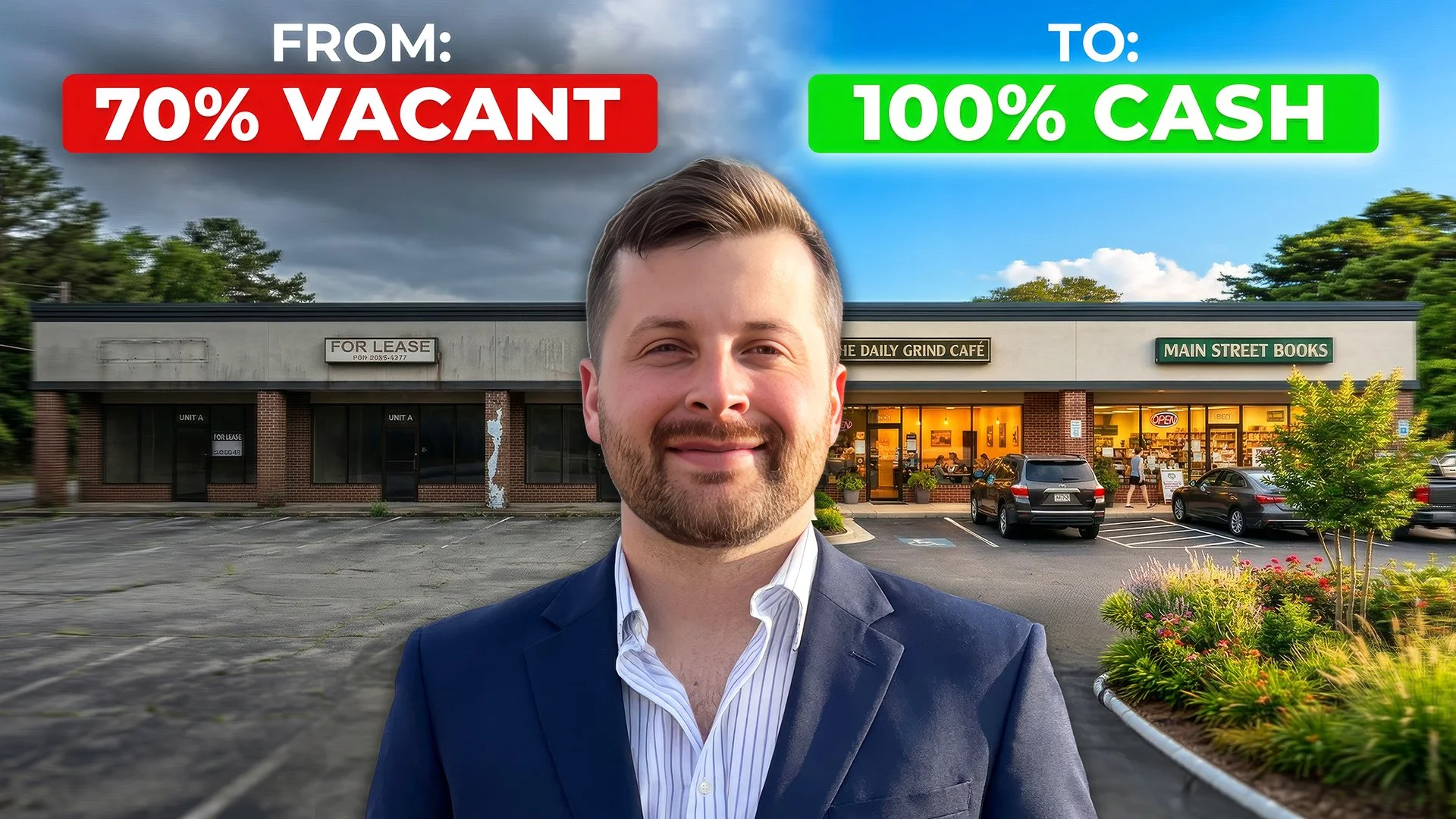
Nobody Wanted This Vacant Warehouse. He Bought It With $0 Down in 45 Days
Nobody wanted this 70% vacant warehouse. Matt Barbaccia did and he closed it in 45 days with $0 out of pocket. When Matt joined the CRE Accelerator, he told me he felt underqualified for bigger deals. 45 days later, he set the record for the fastest commercial deal ever closed by a member using 100% seller financing on a flex warehouse most investors scrolled right past on Crexi.
In this episode, we break down the entire deal from start to finish: how he found it, why it was vacant, how he structured seller financing, what he discovered during due diligence (including a tenant who had quietly expanded into an extra 1,000 sq ft without paying for it), and how he plans to force appreciate the property through lease-up.If you're a residential investor wondering whether commercial real estate is too complicated or too expensive to get started then this one's for you.
Get commercial real estate coaching, courses, and community to jumpstart your investment journey over at CRE Central: www.crecentral.com
Key Takeaways:
Transition to commercial: Matt moved from student housing to commercial to reduce headaches, work with business owners, and gain more control over value via NOI and cap rates.
Deal source & story: Found the property on Crexi, often written off by investors. Former owner retired, left the building ~70% vacant but already subdivided with good bones (1989 build, mostly cosmetic issues).
Location & upside: Building is next to Lowe’s, effectively leveraging corporate site selection. Strategy is forced appreciation via lease-up at market rents and then refinancing at a conservative ~9% cap.
Financing structure: Purchase price $240K, fully funded with private money (family + local investors) at ~10% interest, 2-year term, interest/principal deferred, no prepay penalty—pitched as a safe, bond-like investment.
Due diligence wins:
Held $5K in escrow for seller’s junk; used itemized cost estimates (with AI help) to justify keeping it, then bartered with contractors to clear it at no out-of-pocket cost.
Verified floor plans and discovered a tenant had taken an extra 1,000 sq ft; renegotiated to increase rent (to ~$2,000/mo) and convert to triple net.
Main risk: Timeline to stabilize and refinance within 2 years; Matt wishes he had negotiated an extension option with private lenders.
Support & underwriting: Leaned on mentors, local brokers/appraisers, and the accelerator community (notably Chris Thorndike) to stress-test rents, cap rates, and long-term exit strategies.
Tax strategy: Pushed to close on Dec 30 to enable cost segregation and bonus depreciation for that tax year.
How to replicate:
Don’t ignore Crexi/LoopNet—good “hiding in plain sight” deals exist.
Target Boomer-owned businesses where owners are retiring and want to sell or walk away from their real estate at low prices.


About Your Host:
Tyler Cauble, Founder & President of The Cauble Group, is a commercial real estate broker and investor based in East Nashville. He’s the best selling author of Open for Business: The Insider’s Guide to Leasing Commercial Real Estate and has focused his career on serving commercial real estate investors.
Episode Transcript:
Tyler Cauble 0:01
All right? So Matt told me on our very first call back in November, Tyler, I feel under qualified for bigger deals, and I hear that all the time from so many newer commercial real estate investors, right? You've got this momentum going. You're looking at properties, but you're not necessarily confident enough to pull the trigger, because these are different types of deals, right? Here's the thing. Fast forward 45 days, and Matt's closing on his first commercial deal. He sets the record as a member of the accelerator for the fastest commercial deal done. And to top it all off, comes out of pocket, $0 100% seller financing on this deal absolutely knocks it out of the park. So today we're sitting down with Matt barbacia. We're going to do an entire play by play of how he found this deal, how he underwrote it, how he dealt with everything in the due diligence side of things, and got his first commercial deal in 45 days. So Matt, thanks for joining us today. That was a very brief intro and background on yourself, but tell us a little bit more about you.
Speaker 1 1:09
Yeah, thanks, Tyler. I'm happy to be here getting into commercial real estate. It's been a gold nine I gotta, I gotta be totally honest, I've been looking at commercial real estate for about a year, but committing to the program, I think, really helps to have, like, a second set of eyes. Well, I shouldn't say, you know, it's a whole variety of people that, you know, can look alongside me when I'm underwriting, and that really got me over the edge to, you know, make a jump and actually commit to the deal. But just my background, real quick, I really started investing in real estate at a point in time, like about 2020, when, right before the pandemic, great timing, right with interest rates dropping, and of all things, I got into the college rental business and did student housing. And during that time, everybody was selling off their student houses because they thought students are never coming back and that we're going to be, you know, doing this type of stuff. Zoom remote learning for in perpetuity. And that didn't turn out to be the case, and now those have done quite well. But scaling my single family, you know, college rental business was not something I wanted to do, so I jumped into commercial real estate. And you know, thanks to you and a variety of other people locally here in Rochester that are good mentors that have guided me that direction, and, you know, made me take the next step, as opposed to, you know, not understanding it and standing back and saying I can't handle this. So, yeah, commercial real estate, it's definitely not as intimidating when you have support. So yeah, that's, that's my brief intro. I guess
Tyler Cauble 2:38
I agree. Man. I mean, here's the thing, like, if you can underwrite and run, you know, diligence on a residential property, especially if you're already in multi unit, like, commercial is really not that difficult, you know, it's sometimes, it's just, it's a new thing, right? I mean, that's how I was when I was first getting started. I just needed somebody else looking at it be like, Yeah, your assumptions are right. You're good. Keep on working on this. Why? Commercial like, Why? Why not just continue to scale on the residential side of things?
Speaker 1 3:07
Oh, there's a lot of reasons, but I think the main one is, I don't know if you were the one that said this, but someone once told me, like, I prefer to invest in things where people don't rest their head at night. And I think that was, that was, you want to was a Tyler quote. And I've gotten phone calls like on Thanksgiving Day that someone's oven's not working. I've gotten, you know, I've gotten phone calls that there's water coming through the ceiling and that all these, you know, these, these residential problems, have become such headaches that, and they're always, they always seem to be in the worst timing. And it's not to say that I regret the fact that I went through that process, but I appreciate more the triple net structure, or the working with a business owner idea where you're less really a facilitator of the property and more so just more of a manager, like more reserved in allowing them to run their business out of there. They sweep the floors, they keep it clean. They want to have a good presentation for their customers. If they're retail, they want to function their business well, if they're industrial, and I just like that a lot better than, like, you know, someone just the amount of operating expenses that go into maintaining residential property, even large multifamily, you know, you look at expense ratios and what you're spending to redo, you know, furnaces to redo, hot water heaters to, You know, do all the HVAC and everything flooring, everything gets damaged and eventually has to be turned over. So I just really like the concept of commercial real estate because it allows you to remove yourself from a lot of the management side of those hassles, I guess, and focus more on working with a business owner.
Tyler Cauble 4:38
What was your goal specifically for getting into commercial real estate with regards to, you know, either the money side of things or the lifestyle or the family. You know, everybody kind of has these different goals. With regards to, you know, financial freedom, or just not trading time for money.
Speaker 1 4:55
I think the goal is scale in commercial real estate, just shooting. Uh, or going bigger, is a term my good friend Matt drew in here, uses locally in Rochester, and he's another mentor of mine, and, you know, talks about just like the ambitions of like, going after these larger projects, they're not as daunting as you would think when you break them down into simple underwriting. I shouldn't say simple, but you know what I mean? It's, it's a matter of just math equations and working out, you know, expenses, working out incomes, and just coming up with your noi, coming up with your purchase price based on a certain cap rate. There's just more like transparency, I guess, to commercial real estate than what I've noticed in residential where my neighbor decides they need to fire sale their house, and then that impacts the assessed value of my property, you know, as a single family home, I don't like not having that control. I'd rather be in control of bringing in great tenants, driving up the price per square foot, you know, on a rental property, and then that impacting directly the assessed value of the property. And that's just to me, that's so much simpler than relying on, you know, appraised values of residential property. And I know you've said that all that. You say that all the time, it's like, why would you, you know, put yourself into that situation if you can't, if you can't have as much control as you can in commercial
Tyler Cauble 6:11
That's right, yeah. I mean, forced appreciation is one of the most beautiful things in the world. You know. Why would you give yourself that opportunity if you could? Let's, let's dive into this deal that you did, man, because I think you know, I mean, obviously joining and then closing in 45 days. You've been working on things a little bit longer than that, but still, 45 days is a pretty quick time to close. Tell us about how you found this deal, and let's do a deep dive into it.
Speaker 1 6:40
Sure thing. Well, finding the deal was quite simple. It was on crexie, and I joked to everybody that I know, I just, you know, I always write off Craxi and loop net in these platforms, and I shouldn't, because there's so much opportunity on there, if you know how to underwrite and you can read a story of what's going on that might not be as obvious to other people, and so I'll get into that in a second. But prior to this acquisition, I've spent a lot of time, you know, skip tracing properties that I found, you know, were properties I'd like to offer on getting a hold of owners. And I'm always the timing is always off, right? I'm not selling right now. Or my favorite line is, name me up, give me an offer I can't refuse, which is like, you know, okay, Call me. Call me when you're ready to sell. So with this particular deal, I came across it on Craxi, and my first reaction was, like, $24 a foot, is what it was being sold for. I guess 25 at the time that I was offering on it, I got it down to 24 and I'm trying to figure out why that is because I said, Oh, it's such a low price point. I look at the building, I realized that the business owner had retired his business. He was operating out of this property, and when he left, he didn't sell his business off, or if he did, someone just bought his clients and didn't buy his real estate, and he ended up leaving the building with 30% occupancy. There was one tenant in there, which is another thing I'll get to later. A great story with that, but 30% occupancy. So what does that tell you? Well, any contractor or individual who wants to put traditional financing on the building isn't able to do it. So it had been sitting for about 60 days on crexie, and I just started digging into it and realized the potential. I walked the property, I noticed that it's already subdivided into four units with overhead doors to each access unit, or, sorry, into each unit. One of them has an office space that's fully finished and has not been occupied in from what I learned, the owner was getting ready to or he renovated his office space and kitchen space, and I either to sell it, or he was planning to just upgrade everything, and he did that, and then he just up and retired. So the story was like something where you had to really investigate it to get underneath the surface and realize what the real potential was. And then when I saw that, I ran it by some people in the mastermind group, and, you know, realized there's a lot of opportunities, so I jumped in
Tyler Cauble 9:03
that's really cool. There's a lot of opportunity that can be had on loop net and crexia. I mean, we always joke around like, Oh yeah, you know loop nets, where deals go to die, but when you're looking at deals from a different lens or different perspective, there could be great opportunities there. I mean, Matt, what was it about this one that that caught your eye and told you, like, I should spend a little bit more time working on this one and seeing, you know, if that dog will hunt.
Speaker 1 9:28
Well, we've been talking about this a lot in our in our meetups and whatnot. Just the the assessed value of a building versus the income approach to assessing the value of a building are very different, right? And so what I noticed when I underwrote this building was that it was being sold pretty much at the price point of what the building is worth, and not necessarily what it could be worth if it had paying tenants in it that, not only that, have strong leases that will then drive up the value. So I saw there was enough of a gap there and another. Of a entry point to get into this property at a low cost and then drive up the forest depreciation through lease up to get the valuation that I plan to refinance out of, and I just, you know, that's all it was. It wasn't anything complicated. It's just seeing an opportunity that's being overlooked. One critical detail is location this building is you could pretty much throw a baseball and hit lows. So you've mentioned this before. If I'm I'm basically riding off the market analysis that corporate Lowe's did to decide that this is a good location for them to put this building in. And I'm, you know, not adjacent to them directly, but I'm like, one lot away from their building. So that was, in and of itself, enough of an indicator where, okay, this is a good location for some reason. I'm assuming there's probably contractors that operate in and out of Lowe's in the area that would be, you know, very intrigued in having some flex space for warehousing, for office, even to run their operations out of if they need, like a contractor space to run their machines. The units the warehouses are large enough where that could happen, and that's what I plan to lease up these spaces with, ideally, as opposed to storage, which would be a smaller, I guess, gross rent that I would obtain on a price per square foot basis. But yeah, so that I think I answered your question, just location was key, and then the forced depreciation through leasing up the building.
Tyler Cauble 11:22
Yeah, I love that. Man, I mean, let lows do the work for you, right? They've got a corporate real estate team. They've determined, after analyzing all the demographics, analyzing the traffic counts, everything, that this is where they should spend a lot of money to put their one location in. Just ride those coattails. Man, that's a great job leaning into that. Okay, building being 70% vacant, obviously, there's a very good reason behind it, but that's still a pretty scary thing from an income perspective, right? You've got 70% of the property that's not producing income. What made you really lean into that and say, Actually, this is better for the upside. Here's how I'm going to really capture that value.
Speaker 1 12:07
I suppose it was understanding the story behind why it was vacant. You know, that was a big question. Why didn't the owner lease up this building himself and then sell it for what I anticipate the value to be perhaps 2x what I bought it for, if not more, when I understood the story, and I actually just, you know, it's a small enough town where you know these people, or you've you know people who know them, and I really got the story behind the owner and his motivation. He's looking to retire. He doesn't have people who are taking over his business. He wanted out. So that's always a question you got to ask yourself, though, when you're inheriting a building that are you're considering buying a building that has vacant space, why is that? And that was a pretty obvious indication to me, that there was potential to lease it up. The other reason is that it was perfectly laid out in terms of the units. Everything is very cleanly organized and sub metered and split up into these different sections, almost as if it's like the value add that I was planning to do, had I bought that building and it was not split up, I would have done the exact same, you know, build out, which could have cost, you know, 10s of 1000s of dollars, if not more. So it was really just looking at the layout of this property and saying, Man, this is ready for, you know, it's already subdivided. It's already ready for a variety of tenants, or one tenant that wants all the units. There's a couple different ways that you could pitch this space, because a lot of people are just looking for, you know, under 1000 square feet. But then there's some people looking for 3800 square feet, and then there's other people looking for 1700 I happen to have all three of those as an option. So, and then you combine them all, and the options grow even greater. So, yeah, that's, that's really the the opportunity that I saw with the building was just the state that it was in. There's no rust on this building. It's metal siding, metal roof slab on grade. Slab was in good shape. The only issue I knew there was, was some drainage issues that I had a or had a, you know, quotes drawn up for what that would cost to have that repaired, have some gutters put on, and then have the driveway, you know, cleared out because it's all been overgrown due to deferred maintenance. So there's, there's just cosmetic stuff that made the building look more scary than it actually is, as opposed to real structural issues, or knob and tube, or, you know, whatever else. This building was built in 1989 so it's, you know, it doesn't have those older issues in terms of the service that it has the plumbing, the slabs in good shape. Like I said, Everything structured look good. And I'm not an inspector, but I could just walk this building and understand and understand, based on other properties I've walked through, and say, well, it's just in pretty darn good shape for, you know, however many years old it is, since 89
Tyler Cauble 14:52
Yeah, and that that is incredibly important, by the way, if you start getting older, you know, we're talking about 70s, 60. Product. You start getting into asbestos, you start getting into a, you know, metal, metal plumbing, and, you know, cast iron plumbing, like that. Stuff rots pretty quickly, and then you're having to tear up concrete. You know, just your capital expenditure budget has to start expanding exponentially. So 89 is a great year for a building. Okay, so you've gotten out there, you've gotten eyes on it. You're starting to put your plan together. Did you do back of napkin underwriting? Or did you say, You know what? I'm just going to go all in on, starting to figure out the numbers here.
Speaker 1 15:32
I did call around to get a good assessment of price per square foot for this type of product. It's very hard to come by. My particular area is not a metropolitan area. It's not even a suburban area. It's quite rural. And there is a small city, I guess, or the city of Geneva is, I forget what the population is. It's a smaller group of it's a smaller city which I'm on the outskirts of. So when you look for comps, there's not a lot out there, so you really have to lean on brokers and having good relationships with an appraiser or somebody who can give you the information that is within a ballpark, at least. It doesn't have to be exact, but I wanted conservative numbers for price per square foot. So what I found that to be was around, well, you know, if you have it at $6 a foot, you know, full service gross. It should be, you know, a fire sale. Someone's going to be in there tomorrow. So, you know, maybe go $7 a square foot. In one case, I'm at 842 because it's a triple net, which is a great situation. I can explain that later, but $7 was my margin. So when I put together my pricing, I just realized, okay, I can get $7 a foot, pretty conservatively, upon about seven or about 10,000 square feet. So I was able to then run my numbers based on a nine cap. Is what I've been told is, you know, kind of a safe cap rate for the area determine my, you know, after repair value, and there was plenty of upside at my purchase price to pay off my private money lenders and do my capital expenditure slash cosmetic upgrades to get the building to where it needs to be, as far as you know, the upgrades needed. So I did do some back of the napkin stuff. I think it was mostly just calling around and using the network that I have in the area to pull out some of those critical details.
Tyler Cauble 17:24
Yeah, okay, what about the three biggest risks, right? Like, what did you identify when you're looking at this property as, like, Hey, here's what can go wrong. Here's what I need to keep in mind as we're jumping into this.
Speaker 1 17:39
The biggest risk is my timeline. So I secured private financing for this deal, as as you had mentioned, which was, you know, this is the purchase price was $240,000 we're not talking $1.5 million we're not talking a huge capital raise. It was quite small. So I was able to find a few people that were willing to give me 100,000 here, 70,000 there, 80,000 here, and that totaled up to my to my total amount that was, you know, put into the cash purchase. What I did was I structured a two year deal with them, a 10% interest, interest deferred, no prepayment penalty, all payment, sorry, interest in principal deferred. So really, there's no expenses for the first two years of this deal until I refinance it. What I would have done, and what I'm wishing I had put into this agreement was an option to extend that that loan another year. Am I worried about raising capital if I need to, if it's not ready to go to the bank and be refinanced? I'm not like sweating having to refinance. It would be great to know that I had an option to extend it. I know at least two of these lenders wouldn't have had an issue with another 12 months on this loan. It's more of a bond for them. It's a secure place to park their cash, and they're happy to get 10% return over a two year period, potentially three. So my timelines a little bit. You know of an issue that could go wrong if I don't have enough seasoning on the on the property to refi with the bank I would like to go to. Then I might have to look at other banks. I don't want to, you know, I guess I'll leave it at that. It just depends on, you know, the the timeline for leasing up the building. I've had it now advertised for lease for about a month now, and it's a tough time of year. Of February is for you to find tenants, but nonetheless, I'm hopeful that I'll be able to get the building fully leased by this summer and then have a good seasoning period, if not refinance then, yeah,
Tyler Cauble 19:30
especially in upstate New York. In Nashville, it's like, dude, as soon as it just starts getting cold, it's tough to lease anything. I can't imagine having to throw in a whole bunch of snow on top of that as well. Okay, I want to, I want to dive into these, these private lenders that you've got a little bit more because I think this is something that a lot of newer commercial real estate investors actually overlook. And these opportunities are out there. And first of all, like commercial deals can be found for $240,000 right? Like Matt. One. So you don't have to go buy these one and a half million dollar deals. But Matt, where did you meet these lenders, and then how did you pitch this deal to them? Like, how did you actually go about securing this funding?
Speaker 1 20:11
Yeah, so one was family, so that was pretty easy. That's in my inner circle, someone that knows, likes and trusts me, and you know, is perfectly on board with what I'm doing, wants to support it. So there's a whole rationale for that lender. As far as, yeah, this makes sense. You've given me a presentation on what you're doing, what your entry strategy is, your exit strategy. It all makes sense on paper. Really, I took that same pitch to two other lenders, one that I've pitched before on quite a larger deal that I know they would be able to fund, or at least get involved with, and at the time, they just said, you know, you don't have the track record. You don't have the history with us, the credibility. You know, what is your portfolio look like? What historical properties have you, you know, done this too, that we can go off of to know that our money's safe with you. And I didn't have an answer. So they said, call us back when you know you have something more in this ballpark, and then we'll talk. And then, if this goes well, you know, that'll open up opportunities down the road. That was someone just in the lending community here that I was networking with at one point, and same with the other person, just another, you know, I guess mentor person in the area that is familiar with real estate, but just at this point, wants to be more on the lending side, and also was comfortable with my deal, which for hard money, is not this. I want to be clear, this is not like your typical 14% and two points type deal. These are people that I strictly pitched this opportunity to as a bond. You know, people who just have cash they don't want to put in the stock market. They're looking to secure it somewhere where there's collateral, but also have, you know, a personal guarantee, and then, you know, their 10% return. So that was where we negotiated that number.
Tyler Cauble 21:52
And that's, that's a tough deal to turn down, right? I mean, if I'm winning you $100,000 you're gonna give me 10% on my money. Is that 10% per year for the two years, 10% 20 Okay, yeah, so 20% total, right? It's secured by the equity in this real estate deal, which you've already got at a phenomenal price. I mean, $24 a foot, you couldn't build it back for that and a personal guarantee. I mean, it's, it's a no brainer for them, right? And, like, that's what you got to think through when you're pitching to private money lenders is like, Hey, if you don't want to do 14 and two, how can you make this such a hell yes that they're not going to turn you down? I love that, man. That's like a master class in negotiating, like creative financing on a deal. So kudos to you. I want to talk about the due diligence now. What did you learn, if anything during the due diligence that changed your strategy about this deal or your approach?
Speaker 1 22:49
So the due diligence period, I guess there's one major learning point or a strategy that I implored through my broker's advice, which was to to hold money, you know, in escrow until the final walk through, which was, which was very necessary for this deal. As I had mentioned, this business owner had retired his business when I originally walked the building to just do my first walk through to take a look at it. It was full of his equipment, hazardous materials, tires, just construction debris everywhere. And, you know, of course, in our agreement, I'd said I'd really like this all cleared out, because I'd like to hit the ground running when I, you know, purchase this building, I want to just do like a broom clean type thing, and get at least up, get photographs, all this good stuff. I show up for my final walk through, and there probably was more stuff in there than the first time I walked through. So I my broker said, Listen, man, you know, $5,000 he had talked them down, right off the bat, from 250 to 245 and that was what we had agreed on. And then we walked through, and we just look at each other, and we're like, yeah, we're taking the other 5000 because, you know this, this is just going to take a lot of work to clear all this stuff out. And albeit, some of it was valuable materials like cedar siding, and there were some power tools and, you know, Hardy backer, and just like, you know, scaffolding equipment, there was, like, he truly just packed up and said, I'm done. And didn't care about selling his his equipment. So what I ended up doing was bartering with some contractors in the area. Oh, you want scaffolding, it's yours. Just take, you know, 10 of these hazardous material buckets with you when you leave. No problem. Oh, you want this? All right? We'll take 10 tires, okay, and then by the end of it, I actually made out $0 out of pocket, having to clear out the space, because I was able to barter, you know, all these valuable items that he had, like a concrete cutter and whatever else like take that half of this. But it would took time, and it was took effort. I had to go out there. Had to coordinate it. Was it worth $5,000 probably not, but at the end of the day, ask for it, and if they don't argue, you can have the, you know, the full amount of that money held in escrow and and I had ended up taking photo. Graphs of all the stuff that was in there, and generated a pretty well executed report on chat GPT that itemized each item looked up local area prices for disposing of tires looked up like what a five gallon bucket of asphalt was to get rid of at the local dump. And then, like, itemized it out, it came out to just about $5,000 so at the end of the day, it was, was a good effort by chat GPT to send them a pretty in depth report that they weren't able to really contest.
Tyler Cauble 25:29
That's the beauty of utilizing AI these days, is that it's not going to replace anything. It's not going to replace you. But if you use it as the tool that it can be in a situation like that. I mean, you're putting together so much detail that, yeah, of course, they're not going to argue it. They're going to sit there and go, Well, I mean, should we just give Matt the $5,000 credit? Let him deal with it. Should we just go ahead and pay the deal with this ourselves? It makes it pretty straightforward for both parties to really handle something like this. Okay, you had mentioned that in the next deal, one thing that you would do a little bit differently is diving into the current tenants. Are they complying with some of their lease terms? And maybe do a little bit more analysis on square footages. Tell us. Tell us what happened there with this tenant?
Speaker 1 26:22
Absolutely. Yeah. So this was another, I guess, due diligence. Thing to be warned about is that you always need to verify the floor plan of your entire building, including any occupied space, whether or not your tenants are comfortable letting you in there or not. You have to have the right to go through and inspect their property. I didn't go through that process as thoroughly as I should have. And what I noticed is that upon doing my floor plan, I noticed that I was short 1000 square feet in the, you know, vacant space. So I'm trying to figure out if the building is off or if something had just happened. And you know, at the end of the day, what it turned out to be was that the current tenant that occupies this property had, I mean, I'm speculating here, but they had. They must have changed the square footage of their warehouse by bumping it out an additional 1000 square feet. As I was later told by this company, there might have been some shady stuff that was done during the previous owners, ownership, because he was, you know, two feet out the door for the last several years. Wasn't really keeping an eye on his property, aside from just little things here and there, but he was very just eyes off what they were doing. And, you know, I don't blame them for capitalizing on the opportunity of expanding their space, but what I did tell them is, hey, listen, I did a pro forma on this property. I underwrote your space at 1800 square feet. You really have 2850, and you know, I need to have this at $8.42 a square foot. So your rents going from 1250 up to 2000 they didn't. They didn't fight me on it. They there was a little bit of a back and forth between the branch manager and, I think, their corporate group. But they, at the end of the day said, you know, what we are paying for this space. We ran our comps and our our market analysis, and that is fair market. So we're gonna, we're gonna up the rent, which was turned out to be great for me, because it's 1000 square feet less that I have to lease up. But it could have to, to your point, it could have gotten a lot worse if there was a lease agreement, you know, something stated in there where they had another two or three years in this structure, and they tried to argue that they're not paying another dime until this lease expires. Luckily, they were on a month to month lease. And actually today we are wet inking the new lease agreement, which will be going from full service gross to triple net, and also at the new price point, which is pretty awesome, just to have a lot of cooperation from them. This tenant is a national, you know, crane, crane maintenance company, I guess you could say, and they're not like your typical mom and pop local business owner that might give you a hard time about this. They really understand, you know, the need to evaluate this as a business, and to be willing to negotiate, you know, where they might have gotten away with some stuff in the past. They're not willing to, you know, come to reality and, you know, upgrade to market rents.
Tyler Cauble 29:13
Yeah, that's great. I mean, that's, that's such a good reminder to always check the floor plans, right? You never know. I mean, tenants will slowly start to creep if they can, if they've got the leeway to take another 1000 square feet, you know, why not? You know, we've talked about this before. In the group, we use Kube Casa to scan all of our floor plans. Pretty amazing app. If you don't have it, highly recommend that you'll go download it. It's it's free, pretty much. And what I mean, you can add on some upgrades and stuff like that, but if we're scanning four plants, it'll knock it out pretty quickly. It'll tell you exactly what you're looking at, for the most part. And then estoppels, that's always a good thing to get as well when you're dealing with tenants, although in this situation, it might not have actually changed anything, which I think is kind of interesting if. If we hadn't gotten out there and started measuring floor plans. So the this, the estoppel, is basically where a tenant confirms the lease terms for the lease that the landlord gives you, which you'd be amazed, and how often those two have very different ideas of what lease they are abiding by, right? Okay, Matt, you had mentioned Chris earlier on the call. So shout out to Chris Thorndike. He's a rock star. He's one of our earliest members, and he helps with underwriting in the group. And I know that Chris had worked with you on this, on running some numbers and doing some diligence on this deal. How was, you, know, working with Chris and really presenting this deal to the community, like, how did that change your decision making or your approach on this deal?
Speaker 1 30:46
Yeah, well, it was a group think you suddenly, you have all these different minds looking at this project and saying, you know, what about this? What about that? Have you considered this possibility? And Chris brought up some very valid points about my financial structure and just the way that I handled the private the private capital that I raised, you know, he, you know, we took, we kind of bounced a lot of ideas off each other, and were able to come up with, you know, the best game plan moving forward. So I think it was just great to have someone with experience with commercial real estate, looking at the building, looking at the location, just corroborating a lot of the claims that I'm making about why I feel so bullish about the deal, and questioning whatever there was to be questioned about the deal. And like we mentioned, just at this price point, there's a lot of upside potential and not as much risk on the bottom end. So I think it was really helpful to just have Chris's help, like getting the reassurance that, you know, the numbers penciled out. Have you run the comps correctly for whatever comps you can is your price per square foot Correct? Just a lot of good learning lessons with the underwriting spreadsheet that you provide, punching it into that, looking at everything over a five year, 10 year period, and what the exit strategy is, you know, prior to that, I probably would have just looked at it from the front end of acquiring it and repositioning it, and then what? So, you know, Chris was pretty, pretty good about like, thinking down the line, what are you planning to do with this property? How are you going to, you know, exit is it going to be a refinance in five years? Are you going to sell it and buy something else with more equity. You know, it was really good just to have a group think on this deal.
Tyler Cauble 32:26
Yeah, what did you come to like? What were your conclusions on that I know you got to refinance within the next two years? Is this a five year hold for you? Is it a five plus year, 10 year? What are your thoughts on this deal so far?
Speaker 1 32:40
For better or worse, I like to keep my options open, you know, like it's, you can always sell until you do, and then you can't take it back, right? And so I like it's, it's, I know, someone said that to me the other day, and I was like, I like that, saying it's like, you know, you got a property that has 30% cash on cash return, the equity could clearly be used better in a different application. So you can either sell to somebody with the amount of income it's generating, or you can refi, you can do a variety of things. So to answer your question, I'm optimistic on the lease up process, to see where that gets me on a, you know, cash flow base or not, cash flow on a gross rent basis, and then running it at a nine cap, and seeing, you know what type of financing I can get once the property is performing, depending on what cash out proceeds I obtain, I have a lot of options. As far as you know, how much I take out, how much debt I want to be paying on the building. There's a lot of different levers that could be applied here, just on the first refinance here. Now, if the property is able to be, you know, leased up through a true triple net process for all the different units eventually, then I don't see much of a reason to sell a building that is completely, you know, pretty much, I shouldn't say completely. It's never completely passive. But you know what I mean, on a triple net basis, if I have tenants that are the right tenants in there, I see a reason to hold on to it long term and just, you know, obtain the cash flow, allow it to grow and appreciation, pay down the loan, you know, all that good tax, tax benefits. I'm actually doing a cost segregation on this building, because I bought it, I closed on it on December 30. So I, you know, that's another funny story. I just had to, like, get everybody into a room, because everybody was just, you know, on the holiday break, and my attorney was ready to just, you know, reach out to me in January. And I had to emphasize that I'm wanting, wanting to do a cost segregation, because it's a good time for us to do that. And so he, he said, you know, you're the last closing of the year for me. And you know, I, I hope you're happy and like, hope this goes well. And it was, it was kind of funny. We were just cracking up about it because it was a, it was almost the final couple hours before the end of 2025 but we got it done. And now I'm, now I'm doing a nice cost seg on
Tyler Cauble 34:52
it, dude, that's that's always a great boon for the end of the year. I closed the Self Storage Facility A couple years ago on December 3. 31st and we will never do that again. I mean, I've closed, I think, two or three properties at the like, the very last day of the year. And it's great, because you're like, sweet, I got it on last year's taxes, you know, we're good to go. But, man, you're right. No. I mean, come on, nobody wants to work. Then it's right after Christmas. It's right before New Year's, you know, nobody wants to be doing anything. It's wrangling cats.
Speaker 1 35:22
Yeah, his paralegal was already gone on vacation. He's like, I'm doing all the paralegal work. And I'm just like, this is, you know, this is a lot of work. Just so, you know, I'm not encouraging my rate, but if I did, it'd be a heck of a lot more expensive on closing costs. And I was just cracking up because I, you know, he understood where I'm coming from as a business owner trying to capitalize on, you know, the bonus depreciation here and whatnot. And so he, luckily, he's a nice enough guy and, and I'm, you know, he's, he's good enough to do that for me. So I
Tyler Cauble 35:50
was grateful for that. Well, that's exciting, man. Congrats on getting that one closed out. I've got a hypothetical question for you, if you were Matt from six months ago, knowing what you know now and you had 30 days to try and replicate this deal from scratch. What would your step by step approach be?
Speaker 1 36:13
30 days to replicate this deal, having already done this deal or just from scratch? Just from
Tyler Cauble 36:19
scratch, yeah. I mean, just knowing what you know now about how you did this deal,
Speaker 1 36:23
yeah, I think I would not rule out any hiding in plain sights. You know, listing platforms. That was the biggest thing was, this was on crexie, and I think that that's, that's truly a place where just people write off good opportunities. So the hardest part about this deal was the acquisition, at least I shouldn't I got a knock on wood. I mean, I'm still leasing up the building, but finding a building with a storyline like this was very unique. So I think, given this information, I know, like all the boomers, are coming to an age where a lot of them are looking to retire their businesses and get out of their line of work, and their nest egg has been maybe their warehouse that they built back in the 90s or the 80s or whatever. And they're probably thinking to themselves, like, I'm not a commercial real estate investor. I'm not going to try to go through the pains of trying to lease this building up. I just want to sell it for, you know, $24 a foot. I just want to get, you know, paid out so I can go to Florida and have a nice, you know, retirement, and which is what this guy did. So I think what I'd be doing is I'd be targeting business owners that I know are sort of towards the end of their career, looking to sell their businesses, and look into what type of real estate they might have associated with their business that they might not necessarily be selling with their business. And I think there's going to be more and more of that type of opportunity to find these mostly, if not all, vacant buildings, only because businesses are retiring. So that's where I would target my acquisition search, and I think that's probably where I would find another deal like this. I think that's such a
Tyler Cauble 37:54
great approach, because you're right, like, how many Boomer owned businesses that own their own real estate are coming to a close in the next few years, and they're probably not even going to be selling their businesses. A lot of them don't even know that that's an option. They might just be shutting them down. Their retirement plan is going to be in selling that real estate. So my grandfather's plan was right. He closed down his real estate company, or, I'm sorry, his construction company kept the real estate and that's what he and my grandmother live off of, you know, and so it's, there's a lot of that going on out there today. So how can you jump in and find those opportunities? Matt, this is a great discussion. Man, thanks for coming in and sharing your story. What a phenomenal deal. Man, seriously, I'm super jealous. If anybody listening is is curious they want to follow along? Is there anywhere that they can follow you and see what you're working on?
Speaker 1 38:48
I do have an Instagram account, Rei mentality, and doesn't have a lot updated, but I plan to start informing and doing a lot more reporting on this deal once I get everything you know leased up, and just look back at the deal and kind of walk through the whole process that I've gone through as a case study. So Rei mentality would be the site to check out, and you can find me there.
Tyler Cauble 39:13
Love it, man, excited to you know, looking forward to following the journey there. Matt, thanks for joining us again today and diving into that deal. Guys, thank you for listening. Hope we had a lot of takeaways. I mean, the biggest thing for me listening to Matt was that he was going to make it happen no matter what. Like at every step of the journey, it was diving in, persisting and continuing to turn over every single rock that he came across. And I think that's what it takes, right? You've got to be curious, getting into real estate and try to figure out, all right, what's the problem that I can solve here? Right? Appreciate you guys for joining us. We'll see you in the next one. You.