
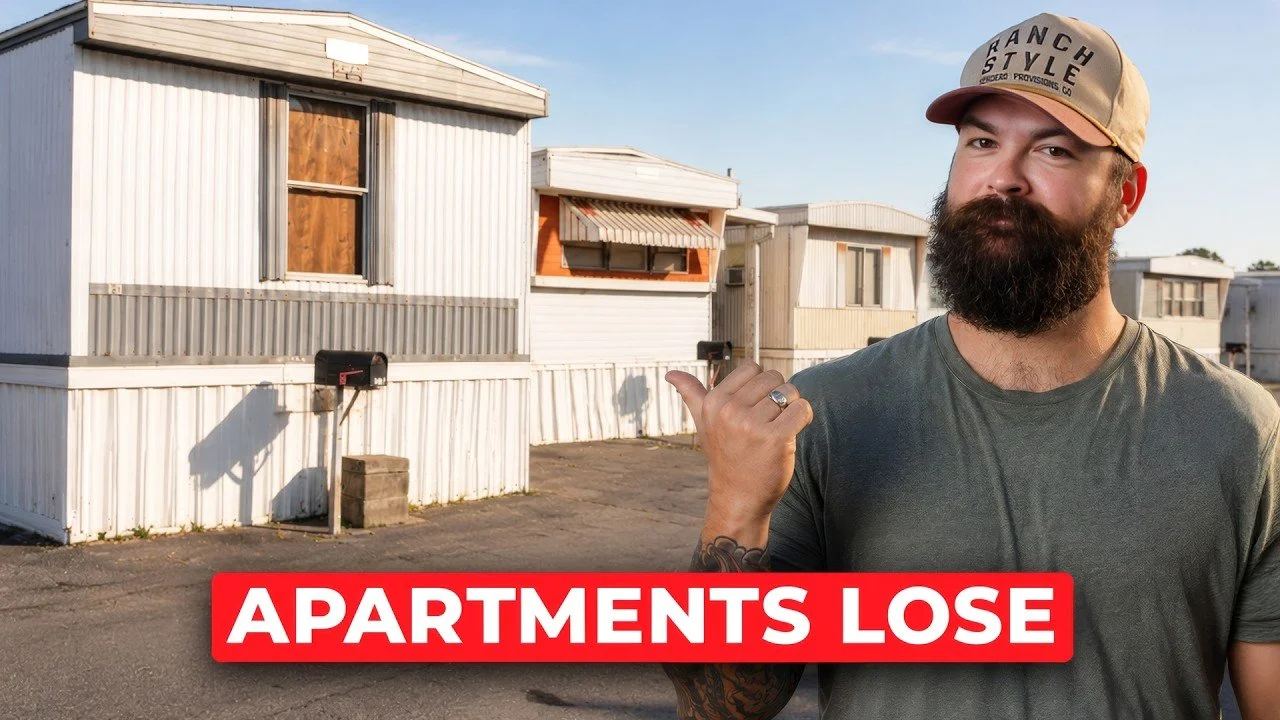
How to Buy Your First Trailer Park
Everybody in commercial real estate is fighting over the same apartment buildings at 5 caps. Frank Rolfe went the other direction and built one of the largest mobile home park portfolios in the country out of the one asset class most investors won't touch. The mechanics are nothing like apartments. You own the land, the tenant owns the home, and moving that home costs more than the home is worth, so almost nobody leaves.
Average tenancy in a park is 14 years. That one detail is why investors love this asset class, and it's exactly what critics point at.
We get into both sides, including the Waffle House quote that landed Frank on John Oliver.
Frank also gets specific about the numbers: 30-40% expense ratios against the 45-50% most apartment operators run, why the industry is actually shrinking (roughly 100 parks redeveloped every year, fewer than 10 built), how he underwrites off the spread between cap rate and interest rate, the five-point checklist he runs on every deal, and what he'd tell somebody with $250,000 buying their first park.
If you've ever wondered why this asset class quietly outperforms and why almost nobody talks about it honestly, this is the episode.
Key Takeaways:
MH parks = land business, not housing business. Owner rents pads, tenants own homes; owner avoids interior repairs and big capex on structures, focusing instead on utilities, roads, and management.
Demand is counter-cyclical and supply is shrinking. Parks are the “Dollar Tree of housing,” performing best in downturns; new parks are almost never approved, while 100+/year are redeveloped into other uses.
Economics are driven by NOI vs. interest rates. Deals are valued almost purely on income; investors seek cap rates 1–3 points over debt, targeting roughly 10–20% cash-on-cash by raising under-market rents, filling lots, and cutting waste.
Expense ratios are lean vs. apartments. A well-run park often operates at 30–40% expenses (lower if tenants pay water/sewer, higher with high taxes or vacancy), compared to ~45–50% in typical multifamily.
IDEAL framework for evaluating parks: Infrastructure (city water/sewer, no master meters), Density (lots big enough for modern homes), Economics (spread over debt), Age of homes (prefer 1990s+, paid-off), Location (urban-safe or strong suburban/exurban demand).
Moat + controversy come from “stickiness.” Homes are effectively immobile (costly and risky to move), so tenants tend to stay long-term; this creates stable income and investor moat, but also fuels criticism around rent increases and perceived tenant lock-in.


About Your Host:
Tyler Cauble, Founder & President of The Cauble Group, is a commercial real estate broker and investor based in East Nashville. He’s the best selling author of Open for Business: The Insider’s Guide to Leasing Commercial Real Estate and has focused his career on serving commercial real estate investors.
Speaker 1 00:00
That's the issue. It's not that the people are chained to the booths, the homes are chained to the booths. You can't you can't move them.
Tyler Cauble 00:06
Everybody in real estate is fighting over the same apartment buildings at five caps. Meanwhile, my guest today built a portfolio reportedly worth over a billion dollars out of one asset class that everybody gets a little tricky around, and that's trailer parks. And here's the wild part: the way a mobile home park works, it makes money in a completely different way than apartments apartments do. You own the dirt, the tenants own the homes. It costs $10,000 to move one, so almost nobody ever leaves. And that one detail is why investors love this asset, and it's also why critics call it predatory. Sometimes we're getting into both sides today, including the quote that put him on John Oliver. Frank Rolfe, welcome to the show.
Speaker 1 00:52
Thanks, Tyler. Thanks for having me.
Tyler Cauble 00:54
Absolutely, man. Excited to have you here. So when I say trailer park, most people picture something rough, right? What is a well run park actually look like today? What are people getting wrong?
Speaker 1 01:07
Sure. Well, one way to look at mobile home parks today is as a high density subdivision because that's really what they always were. the The word park came all the way back from the 1920s and 30s. It meant a place you could park your trailer. It was not a negative stereotype. It was just descriptive of the fact that a trailer park was a field. You were welcome to come in and park your trailer overnight and pay a fee. And back in that era, RV parks, mobile home parks were the exact same animal. When they when they diverged back in the roughly the 50s and the 60s, RV parks went on to be kind of a luxury item for people who were traveling. Mobile home park became more permanent housing, and a modern mobile home park, a well-run mobile home park, has taken that a step further from what people think of when they think of what they see on TV with Eight Mile with Eminem and those kinds of media distortions, modern modern trailer park looks literally like a regular subdivision. But there's some things you notice in them which don't look like your typical subdivision. One is that the lots are very very small. That's why I call it high density. Typical mobile home lot might in some cases be in a modern park, 50 by 100. In a traditional park, more probably 30 or 40 feet by maybe as much as 6070, feet. So a fraction of a typical stick-built home subdivision lot size. And then, of course, the other obvious item is that mobile homes sit up in the air, so they're about three feet off the ground. And you know you're looking at a mobile home and you see skirting and a deck, but beyond that, you should have all the same creature comforts, nice looking entry, nice looking common areas, and in many cases, a lot of these subdivisions today they do have their own in house clubhouses and pools and things like that. So there's there's the the main discerning feature is number one how small the lots are, number two the fact that homes are all sitting up in the air.
Tyler Cauble 03:03
You've said before that parks offer a better quality of life than an apartment at the same price. I'd love to hear you make that case.
Speaker 1 03:10
Yeah, well, you know, apartments have some drawbacks, right? And and mobile homes are are the opposite of that. So we, in a mobile home park, you don't have neighbors knocking on your walls and ceilings. That's common complaint. You have a yard. You never have a yard in an apartment ever. You can park by your front door. Apartments typically you have communal parking. You have a polycart for trash. Typically, you don't have to walk down, take your trash down to a dumpster. And because people live there longer, you have more of a sense of community. Because most apartments, I think the average tenancy is a year or two, so it's transient. It's like a on on the ladder, trying to move up a rung maybe to single family or something next. Mobile home parks, you may also be on that same ladder, but you tend to stay longer. The average mobile home park tenant is 14 years, so it's it's a much longer period of time. But those those are the main differences. Again, you know they're they're very different animals. The look is different, but also the big one, the stigma, is much different. There's not a stigma on apartments. There is a stigma on trailer parks.
Tyler Cauble 04:11
Let's dive into the machine behind trailer parks and how they work. So the tenants own the homes. You own the land. Walk me through why that changes everything about this business?
Speaker 1 04:23
Well, what changes when when you are in just the land ownership business is I'm not responsible for what happens in the home, and that's big, right? If you have an apartment complex, and we have owned apartment complexes in some of the parks that we own, they came with the with the property. I'm responsible for everything. Like if a toilet won't flush, it's up to me. Door won't close, up to me. Doorknob breaks, it's it's on me. Window breaks, it's on me. And when we've owned apartments, and we still own apartments in some of our parks, it's a never-ending phone ringing experience of things breaking. Typically, at an older apartment complex, things break pretty frequently. And beyond that, you have the big capex items with foundations and roofs and things like that. In our business, since we just rent the land, we don't have to get involved in any of those home items. We don't fix toilets, doorknobs, broken windows. We just rent land, so it makes it extremely simple. It's like owning basically a parking lot in a downtown area where I'm not responsible for the cars or anything. I just but they they come in and they go and they pay me rent. It's it's the same it's the same kind of a thing. Now unlike a parking lot for cars, we have to provide utilities. We have to provide a manager. Typically, I know a parking garage might have a manager. Ours is much more engaged, but and and of course you don't live in the parking lot. Hopefully, but in our case you do. But but but that's the difference. It takes you out of being in the loop on a lot of repair items.
Tyler Cauble 05:55
So how does the leasing process around these work? Like, what is how do how do tenants find you? How do they rent space from you, and what does it actually cost them to move their mobile home out of a park if they choose to leave?
Speaker 1 06:08
Yeah. See, this is one of the great misconceptions of the industry, which people don't understand. So maybe I can educate people now. You know, back back in the early days of a mobile home, you could pull it behind your car because they were all eight feet wide, that's the maximum you can pull behind a car. So you could freely come and go just like an RV, because mobile homes and RVs were basically the same animal. But when the mobile home went to a 10 foot width, which was at some point in the 1950s, you could no longer pull them with a car. Then you had to pull them with a with a truck, and you had to have a permit to move them. So mobile homes don't actually move. In fact, that's why they ended the name mobile in 1976. The word mobile was eradicated because the homes were never advertised to be mobile. They're they're about a modern mobile home is just about as mobile as your your house is. Particularly if it's older, it's not even safe to try and do it. So the homes don't don't actually move. But what people also don't realize is the customers don't move the homes to begin with. It's park owners that have always, in modern times, moved the homes. So, for example, if you see a mobile home advertised for sale at a mobile home park, it was brought in by the park owner. It was not brought in by a customer. They could never afford to do it, and they could never get the debt. So the park owner, basically, to sell a mobile home today, they have to co-sign the note effectively with a litany of provisions in the mortgage, which they have to set up. In in that if the customer defaults, the park owner has to step over, step into their shoes, and and basically backstop the mortgage, so customers don't move mobile homes. In fact, I haven't seen a customer move a mobile home on their own with their own checkbook since probably the year God 99 or 2000. So for over 20 years, park owners the only ones who move mobile homes. If someone is unhappy in a mobile home park and they want to leave the park, it's a mobile home park owner that pays to move it to their park, so those those moves are called organic. We do about 100 of those a year or so, and so we we pay for the customer to move. But the whole moving thing is nonsense. Customers haven't they haven't moved homes in at least two decades.
Tyler Cauble 08:16
My my, I've got a lot of buddies that are in the apartment world, and and typically on their projects, they're running 45, 50% expense ratios. What does a well-run mobile park look like?
Speaker 1 08:28
Sure, there's basically two expense ratios in a mobile home park. If the tenants pay their own water and sewer, which is becoming more of the norm, but still on average is not the norm, the expense ratio is roughly 30% If the park pays the customer's water and sewer is 40% there are there are some occasions where you can get better than 30, slightly, maybe down to 25, if the city owns the streets, and the other at the same time, if you are in Cook County, Chicago area, areas with extremely high property tax, or parks with high vacancy, it goes to about 50% So the real ratio is probably 25% to 50% but the normal ratio is 30 to 40% expense.
Tyler Cauble 09:12
Yeah, so it can really vary depending on what the the ownership is actually responsible for. That's exactly
Speaker 1 09:17
exactly correct.
Tyler Cauble 09:18
Yeah, how typical is it to see the city own the streets, or or for the tenants to pay for their sewer?
Speaker 1 09:26
Well, the the tenants pay for their own water sewer. Most every professional investor entering the business, the first thing they look at based on state law, is passing water sewer back to tenants, because when you when the tenants pay, the typical rate reduction is about 30% or so of water sewer consumption, because when people pay for it, they use less of it, and it's just becoming more of a norm is for people to pay their own utilities, and and of course that's been the norm in all every other housing sector forever, pretty much. So. As far as city-owned streets is very very rare. I think you know we we've owned around 500 parks, and I would say city-owned streets occurred in maybe maybe 10 or 20 of them. So it's very very rare.
Tyler Cauble 10:13
Yeah, you've owned you've owned a ton of parks all over the country. What what did what did occupancy look like in 2008 and 2020 when we had those, you know, one a big financial event, and and two the pandemic,
Speaker 1 10:25
right? Well, you got to remember the mobile home parks, as I'm sure you were. We're the Dollar Tree of housing, right? So we're the cheapest form of housing in the United States. It's detached, and most markets were the cheapest form of housing. Period. So our our demand actually goes up when the economy gets bad. So in the great great going back to the.com bust, because I was in the industry for.com. So in.com bust, what happened? America goes into recession. Less people get laid off. All kinds of problems. Our phone rings more because when times are terrible, people need cheap housing. Great recession. Same story. Mobile home sales volume went actually up during during the advent of the Great Recession. So we're like we're totally contrarian. We go we go up when everything gets bad. We go down when everything gets good. So when they were doing zero down, no income doc no income documentation mortgages prior to the Great Recession, then our industry was not nearly as exciting, and I we had people literally that we were evicting in years like 2004, 2005, that were moving across the street to brand new subdivisions, right? So they were jumping from a $10,000 mobile home to a quarter million dollar house while in eviction, because they were doing zero down, no income documentation loans, and I at the time thought, man, our industry will die because everyone in the mobile home parks will just simply go buy big custom homes, and of course, then then the whole thing blew, and they all returned back from mobile home parks for once they came, but that's but that's the times in which our business does poorly is when things are booming.
Tyler Cauble 12:05
Yeah, I mean we see these new subdivisions getting built all the time, and builders offering all sorts of incentives to to get first time home buyers in. When was the last time you saw a brand new mobile home park get approved and built? I mean it seems to me like especially in in Davidson County and here in Nashville, you almost never see that happen.
Speaker 1 12:24
Correct. I can't name as far as parks that are newly built and haven't already gone into bankruptcy. There's one in Katy, Texas, is my understanding that that that has survived. The problem you have is nobody allows mobile home parks to be built within any city or even a small town, I live in a town of 5000. We we don't allow them. No, nobody allows them. So the only way you can build one is to go way way out in the county where there is absolutely no supervision at all. The problem is when you build it, there's no customers because you're way out in the county where there's no you know strip shopping center. There's no hospital. There's nothing. There's no school. They have a county school, and and so that's always been the the paradigm: is how do you build one and not go bankrupt with it? And I saw two get built back in the '90s in north of Fort Worth. Both of those went bankrupt. Those were done by fairly successful builders. So it's it's impossible. I would say in the entire United States, every year there there are roughly about 100 100 or so mobile home parks redeveloped into a different use, and I don't think there have been in the United States ever 10 parks built a year. So the industry is actually shrinking. We're we're in an endangered species.
Tyler Cauble 13:42
Yeah, it's a pretty nice moat to have as an investor, for sure. I mean, that's that's why FlexSpace is doing so well. You know, it's getting most of it's getting torn down and redeveloped into into other things. So, I mean, let's talk about that a little bit more. I mean, why do you think that those new developments have gone bankrupt? Is it just the location is is poor because they're so far out. Is it because construction costs and site development is so expensive now compared to 50 years ago that it's just a different beast?
Speaker 1 14:12
Well, no, it's not normally the cost to build because when you're when you're building mobile home park, the lots are going to run you probably 25,000 a lot, and I think the low point for that pre-COVID was probably about 10 to 15,000, but and then the park owner would have to bring in every home, and so that's going to cost him probably an additional. Depends on if they're new or used. If they're new homes, probably 80,000 a home. You're probably going to be in at 100,000 a lot, but the problem is that goes back to the stigma, because a lot of people won't live in a mobile home. I mean, I don't know if you live in a mobile home or ever have or would, but but probably not. And most people, if you say, "Would you live in a mobile home? They they they they are horrified by the very idea of it. So it takes a unique animal, and normally it takes a lot of demand to capture that one person. That will live in a mobile home park, and when you build it way out in the country, you already have a very small group of people who will live way out in the country, right? So now it's like way out of the country, coupled with way out in the country in a in a mobile home park. And then if you want to live way out in the country, you could just buy your own mobile home because there's no laws anyway, and stick it on an acre of land way out of the country, so you're competing with that. So it's it's just a failed business model. I mean, to mobile home parks, our phone rings off the hook because we're typically in fairly well developed areas, so there's lots of people looking for housing. But if you go out into the rarefied era of rural America, it's near it's nearly impossible.
Tyler Cauble 15:44
Yeah, it all starts with the demand. So so supply on the opposite end of that is is pretty frozen, and Wall Street has definitely taken notice of that. It seems like in the last 10 to 15 years, you know, groups out of New York and Chicago have bought up all of the larger sized mobile home parks here in Nashville. I mean, what have the REITs and and private equity firms done to this market?
Speaker 1 16:08
Well, first off, we have to put it in scale because there's 44,000 parks in the U.S. But I would say private equity groups and REITs own maybe out of that 44,000, maybe about between one and 2000, so they're they're they're just a pinhead on the thing. They're they're not a big deal. It's kind of kind of like the revelations they've had recently on private equity group ownership of single family homes, like in the Road to Housing Act, where they have limited now people owning 350 homes, and then someone actually looked it up and said, "Wait a minute! Private equity guys are less than 1% of the entire housing market. Our industry is about the same now. So you're in Nashville, which is a super hot market, one of the hottest in the United States. So clearly, everyone wants to own something in Nashville. But if you look at other other cities of Tennessee, if you look at Memphis, I don't know if there's any private equity ownership in Memphis. So it's the private equity ownership is very, very, very specific to those markets that they find exciting to own in, which are normally large cities, places like Dallas, obviously a ton in California, a lot in Denver, Nashville's definitely on the radar screen, but they're really not that big a part of our business, to be honest with you, it's it's they're they're kind of rare. I mean, we we we sold a group of parks to a private equity group back in 2018. It's the only time we ever have, only time we've ever had a call to do that, and so it's it's not a huge part of the business. I mean, the media would make would make it appear to be because people hate landlords today and hate private equity groups, so you get the combo. Everyone's two most hated creatures in one in one take, but they're not really a big part of the industry.
Tyler Cauble 17:49
Do you do you see a lot of investors jumping into mobile homes for for cash flow? Is it a covered land play? What's the strategy there?
Speaker 1 17:57
I would say right now the number one reason is the rate of return because because we have the highest rate of return, I think others are turned on by the fact we have the lowest default rate, because it makes lending very very easy. So that's positive. Some like the bonus depreciation. We have four four times more depreciation than any other real estate sector for $1 that you invest. So that's that has just recently become a hot spot for people, but I think the big thing people like is the moat, which you already discussed. They love the good old Warren Buffett idea of protecting your investment through whatever whatever means. And in this case, the means is that zoning departments won't allow parks to be built. I think I think you know apartment had so much oversupply that they're still having to you know survive through our industry never has oversupply, and I think that's attracting people. We're seeing a lot of people in multifamily segueing into mobile home park.
Tyler Cauble 18:52
All right, well let's let's dive into the numbers then and keep this going. So like let's let's just take into consideration an average park. What what is what are you paying per pad? You said around 25,000, give or take, to develop it. What what are you buying these for? What's the lot rent? What are the expenses? What hits the bottom line?
Speaker 1 19:09
Sure. Well, first off, we're not really looking at them as far as cost to build them and stuff because they're they were all built in the 50s and the 60s. So what we're looking at today is literally we're probably the most income-based real estate on earth, so everything is is traded just based on existing NOI. So typically, when you're buying a mobile home park, you're trying to buy at a cap rate that is higher than the interest rate on the loan, and if you can hit an environment in which you've got basically a a cap rate that's one point higher than the loan, then you get a you get a about a 10% cash on cash return. Two points gets you about 15. Three points gets you about 20% And most buyers in our industry are are seeking a. Three three point spread and 20% cash on cash, so the way they get there is either by a mobile home park with a small spread over the interest rate on the loan, and then they're pushing the rents, filling vacant lots, cutting cutting unnecessary cost to get that spread. But that's so so basically the interest rate is the backbone of what the valuations are. So back when we hit the all-time low on the 10-year Treasury, the all-time low on the rates before they started boosting them, you had an interest rate. I think the absolute lowest we saw on a Fannie Freddie loan was something like 3% Let's just say as an example, and that would have been before you know, right at the very bottom of in 2021, before the rates started to go up, so in that environment, people were buying mobile home parks at four caps, five caps, and trying to drive them up after after purchase. Today, people with with rates now up more along six, you're trying to buy stuff like at a seven, eight cap, and then push it from there. But that's kind of how it how it works out. So it's based. It's not really based on location or or what it costs to build. It's really just literally based on what what the EBIT net income is of the deal, and then what the interest rate is. And you'll see sometimes you'll see deals that'll trade at a four cap, and you'll say, "Well, how's that possible? That's negative to the interest rate, and the answer is, it's a seller carry deal, and the seller in that case is carrying the paper for 3% for two years or something like that. But really, when you're in the mobile home park business, the number one thing you follow are interest rates. That's what really predicates whether you want to buy it or not.
Tyler Cauble 21:40
So, are you still able to find deals like that today, where you're you're getting one three point spreads?
Speaker 1 21:46
Yeah. What what happens though is you know you have to. It's all about volume, and historically, over half of everything we've bought came from brokers, and the other half came from cold calling and direct mail. Today, you're you're probably looking at a bigger focus on cold calling, direct mail, reaching people who have not been touched before, because the brokers are, you know, typically trying to peddle the larger deals that most first time buyers they don't even make any sense for them, and even if you're not a first time buyer, sometimes the the prices people are asking are you know seem excessive based on the idea of trying to hit a 20% cash on cash return, but but it varies over time. Sometimes the brokers get desperate, and they'll convince sellers that they have to drop the prices, and then you know you'll have you'll have issues where it's a buyer's market, seller's market, stuff like that. But again, it also is very location specific. I mean, if you went into Nashville today trying to buy a mobile home park, everyone is in Nashville trying to buy a mobile home park. So what you would do is you would go to what are called exurbs, which is the ring of cities farther out than the suburbs of Nashville, or you go to super commuter neighborhoods, which are the areas that are about an hour. So like little towns that people like the schools and the crime and the quaint downtown, and those things can be up to an hour out of the market, so you might be able to have success there. But areas like Nashville are interesting because Nashville was not really hot until recent times, so a lot of Tennessee and Alabama, Georgia, these these are areas that today have wonderful economics, house prices, job gains, but people never looked at them traditionally. They they they they just abandoned the whole kind of south and southeast, and that's probably where the most opportunity is. I mean, where where you are right now, if you drive a four to five hour radius, that that's some of the hottest spots in America right now, as far as mobile home parks.
Tyler Cauble 23:40
Well, so so if you come across one of these opportunities, let's say we find one, you know, within an hour of Nashville, and you and you're reviewing it, what is the first thing you dive into to see if this is a deal worth working on or not?
Speaker 1 23:53
Sure, yeah. There's actually five things we look at, and they spell the acronym IDEAL stands for Infrastructure density economics age of home and location. I'll just give you a quick quick overview on what each of those five are. Infrastructure. We're looking predominantly for city water and city sewer. That's key, and we're and we don't want master metered power or master metered gas. And so we're we're looking for utilities that are the the run well, and are are much lower risk to operate. So, and we're also looking for typically for paved roads. Although I can pave roads, what I can't easily do is I can't easily convert from private water or private sewer to to public water or sewer, and I also cannot very easily convert having every unit with its own separate natural gas access or power. And then on density, we're looking for parks that have sufficient size in the lot. You can bring new homes in on them. That's that's a. Big deal on the economics again. It goes back to typically a spread over interest rate. That's a big item there. Age of homes. We like the part the homes to be predominantly 1990s. We like to be pitched proof but paid for because you have much lower churn of tenants when they don't have a mortgage. And then finally location. We're we're looking for two things. We're looking for either urban safe location, so you're in you're in the big city, but you're in a safe spot, or we're we're looking for a suburban or exurban or even super communal location with good skills and high level of demand. So that that's those are the key things we're looking for.
Tyler Cauble 25:41
Yeah, what's on the inverse of that? What's your what's your immediate drop west? Like, what what are you seeing a deal where you just go, ah, this isn't worth spending any time on?
Speaker 1 25:49
Calling the city, inquiring about the permit, and them saying it has no permit, or them saying, oh yeah, well, we only it only has a permit for 20 lots, but they're running it as 80, things like that. So if it's illegal, not going to touch it. If it's in a floodplain and it's in a high BFE, which stands for base floodplain elevation, so the water would actually reach the trailers, not not flow under them because they sit on stilts three feet high, right? But in other words, let's say the BFE is six feet. So if it floods, the park will be wiped out. We're not going to do that. If the park is in the flood, the flowway, which means you're actually in in the in the water power of the big flood, not just still pooling water, but actually the thrusting, ripping current of the water, we're not going to we're not going to buy that. We're going to run a test ad. If the test ad pulls poorly, we're not going to buy it. If if the density is such that the you know the fire marshal says the thing is unsafe, we're not going to buy that. So there there are there's probably 1010 drivers that would kill it instantly. Now we don't know all those drivers on day one, so we can check out permit. We can check out floodplain. Some things that kill parks, for example, easements. We've had cases where no one bothered to tell us that there's an easement running diagonally through the park, which renders the entire park impossible to to operate. Those come in later. Of course, environmental issues. We always drop that. Those come in later. But those are the kind of stuff.
Tyler Cauble 27:18
Yeah, mom and pop mobile home parks are notoriously bad about their financials, right? Because this is typically a pretty decent cash business. They may not be reporting everything on their tax returns, and when you're going to buy them, they're saying, "No, trust me, I'm collecting this amount of rent. How do you reconcile what the owner is telling you they're collecting versus what their tax returns are showing. How do you get comfortable with the numbers?
Speaker 1 27:46
Yeah, that's been one of the big problems with the industry ever since I even got in. It is the sellers either have bad financial records because they didn't know any better, or they deliberately do that because the actuals don't match. So what what you can do with a mobile home park number one is you you can definitely audit that there's a trailer on every lot right you can go up and touch it and you can kind of see that there's someone living in it although you don't always know but you'll you'll sometimes see people you'll see signs of life it'll have a power meter that's turning okay that looks occupied right but I'm still not 100% sure. So getting burned on the revenue, you you can get burned, but it's typically fairly small. Like if you had 100 space mobile home park, you might get burned on one or two units that actually were abandoned, but you couldn't tell. The cost side, we don't trust anything on the cost side. So on everything on cost side, we're we're going to go to the actual provider, and we're going to get their their numbers from them. So we're going to go to the water department, the sewer department, power everybody, and say, hey, you know, what what were the bills last several years, and and we're going to look at that. If if if it's things we can't do that with, like repair and maintenance, we're going to use either plug numbers or get three bids on it, but you can't trust anything that a seller gives you. If you trust the numbers the seller gives you, I guarantee you will go bankrupt because they're always fallacious and they're always low. I've never had never had mom and pop say, "Yeah, here are my numbers, and then we we verify the numbers and they estimated too high. Never happened. They they leave a ton of stuff off, hoping you will not think about it. Like leave off mowing because they mow. They'll try and capitalize a lot of repair, move it to capex so it falls off the their numbers. They'll do all kinds of evil stuff, and then the the one thing which isn't really evil on their part, but yet when you call them out on it, they often will push back, and that is often the tax assessor has these things at crazy low numbers, particularly in areas that are more small townish, and you know if if if the guy if it's assessed by the by the property tax folk. At $200,000, and you're buying it at a million, you have to use a tax on a million, right? Because it could very well come to that realization the year after you buy it. But mom and pop will tell you, no, no, no, it's always been $200,000. You can't do that. And in Missouri, it's not a big deal like where I am because tax is 1% But in Texas, it's 3% and in Chicago, it's 10% so that's another big issue.
Tyler Cauble 30:25
Yeah, it starts to add up. And Nashville, that's been very controversial here recently because we had a 37% increase this past year, and property taxes are hitting everybody hard. Right. Let's let's play devil's advocate for a minute. Everything we just dived into-the moat, the stickiness, the frozen supply-it all works because the residents can't easily leave, right? I mean, that's that's what investors love about this asset class, but that's also exactly what critics of mobile home park investors point at. And and you've been at the center of that fight as well. You once said owning a park is like owning a Waffle House, where the customers are chained to the booths, John Oliver played that to millions of people. Do do you regret that quote, or do you no not not
Speaker 1 31:09
at all because it was totally taken out of context. The the where the quote came from. If you look it up originally, you can actually find the original article. I was called by a young woman reporter at Bloomberg. This is after the New York Times came out. I was I was in the New York Times. My partner and I, Dave, and and they loved everything we were doing. In fact, the article had in there that we were the best thing and quote the the best thing in I think American housing when the need for low cost places to live has never been higher or something like that? It was a very glowing article, and so I got a call right after the article came out from lots of different people: Time Magazine, Bloomberg, all the people who basically follow other people's articles and then call to try and make articles off of articles. Right. So this girl calls me up, and we're talking about mobile home parks, and she didn't know anything about real estate at all. I mean, she was probably 2024 years old or something. So in the discussion, I talk about how we have a very low default rate, and she said, "Well, why is your default rate so so low? And I said, "Well, do you know what has the highest default rate? And she said, "No, I have no idea. So, well, it's restaurants. Restaurants are the number one most failing business. So let's compare the two. I said, so you know, let's compare like a mobile home park to a Waffle House. I said, you own the Waffle House and you open the doors. You don't know if anyone's going to come in that day, and if they just don't happen to come in and they don't come in for a week or two, you can't pay your bills, and then you go bust. I said, but in our industry, when we open the doors every day at our Waffle House, all the customers are already there. They're like it's like they're chained to the booths. She loved that concept of chained to the boost, but it was it was describing our default rate. It doesn't mean people are chained to the booths. What what people even even John Oliver. Let's be honest, Oliver's he's a comedian. He's not. He's not actual newscaster. You know, he's he's a total different animal. But what what he failed to understand, and but he's not. He doesn't have to understand. He's not a news reporter. But the customers leave all the time. It's not the customers are chained to the booths. The homes don't move. Customers move all the time. We have homes that customer will stay in there for a couple years, default, run off. Next person comes in, they'll stay there three years and run off. Our industry average is 14 years, but that's because we have some people who live there 5060, years, others who live there for one year. But the customers are free to go anytime they want. In fact, if you were in a mobile home and you couldn't you couldn't pay the bills, have a life crisis, lost your job, spouse leaves you, like anybody else. You could just sell the mobile home where it sits. Like, why would you move one? The cost of moving them is more than the homes are worth, right? Why would you spend 10,000 to move a $5,000 mobile home? You wouldn't. But they they since people don't understand our business, they they took that quote and took it into an arena that isn't even applicable because the the people leave but the homes don't leave and the homes don't leave for two reasons one which was created by the government when they took over mobile home manufacturing in '76 they grandfathered every home where it sat but you're not allowed to move them, so any any home you see that's flat roofed, you can't move by federal law. It's not our law; government's law. Everything built after '76, the problem is from an age perspective, you'd be crazy to move a late '70s or '80s home. It won't make the transport. We've actually had homes of our own that we tried to move that broke apart in transport. So we don't even do it anymore. It's too dangerous. So that's that's that's the issue.
Speaker 1 34:50
It's not that the people are chained to the booths, the homes are chained to the booths. You can't you can't move them unless you want to spend a huge amount of money. Even in a 1990s home where they will blue. Look at 20,000 to move that home might cost you 15,000, so you'd be better off selling that home for 20 and then buying another home for 20 that's already in that location. They they weren't you know if you look at when the government took over the industry, they're not even meant to be moved a second time. That's why they took off the word mobile and changed it to manufactured housing in '76. They don't want you moving them because the only they can move when they first come off the factory floor and they're nice and fresh, and they're already up on wheels, right? Then they're transportable. But after you after you take those wheels off and set them on their chassis for decades, and I wouldn't want to do it. I mean, it's just it's not it's not a good idea. No, no one advocates moving mobile homes. That's why they're not mobile. But then you say, well, why do we use the the name? Well, we use trailer park and mobile home because if you look at SEO, that's 99% of the searches. That's how Americans know the the industry. It's kind of like when when copy machines that became known as Xerox machines, right? It's I mean, they were made by Xerox, but Xerox had such dominance, and most of the media has glomped onto trailer park and mobile home, and so that's how people know them.
Tyler Cauble 36:12
Yeah, when I first got started in development, this was probably 13 years ago. The company that I worked for had a double wide on a new construction development that they use as the the sales trailer, and when we were done selling those out, I was tasked with with selling that double wide, and it was really nice. It was really really nice, but we we got almost nothing for it because of the cost to move it. I mean, it's it is an unbelievable operation to jack those things up, disconnect all the utilities and everything, put it on a trailer and haul it off. I mean, it's it really is a substantial amount of work. You you've also
Speaker 1 36:48
and I will add add to that. What's equally terrifying is if that home should break in transport. Let's say you're going down the highway. I saw one just recently had shut down Interstate 55 between St. Genevieve and St. Louis. A double wide had broken apart, had it taken out all travel lanes. When that happens, it's all on you. And if they if there should be an accident, they'll hold you responsible. If there's damage to the highway, you're responsible. Cleaning up the highway, you're responsible. That's that's that's why the moving of mobile homes is the worst industry in the world.
Tyler Cauble 37:21
You've also been quoted by the Guardian talking about some aggressive rent hikes, right? Going up 10% you know, a year when you've when you've taken it over. And again, from the investors' perspective, totally get that. What about on on the resident side? Like when when a new operator comes in, buys the mobile home park, raises rents by 10% What do they get for it?
Speaker 1 37:43
Okay. Well, the first thing most people don't realize is in our industry, you know, when people love talking percent, it's because they don't like talking the dollar value, because the average lot rent in the U.S. is about 300 a month, so 10% 30 bucks, right? The average apartment in the United States is running about 2000 a month, so 10% is 200 bucks, but since most people don't know how low our lot rents are, a lot of the media loves to talk about percentages only. If you look in some of the articles, they never will discuss the actual dollar amount. The headline will say park went up 20% in rent, or 15% or even 10% Our our rents are so ridiculously low that what would people want us to do? In other words, the the I can guarantee you right now, and people won't like this, but most mobile home park lot rents in the future will have to be up to at least 500 a month, or those parks will be torn down. And we're seeing that every every every week in America, parks park owners are throwing in the the towel because they can make way more money demolishing the park and putting in apartments, big box retail, you name it. Mobile home park typically has really good frontage. It's got access to all utilities, and they're the perfect size for redevelopment. the The normal park is between two and seven acres, which, if you look it up, is exactly the normal development pad site that everyone is looking for, right? So what happened was these moms and pops who all who owned these things-they weren't business people. Normally, it wasn't. They had a full-time job. It was just a little side hustle thing they had going on, and they were very unsophisticated. We see this all the time. It's bizarre. So a guy will have them. We bought a mobile home park once in Austin. His guy's lot rent was 250. Right across the street was one at 550, and he was low for the market. We're talking Austin, Texas. We asked mom and pop, "Why are you at 250? It's it's twice your rent right across the street, like your rent. We looked at their books; they hadn't raised the rent in like 17 years. Their response: Well, I didn't think the people could afford it, so we we call this concept mom and pop quantitative easing. And the problem is when when when they die and the new generation gets that land, they're not doing that anymore. I mean, this the whole nonprofit era is ending. People are not going to take a piece. Land in Austin, Texas, and literally make no money with it. If that's the if that's the plan, well, they're just going to go ahead and sell to a developer, and they're going to they're going to bulldoze it. So the rents have to be high enough to make money. So many of these parks in America don't make any money. If the average American saw the financials of moms and pops, and and they were honest about it, and not like with a socialist bend, but just looked at the numbers and say, okay, here's option A. You can keep this as a park and make this much, or we can sell the land for another use and make this much. What are you going to do? They're going to sell that land in two seconds. That's just that's just the reality. So the rents have to come up a lot. the The problem in our industry, is when you say come up a lot. If I go up $50, which is nothing, my get my cost to fill up my my SUV right now is $50 more per fill up than it was prior to the war in Iran. Right, so I'm doing $50 a fillup. So I'm doing like what one of those a week, maybe more. So in our industry, that $50 increase, if your rent is 300, that's like 15% up, right? So you can you can use the percent, but people use the percent because they can't handle the dollar. If if you take, you know, here's one step many people don't realize, but housing is no longer even the number one cost, right? So fourth fourth largest cost for the average American household. If you look at the U.S.
Speaker 1 41:26
government's own housing budget, your your bigger costs are healthcare, childcare, and transportation, and that's true definitely in our parks as well. Well, those suckers are up so much more than we are. It's not even funny. I mean, the the the U.S. health insurance industry is so out of whack that I have a neighbor in St. Jen. His health premiums went up from 400 a month to 2000 a month in one whack, right? Because his his subsidies ended or whatever. If you talk to any anyone looking at a car today, the average automobile, the the payments are going to run you five to 700 a month. That's more than our entire lot rent, and you probably have two cars. So we're we're just we're just like picked on based on this one item only, which is percent. But the reason our percents are so high is our prices are so low. It's like Dollar Tree, right? Dollar Tree went from $1 to $1.25, so it's no longer $1 store; it's $1.25 store. People wrote articles and said it's scandalous. They went up 25% It was a quarter. So when you're when you're when your pricing is super low, you can't really use percents. It's not fair.
Tyler Cauble 42:32
Yeah, I get that. So if if somebody tuning in has 250 grand and they're considering buying their first mobile home park. What should they be looking for?
Speaker 1 42:47
Okay, well, if you have 250 grand, that's a good starting spot because the key to the industry is you want to buy deals that that when you're done with them are at least worth a million dollars or more, because our industry has is is bifurcated. If your deal is a million and more, you have access to all these cool lending items, and if it's under a million, you have access to none. So it's under a million, you're stuck with seller financing in a small town bank, and small town bank is it can be okay, but it's you're not going to get long terms or lower rates or non recourse or anything. If your deal is at least a million, you have options like conduit, which is non-recourse, fixed rate, 10-year term, all the good stuff. So if you had 250, what you'd want to find is a park that you can buy where you're at least a point over interest rate, with the ability to fill lots, push rents, cut costs, and most importantly, get the thing ready to go to the next level, which also includes some degree of esthetics. You want to have a nice entry, rules enforcement, clean it up, make it nice, and then you can go out and you can either refinance it. If you can get your EBITDA up 50% in our industry, you can typically do a cash out refinancing pretty quickly because they don't require as much seasoning in our industry because everything is so fixed in stone. So that's that's one option people have. But all even that option it begins at a million and up. So the key is don't buy a park you cannot make worth at least a million bucks. That's the bottom line. It's like don't buy a a 12 space mobile home park, you know, three hours outside of Nashville, because when you're done with it, it'll be worth half a million bucks or something, and those are very hard to sell, very hard to finance. So try and stick with stuff which is at least in seven digits when you're done with it.
Tyler Cauble 44:35
What did I not ask you about mobile home parks that I should have?
Speaker 1 44:40
Oh gosh, you know, I guess one key question would be, you know, what what what is the big problem with parks? Like on a on a global perspective, what would kill the park business? I mean, that's that's what what a lot of people ponder because our business model is so well positioned, not and. Again, not because we did it. That's just the way it ended up. I mean, we didn't. When I got in the mobile home park business, a lot of things people like about it didn't exist back then. But today, the biggest issue you have with mobile home parks is rent control. That that's going to be the biggest one, and the problem is going to be, which people don't don't seem to understand, is our rents are so low as an industry that if you if you shut off the lifeline to being able to raise them, then they just get redeveloped. Land has many different uses. I mean, land land that's well positioned has many uses. Land in the desert doesn't have many uses. So it's like a death warrant. If you if you shut off the ability to get the rents up to where the things make money, it kills it. It's like I I like to collect cars, for example, not like Jay Leno style, but I like old old cars, right? And so about a 1940 Cadillac, probably 15 years ago or so, and so I took it over to a place that works on them, and I said, yeah, I'd like to put in the safety stuff, like the seat belts and stuff. The guy said, "Oh no, we don't do that. Why don't you do that? We don't we don't do it because we think it ruins ruins the originality of the car. I'm like, "Dude, I'm not going to drive the car without seat belts with my family in it, right? So like, what's the plan? What's the choice here? The guy's like, "Well, then probably all these old cars they should all be end up in museums. Well, there ain't that many car museums. Not that many people want to go to car museums. So what these guys are doing is it's like a death warrant to the older cars as far as collectability or driving them, because no one's going to drive them without seat belts or safety glass, etc. And that's a problem that the mobile home park industry or society is facing, because people want to have cheap housing, but at the same time, they won't have any housing if it doesn't make at least some money. If you look at a lot of the real estate newsletters and stuff, which I'm sure you get the same as I do, they don't even have mobile homes as a category of real estate, and so we tend to get washed into all of this other legislation from stuff that doesn't even apply to us. And the problem is, it's going to kill the industry off because if your park is not making money and mom and pop dies and you can't raise the rent, it will not be sold as a park. It'll be sold as raw land, and that and that's the one thing most people don't realize.
Tyler Cauble 47:14
Yeah, that's that's certainly not endemic to just mobile home parks. I mean, that's apartments, that's single family homes, it's residential across the board, which which you know I understand the intent. I think the intent is positive, but the way that it's put into practice doesn't make any sense in in the real world. Frank, thanks for for jumping on the show today and diving into mobile home parks. For those that are tuning in that want to learn more about you, follow along with what you've got going on, where can they find you?
Speaker 1 47:42
Oh, they can find us at the very simple domain mhu.com, which stands for mobilehomeuniversity.com. Everything I write and record, it's all on there, so it's mhu.com.
Tyler Cauble 47:56
There you go. That's great, guys. We'll leave that in the show notes as well. mhu.com. Frank, thanks for joining us, guys. Thank you for tuning in, and we will see you all in the next one. This episode of the Commercial Real Estate Investor Podcast is brought to you by my CRE Accelerator Mastermind, where you'll get access to my step-by-step investment blueprint, essentially a library of resources on how to invest in commercial real estate, you'll get connected to a supportive community of other commercial real estate investors that are doing projects just like you. You'll get personalized coaching and feedback from me every step of the way. Go to www.crecentral.com to learn more.