
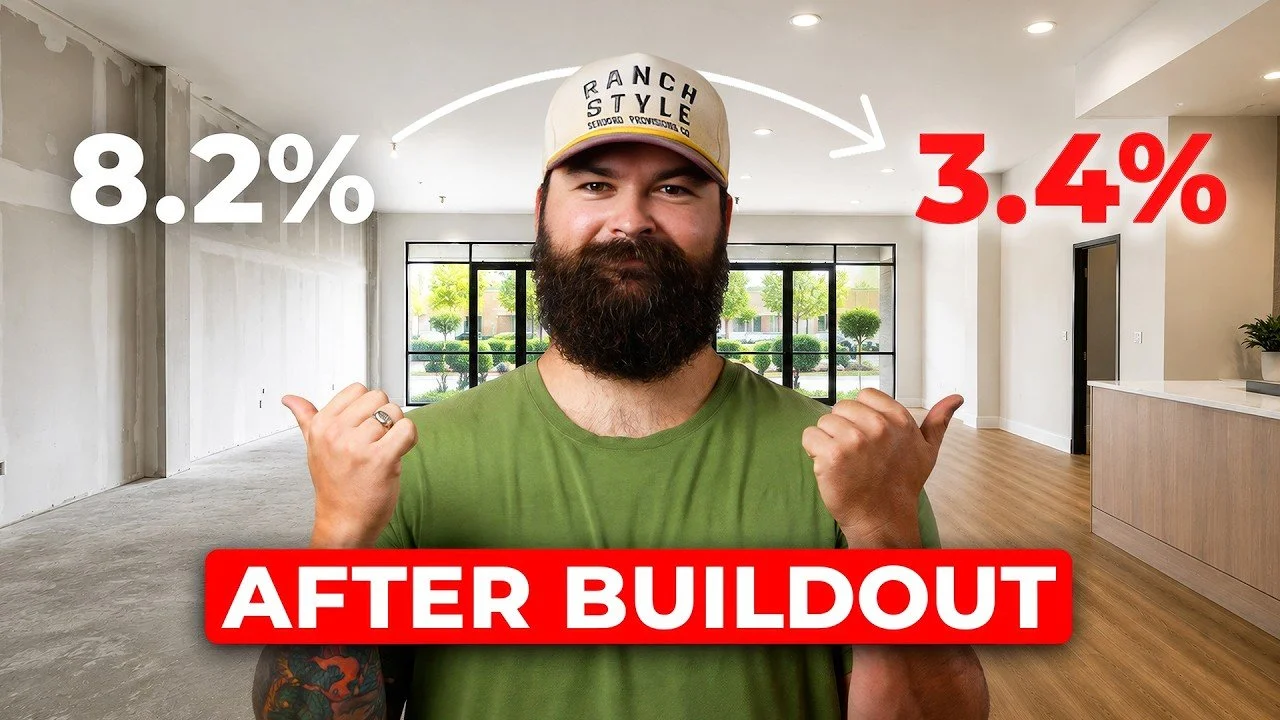
Your Buildout Budget Is Off by Six Figures
One of the easiest ways I see investors underestimate a deal is the buildout.
In this episode, I’m taking a real 6,000 SF retail property and showing you how I estimate buildout costs using the CRE Central Cost Estimator — then take those numbers directly into the Deal Analyzer to see what happens to my returns.
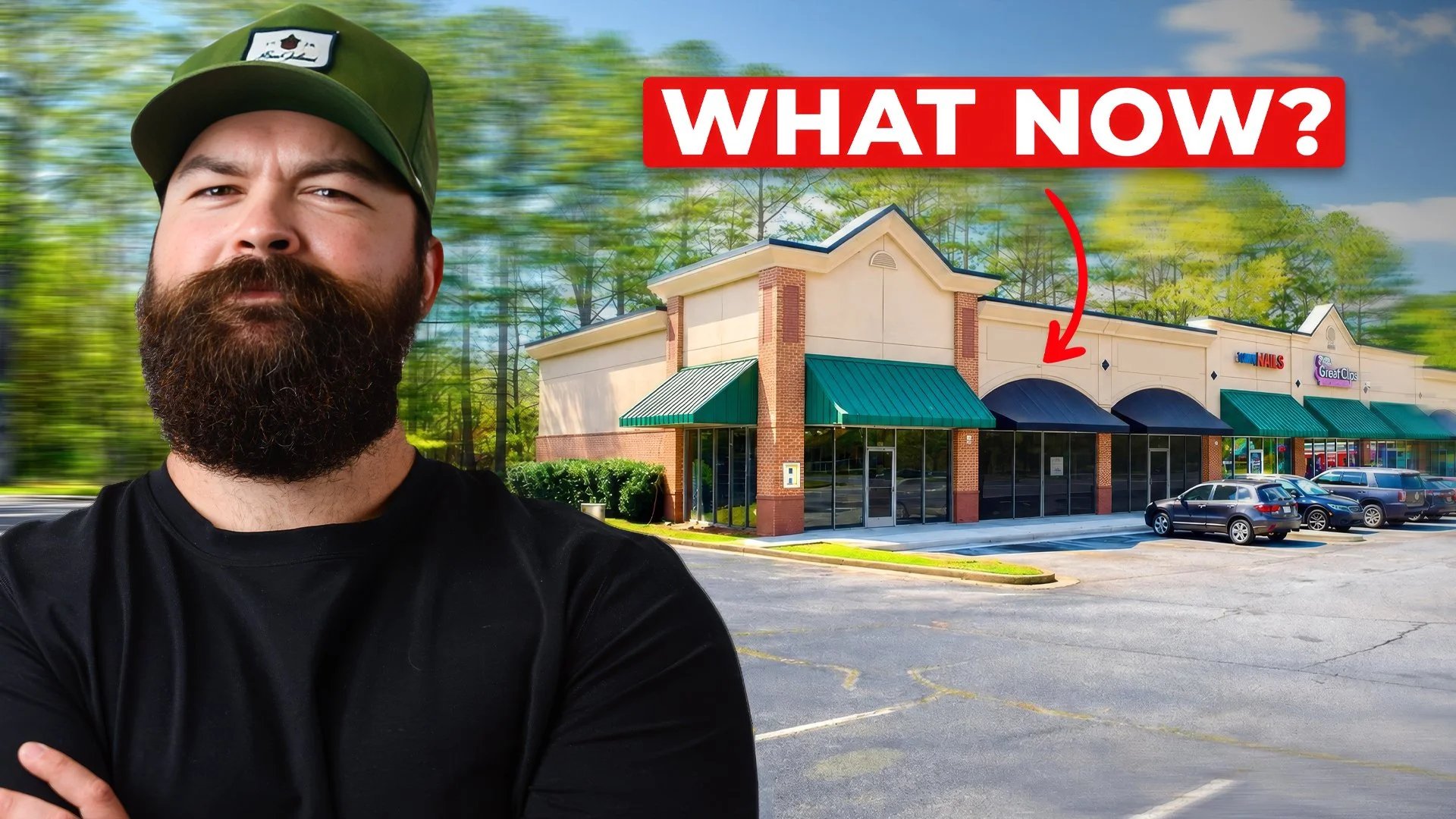
There’s a 1,500 SF vacant suite in this deal.
If I put another shop into an already-built-out space, I could be looking at roughly $27,000.
If it’s a bare shell, that jumps to around $112,500.
If a restaurant moves in? I could be looking at $262,500
That one decision takes my projected cash-on-cash return from 6.8% to 3.4%.
And here’s the part that matters: my lender is lending on the purchase, not all that additional buildout money.
That cash has to come from somewhere.
I’ll show you the two questions I ask before estimating any vacant space: What’s in there now, and who’s moving in?
Key Takeaways:
A contractor’s quote is not your total buildout budget. The quote typically covers the construction scope, but investors still need to account for soft costs, code requirements, permitting, and carrying costs.
Soft costs can add tens of thousands of dollars to a project. Architecture, MEP engineering, permits, plan review fees, inspections, testing, surveys, and as-built drawings all need to be included in the underwriting.
A change of use can completely change the economics of a buildout. Converting a space from residential to commercial, office to retail, retail to medical, etc. can trigger accessibility, egress, sprinkler, fire/life-safety, and other modern code requirements.
Time needs to be treated as a real line item. Permitting delays, long-lead materials, construction timelines, vacancy, lost rent, and construction-loan interest can significantly increase the true cost of a project.
A $550K contractor quote can easily become a $725K+ project. In Tyler’s 5,000 SF example, $550K in hard costs grew to $725,600 after $130K in soft costs/code requirements and $45,600 in carrying costs—roughly $110/SF to $145/SF all-in.
Do your homework before signing the LOI. Ask the city what the proposed use will trigger, determine who is responsible for tenant-specific improvements, negotiate TI/free rent appropriately, and price as much of the project as possible before committing.
Build contingency and realistic lease-up time into your underwriting. Tyler recommends adding a 10–15% contingency plus enough carrying costs to cover the typical absorption period in your market.
For first-time buildouts, surround yourself with experienced professionals. Tyler recommends working with an experienced CRE broker, architect, engineer, and contractor—and having the architect prepare drawings before sending the project to a GC for bidding.


About Your Host:
Tyler Cauble, Founder & President of The Cauble Group, is a commercial real estate broker and investor based in East Nashville. He’s the best selling author of Open for Business: The Insider’s Guide to Leasing Commercial Real Estate and has focused his career on serving commercial real estate investors.
Tyler Cauble 0:05
This episode of the Commercial Real Estate Investor Podcast is brought to you by my CRE Accelerator Mastermind, where you'll get access to my step-by-step investment blueprint, essentially a library of resources on how to invest in commercial real estate. You'll get connected to a supportive community of other commercial real estate investors that are doing projects just like you, you'll get personalized coaching and feedback from me every step of the way. Go to www.crecentral.com to learn more. Welcome back to the Commercial Real Estate Investor Podcast. We are live from the Cobble Group Studios here in Nashville, Tennessee, and today we're going to be talking about buildouts, commercial buildouts. Whether you are a tenant or whether you are a landlord, an investor, a developer, you're probably underestimating your buildout costs. I was having a conversation with one of my clients last week, which is what sparked me to have this conversation with you guys. They were looking at a property that they currently own in Germantown here in Nashville and wanted to convert. It was already zoned. They wanted to convert a unit from a residential unit into a commercial unit, and they had no idea what would be involved in converting it from residential to commercial. And so it got me down the path of having the conversation of okay, well, here's everything that you need to keep in mind going through the buildout process. And she was like, "Well, I've got a great contractor. He can get me a great price. I was like, "Yes, but that's not all. All right. So let's dive into today's topic. Your build-out budget is likely off by six figures, and that can make a massive, massive difference if you are going through the process of underwriting. Because if you underwrite your deal wrong, and you miss some of the figures in here, one, not only will you not have the money to do some of the things that you're going to have to do, but two, your numbers are just going to be really, really wildly off. All right. So the big thing that I want you to take away from this, and I'm going to use a 5,000 square foot example today. Is that the quote is not the budget? Just because you're getting a quote from a contractor does not mean that that is actually the budget, the total budget for your project. It doesn't matter how big or small it is. Whatever the contractor tells you is still not the actual budget. All right, so let's say that the contractor quotes you $110 a foot on this 5,000 square foot suite. That's $550,000. There's a lot of people that will just say, "Hey, my buildout budget is $550 grand. Well, you've got to add in soft costs, right? That adds another $26 a foot in this example could be more, could be less, but this is what we're going with here. That's everything from architectural to MEP to your permitting. Those are things that you may not necessarily think about, and it's something that the contractor is not going to be quoting. They're not going to know that. That's not up to them. You're the developer; they're the contractor. And then when you add in interest carry or just general carry costs for how for the the suite being vacant after you're done building it out between the time that you deliver it and the time that you actually get a tenant into it, now we're at $145 a foot all in. That's $726,000 when our contractor originally quoted us $550,000, none of it was a mistake. All of this would have been predictable if you had been properly accounting for all of the actual expenses going into the project. But you don't know what you don't know, right? So if you don't know that you need to be accounting for those things, of course you're going to miss them, and that's why you guys are here. You're here. I'm going to teach you, and if you're joining us live, feel free to drop any questions into the live chat, and I will jump to those as soon as I can. So here's how the budget really gets built. I mean, it's it's three pretty basic steps. All right, you take the square foot, the the amount of square feet times a price per square foot. Right. So we had 5000 square feet.
Tyler Cauble 4:00
We had $110 a foot, and I'm just gonna say, hey, that's the last deal that we did was 110 bucks a foot in construction, so that's where we got that number for. All right, or two, a contractor walks the space, he prices the scope that you described, right? Pretty simple and straightforward, and then that number goes into your model. That becomes your TI allowance, that becomes your total capital expenditures, whatever that is, right? That is how your budget gets built, and every step is right. All right, the output is wrong in the sense that you're still not accounting for everything in total that will actually be involved in this buildout. The quoted price, the quote price your scope, it does not price what the building will require, right? So the contractor is quoting based off of the plans that you are giving them. Okay, that could be walls, floors, HVAC, painting, lights. We're redoing the exterior. We're redoing the landscaping. We're sealing and striping the parking lot. Whatever that is, that. Is what the contractor is quoting, all right? But when we get into the soft costs and the code work, yes, some contractors will quote you permitting fees, but more often than not, they're saying, "Hey, that's on you as the developer, as the owner. You pay for the permitting costs. You deal with all of that. And sometimes builders won't even get you a quote unless they have a full set of drawings, right now. It doesn't have to be a full, you know, 100% set of CDs. It could just be schematic drawings, but they're probably not even going to get you a quote until you've spent money on architecture and engineering for the site, because they don't want to give you a quote that could be wildly off, depending on what actually ends up coming back designed. All right. So here are some of the soft costs to keep in mind as you're going through this process. On this one, we added roughly $62,000. That could be architecture and MEP engineering. MEP is your mechanical, electrical, and plumbing. Okay. You need drawings typically, depending on the scope of work that you're doing. You're probably going to need drawings for all of your MEP. All right, those are stamp drawings. You cannot get a permit without them. $38,000 right there. Permit and plan review fees, municipal fees that scale with the job valuation. So these could be lower or higher depending on how expensive your you know actual construction costs are. We're assuming $12,000 for this. You also have special inspections and testing. So these are third party. They're required, billed hourly. Another $8,000. Well, I'm dealing with this on my hotel right now. You need survey and as-built drawings. All right. Nobody has plans for a 1980s building, and then once it's finished, you have to shoot the as-builts and send them back. We are still on our temporary use and occupancy permit for the hotel, which we opened in April, april 1, because our and this is really sad. Our our our engineer he passed away unfortunately last month. He was really sick with cancer, and so he wasn't able to get out there and shoot the as-builts, right? Which we have to have as-builts of the stormwater to be able to hand those to the city for us to get our final use and occupancy permit. Well, everything's done; it's all been approved. I mean, everything's been signed off on, but we don't have the as-builts to hand over to the city for them to have on record, so we can't get our use and occupancy permit until that's done. And so, for that one, I've added another $4,000 in this example, right? And so, a new use means a new code. If you're going from residential to office, if you're going from office to retail, all of that means that you are you're technically doing what's called a change of use and occupancy. Okay, and that means you have to completely bring it up to modern day code in order to get your new, you know, permit. If that building has been used as a building since 1850, you're probably grandfathered in as long as you keep using it as an office building. But the second that you switch it from office to retail, you've got to bring it up.
Tyler Cauble 8:02
Typically, every municipality is a little bit different, so you guys know. Like I will always tell you in generalities whenever we have to, in situations like that. But for the most part, if you change from office to retail, I mean, it's a complete switch in in the use and the occupancy, and you've got to bring it up to code completely. All right. So if you budgeted $0 for your soft costs, and all of a sudden, you know, you've got accessibility, egress, sprinkler heads, like the fire and life safety stuff, $68,000 right off the bat, right? I mean, look, if you have to add sprinklers to a building, I mean, we typically just say like that's 150 grand, like right off the bat, doesn't matter, doesn't matter how big or small the space is. If we're adding sprinklers, we're starting at 150 grand. I just added sprinklers in my self storage facility out in Chattanooga, and it was about four. It was over $400,000 for us to do that, and we had to now we had to run a water line to the building, so that was a decent chunk of that, but even without that, I think it still would have been well over $200,000. So you know, time is a line item that you guys should also be considering in here. And this is one thing that I see a lot of people never take into account when it comes to their underwriting. Even if you're sophisticated, even if you're using our badass suite of tools in the deal analyzer, like you do, still need to take into account how many months it's going to take you to lease it up. All right, and you can actually do this automatically in our deal analyzer tool. By the way, we released our full suite of software last week. Super excited about that. It's called CRE Central Pro. Go to crecentral.com/pro to check it out, but we've got everything from the deal analyzer, the deal desk, which is your pipeline, your CRM, how we run all of our numbers, and I'm going to show you guys our cost estimator here in a second. That way, we can kind of see how it all works, which is really really cool, and all these tools work together, which is just something I haven't seen in the. Commercial real estate world ever, and it's something that I will always wish that we'd had. So we went out and built it. Okay, so on the on the time right permit review takes what it takes. I've seen this take three months before on the short end. I've seen it take 612, or 18 months. I mean, in Nashville for our hotel, it took us nearly two years to get fully permitted, it was an absolute nightmare. They made us jump through all sorts of hoops. We argued with the city at different points over certain things that were very, very stupid, and it just took us time. So, upwards of 18 months for that. All right. Now, you also need to keep into account long time, like long lead equipment. All right, so back during COVID, we had to order our roofing materials like the day that we started construction. Even though we knew that we weren't going to be roofing for like six months, because it was there was such a long lead time on getting those materials on site. That's why it's very important to have a good contractor that's working for you, or a good interior designer. Make sure that you're checking the lead times of all of the items and materials that you're going to have to order, especially if it's a special order, because these days you can't you can't just assume that it's sitting in a warehouse somewhere and it can get shipped overnight. You just can't. And you know, like if you're if you're trying to get windows or transformers, you you could be waiting months and months. So that's definitely something you want to look into because the last thing you want to do is spend all of this other money and then sit there and wait for one thing. You might as well delay the entire project because the more you draw down on that construction loan, the more you have to pay an interest every month.
Tyler Cauble 11:37
All right, and that kind of gets to my next point, you pay rent and interest anyway, right? You're you're you've got on on these months where you're sitting vacant $30,000 or more, you know, or give or take, of lost rent payments. You've got $15,600 of construction interest, right? It adds up. Every dollar adds up as you're going through the process, which is why you want to be as tight on this timeline as possible. So we go back and we look at the whole stack. This is 5000 square feet. So it's second generation retail that we're converting to medical use. Because you're probably sitting there thinking, "Well, dang, $110 a foot to convert this. If you're going from retail to medical use, you're spending that all day. I want to go ahead and tell you that if you're going from retail to restaurant use, you're spending 110 bucks a foot all day, easily. All right. So hard costs are 550 $1,000. That is our contractor quote. Soft costs encode 130 $1,000. That's roughly 62,000 in soft costs and 68,000 in code triggers, and then we've got $45,600 in interest carry. That's four months of lost rent and interest. So our quote was originally 550,000. We ended up spending 725,600. Okay, which as long as you account for that, you're totally fine. But the last thing you want to have to do is go back to your partners or investors or whatever and say, "Hey, we're $175,000 short. We got to figure this out. All right, the gap is not the same size on every deal. Obviously, like if you're changing the use, if you're going from retail to medical or warehouse to office any of it, that's going to get hit harder, right? Because you're you're doing a complete change of use, which means you have to bring everything up to modern day code. Generally, if the building was built before 1995, your accessibility and egress rules are very very different, right? We have the Americans with Disabilities Act that came into account in the '90s, and it completely changed how buildings were able to be constructed. All right, so anything before that, you're grandfathered in until you have a change of use, and then if it's your first build out, oh my gosh, you don't have any scar tissue built up. You better make sure that you've got some very good experts on your side. Get a commercial real estate broker that has been through buildouts before. Get a contractor that's done this. Make sure you're hiring the right architect and the right engineer to just walk you through the process. Because the last thing that you want to do is try and take on all of this yourself, and then get caught in a really bad situation where you could have seen something coming, but maybe you didn't, or you've just spent all this money. Now you're stuck, and you're having to figure it out. Right? It's never fun. So you should always be aiming to price everything out before you sign anything. Okay. So pre LOI, right? Before you you go under a letter of intent with a with a tenant, ask the city what that use could trigger. It's free to go and ask them. I will also put in my letters of intent that anything triggered by this tenant's specific use is their responsibility. So if they come in, like even if. Always do that, even if it's a restaurant going to a restaurant. And here's why. So if we're going from one restaurant to another, well, the first restaurant has an occupancy of 99 or fewer, at least where we are, no sprinklers. But if the second restaurant coming in doesn't change anything besides the layout and how much occupancy that they want to have, and it's 100 now, full sprinkler system. Well, I'm not going to pay for that as the owner. You trigger that as the tenant. You should have to pay for that. Whatever of intent, make sure that you're negotiating those TI dollars, right, and the free rent for the delay. Make sure you're hiring the architect before the general contractor, you've got to. If it's your first time, if you've gone through this plenty of times, obviously you already know what you're doing.
Tyler Cauble 15:46
But if you're going through this for the first time, hire the architect, do the drawings, then hand them to a general contractor to bid. All right, because general contractors like yes, there's a lot of design build out there. If it's your first time, you kind of want a second set of eyes on everything, which means let's get an architect involved and then let's get a GC involved. You don't want the GC just calling the shots kind of on everything if you don't know what you're doing because you can't be the second set of eyes. All right, get the code review in writing, not on a phone call. Make sure that they confirm with you where you are, what you're going to need, all that kind of stuff. The problem is, even if the city puts everything in writing and says that you're good to go, they can still come back later and say, "Actually, we changed our minds. And you could say, "Well, I've got it in writing from you here. And they say, "Well, what are you going to do? Sue us? It's dealing with a city can be really, really difficult sometimes. Just make sure that you're budgeting for that, and then on your budget, add 10 to 15 percent contingency. All right, and and several months of carry. How many months of carry do you need? Well, that depends on your market. All right, if you are in a market where absorption rates, you know, it takes six months on average to fill that space, I would make sure you've got at least six months of interest carry. If it takes nine months, then I would have nine months of interest carry. If you're if the leasing velocity in your market is just insane that by the time you deliver it, you know within three months you're fully leased up, then just bring three months. It's a factor of how quickly product is leasing up in your market. So go out and talk to brokers, look at data on Crexi, whatever it is that's going to give you the assurance of how long your your you know spaces are going to sit there vacant before you get them filled and you're getting all your costs covered, and then that's what you budget. Okay. So the quote is a quote. It is not the budget. All right. That is how $110 a foot when we first started working on this became $145 a foot. Now let me see here real quick. I'm going to pull up the the cost estimator for you guys. I want to show you this because it has really made a massive difference for us as we're going through and working on all of these things. So of course I've got to log in real quick. Of course I wouldn't be logged in on my studio computer. Get my code sent to me. So the cost estimator is pretty great because it allows you to go through. It's we're we're pulling data from all over the country, all right, on on various items, like what it's actually costing people to build out these spaces for, all right, which makes a a massive difference. And you know, as you're going through the process, you're then figuring out, well, maybe it's not going to let me log in. You figure out what it actually costs in like a good range for actually doing those items, right? Which makes a huge, huge difference as you're going through the process Because the more accurate the data that you can have, the better you are overall. Probably should have just logged in before we went live, but hey, here we are. It's all good. All right, it is not going to let me log in. Something is going on with my email. I'll show you guys next time. All right, Garden Man is saying good morning, Tyler. Hope things are going well. Not sure why my designation changed to Garden Man. This is Jorge. I'm finally able to access the deal analyzer. What a fantastic tool, Jorge! Glad to hear that, man. Glad you're enjoying it. It is a lot of fun, dude. That that tool is making a massive difference for us as we are going through and underwriting these deals. It really has, which has been which has been a lot of fun. All right. Appreciate you guys for joining us.
Tyler Cauble 20:01
Office hours we go live every Tuesday, 830 a.m. Central Standard Time. Guys, come and join me. Ask your questions. Hop in. Learn something about commercial real estate. Appreciate you guys. We'll see you in the next one. This episode of the Commercial Real Estate Investor Podcast is brought to you by my CRE Accelerator Mastermind, where you'll get access to my step-by-step investment blueprint, essentially a library of resources on how to invest in commercial real estate. You'll get connected to a supportive community of other commercial real estate investors that are doing projects just like you. You'll get personalized coaching and feedback from me every step of the way. Go to www.crecentral.com to learn more.
Two identical commercial spaces. Same size, same property type, but one is worth $97,222 more because of how the lease is structured.
One rents for $14/SF triple net, while the other brings in $18/SF gross. You'd think the higher rent means a better investment, right?
Not necessarily.