
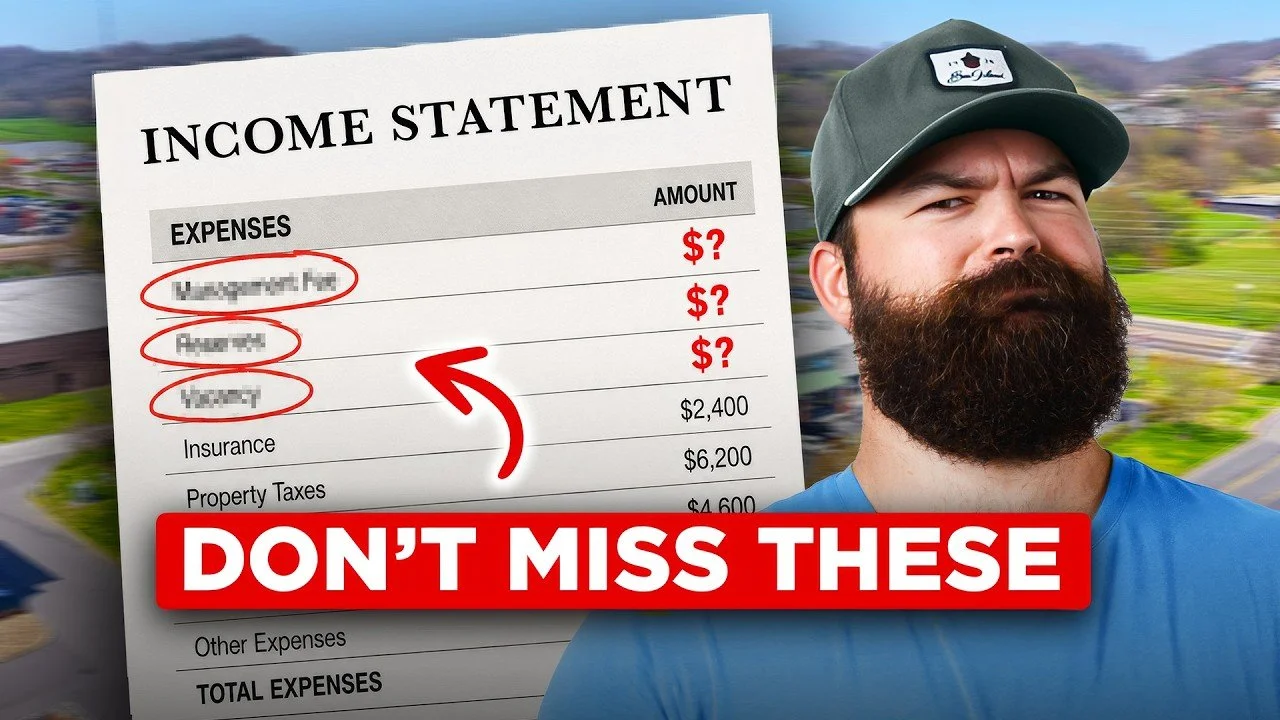
The Seller’s Numbers Are Lying to You
The seller’s numbers are only the starting point. In this Office Hours, I'll break down how to pressure-test a commercial real estate deal, spot missing expenses, and uncover what a property is actually worth. We’ll cover management, reserves, vacancy, and the underwriting mistakes that can make an average deal look like a great one.
Three missing line items can change the price by six figures. If you’re buying or underwriting commercial real estate, this is one you don’t want to miss.
Get commercial real estate coaching, courses, and community to jumpstart your investment journey over at CRE Central: www.crecentral.com
Key Takeaways:
OMs are sales documents, not truth documents – headline cap rates and “stabilized pro forma” are usually built on optimistic, not proven, assumptions.
Sanity-check income – don’t underwrite rents that no one at that property has ever paid, especially if the space has been sitting vacant for months.
Rebuild expenses – recalc property taxes at your purchase price, and target a realistic 30–35% expense ratio instead of trusting the OM.
Add the “missing three” every time – baseline 5–7% vacancy, market-rate property management, and capital reserves (e.g., per SF per year).
Price the path to stabilization – include TI, leasing commissions, and downtime to reach the seller’s pro forma NOI; that upside isn’t free.
Judge the deal on your version of the numbers – when Tyler rebuilt the OM, the deal went from a “7.25% cap, decent returns” to a 4.56% cap and negative returns.




About Your Host:
Tyler Cauble, Founder & President of The Cauble Group, is a commercial real estate broker and investor based in East Nashville. He’s the best selling author of Open for Business: The Insider’s Guide to Leasing Commercial Real Estate and has focused his career on serving commercial real estate investors.
Tyler Cauble 0:01
So the seller's numbers are lying to you. We're going to talk about how to rebuild, or I guess rethink an offering memorandum over the next 15 minutes. You know, just because a seller has put together numbers for you doesn't necessarily mean that those numbers are accurate. All right, so you need to be able to understand what you should actually be looking for as you're getting into these offering memorandums, because there's there's several things that we'll dive into today that really really stand out. So the building that we were talking about today, I have removed names to protect the innocent. I have changed some of the numbers around, but this is based on an actual deal that one of our accelerator members was looking at. Okay, so this is all based on actual deals that you guys see all the time. I mean, it's just because it's based on that one deal doesn't mean that it doesn't happen all the time. I see this every single deal that I look at, every single one. Okay, you get into it and it's it's the same rent roll, the same leases, the the same day that you're underwriting this deal, but the seller's offering memorandum will say that it's a 7.25% cap rate, and you're going to underwrite it, and it's going to be a 4.56% cap rate. All right, even though every number the seller is actually giving you is correct, right? So I'm saying the seller's lying to you, but they're not necessarily lying. They're not being untruthful. There's a pretty significant portion of understanding these numbers that comes down to you, and there's only you're the only one to blame for this. I guess is the point that I'm trying to make. So when most investors get into offer memorandums, what they do is they jump in, they read the cap rate on the cover. All right, and and we're based on the cap rate because we know, hey, there's certain cap rates that we can make work. All right, that's what's more attractive to us as investors. And cap rates also just allow you to analyze deals side by side on a very quick basis. So that has become the metric that we all pay attention to. Right? Typically, it's the first number on the page. It's the one that everybody's talking about. The next one is the expense ratio. All right, the expense ratio is the ratio of operating expenses on the property compared to the revenue that you're bringing in. All right, depending on the type of asset class that you're in, and then depending on the level, you know whether it's Class A, Class B, Class C. It's 1970s vintage versus 2005, right? Those are very different. They're going to have very different expense ratios. Generally, we're aiming for a 30 to 35 percent expense ratio. Can you do better? Sure. Can you do worse? Absolutely. That's generally where you're aiming, and anything higher than a 35% expense ratio starts to say to me, "Okay, this is probably not being run efficiently. And honestly, anything below a 30% expense ratio kind of says the same thing. And you're probably thinking, "Well, if your expense ratio is lower, isn't that better? Yes, to a certain extent. There is a certain amount of operating expenses that you are going to have to spend every year, no matter what. And if you are starting to cut those expenses out, you're probably going to create bigger capex issues for yourself later down the road, so Opex can help with the day-to-day maintenance. That will you know it's it's like making sure that you are maintaining your HVAC unit once a quarter instead of once a year. Could you decrease your expense ratio by maintaining your HVAC unit one time a year instead of four? Of course you can, but guess what? That HVAC unit is probably going to last five years instead of 12. All right, so you're going to create bigger issues for yourself later down the road. So I actually pay attention to that as well. And of course, the words stabilized pro forma. If you ever open up an operating agreement, or not an operating agreement, my goodness, I need more coffee. An offering memorandum, and the numbers are based on pro forma numbers or stabilized pro forma.
Tyler Cauble 4:08
All that means is that they have made up some numbers for you to show you what it could look like. It doesn't mean that that's actually what it's doing or what it could do. They're just saying, hey, this is what we think that you know you as the buyer would like to see. So we're going to put those numbers on the paper. And again, it's not outright lying, but it's also not entirely truthful, right? If you're saying, "Hey, the pro forma cap rate's 8% but you're going out and you're getting 15% higher rents than market, that's not achievable, all right. So the deal that we're going to be looking at today, it's 78% leased, and it's going to be priced like it's full. That happens all the time, right? The sellers will be like, "Well, you know, hey, you could easily rent these out, and then it's going to be worth, you know, what we're asking. So. You you should pay me tomorrow's price today, and I don't do that. I don't know why there's so many sellers that think that I should go ahead and pay them for the work that they haven't done, but I never do it. All right, unless there's just some sort of massive upside that I just think that the seller hasn't seen that I know that I can capitalize on. Pass. All right. Not worth my time. Let's see what else we got. Okay, and here here's why checking the math fails. Like I said, the offer memorandums not necessarily fraudulent. They're they're selectively assembled. You know, it's it's like in residential real estate how how good residential agents have gotten with the euphemisms, you know what I'm saying? So like, the house is cozy. Like, okay, I know that it's the tiniest house ever. It's quaint. Okay, it's very weird, and whoever designed it had no idea what they were doing. Right? They they come up with these words that kind of sound way better than they actually are. It's the same thing when it comes to these these offer memorandums. I mean, nothing is fabricated necessarily, right? They can actually like these brokers, these sellers will be able to point you in the direction of where these numbers are coming from, but they're not necessarily 100% possible. Like, yes, maybe they're real, maybe they can be attributed to something, but that doesn't mean that it's actually attainable. Okay, the math is also going to be correct, right? $145,000 over $2 million, so 145 kNOI over a $2 million purchase price really is a 7.25% cap rate, and they may really be making today $145,000 in net operating income, but we're going to dive into it here in a minute, and I'm going to show you why that may not necessarily be the case. Okay, the deception really comes down to what is absent, what is absent, what is not being accounted for in this offering memorandum, And again, it's not necessarily that a seller is trying to hide anything from you. These are numbers that you have to bring to your to the deal yourself. All right. So when you're going through, you're not necessarily planning on auditing an offering memorandum. You kind of have to rebuild it based on what you are truly looking at here, okay? They are giving you some data points, and then it is your job as the commercial real estate investor to go through and actually do something with those data points. Now, don't just listen to the seller. Don't just take the broker's word for it. Make sure that you are actually going through the process on your own, we see this all the time too. Why number one? A rent that nobody has ever paid. You've got two suites that are empty in this deal that we're looking at today. The offering memorandum has priced them at market anyway. Okay, maybe suites down the street are actually renting for $14 a square foot. Right, we're looking at 4000 square feet in the deal that we're looking at today. That that the owner, the seller, is saying that you could rent for 14 bucks a foot. Every lease signed at this property is 10 bucks a foot. Now I made this simple, you know, for for obvious reasons, but that could be between eight and $12 a foot.
Tyler Cauble 8:17
Okay, well if everything is rented in this building between eight and $12 a foot. Why do you think that I could get $14 a foot for this space over here, especially if it has sat on market for 369, 12 months more, and nobody has come by and rented it? That that always that always astounds me. There's no point in taking the seller's word for how much this is going to rent if they are have been unable to rent it. It's just a fact, unless they have other leases that they have executed on the property recently at the asking price that they are saying is market rent. Then their numbers probably aren't true, right? So the the market is voting. The market is telling you what the spaces are worth. If the seller is asking 14 bucks a foot and they are renting nothing, but everything is rented, you know, closer to 10 bucks a foot, that's probably closer to your market rate, and you'll need to have a little come to Jesus moment about what the true value of the property is because he's going to try and price it at 14 bucks a foot, which is what you should be paying because that's what market is, and you're going to want it closer to 10 bucks a foot because you are unable to get 14. You haven't been able to prove to me that that's actually possible here. All right. Line number two, the tax bill. Man, we see this all the time. People completely forget to update the tax, the property taxes when they're going through and underwriting these deals. Obviously, it's going to get updated when you buy it. Like no matter what you do, at some point that is going to change. Okay, but when you're underwriting a deal, don't take into account the seller's property. Taxes. It's going to change. It is going to go up probably, unless for some reason they really overpaid and you've gotten a hell of a deal. All right. In this scenario that we're talking about today, seller has owned it since 2009. Kind of a long time ago, right? It's probably not even assessed at the Right price, right? Which means that if they're paying $21,000 a year in property taxes, which is the seller's current annual bill, based on the new price, you're going to be paying $38,000. All right, that's reassessed at the purchase price that you are paying, okay, and actually in the deal analyzer, I'm going to show you guys too. We actually have a section where you can take your purchase price and your local millage rate, and it will calculate your you know estimated property taxes on its own. So you don't have to make these numbers up or guess at them. You can actually calculate this stuff so you can get a pretty good idea of what you're actually going to be paying. All right, this is one of the biggest single line items that will change at closing. It is it is guaranteed to change. Right, it's like what what's that saying? Death and taxes are the only things that you're assured in life. Your I can assure you, your property taxes are going to go up, and look at that. I mean, you know, the difference between $38,000 and what you're paying versus the OM showing $21,000-it's only 17 grand, all right. But that $17,000 could be the difference between you making a two times equity multiple over five years and you breaking even or losing money on a deal, it can add up, right? Over a five-year period, we're talking close to $100,000 that has not been accounted for. Very, very important. All right, and then line number three. These are the three lines that nobody enters. All right, again, the seller is not going to put these in an offer memorandum, because that's I mean they might depends, but look we're talking about vacancy, property management, and reserves here. Okay, vacancy. I don't care if a property is 100% occupied today. Good, great. What is the market rate vacancy? Because you need to account for that, there's a reason that a market rate vacancy is is never zero. Even if a market is 100% occupied in a snapshot, your building is never 100% occupied over the long term, even if it is in a certain snapshot.
Tyler Cauble 12:35
All right, we typically throw a five to 7% vacancy rate on every building, it doesn't matter if it's a single tenant net lease Starbucks with a 15 year lease in place. Does not matter. It is getting a 5% vacancy rate thrown onto it. Two reasons: one, that allows me to account for vacancy over the 15 year period. All right, so I get 5% vacancy added up every single year. That might come in handy down the road. Unfortunately, if Starbucks, for whatever reason, or whoever it is, right? It could be Dollar General. Could be you know take five oil. Doesn't matter. Could be you know the local mom and pop biscuit shop. That adds up over time, so that when I have 100% vacancy for 346, months, it basically washes out. Okay, and so that is how banks look at it. A bank will look at a deal like this, and they will say, "Okay, great, Tyler's buying a Starbucks that's 100% occupied. We're throwing 5% vacancy on there because we're not going to give him credit for this being 100% occupied the entirety of the time that he has it. Okay, very important for you to keep that in mind. I'll see investors skip that because they're like, "Oh, well, it's 100% occupied. I don't need to account for vacancy until until later on, and that's fine. But it's going to bite you in the ass, and a bank is going to discount it on how much they're going to give you anyway. So you might as well underwrite it on the front end. Property management, and you can see we've added some numbers in here for what the management actually costs. I think this is like 4% on this deal. Call two to three local managers and get an idea of what the property management is actually going to cost you. Get an idea of it because if generally what I see when people make a mistake here is that the seller is managing it themselves, and then the buyer is thinking they're going to manage it themselves. Okay, that's great. I'm really glad for you that you want to get yourself one of like a full time job. Okay, that's what that is, right? You're picking up a a new w2 role for yourself for $7,000 a year in this instance. All right, not worth it, by the way. Not it's hardly ever worth it to self manage until you have enough properties. Go out and have somebody else do it because it's one. It's going to be easier on you. Two. You need to account for it anyway. Even if you are going to be the one that is managing the property, you have to account for it. What happens if you get hit by a bus tomorrow? Your family is going to have to step in, or your partners are going to have to step in, and they're going to have to hire a third-party management company. Which means all of a sudden, that pro forma that you put in front of them no longer pencils because you didn't account for market rate property management fees on the front end. We do market rate for everything, even if the partners are bringing it to the table. I don't care. You happen to be getting the job because you're a partner and because we think you're qualified, but you're not going to give us a discount in exchange for more equity, like that stuff never happens. We pay market, or I'm not going to get a discount just because you're a partner, right? We pay market rates, market rate for property management, for leasing, for construction doesn't matter because again, if I have to fire you off the job because you're not leasing the building, I have to go hire somebody else. The numbers still need to work, and then reserves. All right, reserves are the amount of cash that you are setting aside every single month to make sure that you have cash there on hand just in case something comes up, because it always does. Guess what? You're not often buying a brand new building, which means that you've got a roof system, HVAC, plumbing that has all been there before you were there, and you don't know how it was treated, how it was constructed. You don't know how it's been taken care of.
Tyler Cauble 16:31
Okay, so you need to make sure that you're accounting for something every single month, just setting some money aside. Now, at the end of the deal, if nothing ever comes up, good for you. You've got a pile of cash sitting there waiting to come back to you, all right. But it's good to have that on hand so that you don't have any surprises. You need to be taking that out of the cash flow every month. So these are numbers that aren't even hidden by the seller. They're just typically not accounted for by the seller because that's not their problem, right? That's your problem as the buyer. You need to think about that when you're going in and pulling these from an offering memorandum, and then lie number four: what it costs to go and get it. Just because you have vacant space and you could very easily get it leased up doesn't mean that it's going to be free, right? You might have to spend $60,000 on tenant improvements for 4000 square feet-that's empty. That's only 15 bucks a foot. I mean, to be honest with you, 15 bucks a foot gets you paint, carpet, and might get you some new ceiling tiles. It's not going to go very far. You're probably going to be spending 10 to 15 bucks a foot, no matter what. All right, especially if you want a good quality tenant. Tenants are expecting you to invest into them. I'm not going to turnkey it. I want them to invest in themselves as well. But that's pretty normal. You also got $8,000 in leasing commissions. That's 4% on a five year deal. That's do it signing. I mean, you're not going to get that for free now. Can you go and lease these properties yourself? Of course you can. Are you going to represent yourself in a DUI case because you can, you know, get on ChatGPT and ask it how to represent yourself like an attorney? No, it's really stupid. If you have never gone out and leased commercial properties before, not only is there a massive learning curve in finding tenants and touring tenants the right way and keeping track of all of that and marketing, but also you got to know how to negotiate and what to negotiate and what is market for $8,000. Just hire a professional that does this every day, that has a lot of experience, that has the contacts, that has the the relationships that you need, right? And of course, you could have nine months of downtime, right? This space specifically that we're talking about this example today has been on market for 14 months already. Okay, that if you actually get it up and running and marketed the right way, it might take you another nine months to get at least up. Okay, so we're looking at at least $68,000 to chase the income that the seller is trying to book for you, and get value out of. Unacceptable, ridiculous. So what we're going to look at today, it's I'm going to go through our underwriting on this, you know, quote unquote offering memorandum that we've been talking about. The OM says that it has a $145,000 NOI annual NOI. That's a 7.25% cap rate based on their ask. The rebuilt version of it is going to show $91,208 of NOI. That's the real NOI. That's a 4.56% cap rate at the ask, and it makes a huge, huge, huge difference when you're going into this. Now, here's the other thing. Here's the caveat that I want to throw onto this conversation. Some of this stuff is a big deal between you and the seller. All right. Some of this stuff really matters. Right. Property management. Those are fees that need to get back baked back in because everybody's going to have that fee. But some of this kind of just falls on you, and that's a that's a part where you're you're not necessarily going to be able to go back to the seller and say, hey, you know, you're telling me the NOI is 145,000, but when I run my numbers because you know the property taxes are changing. It's no longer 145,000. I want to get a credit until it gets to a true 7.25% cap rate based on the net operating income that I think I'm going to get. They're going to say pound sand.
Tyler Cauble 20:32
That's not my problem. You can come in here and do whatever you want with this property once you've got it. It's not my fault that your property taxes are going up. All right, my property taxes went up when I bought it, so keep that in mind. There's there are certain aspects of this that it does make sense for you to go in and negotiate, and there's some things that just zero chance. Okay, all right, let's let's get into this real quick and take a look at this deal. So we'll run through this real quick. This is Maple Grove Commons, a little 18,400 square foot building built in 1998. We're buying it for $2 million. By the way, actually, I need to shrink my screen so you guys can see this a little bit better. I will get to y'all's comments here in just a minute. We are live, so if you have any comments, you have any questions, anything like that, I will get to those as well. Let's see here. So we've got a $2 million purchase price. Oh yeah, this is available on TylerCabble.com/Analyzer. Like, if you want to use this underwriting tool for free, you are more than more than welcome to go check that out. Closing costs one and a half percent, down payment 30% interest rate 7% I went with a 25 year amortization. Feel like we're working with a local bank. I'm feeling a little frisky. Generally, that's always 25. year loan term, 1% origination. Okay, none of that really matters. Here's here's the big thing. We're looking at six tenants. Okay, and if you go through this, every tenant is at 10 bucks a foot. All right, the existing tenants are all $10 a flood. Differently start dates, and then we get down to suite 140, which is vacant, and they are asking $14 a flood. Right, so if we're underwriting this based on what the seller is saying, which is what this version is, it's 14 bucks a flood. Okay, I'm going to ignore my second generation assumptions for a minute. Okay, operating expenses: we got $21,000 for real estate taxes, 10,500 for insurance, 6000 for utilities, 13,500 for repairs and maintenance. Notice how we have zero for a management fee. The miscellaneous is four grand. Opex goes up 3% per year. We're not even going to bother with the cost seg because it's not going to matter for this example. We are going to exit this deal in year five at a seven and a half percent cap rate with 1% closing costs and 6% commissions. Let's see how this shakes out. So over the five-year period, we're looking at an average debt service coverage ratio of 1.45. That's pretty good. A projected IRR of 12% not so hot. I typically like north of 15% 12% not bad. I mean, it just depends on if it's your first deal or not. All right, annualized cash on cash. This is pretty good, 13 and a half percent. We like to see that, and an equity multiple of 1.68. I like to see closer to a two times equity multiple. That's just what I like to see when I'm going through my own deals. So key metrics: I'm bringing $600,000 down. My closing costs are 30 grand. My origination fee is 14. So total cash to close and carry is 644,000. Year five NOI gets up to 172 137. Not bad. All right. Let's see gross potential rent. Okay. Now this was based on the seller's numbers. So what I want you guys to to take a quick look at right here is the deal snapshot. This is all. This is like the thermometer, right? I like to look at this to immediately tell how a deal is doing, and then we can of course dive into all of the different, you know, the rent roll, the cash flow, the returns, sensitivity, whatever. We can do, all of that. But this is our snapshot. Okay, 145 DSCR, 12% IRR, 13 and a half percent annualized cash on cash, and a 1.68 times equity multiple. Now let's go through here and let's update everything as to how it would actually be if we were buying this, how things would change. First thing that I've got to do is change the rent on the vacant suites. Number one, we are not getting 14 bucks a foot.
Tyler Cauble 24:51
Maybe we can push it, but I don't want to put too much money into the space, so I'm just going to say, hey, we rent it for 10 bucks a foot. Well, guess what? I've also got to pay leasing command. Okay, the seller didn't tell me about that, and they're offering memorandum. So I'm coming in here. I'm updating the price per square foot. I'm adding in some leasing commissions. That will change everything that we needed to there. Okay, property taxes. Let's go down to the operating expenses. Right now we've got 21,000 in here. Again, if I want, if like in this calculator, guys, if you just click this tab right here, model property tax reassessment at purchase price, you'll do your assessed value ratio, your mill rate, and then it'll tell you what that actually is. And you can just look that up in your local municipality; they'll tell you what your assessed value ratio is and your mill rate. We're moving our property taxes to 38,000 for this property. Once we close on it, that is what they will be. Vacancy-they have no vacancy. See, our baseline vacancy rate is 0% because they're saying everything's going to be leased up. Okay, well, we've got to have at least a 5% baseline vacancy rate getting into this. Going back to our operating expenses, they did not have a management fee whatsoever, and that's just not going to be the case. We're going to add in 4% there. It's going to completely change, and then down here too. Again, capital reserves right here. We need 25 cents a foot per year. All right, that's going to set aside what roughly three four grand a year. So if a HVAC unit goes out, we've got the cash set aside to do that. Okay, now let's look at our returns. Oh, our debt service coverage ratio went from 1.45 down to point nine eight. We are no longer carrying the deal. Projected IRR is a negative 26% This is still over a five year period, by the way. Annualized cash on cash return is a negative 15.6% Equity multiple is point two two. That means for every dollar you put into it, you're getting 22 cents back. I don't know about you. I wasn't a math major. I could tell you that math doesn't look good. All right, total cash to close and carry went up by $69,227 because of our interest carry reserve. What the hell is that? Well, if we go over to our cash flow, look at this. Property cash flow is negative every single year. So the calculator is telling us, "Hey, you've got to bring enough cash to actually carry this deal throughout the term. The deal doesn't work. All we did was change the numbers to what the seller was currently getting, not based off of their really highly overly optimistic approach. That is how drastically these deals can change when you start to think about the things that you're going to like, how you are going to have to operate it versus how the seller is saying that you should be doing it. Okay, so when you're getting into these offering memorandums, the seller may not necessarily be lying to you, but that offering memorandum is not telling you the whole truth. So you need to know what to account for when you're getting into your underwriting, so that you don't miss things like this. All right. Again, this analyzer is available for free. TylerCabble.com/Analyzer. Get in there, play around with your deals. There is an AI version of me in there, which is kind of wild. It's based on all of the coaching calls that I've had with our Accelerator Mastermind members and the feedback that they've gotten. So you can actually go in there and ask it questions, and you'll get some like strangely Tyler optimized feedback for you and your deals. So, all right, let's get to let's get to your questions, guys. Let's see what's going on here in the comments. Hunter saying, "What up? Good morning, good morning, Hunter. Good to see you, man. Garden man, good morning, Tyler. First of all, congratulations on your marriage. Wishing both of you a long and happy life. I appreciate that, Garden Man. If y'all missed it, we got married back in November, so we're coming up on our one-year anniversary. Pretty exciting.
Tyler Cauble 29:04
We're actually going back to Japan this year too. Jason's back in the comments. He focuses on Florida, Sarasota, Venice, Tampa. He buys commercial flex, parking lots, industrial land, any size. Jason is also in the accelerator, and he is crushing it. So if you guys have any deals that fit that criteria? Reach out to Jason. Let him know. Husnihart saying, "Sup, guys, what's up, Hosney? Good to see you. Mike is saying, "You do anything outside of Florida? Oh, he's talking to Jason. Cool, Mike. I pay property taxes based upon the state and county assessor office, and they make those numbers available. Yes, that's correct. Yep. Let's see. Windermere saying assessor doesn't assess at sale where I live in Washington State. That's a good point. Every municipality is different. You know, there are some municipalities that will reassess immediately upon sale. There's some. Do it every couple of years, every two to three. There's some that do it every year, so make sure you understand that too, because every market will matter. Yep, Mike Shaver saying the same thing. Annual property tax is different depending on the local jurisdictions. Yep, yep, yep. Ted is saying good morning, good morning. This is hilarious. Hunter is saying Tyler with AI instead of Y. AI Tyler is Tyler. I like that. That's great. Let's see. Ted is saying, when can you tell if an area is overbuilt? Ted, the best way to tell that is just by looking at absorption rates. How long something is sitting on market, okay. So if you've got some nice retail coming online and it's just sitting there, like nothing is getting leased up, that probably tells you there's not a whole lot of demand in that market. That's generally what I'm looking for. So go in and look at how much is being built in the market, how much space is currently available, how long it has been sitting available. Okay, all of that is a great way for you to tell if something is overbuilt. Luke is saying good morning from Minnesota. Another very helpful episode. Luke, glad to hear, man. Thanks for joining us. Good to see this morning. Guardman says, I keep saying this. You are one fantastic asset. FYI, I signed up for the calculator, but have not been able to access it. Guardman, shoot me a message on Instagram, and I will help you figure it out. Because it is-it's in the same access as our Accelerator Mastermind, which is pretty cool. So, be happy to happy to help you get it figured out there. All right, guys, appreciate you all for joining us this week's office hours. Time for me to go sign a loan for a storage deal that we are doing, headed down to Franklin to knock that out. Every Tuesday, 830 a.m. Central Standard Time, we are going live. I'm answering your questions. I'm teaching you guys a couple of things. We're having conversations. Whatever you want to do, jump in the comments. Let me know whatever you've got going on. We'll take a look at it. Appreciate you guys. We'll see y'all in the next one. This episode of the Commercial Real Estate Investor Podcast is brought to you by my CRE Accelerator Mastermind, where you'll get access to my step-by-step investment blueprint, essentially a library of resources on how to invest in commercial real estate. You'll get connected to a supportive community of other commercial real estate investors that are doing projects just like you. You'll get personalized coaching and feedback from me every step of the way. Go to www.crecentral.com to learn more.