
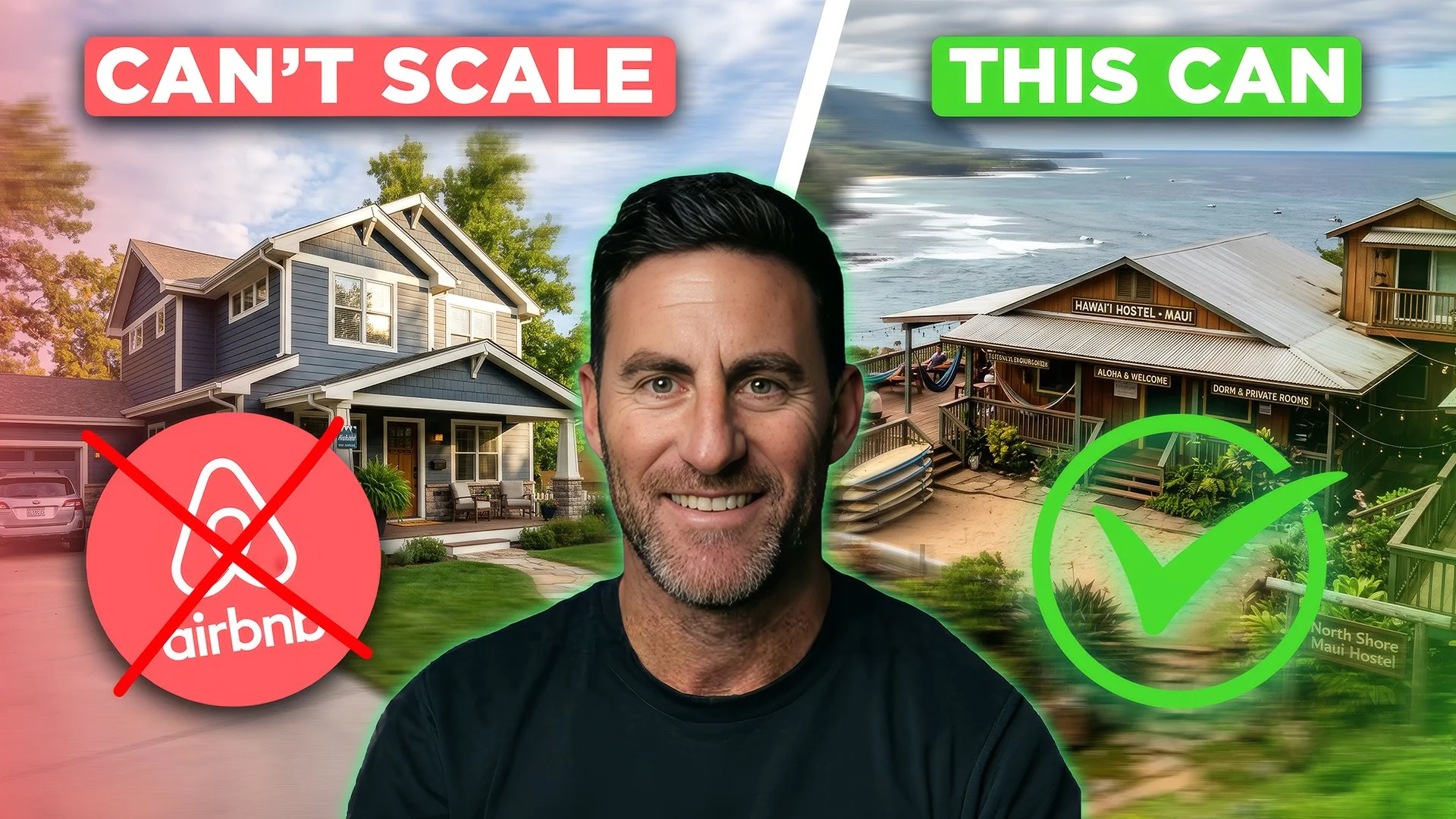
He Stopped Buying Airbnbs and Built a $20M Hotel Portfolio
Michael Russell built a portfolio of luxury Airbnbs in Maui and then regulation shut the door on scaling any further. So he did what most investors wouldn’t: he bought a hostel in the middle of COVID, when occupancy was zero and everyone thought he was crazy.
Today that hostel is the number one hostel in North America. And his real estate portfolio is worth $20 million, built without raising a single dollar of outside capital.
In this episode, Michael breaks down the full journey from residential homes to short term rentals to commercial hospitality, why he made each jump, and what the math looks like when you stop renting one room at a time and start running a hospitality business.
Including this: same 400 square feet. $200 a night as a hotel room. $480 a night as a hostel. That’s not a typo.
What you’ll learn:
• Why Airbnbs hit a scaling ceiling fast and what to buy instead
• How Michael bought his first hostel during COVID for a fraction of its value
• The financial case for hostels vs. hotels vs. short term rentals
• What a realistic return profile looks like for boutique hospitality (and why 20%+ IRR is the minimum worth pursuing)
• The one thing Michael wishes someone had told him before buying his first hospitality asset
Get commercial real estate coaching, courses, and community to jumpstart your investment journey over at CRE Central: www.crecentral.com
Key Takeaways:
Buy when others are scared: Michael bought post-2008 and during COVID, using fear-driven discounts to build a $20M portfolio.
STRs → Hostels: Started with Airbnbs in Hawaii, then pivoted to hostels due to regulation limits and desire for a more scalable, centralized operation.
Hostel strategy: Not “cheapest bed” but best social experience—design-forward common areas, events, and strong community vibe.
Economics: Same-size room can earn more per night with bunks (e.g., $480 vs. $200), plus partial occupancy still produces strong revenue.
Returns & risk: Targets ~20%+ IRR, 2–3x equity multiple, but with higher risk, longer holds (5–10 years), and heavier operations vs. multifamily.
Big lesson: Don’t do your first hospitality deal solo—partner or get a mentor/mastermind to avoid costly mistakes.
Portfolio fit: Hospitality offers a hybrid of strong cash flow + equity upside if you can execute on both real estate and the operating business.

About Your Host:
Tyler Cauble, Founder & President of The Cauble Group, is a commercial real estate broker and investor based in East Nashville. He’s the best selling author of Open for Business: The Insider’s Guide to Leasing Commercial Real Estate and has focused his career on serving commercial real estate investors.
Episode Transcript:
Tyler Cauble 0:00
This
Tyler Cauble 0:05
episode of the commercial real estate investor podcast is brought to you by my cre accelerator mastermind, where you'll get access to my step by step investment blueprint, essentially a library of resources on how to invest in commercial real estate. You'll get connected to a supportive community of other commercial real estate investors that are doing process. Are doing projects just like you. You'll get personalized coaching and feedback from me every step of the way. Go to www.crecentral.com to learn more. Michael Russell is co founder of Malama capital and housed at hostels. He's got over 20 years of experience in the real estate world, and today we're going to be diving into how he got started, what moved him into the commercial realm, how he got into hospitality, especially considering the fact that I just opened up my own hotel here pretty recently, and he has the number one hostel in North America. We're gonna be picking that apart. I want to know more about that. How do you get an accolade like that? Michael, that is a very brief introduction of you, but tell us a little bit more about your background and how you got started.
Speaker 1 1:08
Yeah, appreciate being on the show. Longtime viewer, first time guest. But yeah, so I think that you know short term rentals, really is what introduced me to hospitality. And I'm happy to go into where my short term rentals are, because that was really, I think, the springboard to my path in hospitality. But I will touch upon prior to getting started with short term rentals, I started investing in residential homes right after the Great Recession, and I think that this is an important detail, because, you know, I feel like there's these windows of time that really, you know, there's these buying opportunities. And, you know, everyone always talks about how there's, there's no bad time to buy real estate, and that might be so. But what I found in my own, like just my little career arc here is that there are good, better, best times to buy real estate, and the best times to buy real estate is when everyone is fearful. And so I got very fortunate that I recognized an opportunity right after the Great Recession. There sort of around 2009 2010 I was like, Wow. I was looking at these residential homes, and I started realizing, like, wow, the the prices with all of these short sales and foreclosures, they're so depressed that they're selling these homes for below replacement costs. And without having to be very sophisticated with real estate, I just recognized this is an ultimate buying opportunity. Problem. Was, like most folks that are starting on real estate, I didn't have any money, and so I just read all the books I got, all fascinated with real estate. I saw my trajectory, and I just didn't know how to get money. And I was a 20 something year old kid, so it's not like I was the most experienced, or I could go out and raise capital, but what I did recognize that I could go and I could hustle, and I could go get a sales job, and I could go and just try to make as much money as possible to be able to funnel that money into real estate. And that's exactly what I did. The short version is I just lived very humbly. I got a high paying w2 job. I put my head down. I lived modestly, and I just worked and worked and worked. And every time I had enough money to go and put enough money down for a down payment. I did so, and I took out hard money loans, and so there was a little bit of work ethic there, and a little bit of risk taking and a vision. You know, I had a goal to go and buy five single family homes in as quick of a period as I could. Because I just, like I said, this window was a unique opportunity. So I had that foresight, and I didn't I wasn't able to buy five homes. I was able to buy three, but hey, that's a great start. And so I bought these three homes, and over the course of those couple three years that I was able to do so, naturally, prices appreciated. And basically, what I bought those homes for they doubled in value in a relatively short period of time, and that's where I got the capital to go and buy my vacation rentals. Now I am skipping some steps here, but I ultimately moved to Hawaii, and I recognized that in Hawaii there was an opportunity to buy short term rentals because of a lot of factors. They're just they do very, very well. And so I was able to take the money from those initial residential homes that I bought, and I did a 1031, for two of the three homes, and I was able to buy two vacation rentals over a period of two or three years. And so that was my introduction, so to speak, to hospitality. And I realized, wow. So with real estate, there's two ways that people typically approach how to make money, either through cash flow or through equity. And with the short term rentals, they were really cash flow positive. Like, beyond anything I'd ever seen. You know, when you evaluate multifamily, for example, everyone talks about the equity cash flow is very low. And my goal at that point in my career was I want to get out of my w2 job. I had done it for four or five, six years, and I had dreams and aspirations to be financially free and to also live on Maui and enjoy a great life here. So I started thinking about, wow, if you know these short term rentals are producing so much money, well, what's the next step that led me to start evaluating commercial real estate. That's kind of a whole like, like, explanation of how I got to where I'm at in a short story. Why would you take a pause there? But that's what ultimately led me to discover hospitality and the potential of combining commercial real estate with hospitality, and that's where I'm at now,
Tyler Cauble 5:54
I'm curious about this because you moved from California out to Hawaii, right to very different markets. Before we dive further into, you know, the rest of your real estate portfolio and how you approached everything. What was it like wrapping your arms around a brand new market?
Speaker 1 6:14
Well, the thing about Hawaii, it's, it's pretty obvious, you know, there's, there's basically no seasonality. And the hardest part for me to get adjusted was a little bit of the pricing shock, because things are more expensive here. And so, you know, in relative terms, I got a super low price for the real estate that I bought. But at the time, I ended up buying a $1 million home, like, to me that was so much money. Now, I know in a lot of parts of the country, that's still it. I get it, but over the last almost, it's not quite a decade, but since I bought that first home, I mean, the prices have doubled and sometimes tripled, and it's just crazy expensive. So that's like, that's like a little bit of a mind bender, is to think like, Wow, can I really go and take on that, that, you know, go and spend a significant amount, or commit to spending a significant amount of money. That was, that was, like, the hardest adjustment. But as far as, like, the metrics go, when you just evaluate, like, Okay, I was, like, a crazy person. I would write down the math like, just on a piece of paper over and over. I just couldn't believe I'm like, Okay, this thing is going to be occupied 8085 90% of the time, because it's just evergreen, hearing why all these people always want to come here, and the nightly rates that charge and the limited supply, it just seemed like this golden goose. I just couldn't believe I was, like, asking other people over and over, Am I Am I crazy? Does that? Does anyone else see what the opportunity here is, and that at that point in time, like, Airbnb was still a relatively new company. This was 2015 Okay, I'll be specific. Like, when I kind of started this, short term rentals were around, but they were a little bit less, like, they haven't really been introduced yet to the full market. People weren't as familiar or as comfortable, like the concept wasn't as widespread, and so I don't know that everyone fully recognized the value opportunity in short term rentals. So I was a, I was a relatively early adopter to that market, and that that took a little bit of, I don't call it guts, but it was, it was a little bit of a risk to jump in.
Tyler Cauble 8:22
Yeah,
Tyler Cauble 8:22
in. Yeah. I mean, 2015 is pretty early, right? I mean, because they started Airbnb, I think around 2010 give or take, is when the company was founded. And, you know, I don't even think that I realized what short term rentals technically were until around 2015 so the fact that you were already, like, going all in, buying these Airbnbs and make it happen is, is pretty impressive. So you're running these Airbnbs for a few years, and I believe it was around covid, you decided to go out and buy a hotel or a hostel. Tell us. Tell us about that. What was it like going from the experience of running a couple of Airbnbs, right? Which is, which is basically one guest group at a time to multiple groups, an actual operation, like a whole hospitality operation, essentially,
Speaker 1 9:11
yeah, well, it came in pieces, right? You learn as you go. You learn by doing. I didn't have it all figured out. I knew that there was significant demand, just from like, just tourism in general, and so I made the leap to want to go and get into hospitality prior to covid. Covid was a blessing and a curse, right there some advantages and disadvantages in the hospitality market. But for me, what I recognized was, hey, these short term rentals. They're doing really well. How do I scale this? How do I get more of this? But right around that time, there was regulation that was coming into place, and the writing was on the wall that while prior, you know, to 2019 or so, they're pretty loose about enforcing. Rules and regulations. People were renting their homes and technically doing so illegally. And what happened was legislation started passed to where I could sense that they were going to shut down anyone that was renting else without a permit. But we had two permits. Problem is we couldn't get any more. We were maxed out. And so that's where I thought, Wow, this hospitality game is pretty cool from a cash flow perspective. Here's what I noticed. All the education out there, most much of the education out there relates to multifamily and like anyone that types in how to make money in real estate, you're inevitably going to be hit with someone selling a course on how to buy apartment buildings. And so I enrolled in a course to buy apartment buildings, and quickly really understood the value proposition of if you can increase net operating income, then you could force appreciation. And instead of single family homes or short term rentals, like what I own, where you're reliant on a comparative analysis, what are the other homes worth in the neighborhood. I was really attracted to the idea in commercial real estate, through either cutting cost or increasing revenue, you can drive tremendous value upon exit. And so I kind of connected the dots between short term rentals and commercial real estate or multifamily. And said, Well, how can we do this with hospitality? Problem in Hawaii is most hospitality assets are $30 million or more, and that's not really feasible for someone like me. That's just an independent person. And so through a conversation, someone referenced that, oh, there's these hostels that are operating in Maui. And I called him up and I asked him how much it would cost. And then I asked him, Well, how many beds Do you have? And I quickly did the math on what they were generating per night in revenue. And I was like, mind blown. Like, wait, what? How much are you generating in revenue? Like, of course, the person that's manning the phone is not going to tell me, but I did the math and I kind of reverse engineered, and I was like, wow, okay, this is the perfect mix to be able to scale up from short term rentals into commercial real estate, and do so at a price point where I'm not buying a $30 million asset. And so at the time, there were no hostels available for sale. I called every one of them, and they were all just fine, but me and my business partner, we located a commercial space that was zoned for hospitality, and we started going through the process to convert this retail, like, like building into a hospital. We hired the architects, the engineers, we probably put, honestly, close to 100 grand into this conversion process because we had the zoning we just had to go through the right ministerial steps, and unfortunately, that's right about when covid hit, we were through that process and pretty much wiped us out, because the conversations that we had with banks describing how we're going to open up and build we needed a construction loan to build accommodations that would be shared during the very beginning of a global pandemic. You can imagine those conversations. They ended quickly. And so we kind of, we got punched in the gut a little bit. We were stuck then with this property that we had intended to convert into a hostel, and we had to pit it, we had to have some hard conversations, and we're also we bought this property out of bankruptcy. We got a smoking deal, really low price on this property that we bought, but we bought it with hard money, and there was a ticking time bomb. That hard money note was going to be due, and we had to figure out, well, What's plan B? Now I will say we, you know, weren't naive enough to go into this just without a plan B. We knew, Okay, worst case scenario, we'll turn it into a, you know, we'll continue to operate it as a retail space. We'll just operate a little bit better, and that's ultimately what happened now, when covid hit and the world was ending, we didn't give up on our dreams. We had the resiliency to say, well, let's go revisit and have a conversation with some of those hostel operators that wouldn't give us the time of day before. And we went, door, knocked, and sure enough, one of them was like, Yeah, I'm ready to sell. The world is ending. I've got zero occupancy. I'll sell you this thing at a fraction of what its real value is. And he was ready to just start to walk. So covid destroyed one dream, but when one door closed, another one opened up, and we were able to buy an existing hostel for a fraction of its value, because it was right in the beginning stages of covid. And everyone was fearful. And just like I brought up in the wake of the Great Recession, this was another window a buying opportunity, and it felt very familiar. And so everyone was fearful. We jumped in and we bought this thing. And. We were closed down like when we when we were under when we went under contract, you were not allowed to stay at the hostel. So that was an interesting choice. A lot of people were like, Are you guys crazy? What are you thinking? But we knew, or we hoped, we're optimistic that things would turn around, and that's ultimately why we're able to be so cash flow positive now is because the basis in which we bought originally was so low. That's
Tyler Cauble 15:26
the that's the beauty of buying when everybody else is scared, because you can get such great deals and you can't get good deals when the market's great, right? I mean, you know, and people that aren't in the real estate industry, you know, when Nashville was just absolutely booming in 2018 or 2021 they'd always say, Oh, you're in real estate. Like, I hear it's great. It's got to be a lot of fun. And like, yeah, the market's doing really well, but it's actually the most competitive time. It's one of the worst times to get a deal, because you have so many buyers competing over the same deals that they're just driving prices up. It's actually not a good time for buyers when the market is pretty good. So you guys really timed that well, or, you know, the timing came to help you out on its on its own there. Why go into hostels? Why not scale the Airbnb side of things?
Speaker 1 16:16
It's much more difficult to scale. It's like, you know, operationally speaking, you're you're not able necessarily, to hire a centralized staff, you know, the having well, particularly in Hawaii. I mean, the simple answer is, we couldn't scale their regulation was preventing that from happening. Now I know that a lot of people own larger portfolios of short term rentals on the mainland, but being in Hawaii, logistically that was not attractive to us. We just we didn't really have the ability to manage all these properties remotely. And so I think that's the real answer. Number one is that just logistics prevented us being 2500 miles away from the California coastline, for example, at that point in time seemed operationally difficult. But also, now that I have three short term rentals, I also understand when I can compare that to what I have with the hostels, it's more involved. It's like the short term rentals require a lot more. There's just a lot more moving parts. But operationally, it doesn't have a scale to just delegate and to have someone take care of it. So as an owner operator, I'm I'm more involved, and I just didn't want to continue that process. It seemed more attractive to build like a legitimate business?
Tyler Cauble 17:43
Yeah, I can feel that completely, because we, you know, before the pandemic, we managed our property management company managed about a dozen short term rentals in Nashville. Nationals are such a strong market for that, and we were exhausted. It was like, Okay, well, with a dozen under management. We either have to now scale to like 24 or 30 overnight, or we have to stay where we are, like in because there's, there's these, and I'm sure you're aware of this, but there's these segments where it's like, okay, if you you know from one to two units, it breaks. From two to four units, it's fine. The fifth unit, it breaks again. Like your your systems, your operations, you have to keep changing that. And it's just, it's a logistical nightmare, which you know, whereas with the hostel, you can have that many units in one location, with one manager, your cleaning crew shows up to one location. You can throw events, you can do all that kind of stuff before we get further into this hostel specifically, and what you're offering there, and how you actually run the place. Talk to us about the renovations. I mean, you converted it from, you said, a rundown, you know, retail building into the hostel. What was that like?
Speaker 1 18:56
Well, okay, let me be clear. So our first attempt at the conversion was buying a retail space and going through the process of converting that during covid, because that got shut down, we pivoted. We went and bought an existing hostel. Now we did perform a significant amount of improvements to the existing hostel, but that is a separate property than than that original retail what we saw with the first hostel that, with mind boggling was we had an operator that was like, just, you know, there's this concept of hostels with being kind of dingy and just being a low budget place. And like, the real value is that, oh, it's just the cheapest place to stay and look I own luxury short term rentals, like mom color from perspective of like, how do we provide the most amazing experience? Like, how do we pour into design and artwork and amenities and so not all of that is going to apply to a hostel, but my my frame of reference was. Was, I don't want to own something that I'm not proud of, that's dingy, that's dirty. And so we started looking at other models that were out there. And you know, in Europe, fossils are, they're they're a lot more established. There's just many more. And so we looked at some of the European companies, one of which is called generator. Generators is huge, like billion dollar hostile company. They're massive, but they're really designed forward. They're edgy. They have, like, graffiti and, you know, some of their artwork and such. And they have really good lighting and designs, and they have fun atmospheres where people they want to congregate and hang out. And just the whole ambiance is it doesn't ooze dingy, cheap place to stay, it oozes social and fun and useful. And that's kind of what we envisioned us like. That's what we wanted to do with this property in Maui. And so the owner was just, for lack of a better word, he was just cheap. He just didn't want to spend the money. And so he just had this thing for 25 years, and there was a lot of deferred maintenance. He had this ground floor, beautiful space, massive space, with 14 foot ceilings and just beautiful wood support structures, like it's 100 year old building, and beautiful windows that overlooked the street and it was all closed up. He had a bunch of storage in there, like nasty, just old paint cans and, like, it wasn't being used to get people going just directly upstairs to where their accommodations are. And what we noticed is, oh my gosh, this could be a hangout area, and that's exactly what we did. We completely converted the storage space into this beautiful common area, place where, if you can imagine now, when someone walks into the hostel, they're immediately hit with bright, vibrant colors, beautiful like furniture, new counter space that invites people to to gather. There's, there's tables, there's things like pool tables and foosball. There's a stage where people do karaoke. There's there's a little mock bar where, you know, we host events where people can, you know, have Margarita night. And so the whole ambiance of the place is, what we're offering is no longer the cheapest place to stay. We're offering a place where, if you're coming to Hawaii and you want to meet other people and have a good time, then you're going to want to stay with us. In fact, you could go find, these days, an Airbnb, and maybe there's two or three, you know, travelers together. It would be cheaper. They still prefer to come and stay with us and stay in shared accommodations. Because when you're in your 20s, you know you know, you want to be where the party is. You want to be where others are. You want to meet people from all over the world. And so that's really the driving force, is we are no longer the cheapest place to stay. We are a place where people come to gather and to socialize, and we do still value safety, security, you know, belonging. So all of these kind of core values is what we bring, and that's a very distinct difference than your typical hostile stigma of, oh, it's going to be gross, it's going to be kind of dingy, and it's going to be cheap. We're none of that.
Tyler Cauble 23:15
Yeah, I've actually really thoroughly enjoyed my experiences in hostels. You know, we've we've stayed at some in Mexico and and you know, they're really socially forward, which I think is a unique experience from most, you know, hotels, motels or other Airbnbs, other hospitality experiences. So you have this opportunity to create something really unique, create an experience that you know your guests wouldn't necessarily get elsewhere. Break down the financials for us, though, by comparing a hostel to an Airbnb, because I would imagine most solicitors are probably pretty familiar with how Airbnbs work, but hostels are a different story.
Speaker 1 23:54
Yeah. So in our hostels, we have private rooms, we have four bedrooms, and we have eight bedrooms. And actually now we have six bedrooms as well. So look, I'll break it down like this. Let's say, in Hawaii, it's very difficult to find something for $200 a night. But if we just go that route and just say, you know, hey, let's compare $200 a night hotel room. And let's say we took a look at our we'll just cut it down the middle. We'll say our six six bed dorm, at 80 bucks a bed times six beds. We're going to take the same roughly 400 square feet or 500 square feet room, and instead of collecting $200 a night, we're going to collect $480 a night. So the economics are clear. We're just we're able to get a higher volume, we're able to maximize the density per square foot, to get more revenue. And also, you know, if you have vacancy at $200 a night, where you know. Someone's not has not booked that room, then you're missing all $200 but if we run 50% vacancy, then we're still collecting $220 which is 100% occupancy at the Airbnb. So from a financial perspective, the economics just make it there's tremendous upside, and that's how we've been able to really drive tremendous value, is we've shifted the narrative so that, you know, 80 bucks a night for a bunk bed, that's a lot, but again, you're not just getting a place to stay, you're also getting experience. We offer tours, we offer activities, we offer just like really great hospitality service, when someone walks in the door, they feel it, and we're obsessed with our reviews, and so we're constantly making improvements based on feedback we get from guests, so that we do offer the very best value from that perspective.
Tyler Cauble 25:54
Yeah, we talked about this a little bit when I was on your podcast, the hotel investor podcast yesterday, I want to dive into the realistic return profiles for well executed boutique hotels. Like, how does that compare to the residential side of things, or even to an Airbnb? Like, if I'm, if I'm going out and I'm, let's say I'm passing the hat, I'm raising capital from a couple of investors, and we're going to go buy a hostel or a boutique hotel. Am I getting? Am I aiming for a 10% cash on cash? Am I aiming for a 20% How does that look compared to, you know, again, what everybody might be familiar with on the Airbnb side, so to speak,
Speaker 1 26:35
yeah.
Tyler Cauble 26:37
Well,
Speaker 1 26:38
what I would say is there's more risk involved in hospitality. And so if you're referring to perhaps, like, maybe, what would the profile look like as a syndication? What should the returns be? What would you expect? You know, the way that we underwrite deals, if the deal doesn't provide at least a 20% return, IRR, then we're not going to proceed. We have to provide a higher return, because there is significant risk, you know, let's face it, vacations are people are spending discretionary income. When you look at multifamily, you know that that's where they have to live. They have to pay that. And so we do see greater fluctuations, and we saw that during covid. You know, the upside with hospitality, and what makes it to me, opportunistic, is when you think about real estate investing, it's, in general, a pretty inefficient market. When you compare real estate to the stock market, like all the information is publicly available for stocks. With real estate, it's inefficient in the sense that it's not generally available. But with multifamily, the information is pretty widespread. You can do a you can go and research now, what are one bedroom market rate rents, what are two bedroom market rents and and so what ends up happening is it gets extremely competitive with hospitality. That's on the far end of the spectrum. It's, in my opinion, one of the least competitive asset types to invest in with real estate, because there's a lot of uncertainty on what something's worth it is in many ways. Well, not only is extremely inefficient, people have no idea what it could potentially it could potentially be. You know, someone vision of like, like, like, our hostel, you know? So he was collecting $32 a night, right? We take the same building, and we're charging $80 a night. So when you apply that concept to hospitality, really, if someone's got creative vision and they can execute, well, there's tremendous upside with multifamily. I keep using that as an example because people are very familiar with it. It's like, yeah, you might have some vision, but at the end of the day, like, there's only so much you can increase a building's value or revenue, I should say. And with hospitality, there's, there's a lot more bandwidth to be able to drive value by offering a way better experience. And I know, in your case, I asked you some some questions about, well, how are you going to generate value? And you describe all of the ancillary income that's that's tremendous. So for someone that wants to go and add food and beverage or wedding venue revenue, there's all these opportunities to go and and, you know, add tremendous value that way. So from an opportunity perspective, if you're looking at investing in a syndication and hospitality, number one, you're probably going to command a higher return, but you also have to be comfortable with more risk, and there's a longer timeline, you know, like to your point about single family or short term rentals, like you can buy one of these, and if something goes haywire, you know, you can offload them relatively quickly, not with hospitality. The for people to go full cycle. Usually it takes, you know, anywhere at minimum, five years. But more likely, it's a 10 year swing. Not everyone is comfortable with having their money tied up for that long, but over time, you know, this is in general, hospitality over time has proven that there is a lot more upside that could be generated for the right operators that Excel and deliver a great product.
Tyler Cauble 30:17
Yeah, I think you nailed it on the head. I mean, 18 to 22% IRR, yeah, that's, that's a pretty good, you know, look two to three times equity, multiple, depending on how long you're holding these things, is a good idea of what you should be going after, especially considering the fact that, you know, we discussed this yesterday. So you guys are gonna have to go over to his podcast and hear our conversation about, you know, salt Ranch, kind of our approach on it, because we had a great talk just diving into the operations and, you know, the the differences that self managing, or managing, or really creating a brand and a business, how all of that matters, which is very different in, you know, hospitality than it is and the rest of real estate. I want to know this, Michael, what do you wish somebody had told you before you bought your first hospitality concept, not the Airbnbs. Let's start. Let's, let's kick it off with the hostels. What do you wish you'd done easy?
Speaker 1 31:15
Hell yeah, hands down. Find a partner. Find a mentor, partner with someone who's done it before. You know, in our situation, we used our own capital, so we didn't raise capital from outside investors, and we learned a lot, but we paid for that learning experience with mistakes. And for someone starting out, it's inevitable, and it doesn't matter how much experience you have in other areas. At the end of the day, hospitality is a unique beast, and if I could go back in time and do anything differently, I would have found someone and given them an equity stake to help provide experience and everything from the renovation to operational efficiency. There's just the unique thing about hospitality investing is it's a real estate investment and it's a business investment all wrapped in one and there's just a lot of lot of variables. The advantage, though, of all those variables is you got a lot of levers that you can pull, and so it's kind of like hopping into a sports car, right? Sure, you should maybe comfortable driving a minivan, but you hop into this Lamborghini, and it's like you hit the gas pedal, that thing's gonna go, you know, it'd be nice if someone gave you a couple, you know, laps around the the facility to kind of get comfortable with things first. And so, you know, with real estate, typically, you're not gonna become, you know, a billionaire, if you're going to follow the path of real estate, you're probably going to do more than one deal. It's worth it for your first deal to go and find the mentorship, and even if that isn't necessarily getting someone on your team, at minimum, joining a mentorship of others that are in you know, the same realm of what you're doing so you can build a network of other people that's like, bare minimum, join a mentorship group. But like I said, Yeah, knowing what I know now. I mean, I would definitely have employed someone as a mentor to help us through some of those rough patches that we went through.
Tyler Cauble 33:18
Yeah. I mean, being a member of a mastermind. It's been a, you know, total game changer for me. I mean, like you said, just surrounding yourself with the people that already like, if somebody, somebody once told me, get advice from the people that touch the pan and learn that it's hot, you don't need to go touch the pan yourself, right? It's that like that alone. Just the what not to do aspect of mentorship is massive, let alone everything else that comes along with that. Michael, we've got a lot of members or listeners on this show that are either commercial real estate brokers. They are residential investors that are looking to make the transition into commercial real estate, or they've already got a commercial real estate portfolio, typically one to five properties, maybe more. We've got some family offices listening too. What is the case for adding hotels or motels or hostels to your investment portfolio today?
Speaker 1 34:14
I think what makes hospitality distinct is the ability to combine long term equity with relatively immediate cash flow. I'm not seeing another asset out there that can do both. You know, like I said with with multifamily, it's all about the exit. You know, you're going to get paid upon exit. But since hospitality combines the aspects of running a business while the opportunity for long term equity, gain, it's great in that sense that, like you can really spit off, you can earn good cash flow to to earn a nice living. It's a nice hybrid of sorts.
Tyler Cauble 34:54
Yeah, I love that. All right, man. If somebody wants to follow what you're doing, learn more. About the hostels. Join your podcast, you know, start listening to what you've got going on. Where can
Tyler Cauble 35:04
they
Speaker 1 35:05
find you? Yeah, well, check out the hotel investor playbook. You know, my purpose of doing this podcast is I'm just, yeah, I'm not a guru. I'm just a guy that's out there learning from others, and I'm documenting it along the way. You know, over about a 20 year period. Yeah, I've built up a $20 million Portfolio of real estate without having to raise any capital. And so I know a thing or two myself, but I also really enjoy interviewing others that are successful in their space. And so for someone that wants to learn, that's a great place to start. I'm on all the socials as well. You can find me on LinkedIn and such, but yeah, hit me up on the hotel investor playbook. We do weekly episodes, and I think you'll learn a lot if hospitality is something you want to
Tyler Cauble 35:48
learn
Tyler Cauble 35:49
about. Love it. Guys, go check out the hotel investor playbook. Listen to the episode with yours truly. I think you'll enjoy it for sure. Give them a follow. Michael, thanks for being here, man. Thanks for walking us through that. Appreciate you guys for joining us. We'll see y'all in the next one.
Tyler Cauble 36:05
This
Tyler Cauble 36:10
episode of the commercial real estate investor podcast is brought to you by my cre accelerator mastermind, where you'll get access to my step by step investment blueprint, essentially a library of resources on how to invest in commercial real estate, you'll get connected to a supportive community of other commercial real estate investors that are doing projects just like you. You'll get personalized coaching and feedback from me every step of the way. Go to www.crecentral.com to learn more you.