
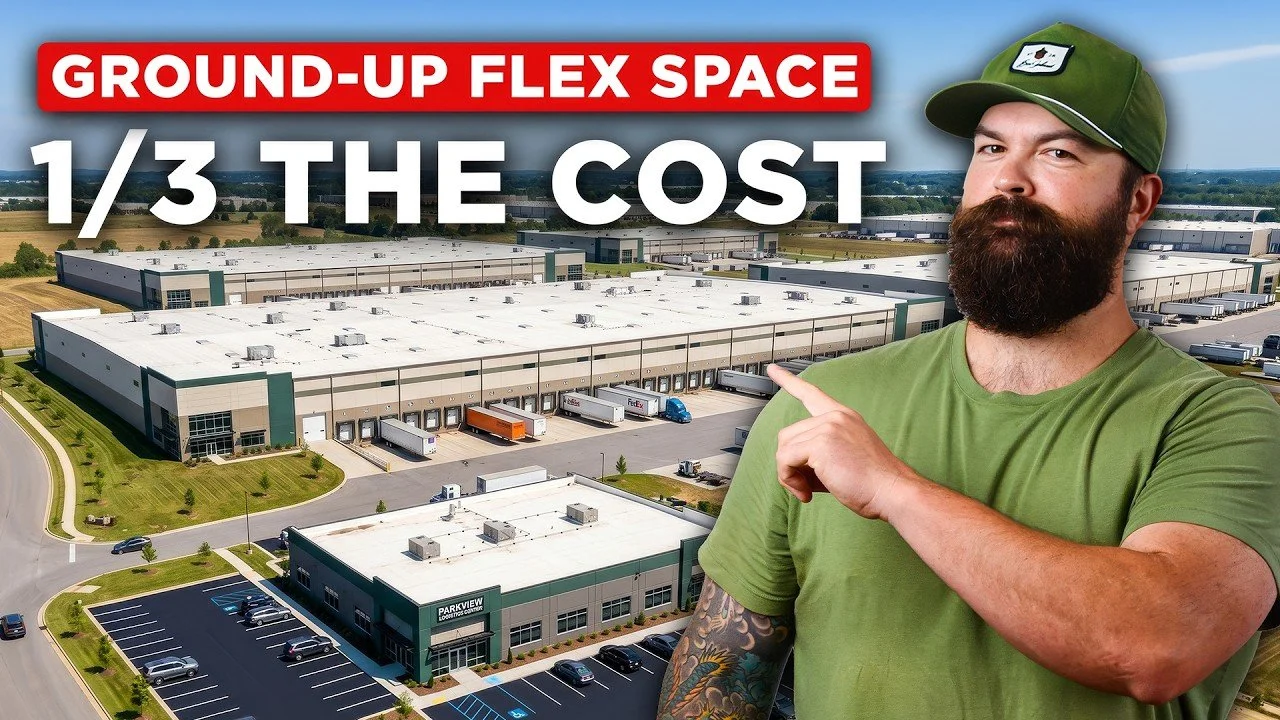
I'm Building 43,000 SF of Flex Space at 1/3rd of The Cost - Office Hours
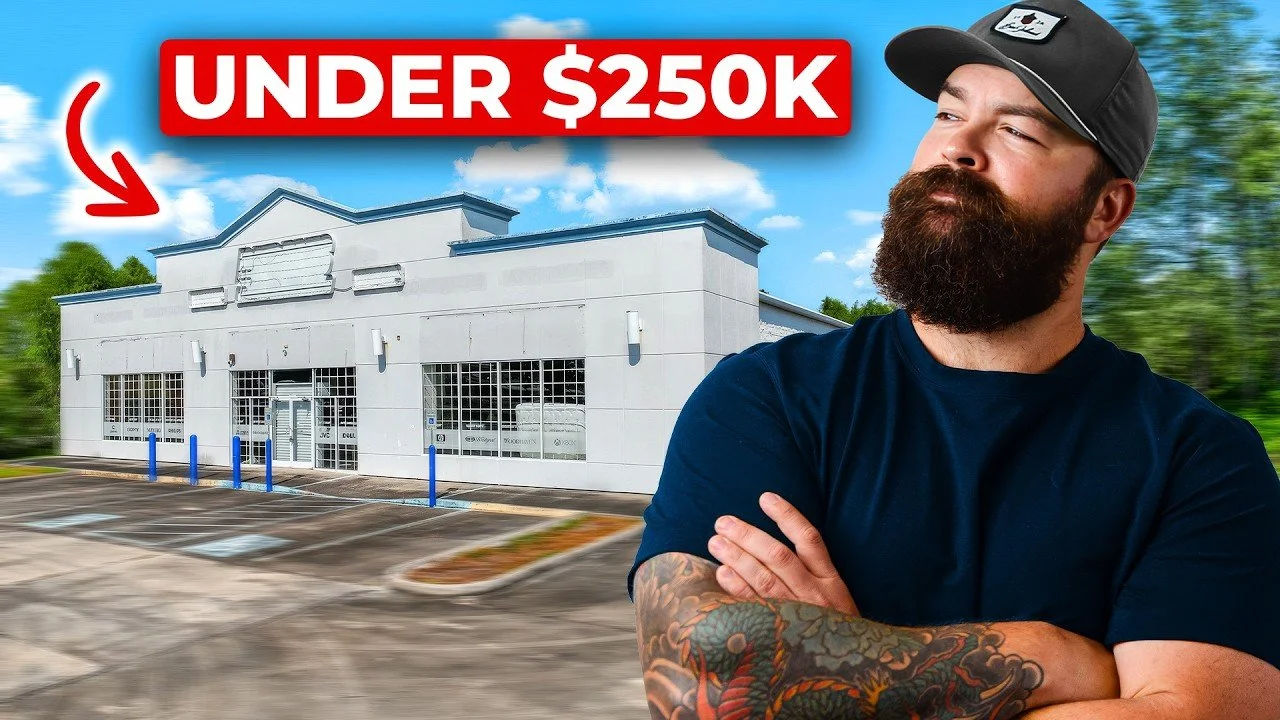
The going rate to build 43,000 square feet of flex space from the ground up right now is somewhere between $6 and $8 million.
I'm doing it for around $2 million and in this week's Office Hours, I'm showing you exactly how.
The answer isn't a secret or a shortcut. It's a structure called the master lease and it's the most powerful tool in commercial real estate that almost nobody teaches. In this episode:
- Why the conventional path to building flex space puts it out of reach for most investors
- What a master lease actually is and how it replaces a land purchase entirely
- A full breakdown of the Peerless Mill Warespace deal: 43,350 SF, 20-year hold
- The live numbers
- The ML Operator tax election — and why it generates $637K in Year 1 tax savings alone
- The risks you need to understand before you try this yourself
- What it actually takes to execute a deal like this
This is not a first deal. But it is a blueprint for how sophisticated investors control large commercial assets without ever buying the land.
Get commercial real estate coaching, courses, and community to jumpstart your investment journey over at CRE Central: www.crecentral.com
Key Takeaways:
Core Concept
Instead of buying land + building ground‑up flex, Tyler uses a master lease on an existing 43K SF building.
Traditional build: $6–8M ($150/SF).
His deal: $2.5M all‑in ($39/SF hard costs) by leasing + converting, not buying.
What a Master Lease Is
You lease the whole property from the owner and sublease to tenants.
Your profit = rent spread (sublease income – master lease payment).
You control the income and operations without owning the dirt.
Works across flex/industrial, retail, office, mixed‑use, even hotels.
When It Makes Sense
Owner won’t sell at your price but needs income.
Building needs capex the owner won’t/can’t fund (vacant or tired asset).
You want to control more SF with less upfront equity (no big 20–30% down payment).
Peerless Mill Example
43,350 SF warehouse → ~24 flex units.
Master lease: $0 base rent + 10% of revenue to owner.
Capex: ~$2.5M total vs. $6–8M if built new.
Hold: 20 years, targeted:
~13% LP IRR
~4x equity multiple
~19% annual cash‑on‑cash
Tax & Risk Highlights
Treated as an operating business, with large bonus depreciation potential (deal‑ and CPA‑dependent).
Key risks:
You carry operating + lease‑up risk.
You don’t own the real estate—exit is business/lease focused.
Long‑term commitment, so structure terms (rent, maintenance, termination) carefully.
Want the full guide to flex space? Read our complete guide: What Is Flex Space? The Complete Guide to Investing, Leasing & Development


About Your Host:
Tyler Cauble, Founder & President of The Cauble Group, is a commercial real estate broker and investor based in East Nashville. He’s the best selling author of Open for Business: The Insider’s Guide to Leasing Commercial Real Estate and has focused his career on serving commercial real estate investors.
Episode Transcript:
Unknown Speaker 0:00
This
Unknown Speaker 0:05
episode of the commercial real estate investor podcast is brought to you by my cre accelerator mastermind, where you'll get access to my step by step investment blueprint, essentially a library of resources on how to invest in commercial real estate. You'll get connected to a supportive community of other commercial real estate investors that are doing projects just like you. You'll get personalized coaching and feedback from me every step of the way. Go to www.crecentral.com
Unknown Speaker 0:30
to learn more.
Unknown Speaker 0:32
The going rate today for 43,000 square feet of flex space from the ground up, once you include the cost of the dirt all of your soft costs is probably somewhere between six and $8 million
Unknown Speaker 0:46
I am building it for a third of that cost. And today I'm going to break down exactly how we're doing that. And it's a deal structure that you guys might not have even considered, and that is the master lease. It's a really interesting opportunity. It's a great way to get creative. It could be interesting if you don't necessarily have six to $8 million of your capital stack, right? I mean, obviously you don't need six to $8 million in cash, but we're talking about a two and a half million dollar deal compared to a $6 million deal far more approachable. And the numbers are actually pretty astounding. So today I'm going to break down this master lease. We're going to talk about a deal that I'm actually doing through some numbers on a deal that I'm actually doing, so you can see exactly how we're doing it. And if you have any questions along the way, feel free to drop those in the live chat. I will get to them. Money King is already jumping in, saying, Tyler, about to give us the truth. Can't wait.
Unknown Speaker 1:43
Absolutely I will be you guys. We're gonna have some fun today, diving into this. Okay,
Unknown Speaker 1:48
welcome back to office hours. This is the commercial real estate investor podcast. I'm your host, Tyler Cobble. We're live from Nashville, Tennessee, and this is the series where I go live every tuesday, 8:30am central standard time to answer your questions around commercial real estate, teach you guys a little bit about investing, share with you what I've been up to, and hopefully give you guys some really interesting things to look at. All right. Now, I want to be clear, this is not solicitation of any investments whatsoever. Okay, this is just educational content only for you guys to go and use in your own deals. Okay? So a traditional build for flex space, somewhere in that six to $8 million range for 43,000 square feet, right? I'm using the number $150
Unknown Speaker 2:36
a square foot, give or take, which is insane, because it used to cost like 100 to 120
Unknown Speaker 2:44
bucks a foot to build flex space, and costs just keep going up. All right, so now we're looking at about $150
Unknown Speaker 2:50
a square foot, once you include the dirt and all of your costs, this master lease build is going to cost me right around two and a half million dollars. The biggest difference here is that one, I'm not having to buy anything, so it's substantially cheaper. And we'll get into that. Well, oh, Tyler, if you don't buy it, how do you have enough certainty on the exit? How do you take advantage of any tax benefits of commercial real estate? That's why we invest in real estate in the first place. We'll dive into that today too, because we're getting just as good, if not better, benefits in some ways,
Unknown Speaker 3:23
and we're also not having to build a building from the ground up. So I'm already saving money on that front. So this is essentially the same building, same market, 1/3 of the price, all right. So we'll dive into that structure and how everything looks today. Now here's what most investors assume, when it comes to doing commercial deals, one you have to find and buy the land.
Unknown Speaker 3:47
I will say that the land acquisition, especially today in flex space, can be very difficult. It can be very expensive. It can be tough to find the right piece of dirt, and it's one of the, if not the single, largest line items that you have in your costs, right? Because it is, I mean, the weigh in, $500,000
Unknown Speaker 4:07
an acre, you know? I mean a million dollars an acre. $2 million an acre depends on where you're buying it, of course. But there's not really anything else in your budget that's going to be necessarily that high. Number two, that you need significant equity. Just to start, when you're buying a traditional commercial property, we're talking 20 to 30% down on a multi million dollar project, right? If you're building a $6 million deal, that means you're probably bringing $2 million in cash to the table. That's a lot of money. Most investors just simply can't get to that number. Now, sure, we have plenty of high net worth individuals that follow this show. We have plenty of family offices that I have worked with on this show that do pay cash in a lot of ways, and this is probably not a strategy that they would use, because they're going to pay cash.
Unknown Speaker 5:00
So this is for those that you know. Maybe you're looking to transition in from from residential real estate, or you're just looking to grow your commercial real estate portfolio faster, this method will give you that capability. Number three, on your assumptions, you absorb all of the construction risk, right material, cost delays, overruns, all yours. The asset doesn't generate income until it's leased ground up development for the majority of newer commercial real estate investors, and honestly, the majority of commercial real estate investors in general, is way too risky. It takes way too much time, and I would say most of the time, it's not actually worth it's not worth it the risk adjusted returns that you can get on ground up while they can be great if you find the right deal, right. And don't get me wrong, we're working on a ground up development deal as well,
Unknown Speaker 5:47
but it's because we got a hell of a deal right, and it's even more difficult to find those opportunities all right. Then on top of that, number four, you're waiting 18 to 30 months for revenue, right? You've got to go through the permitting, through the development, through the construction, through the lease up. It's a long runway when you're doing these, these projects, new construction, ground up, right? And a lot of investors just don't have the capital to carry that. So these assumptions are real, right? But they're not the only way for you to go about doing flex space. That is exactly what we're going to be talking about today. All right,
Unknown Speaker 6:23
so what a master lease actually is, let's let's talk about this. Because I feel like there are some misconceptions out there about what these deals are. Essentially, you go and lease an existing property from the owner, and then you sublease it to tenants, right? So the spread between what you are actually paying for the master lease and what you're renting to the tenants for. That is your business, right? That is your cash flow. So the property owner keeps the land in the deed, right? You're not actually buying it from them. You agree with that property owner to the terms of the lease. You negotiate a lease with them, then you control and operate the asset. You basically get all of the control that you would have if you structure the lease the right way, as you would if you were the property owner, and then your tenants will pay you market rent, right? So you don't need to own the dirt. You just need to control the income stream that is coming from that specific property. Okay?
Unknown Speaker 7:23
Now this is one tool to have in your tool belt, right? We were having this conversation on the CRA accelerator mastermind call last night, like, the more
Unknown Speaker 7:33
the more methods that you have for structuring creative deals, the easier it's going to be for you to get a creative deal done right? One of my favorite quotes you guys have heard me say this time and time again, and I will say it till the day that I die.
Unknown Speaker 7:49
Miles Davis, you have to know the rules before you can break them, and that's what I'm teaching you guys here today. I want you to know the rules. I want you to know all of these different methods, all of the different ways to get creative on your deal so that you can go and find the method that works for you, right? This isn't the only tool that you can have out there when you're doing these deals, all right, but here's what's interesting, Master leases work across all asset types because the the
Unknown Speaker 8:15
structure follows the deal, not the asset, right? So you could do flex industrial, you could do retail strip, you could do office mixed use. I mean, you could even do a hotel, to be honest with you, and structure this in any sort of way that you really want. That's what's really cool. Like on the flex side, you can convert vacant warehouse bays into small bay units without buying the building. That's what we're doing today. And I'll tell you guys a little bit more about this in a minute. But we're taking a 43,000 square foot existing building. We're putting walls inside of it. We're adding row of doors. We're building it out and doing flex space inside of it. So we'll have 2324 units out of that 43,000 square foot building. So now, instead of having to go look for like, how do I build, how do I find land to build a 10,000 square foot flex unit to get six tenants. Maybe you start thinking through, okay, well, there's some vacant properties in my area that are 3040, 50,000 100,000 square feet. How do I go about doing that and converting that into flex space and get a bigger, larger multi tenant asset? There are other brands out there that are actively doing this on a much larger scale. If you guys haven't heard of where space, highly recommend you check them out. They've raised a ton of private equity capital to go and rapidly expand. They essentially are doing this mono at scale. This isn't something that I've necessarily created now. I think in a lot of cases, they are buying the buildings and then they're leasing them out. They don't necessarily have to do that, all right. And that's W, A, R, E space like warehouse wear space on
Unknown Speaker 9:48
the retail and strip strip center side, you operate a multi tenant retail strip on a long term lease, when the owner won't sell at your price, maybe somebody's not willing to sell, but they're also tired of D.
Unknown Speaker 10:00
Dealing with the leasing they don't want to deal with the tenants. You could sign a master lease, take over, you know, the payments for them, and make it a lot easier for them. All right, we've got some questions coming in. Let's see. Rich is saying, I've been waiting for this. Can't wait. This is actually Rich's idea for me to go further into this, because I had posted about this on my Instagram story. So Rich, thanks for being here, my friend, and thanks for the suggestion. Nikram is saying, Good morning, good morning. Nick rum Debra, thanks for your knowledge. Happy to share. Rich is saying, can you 1031 into these? Since it's not real property and it's paper, no, you technically cannot, right? Because this is not a real estate asset, so you couldn't sell a single family home in 1031 exchange into a master lease like this. All right. Chase is saying, This is awesome. Literally, just put an LOI in to do this concept yesterday. Hell yeah. Man, congrats. Eight offices, $2,000 a month lease, individually estimated gross revenue, $4,000 a month. Guys, this model isn't new. Any salon that you see, most salons that you see, those salon suites, it's just a master lease, and then they're subleasing it out. We have, we talked about this. One of our members is looking at a salon building where he would buy it and then basically rent it out to eight or 10. You know, stylists, right? They get a lot. They pay a lot for that, right? And so, so the math can work really, really well, all right,
Unknown Speaker 11:30
if you're looking at office or mixed use, just like what Chase said, you can take over a partially vacant building. There's a lot of those today, a ton on the in the office world, that are that are partially or mostly vacant. If you can get a good deal right, which some of these property owners are going to want, because they just want some some sort of revenue coming
Unknown Speaker 11:49
in, you master lease it. They get the security of knowing that something's coming in every month. You then go out, work your tail off to get it subleased, and you profit from that spread. So the landowner situation does matter more than the asset class. It 100% depends on what the the property owners goals are for their investment. You are going to want to target property owners that are tired of dealing with tenants. They have high vacancy. Maybe, you know, they've considered selling, but they don't want to deal with the tax issues of selling, right? Or maybe they're moving away, you know, maybe they'll consider selling, but it'd be easier for them to just lease it and not have to worry about it, right? That's what makes this structure agnostic. You can do it pretty much anywhere. All right,
Unknown Speaker 12:36
that's what's cool about this. So when this structure makes sense. Let's, let's dive into those scenarios a little bit more. All right. There's really three scenarios that I've found where a master lease is the right call. Now, this isn't to say that these are the only three ways, right, but these are the three most likely. All right.
Unknown Speaker 12:54
So one, the seller won't sell at your price, but they need the income. Right? We see that time and time again, especially in a market like today, where in 2021 right? Everybody, just everybody, was buying commercial property, the prices were insane. Cap rates were super low, and so some of these owners got this price in their head of what their property is worth, but it's just not worth that today, and they're not willing to accept that, but they need the money, so maybe they're underwater, right? Maybe, maybe they're having to pay out of pocket for their mortgage every month. Maybe they're just emotionally attached to the property, right? Maybe it's been in their family for generations, and they just really don't want to sell, but they've got to figure something else out, right? A long term master lease gives them monthly income without their having to give up the asset. But you get control. That's what's so great about this. All right. Number two, the asset needs capital that the owner won't put in. How many times have we all driven past a building where we're like, man, that guy's owned that property for 20 years. They're just running it into the ground. They're not reinvesting into it. It needs a lot of work, but they just won't sell it, right? And they can't lease it now because tenants don't necessarily want it. So that building is vacant, it's underperforming, and again, they're just not going to invest the capital into it. Maybe they don't have the capital. So you would fund the improvements, you would operate the business, and you get to capture the upside from that spread, all right? And then number three, you want to control more with less capital upfront. Like I said, if we were going to go build this same building from the ground up, we're talking six to $8 million whereas in my underwriting, we're looking at two and a half million dollars, all right? And that is including, like, replacing the roof, redoing all of the electrical building, out all of the flex units, right? So we're still spending a ton of money building this out, making it really nice, but we're still not getting to that six to $8 million mark, which is amazing. So these master leases are great because they don't require a down payment on a purchase price, right? Your capital is going to towards the operations and the physical improvements.
Unknown Speaker 15:00
That you're making to the property, not to the seller. So just take that down payment out. You're still going to have to come out of pocket for something, right? You're building it out. But instead of having to buy what you're putting a down payment on and then build,
Unknown Speaker 15:14
you're just going straight to the build part. All right, so what I will say is none of these situations require an owner to be distressed, right? They don't have to be in a terrible situation where they have to do something. They just need to be motivated in some sort of fashion to say yes to a creative or different deal structure. All right,
Unknown Speaker 15:35
so here's how the cost equation changes when you're removing the land acquisition and you know, the property ownership from,
Unknown Speaker 15:45
from the deal, right? So traditionally, you're looking at a land and purchase, like a land purchase, right? That is your largest single line item in a deal, typically construction and TI, I mean, if you can build something for $80 a foot today, good for you, right? It's probably going to be a shell of a space, all right, we're
Unknown Speaker 16:08
probably looking closer to 140 bucks, 150 bucks a foot, all right, then you add in your soft costs and fees. Now, ideally, that $150 a foot is going to include your soft costs, but that can be 12 to 18% of your hard costs. All right. Financing carry. You have the pre revenue hold, right? You're spending millions of dollars, and then you're having to pay interest on it. You're having to pay for the operating expenses in the meantime, until you are getting tenants, right. So it's very, very capital intensive, whereas in the master lease structure, you don't have a land purchase price, right? It's $0
Unknown Speaker 16:41
now you are paying for construction at TI. It's the same scope of work in many ways, but a lot lower. And it's a lot less because again, we're going out and we're renting an existing building, and then we're building it out, right? We're not having to go out and build something purely from the ground up, these
Unknown Speaker 17:01
lease payments, if you structure it right, that will be your ongoing operating costs. That is something that you do need to keep in mind. I'll show you guys a creative way to structure those lease payments so that you're not having to come out of pocket until you've actually got some stuff coming in, right? And then there's no acquisition debt, right? So you just have lower leverage risk. Now you will likely have to have a higher, I'm sorry, a lower loan to cost if you are getting a loan, because it's going to be backed by the lease. It's going to be backed by the work that you're putting into it. It's going to be backed by the leases that you are executing to the sub tenants, and it's going to be backed by your balance sheet, your personal guarantee. So you might want to grab a partner or two, all right, that way, it's just very secure. On that front, we're talking probably 50 to 65% loan to cost, as opposed to maybe 75 or 80% if you're buying the real estate,
Unknown Speaker 17:49
right. Still worth it. Okay, so this structure doesn't eliminate your risk, and we will go over those risks here shortly. All right, it just reallocates it and dramatically lowers the cost of entry. This is a far more approachable way for you to be doing commercial real estate. Okay,
Unknown Speaker 18:08
so here is how I'm applying this. This is an actual deal that we are working on at peerless mill. So the building is 43,350
Unknown Speaker 18:17
square feet when we subdivide it, depending on the average size of units that we end up doing, we're looking at somewhere around 24 flex units. It could be 23 could be 27
Unknown Speaker 18:29
we're looking at around 24 Okay, now we have 25 foot ceilings. That's very attractive for a lot of flex users. If you're going to go out and you're going to find a building, I would say at least find something with 12 to 14 foot ceilings. That way they can actually put some racks in there and stack some stuff.
Unknown Speaker 18:45
It's, you know, the taller the better. Ideally, you're at 18 to 22 feet. Okay, so this one happens to have 25 foot ceilings. We've got 25 foot column spacing as well. So we can actually build bigger units without having to have a bunch of columns everywhere. Now we're doing a master lease that has a $0 base rent
Unknown Speaker 19:06
and 10% of revenue. Now, I know what you guys are thinking, Oh, well, Tyler already owns peerless mill. I do, but I own that in one partnership, and I'm doing a new partnership with my investors that will be master leasing this from us. So essentially, treat me as if I'm a third party, okay? And I'll talk to you guys and here in a minute, as to why this makes sense for me and my partners on the peerless mill side of things. All right, so 10% of revenue means peerless mill, the property owner will not be getting any money at all until there's actually money coming in. It's a win win for everybody, right? Peerless mill doesn't have to actually spend the capital to build out this space. And I as the operator, as the master lessor, I guess, or lessee. I don't even know which one it would technically be. I don't have to.
Unknown Speaker 20:00
To worry about those payments until we have revenue coming in. It just makes my life so much easier. So we're really de risking it our hold period on this totally different approach, right? Most commercial real estate investments you're looking at three to five years. You flip it on a cap rate, you move into the next one. This one is actually going to be a long term cash flow play. Long term cash flow play, you cannot find cash flow plays like this today. I almost guarantee it. It is so, so difficult with where pricing is, with where rents are, right. It just, it just doesn't work. However, over that 20 year hold period, we will 4x our investors capital, purely through the cash flow and then the exit, we have an $800,000
Unknown Speaker 20:43
guaranteed lease assignment that we have negotiated with peerless mill. So basically, at the end of the day, after 20 years, peerless will buy out the equity that the investors initially put into the deal. All right, so the capital stack breaks out like this, looking at a construction loan of 1,000,004
Unknown Speaker 21:02
50, give or take. All right, that means LP equity of about 1,000,018
Unknown Speaker 21:07
our hard costs are $39 a square foot. Think, think about that for a minute. We're talking about all in costs for ground up flex development being around $150
Unknown Speaker 21:21
a square foot. This one, our hard costs are just 39 because I'm not having to build a building. It's already existing. Soft costs around $300,000
Unknown Speaker 21:29
we have contingency of 200 grand, which puts our total capitalization being very conservative, at $2.5 million
Unknown Speaker 21:39
for the same 43,000 square feet, right?
Unknown Speaker 21:43
We've de risked a lot of what you typically see in a commercial real estate investment. So we have one deal, one structure, and now your version will have different terms, obviously, different asset, different numbers, but there's no reason that you couldn't take this deal structure and go and apply it in your market, on a building of your choice. Okay? I mean, think through how many buildings out there are vacant, right, sitting vacant, waiting for somebody to come along and do something. Maybe it sat there on the market for a little while. Maybe, you know, maybe it hasn't sat on the market at all. The owner just hasn't touched it, doesn't want to do anything with it. That is an opportunity for you to do this type of deal structure,
Unknown Speaker 22:24
all right? So how do you go out and find willing landowners, right? How do you find a property owner that's willing to do something like this? The conversation is actually a lot easier than you think. It's really not a complicated thing, right? Number one, they probably have maturing debt or refinancing pressure. Think about where we were five years ago, right? 2021. Was a very different time to be getting debt today, night and day. If they are refinancing that debt, it's going to be higher, almost guaranteed. All right, they need the cash flow to service that debt because they can't refinance easily. If you come in and sign a master lease, it's actually going to make their lives a lot easier to lives a lot easier to go out and refinance. All right, so the master lease will provide them that income without the friction of them having to go through the sale, without you having to come out of pocket for the cost, all right. Number two, free and clear. If somebody owns the property free and clear, they are likely in it for the long haul, right? They're probably not trying to maximize their dollars at every turn. They just want income, all right. So if they own it, free and clear, they've probably owned it for a long time. They're probably tired of managing the asset, right? They want something simple. They want to check. They don't want to have to deal with the management in the day to day. That means you're taking over the operations. They keep the asset right, so you're really making this a win win for for both of you. Number three, they can't sell at their price. We talked about this earlier, but some owners just have unrealistic expectations of what their property is worth, all right? And the market just won't support that. Today, a a long term lease like this will let them hold out without bleeding cash on a monthly basis. Okay? And
Unknown Speaker 24:08
then number four, a developer with a building they're just not ready to activate, right? Maybe it's a future phase. Maybe somebody has bought a multi building property and they have a building there that they're not planning on getting to for another three to five another three to five years or 10 years, you could actually solve a problem for them today with a long term lease where they won't even have to worry about that building for 20 years if they don't want to. All right, so you're not asking them to necessarily give anything up. You're solving a problem that they already have that they don't know what to do about. Now here's the thing we mentioned this earlier. Well, Tyler, we buy commercial real estate for the tax benefits. Have a lot of investors that actually don't want the cash flow, which I know is wild. They don't want the cash flow because they're netting a million dollars a year, $2 million a year, $5 million a year in cash already. They're trying to figure out, how do we protect the cash that we already?
Unknown Speaker 25:00
Have right? And so commercial real estate is one of the best ways to protect your tax liabilities, right because of the depreciation. Well, here's the thing, since we are an operator, we're actually a business. This is our business. Is renting warehouse space and then subleasing it to tenants and managing it. That is a business. We get to offer to our investors the opportunity to take advantage of full depreciability as a business. So you don't have to be a real estate professional to get to that full tax benefit, which is pretty nice. All right, so we're talking about the qualified improvement property, we get bonus depreciation on roughly 85% of our costs, FF and E, 10% of costs, all right, that's section 179, plus bonus depreciation on furniture, fixtures and equipment. All right? Soft costs, we get to write a 5% of that as well. Right? Those are amortized over the hold period. So this is very specific to every deal structure. Every deal is going to be a little bit different. It completely depends on what you're building out, how you're structuring all that kind of stuff. So I'm not a CPA. I'm not your CPA. I'm not playing a CPA on a podcast. All right, go and talk to your CPA about how you would structure this deal. I'm just sharing you with what what we're doing. All right, so that means that we get to deduct roughly $2.1 million in the first year. So at a 37%
Unknown Speaker 26:30
tax bracket, that's roughly $782,000
Unknown Speaker 26:35
in tax savings. $782,000
Unknown Speaker 26:40
that's almost our that's like, what 77%
Unknown Speaker 26:44
roughly, of our initial equity contribution. That's a pretty substantial deduction. So here's what the numbers will look like. This is a very 20 year hold, all right, so keep this in mind, 20 year old, 13% LP, projected. IRR. Now
Unknown Speaker 27:02
you might be sitting there thinking, well, 13% doesn't sound great, like I mean, to be fair, that's outperforming a lot of multifamily today. 13% is not outstanding. Tyler, most of your deals get an 18% plus internal rate of return. They do, but this is over 20 years. Most of my deals are over five, right? And so the internal rate of return takes into account the amount of time, right? So that's that's a big thing to keep in mind. There 13%
Unknown Speaker 27:28
here's the number that I like to look at the most. Or I guess these next two really are the two that I like to look at the most, a 3.99
Unknown Speaker 27:35
times LP equity multiple. We're 4x ing the LP capital just through that cash flow, which ends up being about a 19.2% annual cash on cash return for the LPs, which, I mean, think about it, if you're going to your investors and you're saying, hey, over a 20 year period, I'm going to be able to give you a 19.2% annualized cash on cash return, you're gonna have a hard time finding An investor that's going to say no to that, right? Especially when you stack the tax benefits on the front end, especially when you say, hey, it's a consistent amount of cash flow that you're going to get for 20 years that you don't have to worry about. That's, I mean, that's like a that's like a treasury that's a treasury bill with four times the returns, all right? And then, of course, the nice thing is, too, we have a guaranteed exit
Unknown Speaker 28:25
that we've negotiated, right? Hey, here's a there's value in what we've created here. Owner, buy us out at the end of the 20 years, we'll give it to you. The other thing that you could do is just say, hey, we want a 20 year master lease with three five year options. After that, make it 35 years and just cash flow it into the sunset, right? Because the longer you own it, the better it's going to cash flow, right?
Unknown Speaker 28:47
And there's and there's not, like, going to be some huge capital or liquidity event, unless you pre negotiate that on the front end, or unless you you are able to renegotiate the lease and then sell the asset based like a business, right? Every master lease is going to have different returns depending on the terms, depending on the terms, depending on the asset, the market, how you operate it, but it's the structure that really creates the opportunity. The deal you find and how you run it will determine the outcome. That's what makes it so attractive.
Unknown Speaker 29:18
Like I said, there's no deal, there's no commercial real estate investment that's going to have zero risk. All right, so here let's, let's go through the risks of a master lease. You're responsible for the operating costs regardless of the occupancy. Now, I don't have to pay rent until we have revenue coming in, but there could still be some cost, right? I'm going to have utilities. While we're going through this stuff, we're going to have to clean it. We're going to go through the lease up all of that. All right, so you should, I highly recommend you structure it as a percent of revenue if you're able to do that, or at least a super low base rate plus percentage rent, right? Because that will keep your overhead low.
Unknown Speaker 29:55
Number two, you don't own the underlying asset, right? I mean, your exit is a lease assignment.
Unknown Speaker 30:00
Or an operating company sale, or you just hand the keys back, which any of those are totally fine, right? Especially if you're cash flowing it as much as we are. We don't have to sell it to somebody else to make the exit. A lot of commercial real estate deals are very, very heavily dependent upon that exit in three to five years or seven years,
Unknown Speaker 30:20
this model is not and so it takes out the risk of, well, what happens if we have a market dip and cap, rates go up and property values go down? I don't have to worry about that. Here.
Unknown Speaker 30:30
You have a long term commitment, right? With limited early exit options, unless you pre negotiate a lease termination. If things just really don't work out, you're stuck in there for 1020, years, however long you decide to master lease this. All right, so that's something to keep in mind for sure. All right, and then you've got construction and lease up risk if you're improving the asset, if you don't know how to go out and find tenants, two subways to right, that is going to become very expensive, because fortunately, again, you have negotiated this with percentage rent, so you're not having to pay any rent. You're still going to have your debt on the construction you're still going to have your operating expenses other than rent that you're going to have to pay. So you want to make sure that, if you're doing this model, that you know how to go out and find tenants. Very, very important, that you understand the risks associated with any type of commercial real estate investment that you are approaching. Okay? I just
Unknown Speaker 31:23
realized that those weren't showing on the screen. Of course, not.
Unknown Speaker 31:26
So there you have it.
Unknown Speaker 31:30
All right. So the bigger lesson, like I said, this is a tool. It is not a replacement. This is something in addition to your portfolio. All right. Master leases don't replace buy, by any means, but they're an alternative when buying doesn't work, and today might be a market where that's the case. Number two, context determines fed the right structure depends on the owner situation, the assets potential and your operating capability. There's no one size fits all when it comes to any commercial real estate deal. Again, it's a tool, not a replacement. The more of these tools you have in your tool belt, the more creative you can be in making deals work and the structure is what really creates the return, right? The deal you find is the opportunity. The structure you negotiate determines whether you can actually capture that capital. All right.
Unknown Speaker 32:17
So again, to recap, 43,000 square feet of flex space, two and a half million dollars all in that is 1/3 of the cost of a traditional build, one deal structured one way, right? That's what's so amazing about it. And you don't have to buy it to control it. So if you want to learn more about how to do deals like this, I teach our investors in the CRE accelerator mastermind how to go through this process and then work with them to structure these deals, put these deals together, review the deals to make sure that that's actually a deal worth doing. Okay, if you want to work with me, then jump in the CRA accelerator, mastermind, book a call with me. I will be the one that actually takes the call. We'll go through your situation, see if it's a fit or not, and take it from there. All right. So your turn. Let's jump into the live chat. Have you ever come across a deal where the owners wouldn't sell but might have leased? I want to hear it. All right. Let's get deals comments.
Unknown Speaker 33:15
See what you guys are saying. Nasty was saying $39 is insane. Most owners I speak with in the storage space are in it for 150 to 200 bucks. It's pretty crazy. These numbers were actually based on the 350 unit self storage facility that we just built out there. So we actually know the real numbers of almost every single thing that we're going into. So that's the cool thing. It's not an estimate, or it's not just a back of napkin estimate, like, it's a pretty well informed estimate, too.
Unknown Speaker 33:43
Charles is saying Tyler is always thinking outside the box on this stuff. He's a property pump. I love it. I love thinking outside the box. I just love coming up with creative deal structures and doing things differently because it allows us to put together much, much better deals. All right.
Unknown Speaker 34:03
Nasio is saying, What would need to change or happen in the market for your team to exit before the 20 year holding period?
Unknown Speaker 34:10
That's a good question. I mean, honestly,
Unknown Speaker 34:13
what would have to happen because of the way that it's just going to cash flow so well, I would have to have somebody come in and offer me a hell of a price contingent upon, you know, peerless mail like the property owner extending the lease even further if we got into this, you know, five years we stabilized it, and somebody said, Hey, I want to buy this 15 years of revenue, we would certainly consider it, especially if it made sense for my LPs to go ahead and do that.
Unknown Speaker 34:39
Michael is saying one thing to be careful about with a master lease is the property maintenance riders. I've seen a number of deals like this in New York City. Hospitality assets and the quality maintenance requirements can suck all of the profit out of the deal.
Unknown Speaker 34:56
It certainly can, right? That's why you make sure on the front end, when you're doing your build out you.
Unknown Speaker 35:00
Doing it right. Fortunately, with like flex space,
Unknown Speaker 35:04
the quality kind of is what we want it to be, right? It's, I mean, obviously that's going to determine what our rental rates will be. But if you're doing a hotel, you have to make sure, especially if it's flagged, right? If you're going with a Hilton or a Marriott brand, you're going to have to adhere to their brand standards, right? So I would recommend avoiding that if at all possible. So there you guys have it. That was our office hours for today. Highly recommend you guys go out and explore the master lease method. Let me know what your thoughts are in the comments. Is this something that you would actually consider pursuing? Does it unlock a new door for you as you're going into it. Appreciate you guys for joining me on this week's episode of office hours. We go live every tuesday, 8:30am Central Standard Time with really cool tips, tricks, what I'm up to, all this kind of stuff, so that you guys can be better commercial real estate investors. Thanks for joining me. We'll see you guys in the next
Unknown Speaker 36:02
one you episode of the commercial real estate investor podcast is brought to you by my cre accelerator mastermind, where you'll get access to my step by step investment blueprint, essentially a library of resources on how to invest in commercial real estate. You'll get connected to a supportive community of other commercial real estate investors that are doing projects just like you, you'll get personalized coaching and feedback from me every step of the way. Go to www.crecentral.com
Unknown Speaker 36:30
to learn more you.