
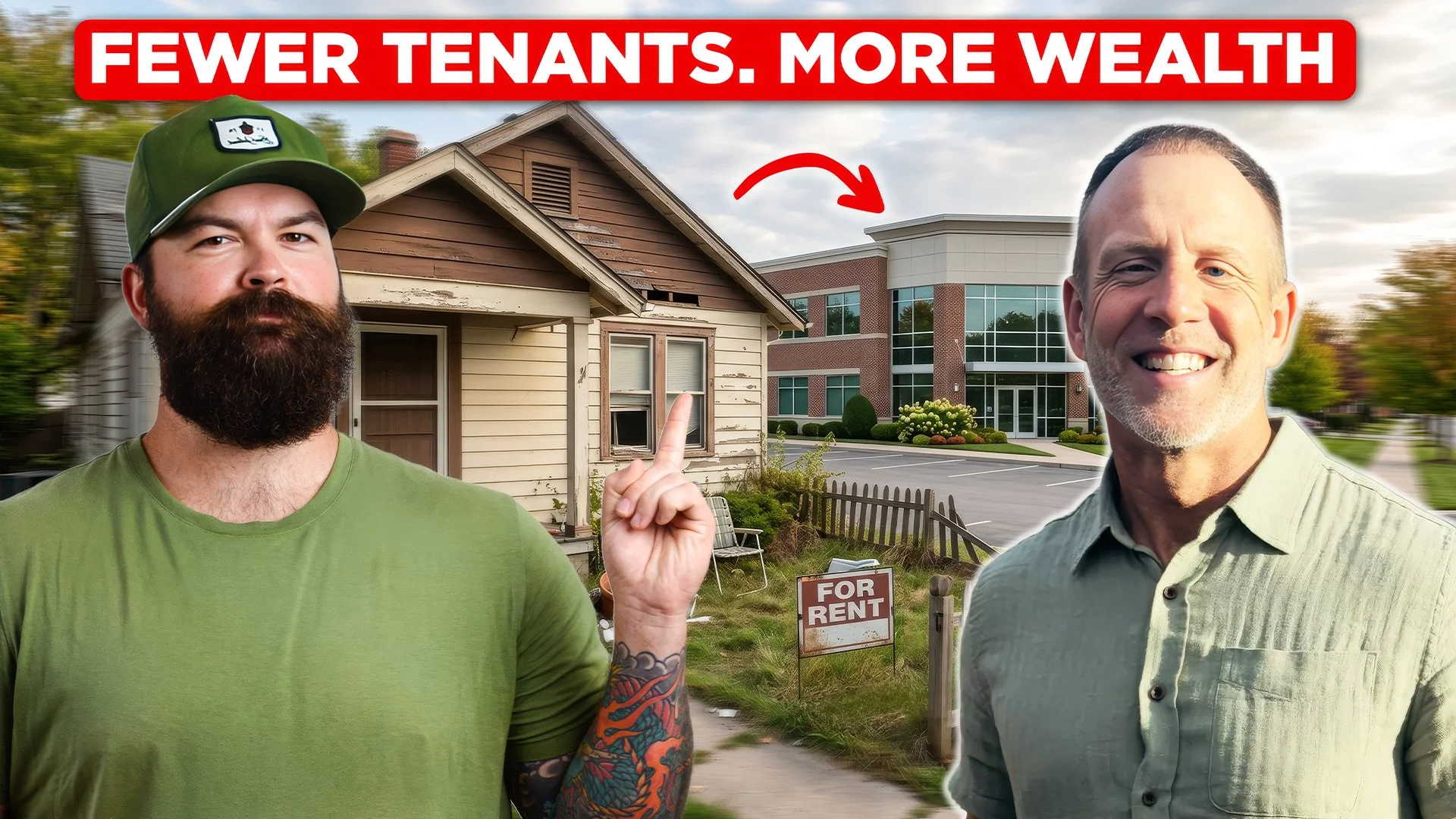
100 Doors. 35% Returns. Why He's Walking Away.
Ray Smith built a portfolio of 100 single-family rentals paying him 35% a year. He's a year and a half into a three-year plan to sell every single one.
This conversation is the most honest take I've heard on what it actually costs a residential investor to make the jump into commercial.
Ray walks through the 2009 bankruptcy that left him with $7,000 and a waiter's job, how he rebuilt to 100 doors on Section 8, the mental shift that made him realize scale wasn't freedom, and the $50,000 oven disaster on his first commercial commissary kitchen. If you own 10 to 100 doors and you're tired of tenants and toilets, this video is for you.
What we cover:
The inflection point. Why the 100-door portfolio stopped working even though the cash flow was great.
The financial shift. Why no-money-down doesn't exist in commercial and how to prepare for skin in the game.
Picking a market. How Ray reads neighborhoods, zoning changes, and "blue ocean" pockets that aren't priced in yet.
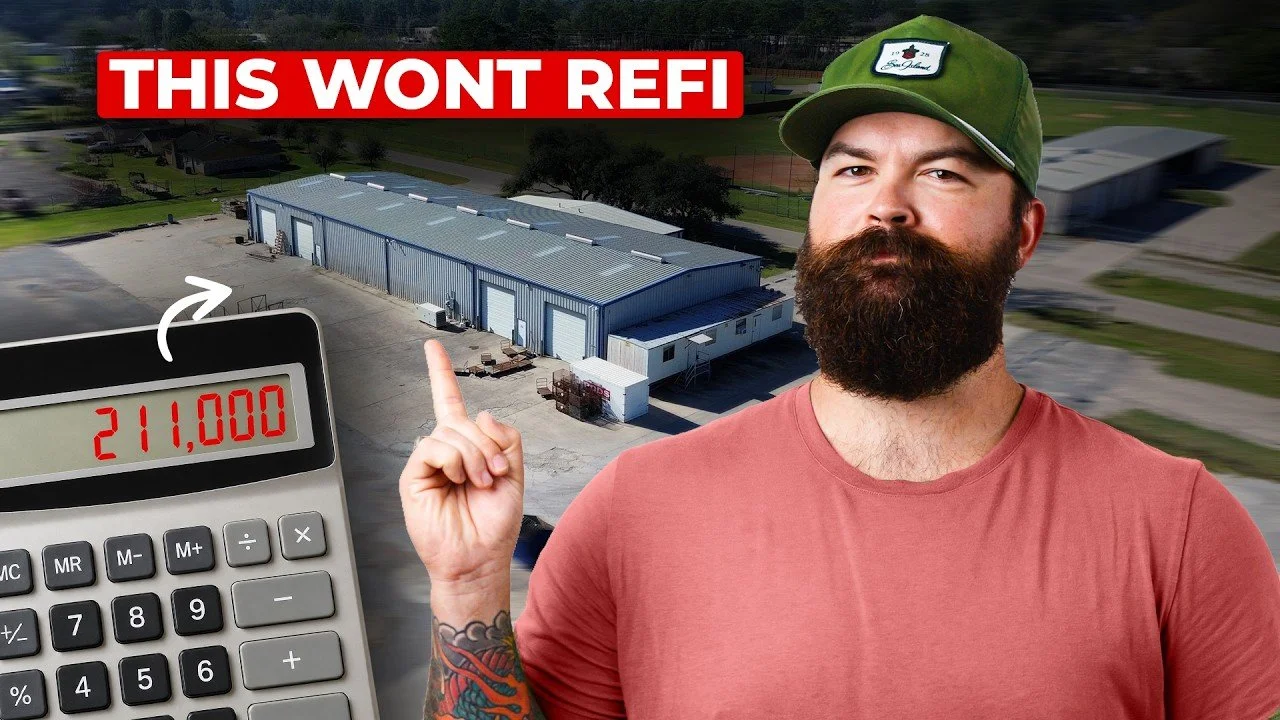
The build-out reality. What a 5,000 square foot commissary kitchen actually costs to renovate, and why the budget always blows.
The discipline. How Ray hasn't lost a dollar in real estate since 2009.
Connect with Ray: Orange Belt Investing — https://Orangebeltinvestments.com
Get commercial real estate coaching, courses, and community to jumpstart your investment journey over at CRE Central: www.crecentral.com
Key Takeaways:
Private money + confidence
Ray rebuilt after 2009 by using private capital from friends/family and backing it with confidence and a clear story.
Buy cheap, cash-flowing assets
Single-family play: buy well below rebuild cost, add light renos, and rent Section 8 for strong cash flow.
Principle carries forward: hard to lose if you buy under value.
Why exit 100 SFRs
Headaches and damage from low-end tenants scaled with door count.
Commercial/triple-net tenants maintain the space and see it as part of their brand.
Early commercial wins
First commercial: $30k office with $80k in liens, made workable via city lien-relief program.
Realized niche opportunity in turnkey restaurant/first-gen spaces → higher rents, strong demand.
How he picks markets/locations
Follows directional growth and “vibe” by driving day/night.
Buys one street off the main corridor for better pricing + similar zoning.
Watches zoning meetings and parking/transit changes to front-run value jumps.
Renovation & risk lessons
Always add 20–30% contingency on value-add deals.
Fully vet tenant equipment + code requirements (his tenant’s oven added ~$50k in surprise work).
Best “first commercial deal” for SFR owners
Start with a small office / multi-tenant office (possibly occupy one suite).
Use it to build bank credibility and learn commercial without jumping straight into a big, complex project.

About Your Host:
Tyler Cauble, Founder & President of The Cauble Group, is a commercial real estate broker and investor based in East Nashville. He’s the best selling author of Open for Business: The Insider’s Guide to Leasing Commercial Real Estate and has focused his career on serving commercial real estate investors.
Episode Transcript:
Tyler Cauble 0:05
This episode of the Commercial Real Estate Investor Podcast is brought to you by my CRE Accelerator Mastermind, where you'll get access to my step-by-step investment blueprint, essentially a library of resources on how to invest in commercial real estate. You'll get connected to a supportive community of other commercial real estate investors that are doing projects just like you, you'll get personalized coaching and feedback from me every step of the way. Go to www.crecentral.com to learn more. Ray Smith built a portfolio of 100 single family homes that were paying him a 35% annual return by every traditional metric, he'd won the residential game. So today we're going to talk about why he's a year and a half into a three year plan to sell every single one of them off, what he's replacing them with, and what residential investors get wrong when they think about making the jump into commercial. Ray's not theorizing about his transition, he's literally living it right now in real time, and his perspective is one of the most honest takes I've heard on what it actually costs to make the leap. He recently came into the CRE accelerator virtual event that we have, he's an accelerator member, and taught everybody about this, and I figured it'd be a great thing for us to share on the podcast as well, Ray. Most people who teach this stuff skip over the failures, you don't, I don't, which I really appreciate about you. So take us back to 2009 You just bankrupted 10 properties, you had seven grand to your name, and you were waiting tables. What was actually going through your head about real estate at that moment.
Speaker 1 1:45
Be honest with you, real estate really wasn't even on my mind. I think I'd mentioned that I had an inspection business that I started online. I bought a course for like 40 bucks. I started this inspection company, I was working like 2030 hours a week during the day, and then waiting tables at night, and when, as I was going around doing these inspections, I talked about, you know, I was doing REO clean outs for the bank, we were doing inspections, we're doing BPOs, I started seeing prices just get down to, you know, 1015, 20 grand for a house, which was unheard of, and I never ever even dreamed that I could buy a house for that cheap, considering back in 2006 or seven, when I started buying, we were at the peak at like 151 60, so for me that was that was that was the moment where I had to go out and switch my mindset to really get over, and like, how am I going to find money to get back in real estate, because I already knew the Section Eight game, already knew how to do all that. All I needed was the money to get back into the market and start buying these properties for cheap. Basically, that was my mindset at that point in time when I triggered over, for sure.
Tyler Cauble 2:55
How did you go about finding the money?
Speaker 1 2:57
So, I bought a course, it was called Private Money Blueprint. It was $500 It taught me how to go out and basically work within my sphere of influence and talk to my friends and my family. It had a pitch of everything, basically, that I needed to do. And I remember talking to my first friend, sitting them down. I had no idea what, you know, what was going to happen, whatever he was going to get out of it, or what I was going to get out of it, but the main thing for me was just education for him and me, just going through the motions of getting front of people and asking for money. So, he, I thought it went horribly. So, in at the end of the conversation, he's like, I got $50,000 that I'll invest with you, and then that's kind of the first investment that I have from any one of my friends, which spurred into to this day, I still work with probably 810, of my friends that now invest with me.
Tyler Cauble 3:48
It's so powerful. That's one thing that a lot of people don't think about, is that you have access to all of this capital in your cell phone, your friends, your family, people that know I can trust you. It's going to be so much easier for you to go about it, as long as you know what you're doing and you have that story pulled together, so it's really cool that you did that, so you, you eventually scaled, you know, that 7k into 100 houses. What was the inflection point that that made it work the second time around? You think,
Speaker 1 4:16
well, I think for me it was since I had bought these 10 houses, and I was making no cash flow on the 10 houses, just basically breaking even, trying to get through, you know, the day to day grind, and managing them, doing the construction, and everything else. The reflection point was I need to make money, passive income on the next go around, because when you're buying at, you know, $20,000 for 1000 square foot home at $20 a square foot, you're not going to lose, because it has to get back up to rebuild cost for anybody to get back in the market and start building again. You know, I didn't really realize that at the time, I just knew these things were cheap and I had to jump in and start buying, and I already knew what Section Eight would pay, let's just say around numbers. For a three-bedroom 1000 square foot house, they're going to pay me, you know, probably anywhere from 13 to $1,400 a month. So, if you do the math at $20,000 you do it, you know, maybe a $10,000 renovation, you know, you're making a pretty good return after taxes and insurance and your maintenance and everything else that you pay. So, once I did that first deal, when I, I was hooked, I think I told you, I got that first deal in my belt. I spent that seven grand, $4,000 down, $3,000 Me and my dad fixed up the house, and then went back to that same investor, some old school 80 year old who's like, "Hey, I'll give you $75,000 more, go out and do it again. That's when I got the four houses, and then kind of spurred from there was really hooked when I was able to quit the serving job, right. So the serving job is gone, the inspection business was kind of winding down at that time. That's what allowed me to kind of see the direction I could head if I could just keep finding private money in the marketplace.
Tyler Cauble 5:59
Yeah, what do you think it was about you or your mentality that said, hey, this, this seven grand that I've got, I'm gonna put it all on black, I'm gonna bet on myself, and I'm gonna make this happen. What made you take the leap?
Speaker 1 6:14
I had no choice, I was 27 years old or 30 or whatever it was at that time, and I had not really done much with my life from a monetary standpoint, I'm not saying money is everything, but it definitely helps as a vehicle to get where you need to go, so for me it was, it was an accomplishment for myself to get to a better place for me, so I wanted to kind of really tap into that and get back into real estate and just kind of do it so much better the second go around, you know, post to the first go around, and after that, seven grand, like I said, I mean, it's just, you get hungry, you know, you want to keep finding ways to get stuff done, and I think that's always been my, my superhero power, is just being confident, no matter what is in front of me, or anything that I have to do, I just have to lay out the confidence that I'm going to get it done, and then I think as you, you build that confidence along the way, you get deals done, they just, they just kind of grows to there, grows from there, you know.
Tyler Cauble 7:12
Yes, that's a big demand.
Speaker 1 7:13
Yeah, it really is. And once you, once you really, really get something going, and you see it like working, and you're like, wow, this is really something that I can build a future on, and really make some, you know, sustainable gains that could help out, you know, a lot of things moving forward.
Tyler Cauble 7:29
You bought your first commercial property in 2013 and if I recall correctly, it was a $30,000 office building, which is an unbelievable price, but, but commercial real estate wasn't even really on your radar, then, so what piqued your interest about that investment?
Speaker 1 7:44
I think moving forward, for that office, I had rented my first office before that, for I think it was like eight months or nine months, I rented an office, think it was like 500 bucks a month at the time, you know, being in real estate, you don't really want to rent anything, you want to find something you know that you can purchase and make money off of. I mean, renting is the last thing that I want to do. So, I don't even think I was really looking particularly for this office at the time. I just got a call. We get random calls from people all the time. This guy had purchased this property at a sale somewhere, and maybe it was stuck on a tape roll or something. He just wanted to get rid of it. I don't, I don't remember. All I know is it had about $80,000 in liens on it. He didn't want to deal with in the city back at that time. They had created a program that any new buyer that buys these properties liens attached to them. If I just file a, it's a program that they created, you pay like 250 they go in, as long as you bring it up to code, they'll wipe away all the liens. So that program for the for our city in St. Pete worked wonders, because it was able to clean up a lot of the bad neighborhoods that had liens stuck on all these properties, where people just couldn't pay them. And me going in front of a board to hope, maybe they reduce them, I mean, no one's going to buy a property, you know? You get stuck in a situation like that, you know.
Tyler Cauble 9:05
Yeah. Tell us the story about opening your first restaurant inside one of those properties, because I think this is where things really started to click for you on the commercial real estate side of things.
Speaker 1 9:15
I mean, I was probably the most.. I was probably the most excited I had been in a really, really long time, because I, I felt this passion come back for something that I really loved, and it was a cuisine, New Mexican cuisine. When I had lived out in Colorado, I had fell in love with green chili, so I wanted to bring that authenticity over to St. Pete, which I did. And once we kind of opened the restaurant, you know, looking back, it was a great run. It was two years running it from the outside. We did okay. It just wasn't great compared to what I did. I do some things differently, but in the long term, it helped me to realize there was a dead space in the market for these first gen restaurants that were being net, well, basically not being built. At that time, and it was just kind of fell upon me after I leased out the space, how much interest I had, and the demand that I could put on a higher price per square foot, being it was a turnkey restaurant, someone could just come in and just open the doors, basically. I noticed that there was nothing else in the marketplace like that, for sure.
Tyler Cauble 10:21
Yeah, you said that the biggest mental shift wasn't really operational, it was more on the financial side of things, and in residential you almost never use your own money, but in commercial you have to have a little skin in the game. So, how do you prepare as a residential investor for that reality?
Speaker 1 10:39
How do you prepare as a residential or commercial
Tyler Cauble 10:42
well, like transitioning from the residential side of things into commercial.
Speaker 1 10:47
Well, I think I think the biggest thing, yeah, not using any of your own money and being spoiled for basically 10 years, right? You, in the beginning, I was able to, because prices were still pretty cheap, so I was able to still kind of use someone else's money if I could buy something for, say, $500 or 500,000 or less. Once you get beyond that point, and as rates kind of come back up and prices adjust when you're looking at deals, I started noticing that I couldn't do like the burr strategy on a commercial property and get all my money back, so I had to realize, okay, when I buy this commercial deal, what is my all-in cost once I, you know, renovate and then refinance in two years? How much money am I going to have into the property, and what does that return look like for me moving forward? So, if I say, hey, I'm going to have $200,000 locked up in this property, what is my return? Is it worth me buying this commercial property, where in residential, you know, I didn't have to put anything down, I was still going to make a good return, you know.
Tyler Cauble 11:46
Yeah, so it's a big shift, big shift, for sure, but it's, you know, far more scalable, and I want to touch on that a little bit more too, because, you know, you mentioned Section Eight, you know, 100 plus doors, tenants, and toilets. Talk us through the day that you decided that you were done dealing with that,
Speaker 1 12:04
I think when I had joined the mastermind, and just kind of listening to a lot of your podcasts, and what you talk about, I know that you weren't in residential, but you obviously have seen a lot of people go through the transition like myself, and it was, it was great for me, like I said, when you're making good money, yes, it's great, but even though it's making really good money, I'm still dealing with tenants that have gotten progressively worse over the course of, say, the last, you know, five years, you know, and you do a turnover, you're spending, you know, five grand to renovate a place where, if you're in it, you know, BA area, maybe you're spending 1200 you know, on the same property, because they're going to take care of it, they want their deposit back, where with section eight, I was taking, you know, no deposit, you know, so that mentality is just, it's so much easier, you know,
Tyler Cauble 12:58
yeah, I mean, it sounds like really your, your headaches start to scale alongside the more, the more doors you add.
Speaker 1 13:05
It's just aggravating to me that certain clientele in any area, really, that don't take care of a property, you know. You walk in and you're so fed up, no matter how much money you're making on this particular piece of property, it just doesn't make sense anymore. You get so frustrated that you're just like it's only been a year and looks like someone's lived there 10 years. Oh, wow, yeah, yeah,
Tyler Cauble 13:31
that'd be frustrating, especially, you know, I mean, these are your investments, right? You've put a lot of time and money and effort into it to just see somebody tear it up like that.
Speaker 1 13:40
When you're a commercial, you know, these, these triple triple net tenants, they're taking care of anything, you know, they're the one, you're just managing the walls and the roof, right, and maybe the AC, depending on how you structure your lease, but everything's different, but overall, you know, they're maintaining a lot of the stuff, and it just, you know, you're going to get it back at least decent, you know, there's going to be wear and tear if you're doing a 510, 1520, year lease, obviously, but you know it's just part of the nature of the game. It's not going to be like a one year that looks like 20 years, you know.
Tyler Cauble 14:11
Yeah, I mean, and two, these businesses care about how the place looks and how it functions, because that's a reflection of their business. They want to make sure it's nice, their customers want to keep coming back, or their employees enjoy working there, they just look at it a little bit differently. Speaking of which, I want to get into this Gulfport deal. So, okay, five 5000 square feet, three year renovation. You decided to look at this as a commercial commissary play, right, like these kind of ghost kitchens, so to speak. Why did you decide to take that approach instead of just another retail conversion.
Speaker 1 14:45
Well, this one, this one for the zoning, it is zoned retail, and I could have did a lot of different stuff for this building, but I think position where it was positioned at in the area was positioned. There's nothing walkable in that area, is more kind of industrial-ish, so you're not getting any of the walkability up to a project like this. So, so for me, in the state that it was, I figured this would be the best, highest in use case basis for this particular building, and I did notice that it is another dead space in the area only, because with St. Pete now gaining a lot more first, second gen restaurants, third, you know, whatever it might be, in these restaurant tours are now getting up to say 3456, concepts, they're going to need a commissary kitchen, they're going to need something where they can distribute, you know, the goods across the board all around St. Pete or Tampa, or wherever it might be, and I still believe there's a huge dead space in the market for these commissary kitchens as we grow, you know. So, for this particular, you know, place, it's scary because you go in, you're like, okay, I haven't bought a building like this, it has, you know, 1200 square foot of cooler space, right, and we talked about that on the group call sometimes, and I'm like, okay, well, Who wants this? Who needs this? And I'm just banging my head, going around, you know, and I, I probably get more into this, but I had called my broker at the time and had her reach out to a restaurant tour that I knew that was growing, and it just happened to work out, you know, he signs a lease within three months of us starting the renovation, so
Tyler Cauble 16:22
wow, that gives you a certainty that you made the right,
Speaker 1 16:25
yeah, yeah, that's like, oh, thank God, man, because we left it online just to see how much, you know, traction we get, hasn't been great, there has been people there, but you know, you really got to hustle and call around and find your tenants, for sure, yeah,
Tyler Cauble 16:39
that's that's by far the best way to do it, you know, I mean, it's it's one thing to put a sign up, put it up online, but if you've got the right connections, you've got the right brokers, give them a ring, you know.
Speaker 1 16:48
Yeah,
Tyler Cauble 16:48
I would hear more about your decisions on choosing locations, choosing a market, like especially coming from the residential side. We have a lot of residential investors that listen to the podcast that are looking to make that transition into commercial, and one of the biggest questions that they have is, How do you pick a market? How do you determine a neighborhood is worth investing in? How do you determine that a location has enough traffic or has enough parking, or whatever that is, to fit what you believe is the highest and best use, so when you're looking at these properties, what's going through your head? What are you looking for?
Speaker 1 17:25
Yeah, I think I think that transition for me kind of happened organically as well. I have expanded on that as my searches go on, because me having that first restaurant and really noticing that, you know, like you're East Nashville, right? I'm I'm West Central, basically. What we call this up here, so I kind of saw this, this growth heading in a certain direction once I got my bearings on what was really happening. Once I bought this first restaurant building and leased it out, I'm like, okay, I see a trend coming up this way. When it gets here, I'm not really sure, because you're, you're driving, you're driving the block at night, you're driving the block, you know, in the morning and midday. What's the foot traffic in the area? Who's coming? How many cars? And you're trying to figure out what's the flow and the vibe that you're starting to feel in this area. And for me, I noticed that it's more like a local area for St. Petersburg, because you got your downtown core, which is kind of your touristy type deal, just like a Nashville would be, and then you kind of get, you know, up to west central, where the growth is now starting to happen, so that allowed me to plug in and say, hey, okay, what else can I tackle, because you know, as streets, right, central is the main street, and that's where you're going to pay the most with the best zoning, but the street behind it, which is still part of the area, you can buy substantially less and do relatively the same thing, and I noticed a lot of people weren't looking at the back streets and the street over, and maybe they didn't know the zoning, and then I had, you know, a couple other houses that I have that I bought for the zoning years back, but I could slowly convert, so for me it was kind of organically happened, and then now it's more of, okay, what are the vibes, and where, where are the trends going? Because now trying to buy in this area is just overinflated. There's how are you going to find the next area that is that you see the growth coming in like that, if it's, you know, I haven't ventured out side of St. Pete, not saying that I won't. I like things kind of being in here. I think there's a lot of growth. So, my next area is what they call the Warehouse Arts District. I've had a big warehouse over there that I'm slowly converting into a restaurant there now, because no one's really come into the core and put a restaurant, so for me it's like I've been waiting for the walkability, the flow, the other buildings to come up to speed, as far as what they're putting in. Put it a big pickleball facility around the corner from the warehouse, which, that just, it's like it brings in more people to the area, you know. So, what are big things coming into the. Area, they're going to bring more people. It might push out the small guys, but still bring in more people to the area that are going to see the changes and park down the road and see your spot, or whatever it might be. You know that for me, it's like, where are things going? And that's what I kind of look for. I don't, I don't necessarily want to follow the trends. I want to try to find stuff that people aren't doing, and how can I be creative in my approach? And you do a lot of projects like that, and that's why I joined the CREA group. You know,
Tyler Cauble 20:29
yeah, I mean, it's the Blue Ocean Strategy, right? It's one of my favorite business books of all time, but you know, the Blue Ocean Strategy is, hey, everybody's fighting over in this area over here, over scraps, there's blood in the water, where can you go where you can be a little more creative, you don't have the competition, you kind of have the freedom to swim throughout the ocean, right? So, anybody listening, if you have not read The Blue Ocean Strategy, it's literally what I built my business off of, like going through and finding somewhere that I don't have to compete with everybody else. It's a phenomenal book, really highly recommend
Speaker 1 21:02
it. If I could add one thing to that, I think one thing that you also have to be an advocate for is going to the zoning meetings, find out where the next big zoning changes are going to happen, and start putting, you know, your roots down in those neighborhoods. We just had a huge zoning change, what they call even west to west central. This was over a main corridor. They just changed, so what they did is they put a transit system in up and down. We have one way streets up and down from downtown to the beach. Now they, it's a quarter mile bubble wrapped around each transit station, which the density will start higher at the beginning, and kind of tear back, but now they made it no parking, no parking requirements inside each bubble, and then downtown corridor parking requirements in between. So this changes the dynamic up there, hands down, you know. This is just going to be insane up there right now.
Tyler Cauble 21:57
That's that's one of the reasons we were able to make the wash work. It's on a corridor that, when we put it under contract, we knew there was at least legislation that was being discussed about being passed, where there would be no parking requirements, and you know, we have six restaurants, five micro restaurants in a bar with three parking spaces, we could not have done that if it weren't for, you know, them removing those parking requirements, so that's that's brilliant, that's a, that's a great piece of advice. Pay attention to what's going on in the zoning and what restrictions are being lifted. You're, you're talking a lot about restaurants, right, especially like coming from residential into the commercial side of things, like renovations, upgrades, those can be night and day different compared to what you might do on a single family home. We were talking about building out a commissary kitchen, right? Talk to us about what that looks like. What does the renovation process look like? The build out process for a commercial space,
Speaker 1 22:56
I think, particularly for the commissary kitchen, a lot of the bones were there. I think you can do your best of trying to figure out a budget, you know, obviously being a value add, and once you start digging in and tearing down walls and getting to the root of everything, like I said, you're going to have to add 20 30% to your budget just to make sure you have a contingency, so you don't go over, or you're doing a capital call, or whatever it might be, always going higher, I think on the budget, sometimes I try to be more conservative, because maybe you don't want to tell your lender it's going to be this much, or whatever it might be, but I'd rather just be upfront from the beginning and just say, look, it's going to cost this much, but me not knowing exactly right, you can guesstimate, but then things happen, right, so for the renovation part of it, I think, starting on a smaller scale for me, coming from residential, and then getting into the smaller retail buildings, there wasn't like a huge leap, and kind of the similarities of certain things, commissary kitchen being a little bit bigger and just different, because you don't know what you don't know, once you start, you know, replacing fans and cooler motors and doors and ACs and electrical that you thought you had that you don't have. I mean, it just, it just starts to snowball, you know. The costs are just going up and up and up, you know. I think we've done really, really good. If you want to get into a little bit more of the budget side, I think we on that particular building we budgeted around like 230 or something like that. I think we're going to end up being around 300,000 so not life or death, but still $70,000 more that I have to spend to, you know, get the deal done, you know. So I think what your main point is, be cognizant of what you really have to do, and just add more to it. If you don't know for sure,
Tyler Cauble 24:39
if you could go back and start that construction project over again. What would you tell yourself to do differently the second time around?
Speaker 1 24:47
I would slow down, because sometimes I just want to get things done and just get in there and just start grinding, because I don't want to wait, you know, because you're not as waiting for things like you're waiting for a permit or you're waiting for zone. Me or whatever it might be, I just wanted to get in there and start moving with Gulfport. There are smaller municipality, and it didn't take a lot of time to get the permit approved, so we got in, got things working. I think we were, we got to about month four or five, and we are pretty much wrapping up. I don't know how far you want to get into this conversation about kind of what I talked about, as far as pulling permits and doing certain things. The tenant was coming in at this point, right? They've already paid their deposit, we already signed a lease, they're anxious, they want to get in, I want to get the project done. They wanted to bring in a $60,000 oven, this is the Picard oven, it's called eight by 12. We had to rip out the front door and the frame to get it in in three pieces. And I've never seen an oven like this, and they had mentioned to me that's it's self-contained, right? Doesn't need to be under a hood. I'm like, okay, it's fine, bring it in, rip out the door, do what you got to do, put the door back, bring it in. I find out it needs an exhaust that has to go through the roof, right? They put it in, somebody drives by, they see a new exhaust on the roof, right? They flag it, put a stop work order on it. Then we all meet at the property, building inspector, zoning, fire marshal. We had to walk the entire property just to make sure everything was up to code, and the biggest thing for them is just safety, right? So, under in this kitchen, because this kitchen hadn't been operational, and call it 1015 years, so seeing the oven and this new exhaust, we're staring at it from the road, and they see these, these, these bellies in the roof, and it's just like a dip, and I'm like, yeah, I see those two. Basically, these trusses are nine foot on center, which are a lot bigger than norm, and the batten strips that you normally put in between them to hold the plywood, a lot of more missing, so it caused a bow, so now that flagged me going in and restructurally doing the entire roof underneath this kitchen to anything on the roof, I got to put a landing on it now. Now I got to structurally hold these things up on the roof, and then the oven had a 16 foot or 16 inch clearance, which we had three to the roof. Luckily, it was a drop ceiling, had to rip that out, redo that with a all new plywood five ace drywall. So right then and there, this this oven caused another probably $50,000 in work to be done to the entire project, and that's where a lot of it came with the over budget, to be honest with you. So I think you, for going back, it's just kind of slowing down. Okay, what exactly is this oven that you're bringing in? And let's let me look at it completely and figure it out before we do that. Yeah, one
Tyler Cauble 27:57
thing that we typically do in our releases is we'll add in a clause that states that any, any permits, any additional work that is required to the building that is triggered by the tenant's specific use is 100% an expense on the tenant, right? And now you could always come back and negotiate that, say, okay, well, we'll pay half, you pay half, or we'll extend your lease, that's typically what I go for, is like, hey, okay, you got to spend 50 grand once you stay here for another three years, you know, whatever it is, right? That way you can justify that expense gets everybody bought into into the property, so for, yeah, go ahead,
Speaker 1 28:35
I'm saying it's just insane what this oven cost, you know, it's
Tyler Cauble 28:39
crazy,
Speaker 1 28:40
yeah,
Tyler Cauble 28:41
$100 you
Speaker 1 28:43
learn, you learn from the experience, you know. Now you know, you know what you do and don't do.
Tyler Cauble 28:49
Yeah, it's yeah, I mean, like you said, you don't know what you don't know, you know. For someone watching that has maybe 10 to 30 single family homes, tired of tenants, similar position as to where you were, but maybe they're scared of commercial, right? Because it's the new thing on the block. What's the single best first commercial deal for that person?
Speaker 1 29:14
Man, I think that's it's a hard question to say single best, but I think I think if I'm looking back and I have 30 properties and I'm ready. 30 or 100, whatever it might be. I think the single best route would kind of be something similar to what I did, is maybe find an office building, because a bank will lend you 80% normally on the value of the office building that's existing that doesn't really need it much work that you can just get a loan for from the bank. So, first that builds your credibility with the bank, doing a commercial loan with them, and you only need 20% down to buy maybe a smaller office that you can get your footprint in and start building rapport, you know, with the bank. I think something along those lines feels a little bit more on the safer side, if you want to, you know, stay. Be on the safer side, you know, because I'm not saying you can't jump into million dollar deals. I really, anybody can go from zero to millions if they want to, if they just think they can do it and jump in. But for me, I guess I just.. it's a slower kind of motion for me, right? And I think getting up to a point where, you know, I've invested.. I think the largest building is 10,000 square feet, and almost a million dollars. So, having gotten past that point, I'm not scared to go past that point. I just want to make sure everything is calculated to a certain extent, that I'm not overreaching on all aspects of taking care of my properties, leveraging my debt, spending too much money in capital, not having enough for carrying costs, or whatever it might be, so it becomes a balancing act. So, I think I think a nice office, get yourself situated, buy maybe as a multi-use, or maybe it's three units, and you have an office and two other units you can rent out, kind of like they explain when you buy a triplex back in the day, you live in one, you rent out the other two, or something like that, you can multi-use a building, I think, might help with the anxiety, maybe, of jumping from residential to commercial. It's something that you can possibly stay in, maybe.
Tyler Cauble 31:09
Well, it's good to know your boundaries, and also just what's working for you, right? I mean, because you've also said, like, because of this investment philosophy, because of your approach, you haven't lost $1 since 2009 which is an accolade that most real estate investors, I mean, that's almost 20 years, right? It's unbelievably impressive. So, like, what do you think? Like, what's the discipline behind that that keeps that streak going?
Speaker 1 31:36
I think you talk about this a lot too. Is I have always bought buildings on your value, right? I've always built in the value to the buildings that I purchase, so I think that has been the catalyst that has helped me tremendously in finding deals, and obviously with the market going up for the last 14 years, or whatever, whatever it's been, it's been great too, but I mean, me going in and having to create value in these commercial properties, and even in my residential properties, has helped me sustain and be profitable along my journey, and even to this day, I really don't buy anything less than rebuild, or at rebuild, just to make sure I'm covered in the long run, and I can build that value moving forward.
Tyler Cauble 32:24
That's right. It's hard. It's hard to lose money if you're buying everything at a good discount to market,
Speaker 1 32:29
because I mean, worst-case scenario, I pay everybody back. Maybe we don't make the equity that we anticipated, but at least I can pay people back, and that's for me, one thing that I really don't ever want to do is not be able to pay someone back or have a deal go under, and that, that to me, and I pride myself, I want to go out and make sure that my word is bond to everybody that I get into a deal with, and that I can cover my, my butt going into it, you know, and not lose money, because I don't, not saying that it doesn't happen, it happens all the time, but for me, I, I pride myself on that. I know where I, what happened in 2009 yeah, I didn't lose anybody's money, but still was a hit to your confidence going forward. You have to get past it and kind of move forward, but now you're playing in a different realm, and you're saying, "Hey, Tyler, I need a million dollars. I'm going to go out and do this deal, and this is what I think we can do, right? And you have to be confident in me that I'm going to pay you back, and then hopefully make it some money, you know. And I think that probably scares a lot of people. It is scary, you know. You got this, you know, every day you're constantly like, "Okay, I have to get these deals done. I have to make sure that at least I can hit this point. And when you do sell, sell that building in three years, and you pay people back, I mean, it's the best feeling in the world that you've accomplished something, and you've built credibility with everybody else on the team. You know,
Tyler Cauble 33:57
well, it's great, because typically those investors want to turn around and give you that money back, because you've done it right. Let's go do it. And
Speaker 1 34:03
then they told three friends, right? And three friends are calling you, you know,
Tyler Cauble 34:07
yeah. And it starts to snowball. It's pretty neat. Well, so, so you're a year and a half into this three year sell off. What does the day look like when you sell that last residential property?
Speaker 1 34:18
I don't even know. I haven't even thought about it. I, I'll be relieved that I think one thing that it doesn't hinder me. I have my property manager, who's been with me for 13 years, has typically managed my residential portfolio. So, for me, I'm I want to keep her around because she's great, so I'm finding other avenues to kind of filter her into. It's like taking over some of the Airbnbs that'll go probably eventually, because some are tied to commercial properties, finding other ways to get her involved in different aspects of, and that's kind of why probably I put a three year goal, plus I didn't want to take all the capital. It in one year, or say, you know, or whatever, maybe it expands to four years. We're hoping for three, but I'm trying to kind of just space things out, so I can feed people along the way, and make sure I'm not pulling, you know, rug from underneath anybody, and I can take care of people. But that last day, it will be great, you know, it will be a nice sigh of relief, just just to get that last check, and just move on, and just not deal with it anymore.
Tyler Cauble 35:26
Yeah,
Speaker 1 35:27
I don't.. I'm not.. I'm not a person who.. I'm not high, high, low, low.. I'm just kind of, you know, I try not to exert my endorphins too much, and just kind of even keel, you know. But it'd be nice to get done. It's definitely gonna grind.
Tyler Cauble 35:43
I'll fly down there. We'll, we'll pop some champagne
Speaker 1 35:47
there in Nashville at one of our events.
Tyler Cauble 35:50
Yeah, that'd be great, man. Let's do it. Ray, thanks for coming on and sharing your journey, man. This is, this has been an amazing conversation. If anybody listening wants to follow your journey, just see what you're up to. Where can they find you?
Speaker 1 36:05
To be honest with you, I don't have a ton of social media. You can reach me at Orange beltinvesting.com I have a website, Orange Belt Investings, too, which we post a lot of our deals on, also our updates on any of our projects that are going on, anything that we're leasing, so on, so forth. So that's probably the best way, or best contact you can find me at those two places, for sure.
Tyler Cauble 36:28
Love it. Yeah, if you guys are interested in investing with Ray down in Florida, reach out, Orange belt.com Guys, appreciate you for being here. Thanks for listening, and we'll see y'all in the next one.
Speaker 1 36:40
See you, man.
Tyler Cauble 36:40
episode of the Commercial Real Estate Investor Podcast is brought to you by my CRE Accelerator Mastermind, where you'll get access to my step-by-step investment blueprint, essentially a library of resources on how to invest in commercial real estate. You'll get connected to a supportive community of other commercial real estate investors that are doing projects just like you. You'll get personalized coaching and feedback from me every step of the way. Go to www.crecentral.com to learn more.