
How I Bought My First Commercial Property at 25 (just copy me)
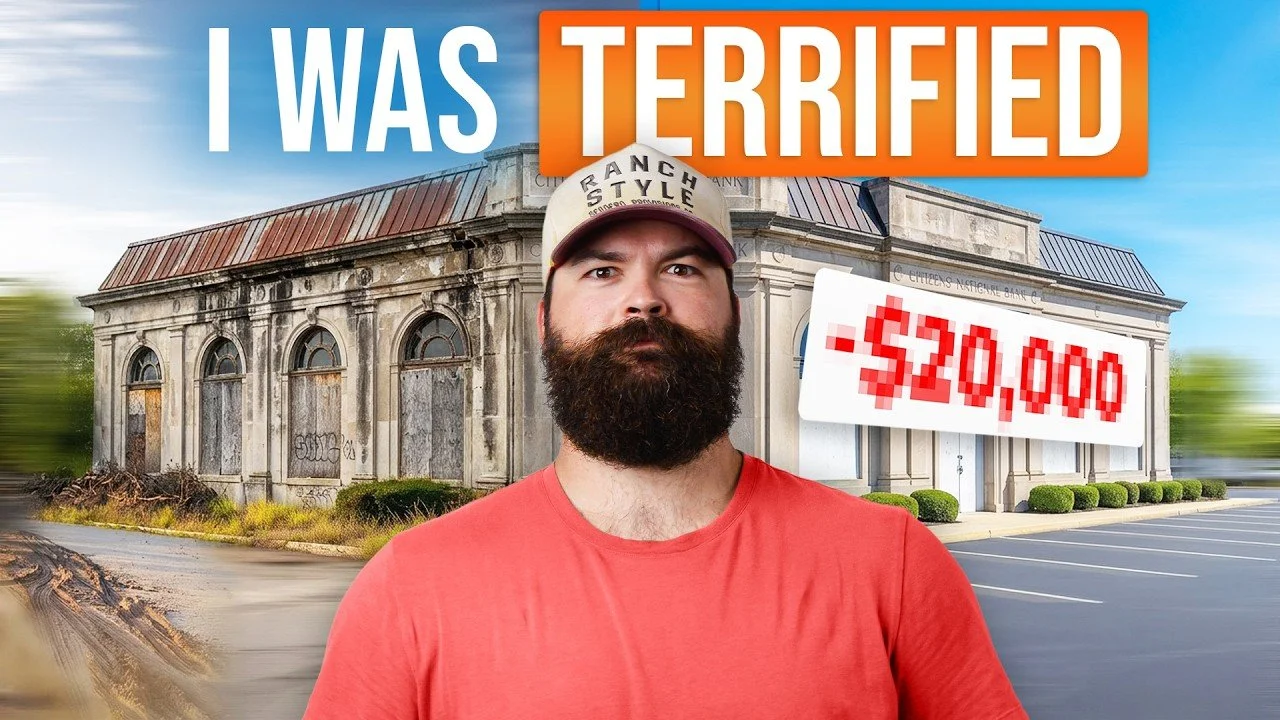
In February 2019, I wired $575,000 to a title company and closed on my first commercial real estate investment.
A former community bank in a Nashville suburb.
Two other buyers had already walked away from the property.
I should have seen that as a warning.
Instead, I saw an opportunity.
For the next 12 months, I wasn't so sure. Between a surprise $20,000 HVAC replacement, vacancies that lasted longer than expected, and several underwriting assumptions that turned out to be wrong, I spent a lot of time wondering whether I had just made the most expensive mistake of my career.
Thankfully, I hadn't.
In this week's video, I'm breaking down the entire deal from start to finish. The negotiation strategy that got me $175,000 off the asking price, how I structured the capital stack with only $115,000 of my own cash, the mistakes that nearly derailed the investment, and the eventual sale that turned a $575,000 purchase into a $740,000 exit just two years later.
If you've been analyzing deals, underwriting opportunities, and waiting for the "perfect" first investment to come along, this story is for you.
What We Cover
The two-offer negotiation strategy that got me $175,000 off the asking price.
How I structured the capital stack with a $460,000 bank loan, $100,000 in investor equity, a $125,000 line of credit, and just $115,000 of my own cash.
The $20,000 HVAC mistake that hit me two months after closing and the lesson it taught me about due diligence.
The three underwriting assumptions I got wrong and how they nearly broke the deal.
What I promised investors, how I raised capital, and how the partnership was structured.
The complete breakdown of the exit, including what the property sold for, what investors received, and what the deal returned to me.
The one thing that actually separates investors who buy their first commercial property from those who spend years talking about buying one.
If you want the same framework we teach inside the CRE Accelerator—from defining your buy box and underwriting deals to structuring capital stacks and avoiding costly mistakes—you can learn more here:
https://accelerator.crecentral.com/575k
Get commercial real estate coaching, courses, and community to jumpstart your investment journey over at CRE Central: www.crecentral.com
Key Takeaways:
First deal’s purpose
Not to make you rich, but to teach you how to confidently do more (and better) deals.
How he won the deal
List: $750k, closed at $575k by giving the seller 2 options and making the lower one ultra-certain (no contingencies, fast close).
Capital & structure
~80% bank loan, $100k from 2 investors, $125k LOC as cushion.
Simple promise to investors: 8% paid at exit, no monthly distributions.
Painful lessons
Scope mechanicals deeply (HVAC failure cost $20k).
Double your vacancy / lease-up timeline.
Underwrite conservatively and stress test for higher expenses and longer vacancy.
Real separator
Not capital or perfect knowledge.
Willingness to act without full certainty, backed by a clear buy box, disciplined DD, and a cushioned capital stack.
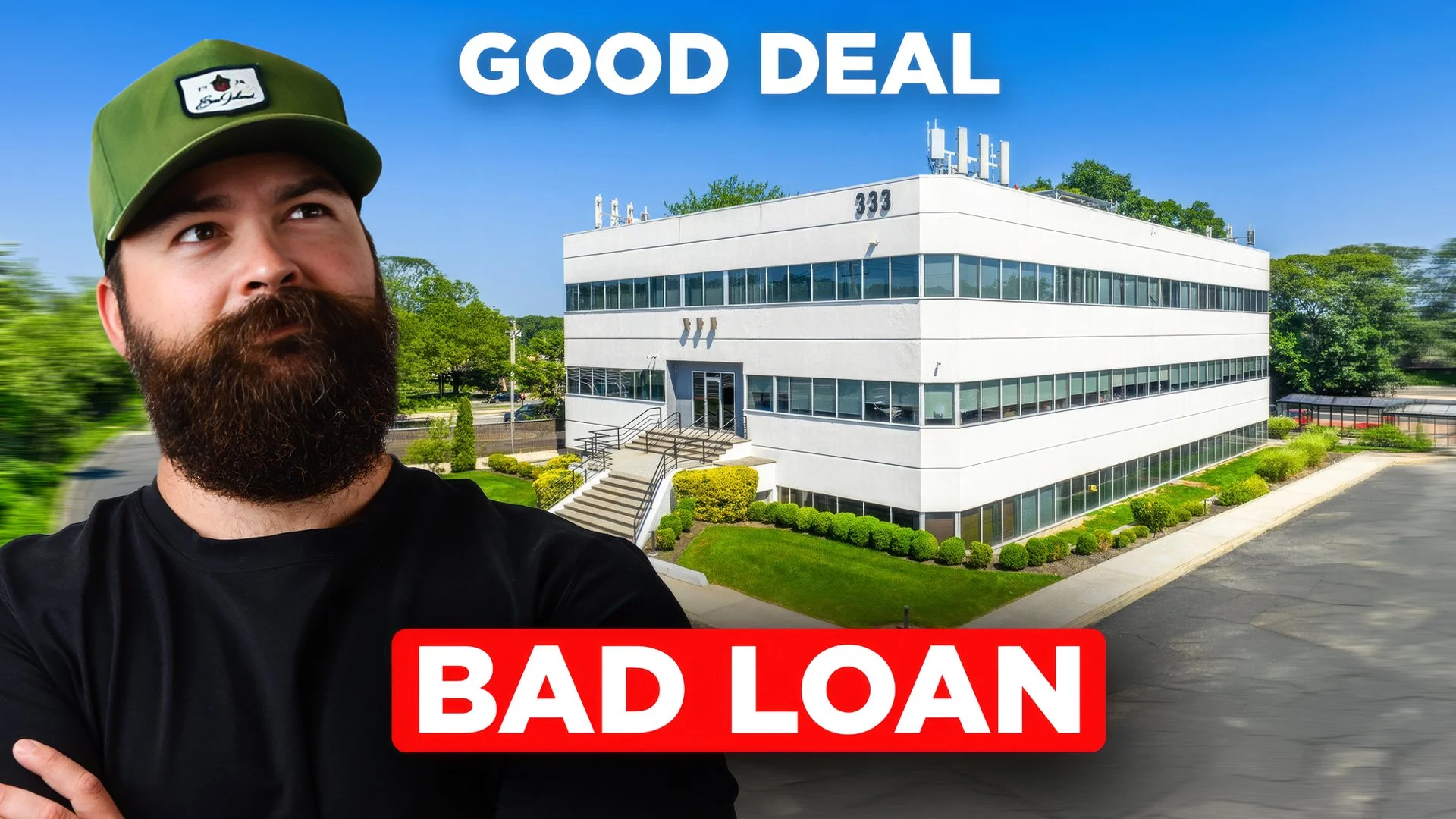


About Your Host:
Tyler Cauble, Founder & President of The Cauble Group, is a commercial real estate broker and investor based in East Nashville. He’s the best selling author of Open for Business: The Insider’s Guide to Leasing Commercial Real Estate and has focused his career on serving commercial real estate investors.
Episode Transcript:
Tyler Cauble 0:00
You've been looking at commercial real estate for a year, maybe longer, running numbers and watching videos, waiting to feel ready, and nothing's happening. I did that too, for 18 months. Then, in February of 2019 I wired $575,000 to a title company and closed my first commercial property, a former community bank in a Nashville suburb that two different buyers had walked away from, and for the next year I questioned whether I had just made the biggest mistake of my life. Today I'm going to show you exactly how that deal worked, the real numbers, the two offer negotiation that got me $175,000 off the list price, the $20,000 mistake that hit me two months after closing, and the one thing that actually separates people who buy their first commercial property from people who just keep looking at them, it's not capital, it's not the market knowledge, it's not even finding the right deal, it's something else entirely, and I'll show you exactly what it is. So, let's get into it. I'm Tyler Cobble, founder and CEO of CRE central.com I've been investing in commercial real estate for over a decade now, I've repositioned over $100 million in neglected and underperforming real estate assets, built a personal portfolio north of $75 million and coached hundreds of investors through their first deals inside the CRA accelerator, but everybody has a first deal, and mine, mine wasn't a grand slam, it wasn't one of those I turned $50,000 into $5 million stories that go viral on Instagram. It was a scrappy, slightly over my head, teeth-gritting, almost didn't really work out kind of deal. Now, here's the thing that most people get wrong about their first commercial property: they think it's supposed to make them rich, and it's not. Your first commercial property is supposed to teach you how to buy your second one, and your third, and your 30th. If you can wrap your head around that, you will actually pull the trigger. If you can't, you'll keep running deals on a spreadsheet for another three years, while everyone else around you keeps building. Now, here's what I want you to understand. First, I wasn't some outside investor who rolled in with a trust fund. I wish that would have been way easier. I was 25 years old, and I've been working in commercial real estate every single day for years, but not as an investor, I was a broker, which means I was in the room while other people made life-changing decisions on buildings I'd found for them, underwritten for them, and negotiated for them, and every single time I'd drive away from a closing, I'd have the exact same thought that should have been me, that that could have been me. I was watching clients build generational wealth off of deals that I had found, deals that I analyzed, deals that I had put together for them, and then I'd go home and look at a commission check that had already been gutted by taxes, by rent, buy a car payment, or just life in general. I didn't own anything, and I know most of you aren't brokers, obviously, but I'd bet almost every single person watching this video right now knows that feeling in some form. Maybe you're a residential investor watching other people in your market buy commercial buildings, maybe you're a W-2 professional with real money saved watching people with less capital than you take down deals. Maybe you're an entrepreneur who's built a business and just wants the tax benefits and the stability, but you haven't yet pulled the trigger. The details are different, but the feeling is exactly the same. It's that feeling of watching FOMO. Right, I decided that year I was going to stop watching. I didn't care if my first deal was perfect, I didn't care if it was sexy, and it definitely wasn't. I just needed to own something, anything that would force me to learn. That's actually the first piece of advice that I give every accelerator member. Now, your first deal doesn't have to be the best deal you ever do. In fact, it won't. It's not possible for that to happen. It has to be the deal that gets you off the sidelines. Now, here's the part that still makes me smile a little bit. I didn't find this deal on Loop Net. I didn't cold call the owner.
Tyler Cauble 4:37
I didn't drive a farm area for six months until I got lucky. Actually, had the building on my own listing board. Remember those two buyers that I had told you about in the hook, the ones who had walked away? They were my buyers. I was the broker who brought them to this building. Both of them went under contract, and both of those deals fell apart in due diligence for. Client walked away because they couldn't get their funding together. The second walked because they also couldn't get their funding together, and each time the deal fell through, the seller got a little bit more nervous. The property sat for a little longer. The list price of 750 started to feel a little bit less defensible. By the time the second contract died, I'd been staring at this building for half a year. I knew the building in and out. I knew which systems were original. I knew the vault was still in the back of the building from its days as a community bank. I knew it had been designed by Earl Swenson, the same architect who designed the AT&T Batman building in downtown Nashville, which I thought was pretty cool. I knew Old Hickory itself was a village that DuPont built during World War One to house workers at the smokeless powder plant, and that most Nashville investors were driving right past it toward the hot sub markets closer to downtown. I knew more about this building than probably even the seller did, and I decided it was time to get off the sidelines. Now, before I tell you what I actually paid, because the negotiation itself is a whole lesson, I want to pause for a second. What does a list price actually tell you? Most new investors look at the list price as the starting point for a negotiation, and it's not. The list price often tells you what the seller wishes the building was worth, that's it. It's an aspiration. Your job as the buyer is to figure out what it is actually worth, and that number almost never matches the list on this deal. I wasn't just looking at the list price, I was looking at the list minus two failed contracts, minus a year of marketing time, minus every real concern the next buyer was going to bring up, that's the actual number, and it was nowhere near $750,000 So, here's what I debt: I didn't submit one offer, I submitted two. Same buyer, same property, two options for the seller to pick from. Option one: $650,000 standard contract financing contingency, inspection contingency, 30 day due diligence option two was $575,000 no contingencies, no financing out, no inspection out, close in 60 days, clean as a whistle. Think about what that does to a seller on paper, $650,000 is the bigger number, but a seller who has already watched two deals blow up in due diligence isn't necessarily seeing the bigger number anymore, they're seeing another buyer who might walk away in three weeks, they're seeing uncertainty, the $575,000 offer, uncertainty goes to zero, money is money, time is time, a closed deal in 60 days at $575,000 beats a maybe deal in 90 or 120 days at $650,000 every time when the seller is tired, so they took the $575,000 I saved myself $175,000 off the list price, and $75,000 off my own better offer, just by making it easy for them to say yes when you put two offers in front of somebody, they tend to just pick the one they like more. Now, I need to be clear about something. The no contingency offer is not a move for everybody. You do not do this if you haven't walked the building seven times. You don't do this if you haven't had a contractor friend look at the roof. You do not do this if you don't have a preapproval from the lender sitting in your inbox, I had all of those things because I'd been on the brokerage side watching two prior deals die. Most buyers don't have that much information going in, but if you're buying with enough information, the no contingency offer is one of the most powerful tools in commercial real estate. So, here's what that deal actually looked like list price $750,000 closing price $575,000 price per square foot roughly $97 I financed it conventionally, call it 80% loan to value.
Tyler Cauble 8:54
So the bank gave me 460 grand, and I needed to bring roughly $115,000 in down payment plus closing costs. The only problem, I didn't have anything near $115,000 in my bank account. I was 20-five and a broker. There's a reason they call them brokers, because they're broke. I had commission checks, not a cash pile. So, here's how I closed it. I raised $100,000 from two investors, $50,000 apiece. One was a friend of mine, one was a client that I've been working with and building up trust over a couple of years. Both of them wrote me checks because I had already shown them I knew this specific building, this specific market, and this specific deal inside and out. I wasn't pitching a business plan, I was pitching a property that I already knew better than the seller did, and on top of that, I set up a $125,000 line of credit for improvements and working capital, that was the buffer, and it turned out to be the thing that kind of saved the whole deal, so again, that capital stack looked like a $460,000 bank. Loan $100,000 of investor equity, plus I rolled in my commissions on top of that, a $125,000 line of credit for TI, capex, and carry, and then my own sweat equity. Now here's the return I promised my investors: nothing crazy, nothing special, 8% annualized, paid out on exit, no cash flow distributions, no preferred return on the back end. And here's why that structure matters. Most first-time operators over promise cash flow and then under deliver. I structured it so that my investors got their number off of this sale, not off of monthly distributions that I might miss. That actually protected the deal pretty well. It protected the investors, and it kept me from writing personal checks, which I didn't have to cover promise distributions every time a tenant was late. Remember that when you're raising money on your first deal, you're not raising money on cash flow, you're raising money on a clear exit. Make sure you have that strategy pulled together. This is exactly the kind of deal structuring that I walk every new member through inside the CRE accelerator. We pull a real deal, build the capital stack, stress test the returns to investors, and figure out if it actually makes sense or if the structure itself needs to change before you ever take it to a lender. If you want to see how that works, the link is in the description below. All right, now for the part that I don't love talking about, because as good as that deal turned out to be, I made three very specific mistakes on it that cost me real money, and if I'd had somebody in my corner, I probably could have avoided all three. Now, mistake number one, I didn't scope the mechanical systems hard enough. Remember how I said I submitted a no contingency offer. Well, that cuts both ways. When you waive inspection, you are telling the seller, I've already seen what I need to see, and I'm willing to take that risk. Now, I'd walked the building numerous times, I've looked at the roof, I looked at the foundation, I looked at the plumbing. In fact, we even had a property inspector come out to review all of the mechanical systems, and despite all of that, about two months after I closed the main HVAC unit serving the biggest suite went down, and this was not a small repair, because keep in mind this was an old bank, it was at full replacement, total cost, including labor and downtime, was $20,000 that's my line of credit taking a hit in month two, that's 20 grand I had not planned for, that's $20,000 that would have come off the purchase price if I'd had a contingency, or if we had been able to discover that on the front end, so the lesson there is, make sure you have a backup plan, because even if you go into it knowing what you know and inspecting everything properly, you don't know what could pop up two months down the road. Mistake number two, I underestimated our vacancy carry. Both of our suites were vacant at closed. I'd built my pro forma assuming that I would have a tenant signed within about 180 days and paying rent that year.
Tyler Cauble 12:58
In reality, it took us nearly a full year to get those suites leased. Market rent was there, that was great. The demand was there, but the space was kind of wonky. It used to be a bank, it needed a little build out, and that took more than I had modeled, and my ideal tenants took their time the way good tenants do. So every extra month of vacancy is debt service and utilities and insurance coming straight out of your pocket, or in my case, straight off of our line of credit. Fortunately, so the lesson there: double your vacancy rate assumptions. If you think it'll take three months to lease up, Model Six, if your deal still works with six months of vacancy on every empty suite, you have a real deal. If it doesn't, you might just be buying a fantasy now. Mistake number three, and this kind of leans into mistake number two as well. I was too optimistic on my pro forma. This is the single biggest mistake most new investors make, and I made it too. I underwrote the deal, assuming rents would grow 3% a year, that vacancy would stay at Nashville market average, which was super low at the time, then my operating expenses would tick up at about 2% per year, and then everything would just kind of work out. Now, to be fair, this was on literally the back of a napkin, because I didn't know how to properly underwrite deals, and in reality, rents grew faster in Old Hickory than I had predicted. That one was a whip, Nashville popped, Old Hickory came along with the ride, but my operating expenses ran a little bit closer to 4% per year. Insurance was higher than we had anticipated. My vacancy was higher in the market for the 12 month stretch there, and I spent a little bit more on capex in year one than I'd modeled, because we were planning to save that line of credit for tenant improvements. Now the deal still worked because of the price that I paid and the line of credit cushion, but if I'd been stretching to make that pro forma pencil, if I'd overpaid by even 50 grand, I would have been running personal checks to cover the debt service, or worse, calling my investors and asking them to do so. The lesson there, underwrite conservatively, then stress test it, if. Deal doesn't pencil with 10% higher expenses, and maybe six months of additional vacancy. Don't buy it, by the way. I have a link to my deal analyzer in the description below. It is a full underwriting tool. You don't need to bother with spreadsheets, check that out. And look, I get it. If you're sitting there right now realizing you haven't been scoping out HVAC or doubling your vacancy rates or really stress testing your performers, you're not crazy. I'm still here today. Nobody teaches this stuff in a book. I learned it by writing checks that I didn't need to write. One quick thing before we keep going, drop a comment below and let me know which of these three mistakes feels like something you might have missed. I read every comment, I'll jump in and answer. So, here's the part that, honestly, nobody tells you about your first commercial deal, the nights. Now, I'm not being dramatic. In the first six months after I closed, and definitely the night before, I did not sleep well. I'd wake up at 2am thinking about the roof, thinking about the HVAC unit I just had to replace, and hoping that that wouldn't go out again, thinking about whether I overpaid, thinking about the $100,000 that I owed to investors I'd never taken on capital from investors before, thinking about the check that I'd written, which at 25 years old was $18,000 was the biggest check that I'd ever written in my life by a factor of probably four, that feeling doesn't go away just because you read another book, it goes away because you see the building deposit the rent check month after month, you see the vacant suite lease up, you see the line of credit balance starting to come down, you see the appraisal come in substantially higher than what you paid, and then you sit there after about 12 months and realize, oh, this kind of actually works. I like it.
Tyler Cauble 16:43
And then you want to go do it again. In fact, that year we bought three more buildings just because I bought that one. That's the moment. That's the only thing that your first deal actually has to do for you. It doesn't have to make you rich. It doesn't have to get you a 30% IRR. It has to prove to you and your own brain that you can own commercial real estate and not have everything blow up, because once you have that proof, you go find your second deal with completely different eyes, you underwrite tighter, you negotiate harder, you move a little faster, and here's what happened with this one: a couple years in, one of my partners committed a massive amount of fraud, and I didn't want to get the asset locked up in an FBI investigation for years. So, I went to my largest tenant, told them that they should buy the building and owner occupy it. They could get an SBA loan at a rate that I couldn't touch, and they were willing to pay me real money for the space that they had been renting. In fact, their mortgage was almost equivalent to the rent that they were paying me. So, we sold the building to the tenant for roughly $740,000 Now, do the math: 575 all in, 740 out, plus two years of operating income on about $115,000 of my own cash. The investors got their 8% return paid out over a two-month disbursement window, everyone got what they were promised, and I walked away with enough capital and enough confidence to go and buy the next one. Now, remember the open loop from the beginning. I told you there was one thing that separates the people who buy their first commercial property from people who just keep looking at them, and it wasn't capital, it's not market knowledge, it's not the right deal. Here's what it actually is: it's the willingness to stop waiting for certainty that isn't coming. I didn't buy 1100 old hickory because I finally felt ready. In fact, I felt very, very far from it. I bought it because I realized I was never going to feel ready. Every one of my clients who I watched close a deal, they weren't more certain than I was. They weren't smarter than I was. They weren't even better funded than I was. In some cases, they were just done waiting and ready to get out there and take the action. That's the whole difference. That was my biggest takeaway. And the truth is, you don't need to get your first commercial deal perfect. You just need to get it done. You don't need the grand slam, you need the one that teaches you how to get the grand slams. You don't need to wait for the market to bottom, or for rates to drop, or for the economy to stabilize, because those things will never happen at the same time. And by the time they do, that deal will be long gone anyway. What you actually need is one, a clear buy box written down, so you know exactly what you're looking for. You want the same questionnaire I give my accelerator members on day one. It's free in the description below. Two real due diligence discipline property financials, tenants, mechanical systems, not the version where you skip steps because you're in a hurry, or because you waived a contingency, like I did. Three, a conservative pro forma that still works when things go sideways. Then stress test it again, and stress test it some more. For a capital stack with a cushion, my $125,000 line of credit is the only. Reason the $20,000 HVAC blowout didn't absolutely break us, and five, a willingness to be uncomfortable for probably about 12 months while the deal proves itself. That's it. That's the whole thing. All right, before you leave, if you're thinking, I want to buy my first commercial property, but I still don't know where to actually start. That's exactly why I built the Siri Accelero. It is the step-by-step system that I wish I'd had when I was 25 years old, standing in that parking lot in Old Hickory, trying to figure out what the hell I was doing, and whether I was about to change my life or ruin it.
Tyler Cauble 20:35
Inside, we help members build their buy box, structure their capital stack, walk through live deals with them, and most importantly, I make sure that they don't make the three mistakes that I just told you about, as well as a Whitney of others that I've made along the way. You can book a call with me. I will be the one that takes the call to see if it's a fit through the link in the description below. But look, if you're not ready for that, I get it. Check out this video right here on buying your first commercial property, even if you're a beginner, it's a natural step for this
Two identical commercial spaces. Same size, same property type, but one is worth $97,222 more because of how the lease is structured.
One rents for $14/SF triple net, while the other brings in $18/SF gross. You'd think the higher rent means a better investment, right?
Not necessarily.