
Why Single Family Rentals Will Never Replace Your W-2
If your goal is to buy enough single-family rentals to eventually quit your job, you may be chasing a strategy that was never designed to get you there.
In this week's episode, I break down what I call the W-2 Paradox—why your paycheck is actually one of the most valuable tools for building wealth, why trying to replace it too early can slow your investing down, and why so many residential investors eventually hit a ceiling.
We'll cover why scaling single-family rentals becomes harder than most people expect, how lenders view investors once they leave their W-2, the hidden cost of living off your portfolio too soon, and why commercial real estate offers a completely different path to building wealth. I'll also share real examples of investors who made the transition from residential into commercial and dramatically increased their equity and earning potential.
Watch the full episode below, and if you're ready to start making the transition into commercial real estate, join us inside the CRE Accelerator where we provide the education, coaching, community, and deal analysis to help you make it happen.
Get commercial real estate coaching, courses, and community to jumpstart your investment journey over at CRE Central: www.crecentral.com
Key Takeaways:
Your W-2 is an asset, not a liability. Your paycheck funds down payments, strengthens your loan applications, and allows you to keep compounding your real estate portfolio.
Quitting your W-2 too early can slow your investing down. Once you rely on rental income for living expenses, you have less capital to reinvest and lenders often view you as a riskier borrower.
Residential investing doesn't scale efficiently. More single-family rentals mean more tenants, more maintenance, more management, and more complexity—all for relatively small increases in cash flow.
Commercial real estate scales differently. A single commercial property can often produce the cash flow and equity growth of dozens of residential units, with far fewer tenants and operational headaches.
Forced appreciation is a powerful advantage. In commercial real estate, increasing a property's income by signing leases or improving operations can create hundreds of thousands of dollars in equity without waiting for the market to appreciate.
Use your W-2 to build wealth, then retire from strength. Rather than replacing your paycheck as quickly as possible, use it to accelerate your portfolio until you've created enough passive income and liquidity to retire on your own terms.



About Your Host:
Tyler Cauble, Founder & President of The Cauble Group, is a commercial real estate broker and investor based in East Nashville. He’s the best selling author of Open for Business: The Insider’s Guide to Leasing Commercial Real Estate and has focused his career on serving commercial real estate investors.
Episode Transcript:
Tyler Cauble 0:00
Uh, single family rentals will never be able to replace your W-2 income, and honestly, the same thing goes for commercial real estate as well, and it's probably not for the reason that you're thinking. We're going to be diving into today what I like to call the W-2 paradox, because it's one of the most prevalent questions that I receive from people that are looking to get started in real estate, whether it's residential or commercial. Right, how quickly can I replace my W-2? And I'm actually going to be making the argument today for why you should not be trying to replace your W-2. All that, and more, on this week's episode of Office Hours. This episode of The Commercial Ealate Investor Podcast is brought to you by my CRE Accelerator Mastermind, where you'll get access to my step-by-step investment blueprint, essentially a library of resources on how to invest in commercial real estate. You'll get connected to a supportive community of other commercial real estate investors that are doing projects just like you. You'll get personalized coaching and feedback from me every step of the way. Go to www.crecentral.com to learn more. Welcome back to the Commercial Real Estate Investor Podcast. And today we're diving into why single family rentals will never replace your W-2. Here's the thing, when you're getting into real estate, the W-2 is actually one of the most valuable things that you can have as a real estate investor, and I know that everybody's getting into real estate to replace it with the passive income, and to be able to leave that today. I'm actually going to be making the argument as to why you should not be doing that. As I stated at the top of the show, that doesn't mean that you have to be working 40, 5060, hours a week at your W-2, but it does mean you should probably keep it, and I'm going to run you through some of the reasons why, at least until you're ready to retire, because when you are building a real estate investment portfolio, every dollar that your portfolio makes is $1 that you can reinvest back into buying more and more real estate. The second that you get rid of your W-2, you are now having to live off of all of your rental income, you will not be able, you will never be able to continue building your real estate portfolio in this at the same level, in the same manner, as soon as you leave your W-2. So, here's, here's the structure, here's what people are typically doing when they're getting into commercial real estate. By the way, this is office hours. If you have questions on commercial real estate, you have questions about getting started, feel free to drop those into the live chat, and I will get to them as soon as we are done through this. So, look, you save from your W-2, right? Your salary is what funds every single down payment, right? You start setting aside a little bit of money every month or every year you get a big bonus, you do really well in sales, whatever that is. And then that's the money that you start using to buy your real estate investments. Your W-2 also helps you qualify with the bank. Now, commercial is obviously very different from residential when it comes to qualifying for these loans, you're not going to be completely dependent upon your personal financial situation, right? The property, the income coming in from it, all of that also factors into this in a different way than what you get with a single family home, but without that W-2 income, it's very difficult for a bank to approve you for an investment loan, right? They're going to be looking at it as far riskier because the only income that you have coming in is from your real estate investments, especially like specifically this investment. What happens if a tenant moves out? Well, all of a sudden your cash flow is gone, you're not going to be able to afford the payment, and they just don't want to take that risk, so then from there you know, step three is really to stack the cash flow until you quit, so you eventually replace the w2 and you walk away. That's when you retire. I want you all to start looking at the passive income side of real estate.
Tyler Cauble 4:15
Basically, if it continues to compound thereafter, because you are living well below the amount of passive income that you've brought in. Great, I hope that that happens, but if you're just looking to maybe replace the level of your income, make sure that you are continuing to live the lifestyle that you have today, while you have a job. Once you don't have a job, then it's probably not going to continue to really compound and snowball, so you want to have yourself in the best position possible by the time that you retire, so that whatever income you have, then you make the assumption that, okay, for the rest of my life, if I'm making $10,000 a month passively from my real estate portfolio, it might grow three. Per year, it might not, but that $10,000 a month is going to be good for me. All right, it's a very circular plan, right? So you save from your W-2, you use the W-2 to qualify for the loan, you stack cash flow, then you repeat that process, right? And you continue to stack these assets. So I mean, it is a good strategy. It works. Here's the problem, though: the plan only works while you have a W-2, unless you have a substantial amount of income, because these lenders are going to look at you from a global cash flow perspective. And by the way, next week we are diving into negotiating commercial real estate loans on office hours, so be sure to tune in for that, because I had one of our CRA accelerator members, Luke had said, "Hey, I don't think we've ever really talked about this. Do you mind doing an episode on that? I was like, "Absolutely, we'll dive into everything that you can negotiate in a commercial real estate loan. But here's the thing: your global cash flow includes your W-2 income, so if you're making 120,000 150 $200,000 a year, whatever it is, a million dollars a year. The second that you stop making that, that global cash flow diminishes substantially, right? So the moment that you actually quit your W-2, the entire investment system here breaks, and you're going to become completely reliant on your cash flow, strictly the cash flow from your assets, which banks are going to look at as an investment, and they're going to consider it risky, right. And so most investors just don't see this until they're on the other side of it. They think, hey, the W-2, quitting the W-2, that's when I'm going to be able to focus on real estate investing full time, and really be able to take this off, and it's actually the opposite. The second you quit your W-2, your real estate investing is probably going to stall out, because now not only do you not have the income coming in, banks don't want to work with you, and it'll take a few years of just stacking up enough cash to be able to put down a 3040 50% down payment to make a bank feel comfortable with it. Look, when I first started my business back in 2018 I couldn't qualify for anything. I mean, it took me two years, right, before I was actually qualified to go buy a house, because banks saw me as risky for having my own business, even though I was making substantially more than when I was working for somebody else, they see it as risk. I mean, it makes no sense. Don't ask me why. I mean, you know, they just see you, you know, being self-employed and being successful as riskier than if you just have a W-2 job working for somebody else, which is crazy. Because if you work for somebody else, you have zero job stability. You could lose that job tomorrow, but banks just look at that as being more stable than if you work for yourself. There are three big walls that close in behind you the day that you quit. The first one is the lending wall, so when your W-2 disappears, so do the banks lenders underwrite you, right? So, they look at you first, of course. They're going to look at your credit. It's not as big of a deal in residential, but they still look at your credit. Then they look at the asset, right?
Tyler Cauble 8:13
They're going to want to see how much cash do you have, what is your experience, what is your global cash flow, what is your debt to income, how much overall debt do you have out there? Then they're going to look at the asset. Now, the asset can be so phenomenal that it really carries the loan, and of course, you know if you're bringing 50% down, then the bank's not going to care as much, but they're going to underwrite you, right? You matter, so having that W-2 income coming in matters, it's the strongest qualifier. Like a steady paycheck beats every other form of income on any sort of lending application, right? It makes a huge difference. And I know some of y'all are sitting there, like you're sitting there listening to this, and going, "Well, hell, I thought I was just about to be able to quit my W-2, or I thought my entire goal getting into this was to quit my W-2. I'm miserable at my job, and what I would posit to you is that once you have enough passive cash flow coming in from your commercial real estate investments, that gives you leverage, that gives you flexibility to go do what you want to do for a job, right? If you're miserable working 40 hours a week, but you like your job, go part-time, work as a consultant, work in some sort of different capacity, but I mean, if you go to a consultant, if you're working for yourself, obviously you're going to be at a very similar situation as to how I was when I first started my business, but if you go and work for a consulting firm or something like that, maintain your W-2, maintain something part-time, that's totally fine, or just go find a different career, right, go do something different, you get to do whatever you want, like that's the, that's the entire point of the passive income. It's not to be able to just retire, maybe buy a little bit of real estate every now and then, and just live off the cash flow. It's to give you the flexibility to go do whatever the hell you want with your life, right? Once you're self-employed, it does get harder, right? Real estate investor, like the quote unquote real estate investor, is one of the hardest borrower profiles in lending, because they look at that and they go, okay, well, you may be diversified by having an office building, a strip center, and an industrial building in three different parts of town, but 100% of your income comes from real estate, so if something happens in the real estate market, they're gonna go, okay. Well, this is a really, this is really risky. So, here's the thing. If you quit your W-2, banks have a hard time lending to you. Now, here's wall number two, and this one I would argue is probably more important. Like, look, you can figure out your way around the lending wall, right? You can go get private money, you can go and negotiate for seller financing, but the compounding wall that is, is in my opinion far more detrimental to your future as a real estate investor. The money that you are spending, because you are now having to live off of it, is money that is no longer compounding. Think about that. For every dollar that you spend today, that's $1 that you could have invested and doubled in five years, right? I mean, that's what we do on all of our investments. If we're not doubling our money every five years, I'm not doing the project. So, if you go and you, you quit your W-2 and your living expenses are, you know, $5,000 a month, that's $60,000 Well, that's $120,000 in five years that you will not have now, and that's a small amount. You start multiplying that over a five year period.
Tyler Cauble 11:51
We're talking about $300,000 over five years, which is now $600,000 in missed opportunity and capital growth, so every dollar that you live on it is $1 that just stops growing, so continue to leverage that, w2 you're spending your deal capital like that cash flow that was coming out of the your properties was helping you fund the next acquisition, and now it's going towards groceries, right, and here's the thing, like you're not going to be working 40 hours a week on your real estate investment portfolio. I mean, if you are, you're doing something wrong, I promise you that. I have $75 million with a real estate. We manage a little over two, I mean, in Nashville specifically, well, Tennessee specifically, we manage over 2.1 million square feet, but in the southeast, because we merged our property management company this past year, we manage over 4 million square feet of commercial space. That takes me about two hours of time every week, maybe four to five, depending on the week. That's not a full-time job by any means, and it shouldn't be. That's the entire point of buying real estate. It should not ever become a full-time job. What are you doing with the rest of your time? So, don't just quit and sit at home and read books all day, or, you know, pick up gardening. You're gonna, you're gonna get really tired of all of these hobbies. So, don't spend all of your deal capital that was intended to fund the next acquisition, and here's the thing, too, like, yes, over time this will not necessarily be an issue, but your portfolio freezes the minute that you quit, because you no longer have that income coming in to assist you in the down payment for the next property, so basically the portfolio that you have when you quit your W-2 is kind of the portfolio that you're going to be stuck with for now. Now, again, that doesn't mean that over 20, 3040, years you can't grow an asset, sell it 1031 exchange into something bigger and keep it going from there, but now again you're having to wait for that asset to grow in value to then sell to then do a 1031 exchange instead of adding another property every couple years and also doing the 1031 exchange right, so that's why I always recommend to our clients, I'm like, look, until you're actually ready to retire, like until your portfolio is bringing in the actual amount of money that you will be satisfied with earning on a monthly basis. Don't quit your W-2. We can mold it, we can, you know, change what your day-to-day responsibilities look like. We can go get you a different job, you could start a career in a new industry, whatever it is, because then you're not 100% dependent on it. Now, I'm not saying go from making $500,000 a year, you know, to $60,000 a year, you might as well quit your job at that point, because that's not going to help you as much, but you do have the opportunity, you have the flexibility. I think that that's, I think that's really the point of this episode today, is that it gives you the flexibility, the passive income from your commercial real estate gives you the flexibility. To determine what you want to do in your W-2 job until you're making enough to where you're fully satisfied with the amount that you're bringing in. Here's the third wall, it's the operational wall. Passive income is the most active job you will ever have. All right, every door is a relationship, like here's the thing, like, just because, just because real estate is more passive than just about any other investment that you can have out there for what it is, right? I mean, obviously, you're somebody's probably gonna sit there and go, 'Well, what if I bought gold? Well, you're buying gold, I have a bridge I'd like to sell you. All right, you still have to maintain your tenants, your leases, renewals, repairs, that all every property has a system. You still have to make sure that the systems and the processes are set up properly. That's what will give you the actual ability to step away. All right, and here's the thing, the numbers can compound, right, 30 doors, especially if you're investing in residential like this, this would be miserable.
Tyler Cauble 16:05
Now, 30 doors means 30 furnaces, 30 HVACs, 30 lease renewals, 30 roofs, 30 residential tenants, should be absolutely miserable. I mean, kids, you guys have all seen the episodes that we've done, you know, on the show here recently with members of the Siri Accelerator Mastermind that started off heavy in the residential world. I mean, there was, there was Bob Van Arco, who we just interviewed him last week, a couple weeks ago, and I mean, he had what, 75 doors, right, a mix of apartments and houses. We had Ray Smith, he had over 100 like closer to 120 single family homes, or in a mixed, you know, residential portfolio. At one point, he sold a lot of it off. Now both of them have, and you know, you like, you hear those numbers, like I mean, even Ryan Stackhouse, my buddy Ryan Stackhouse, who we've had on the show multiple times over the years I think he was up to like 450 residential units at one point, and you sit there and you think about that, and you're like, oh, that those guys are living the dream, like that is what everybody tells you to get to in residential real estate, because then you're living like a king, every single one of them, and this is without fail, every single person that I have ever spoken to that has gotten to 50 100 150 200 plus units in their like residential units in their portfolio is miserable. They're not making as much money as they thought. They are having to deal with so many issues. Either they've hired their own property management team, like they're managing in like themselves, so that they can try and keep more of that, like 10% property management fee, or they've hired it out to somebody else, and so, like, either way, like you're having to deal with the property management, or you're having to pay somebody a lot of money to deal with the property management, it just doesn't really become what you think it's going to become, it becomes a full-time job, and you know that's that's again one of the reasons I love commercial real estate so much more. It's so much easier to deal with, you know, talking about over 2 million square feet. I mean, I've got over 100 tenants in my portfolio across that, right? So, like, $75 million worth of real estate, but only about 100 tenants, and they're all businesses, like that is the beauty of commercial real estate, they're all businesses, they, we hardly hear from most of them, and the ones that we do hear from, I actually enjoy having conversations with them, because we're all like-minded, I'm very entrepreneurial, so were they, it's kind of cool to have conversations with them about the stuff that they're doing in their businesses, you know. I mean, we'll have somebody reach out, like, "Hey, Tyler, I'm considering doing this with my business. Is it possible for us to expand our parking lot? Is it possible for us to, you know, add on to the building? Is it possible for us to do x, y, and z? We want to host, you know, this group coming in. We want to put a food truck up out here, you know. We want to do more community-oriented events, like that's those are fun conversations to me, having to figure out, you know, whether the single mom is going to be able to afford her rent this month because she got let go from her job, and she's got two kids, and she's trying to, you know, just pay for worse, she's going to live this month, that's not that I don't want to deal with that, it doesn't matter how good of an operator, how great of a landlord, how good of a person you are. At some point, you know, and you guys know that I'm working on my next book right now, which is titled I Won't Evict Single Moms and Other Musings About Commercial Real Estate. It doesn't matter how great of a person you are, at some point you're going to face that conundrum of do I evict her and do what's right for my investment, or do I do what's probably the right thing and let her stay, but then I'm losing money on this now.
Tyler Cauble 19:58
That's tough, like that's a tough, tough situation to be in, and I don't ever want to be in that anyway. That's what I got a little bit sidetracked there. Here's the thing, I don't try to replace your W-2, actually use it, leverage it, the W-2, like your salary is the engine of your real estate investing machine, and I hope for some of you out there who are so negative about your W-2, which, like, I completely get it, dude. Like, I have been there, right? I started my company young, but I also used to work for other people, and I was just as miserable. But I hope that you can like that. This episode helps you reframe that to see that the W-2 is actually an incredibly positive force in being able to build your real estate portfolio, instead of something that is holding you back from being able to focus on it full time. Right, real estate is the vehicle, single-family, real, you know, residential is obviously not the way to go. Commercial is the way to go. We talk about that all the time in this channel. And if you're new to this channel, by the way, you're just now tuning in. We've got over 700 videos at this point on investing in commercial real estate, so there's a ton of content here on how to make this happen. The best investors that I know, they're all still working, man. I'm telling you, I've got a buddy that owns well over a billion dollars worth of real estate, and this dude, now he's obviously a real estate professional, like he is. He is working full time on the real estate side of things, but he's still negotiating leases, like he still works every single day on his portfolio, he's got a billion dollars of the real estate, though, right? So, like, he gets to work on it full time, but think about that, like he's one of the most successful real estate investors I know, he's he's here in Nashville, down in down in Green Hills, and he still chooses to work every day, he doesn't have to, he's got plenty of cash flow, he enjoys it, if he has that much coming in, and he's still choosing to work on it, because it's, I mean, really, it is a good thing for him to continue doing it. Why would you quit your W-2 at $10,000 a month, because here's the thing, you know, you know, I hear a lot of time, a lot of time when I'm taking the accelerator onboarding calls, because I handle all of those myself, like I'm looking to, to get to $10,000 a month in passive income, because I'm netting $10,000 a month right now, like after expenses, you know, me, the wife, and the kids, you know, whatever. So, I want to replace that. Think about how powerful it is if you're netting $120,000 a year from your W-2, and you're netting $120,000 a year from your real estate, and you continue to grow the real estate, right, even if you never advance further in your career. Let's just say you kind of want to put it on autopilot, make it super easy. I don't want to take on any more responsibility. Comfortable where I am, I'll make 120 and your real estate portfolio keeps going up because you're living off of 60 or 80,000 right? You're able to invest the difference. That's how things really, really, really start to compound fast for you, so here's the playbook that I want you guys to consider moving forward. For this, keep the W-2 right, that is your leverage. Don't burn it down, don't quit. Reframe how you're looking at it. It is a tool for you to buy more real estate if you have single family residential, sell it 1031 exchange it into commercial. Chances are good today you probably have a really, really low return on equity if you've had a single family residential home for a little bit, because you're probably not netting a lot on a cash flow basis, but you've probably built up some equity, so you can sell that 1031 exchange it into a commercial building and make way more. I mean, we did a video not too long ago where we compared one commercial property to 33 residential homes.
Tyler Cauble 24:13
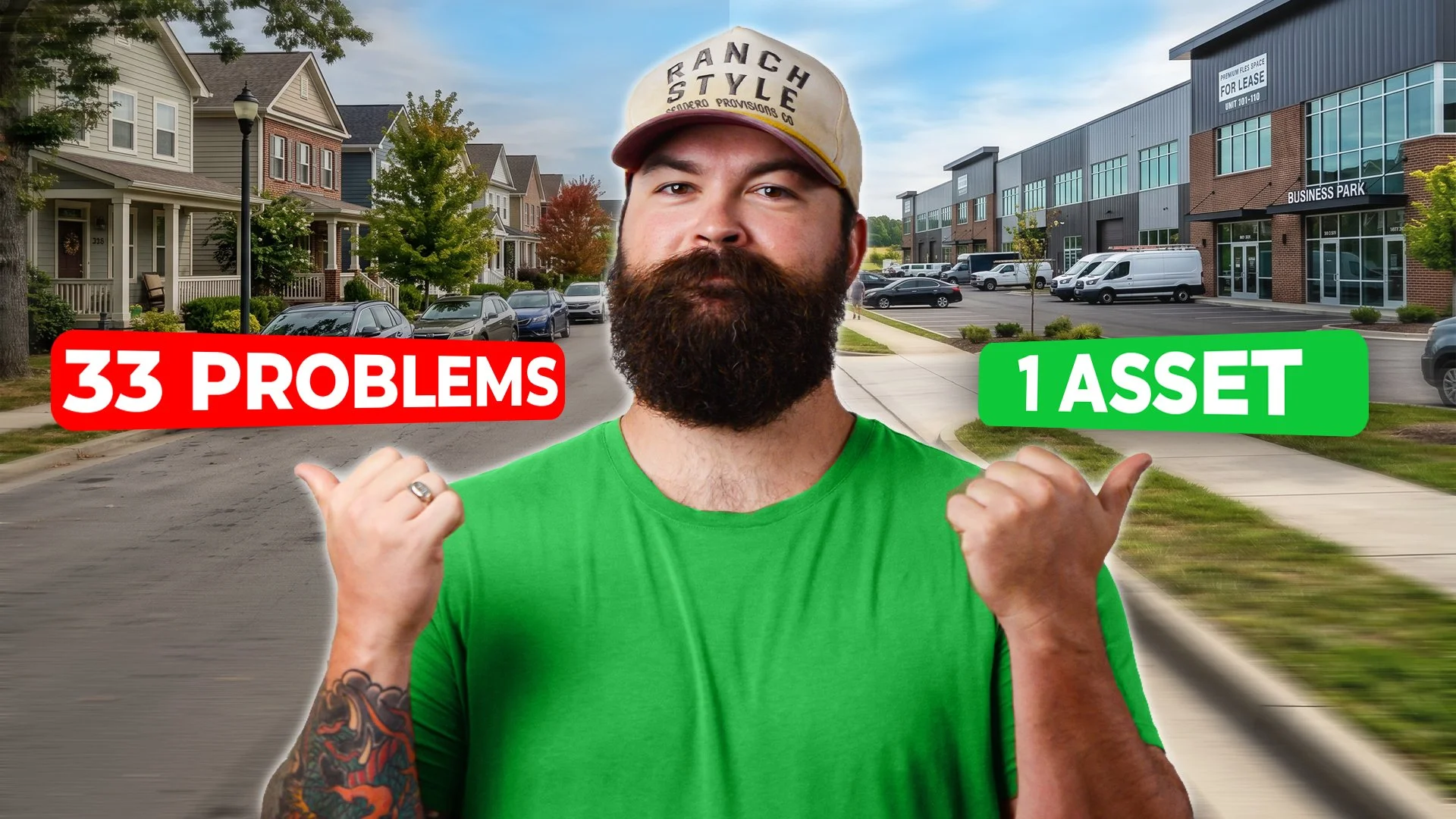
It took 33 residential units to rival one commercial property, and it's not like it was a super expensive commercial property. I mean, it might have been a million dollars, maybe 1.5 I can't remember. It's been, it's been a month. I've slept since then. You can build equity through value add. One thing that you can't do in single family residential, the forced appreciation in commercial real estate is unbelievably powerful. You guys heard from Chad a couple of weeks ago, how he is, you know, once he signs a lease on the property that he just bought, $700,000 in equity. I mean, go show me anywhere else, any other investment opportunity where you can sign a single piece of paper on something you already own that just increases it in 700 by. $700,000 in value, that's incredible. I mean, Bob, just last week, like, we were running through the numbers on his commercial real estate investment, which he found on Facebook Marketplace, by the way, which is just absolutely insane that he got this thing, and it was a hell of a price, but by the time he's done with it, he will have added about $350,000 of equity into that property, insane. He bought it for like 200 that's a great deal, that's the same, that's like as cheap, that's cheaper than some houses you guys are out looking at today. And then here's the thing, once you have enough cash coming through the door, quit when you have an equity event, right? We like to call them capital events, once you have a capital event that is so large that you have enough cash to set aside 123 years of living expenses and continue to bring in cash flow that you know hopefully well surpasses your w2 that is when you actually look at leaving the w2 so the w2 is the engine. Stop trying to kill it. Use it. It will continue to push your real estate portfolio faster, forward, faster than you ever could on your own, even if you were working full time in your portfolio. Now you guys are probably sitting there thinking, well, Tyler, you don't have a W-2, what are you talking about? Well, yeah, I was fortunate enough to start as a commercial real estate professional. Right, I started off as a broker, then left and started my own thing, so bit of a different thing. But we, I do still broker deals, like we handle investment sales in Nashville, you know. We still manage the leasing for our portfolio, so I still do technically have an active job, even though I'm focused on my real estate portfolio for the most part. Next week on office hours, we're diving into negotiating commercial loans. If you have questions on commercial loans, what is negotiable, what isn't, what is reasonable, what isn't - all of those kinds of things. Bring them Tuesday morning, 8:30am Central Standard Time, we will be going live and diving into your questions on that. All right, let's see what we got jumping into the live chat here. Jason is saying, Good morning from Venice, Florida. Jason, what's going on, man? Good to see you. He's saying, send me your residential and commercial deals, you need help with closing. Ted, good morning. Thanks for being here with us. Ted, happy to do it. Thanks for joining me. Let's see, Northeast. Good morning, Jen. Good morning, Costner Commercial. Good morning, Tyler. Good morning. Good to see you, Santa Monica. In the house. All right, let's see. Jason Sin, can you explain example how to make money just restructuring the leases with little or no cap acts than reselling on a higher cap rate. So, Jason, good question. You don't want to resell on a higher cap rate, that would actually mean that you're decreasing the value of the property. You want to resell on a lower cap rate. The cap rate values are inversely proportional to the value, so the lower the cap rate, the higher the value of the property. All right, I mean, it's pretty simple and straightforward.
Tyler Cauble 28:05
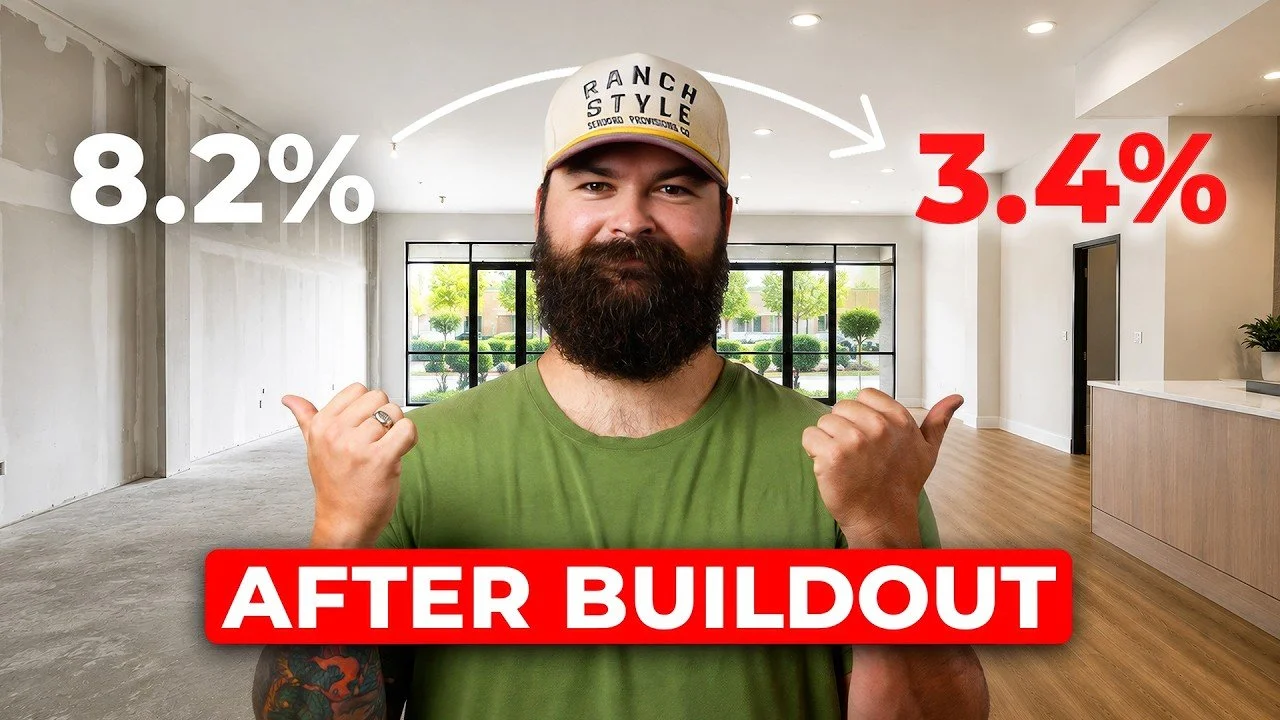
So, I'll give you an example of a deal that we did back in 2021 I went under contract to buy a small retail building for $435,000 It was owner occupied, so the tenant was planning on leaving, and because I have a commercial real estate brokerage, we went out and signed a lease before we ever took possession of it, so I actually had in the purchase and sale agreement that I had the right to market the space to sign a lease, as long as it was contingent upon our closing, right, so I couldn't just like have a lease that would be legally binding without without our closing on him, but because we got that lease signed before closing, I was able to take that to the bank, have them appraise the property using that. It appraised for $650,000 and so we made over $200,000 in equity by closing on the property, because we signed a lease. I didn't, it didn't cost me anything. I mean, it was, it was me who went and found the tenant inside it, so I didn't have to pay myself any brokerage commissions. Pretty simple, straightforward deal, like literally all we did was sign a lease and the bank appraised it for $200,000 more. So, from there, you know, let's say you're talking about, you know, reselling on a cap rate. Let's say you buy a shopping center, and it's 80% occupied, and you buy it for a 9% cap rate. Class C, you know, you got five, 712, tenants, whatever it is. Now, if you're able to go in there and maybe you repaint the shopping center, you reseal and stripe the parking lot, you update the signage to make it all look newer, you add better lighting so the parking lot is safer, maybe you clear out some trees that are growing on one side of the property, so that it's more visible from the drive by traffic, now it's more. Attractive, right? So you could then fill up the remaining 15 or 20% of the space with higher quality tenants, which will help decrease the cap rate. So signing those leases will increase your net operating income while simultaneously decreasing your cap rate, because the quality of the cash flow is better, right? You know, if I've got a Class C shopping center and I go out and I sign a 10 year lease with a national brand laundromat, the incoming buyer is going to look at that and go, okay, well, this laundromat is incredibly financially stable because they're a national brand, they've got a lot of capital behind them. It's a corporate guarantee. The certainty of collecting that rent every month is very high. I'm willing to pay a little bit more for that, and so that's how you decrease the cap rate on these properties, and that's what makes them so unbelievably valuable once you get there. Edwin is saying, what up, Tyler? What's going on, Edwin? Scott Spear, what's up, dude. Thanks for your time. Happy to be here. Happy to do it. Jen saying, how old do you have to be to get into CRE? I mean, probably 18. I guess you could definitely do it earlier. There's not really an age limit to it at all. It's not like bartending, you know? I had to be 18 to get my bartending license. I mean, at least back when I did it, or your ABC license, whatever they call it. So, no, I mean, I think you can get your real estate license whenever, maybe, like, if you're looking to get licensed as a broker, maybe you have to be 18, but I don't even know about that. I think you can be younger, I'm not sure I would look into that, but if you're talking about from an investment perspective, you can, you can start doing that whenever Jason's saying, do CRE tenants ever go on a month to month lease? When are you thinking when you are thinking of selling soon? I mean, yeah, you could have tenants go on month to month leases. We've bought plenty of properties that were on month to month.
Tyler Cauble 31:55
We've also just moved tenants to go to month to month when you know we didn't necessarily want to renew with them, but we didn't want to lose the cash flow, so like I've got some tenants right now that are month to month that their spaces are available, and as soon as we sign a lease with them, we just give them 30 days notice and they're out. That's also nice to have when you're, when you're buying a property too, it can be depends on on the quality of the shopping center, what your plans are for it, because if you're planning on buying it for stabilized cash flow, well, month to month is terrible, but if you're planning on renovating the entire building or tearing it down and redoing it, then month to month is great. So it all just depends. All right, guys. Thank you for joining us this week for office hours. Next week we will be going into negotiating commercial leases. If you have any questions on that, be sure to join us live, 8:30am central standard time, every Tuesday. Appreciate you guys, and we'll see you in the next one. This episode of the Commercial Real Estate Investor Podcast is brought to you by my CRE Accelerator Mastermind, where you'll get access to my step-by-step investment blueprint, essentially a library of resources on how to invest in commercial real estate. You'll get connected to a supportive community of other commercial real estate investors that are doing projects just like you. You'll get personalized coaching and feedback from me every step of the way. Go to www dot cre central.com to learn more,
Unknown Speaker 33:24
you.