
The Deal Doesn't Make You Money. The Financing Does.
Your bank charges you 7%. Your equity investors are costing you 20%. Here's why that's not a mistake.
If that math surprised you, this session will change how you finance every deal you do from here on out.
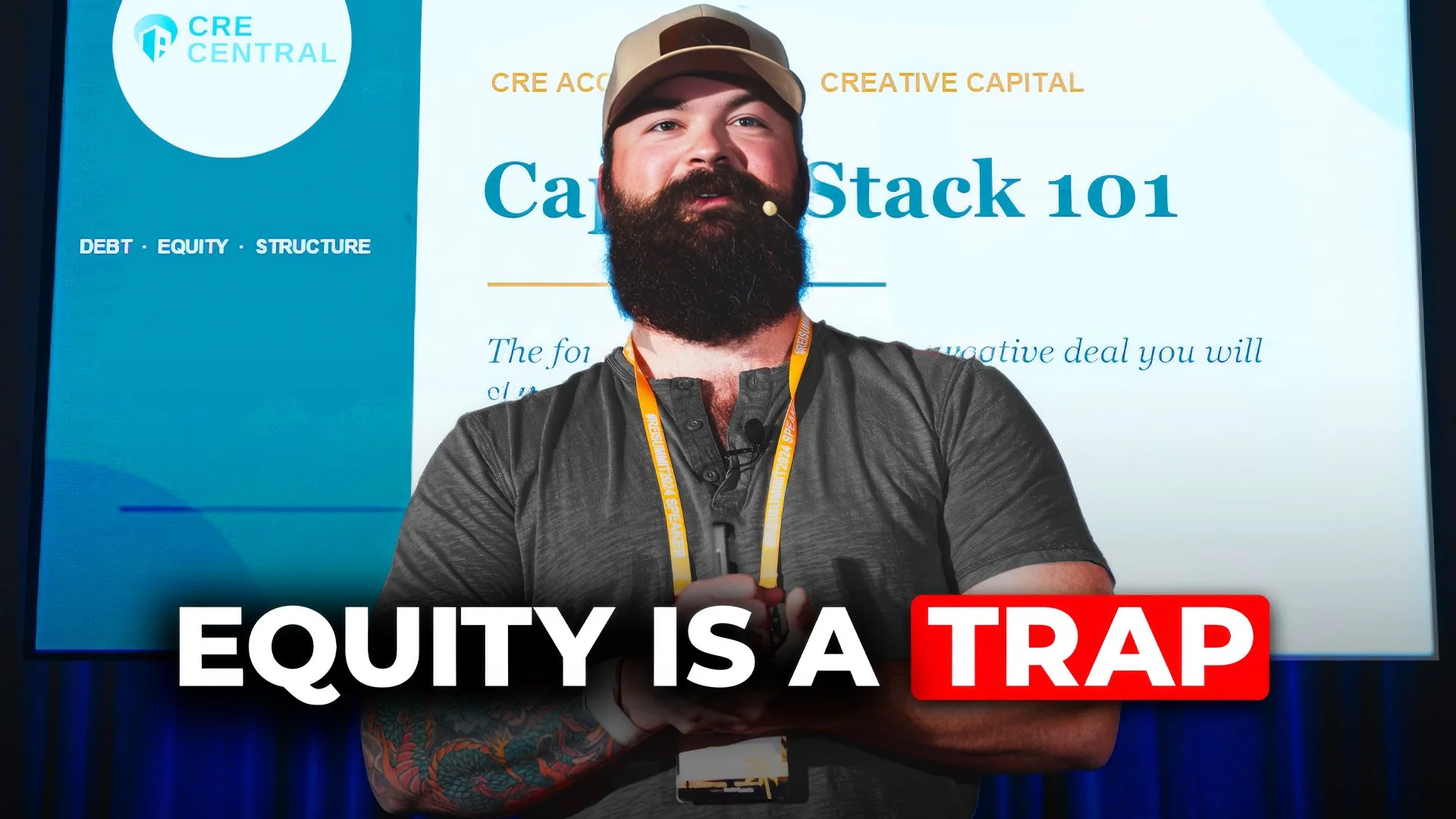
This is the full recording of Capital Stack 101, one session from our most recent CRE Central Mastermind weekend in Nashville. I break down the four layers of financing in every commercial deal, why the "cheapest" money isn't always the smartest money, and why the order you stack it in decides your returns as much as the deal itself.
I've got a project right now where the capital stack has 10 different sources of capital in it. You'll probably never need that many, but you need to understand why each layer exists, because the day you get it wrong is the day a senior lender calls your note.
At the end of the session, I handed the room a real $3M deal that will not pencil with conventional financing and told them to fix it. Grab the same worksheet and work through it yourself. Link below.
What you'll learn:
The four layers, in order. Senior debt, mezzanine debt, preferred equity, common equity, and what each one actually costs.
What's really capping your leverage today. It's not loan-to-value anymore, it's DSCR, and it's quietly limiting deals to 60-65% even when the bank quotes 80%.
The mezz debt mistake that gets notes called. Why stacking undisclosed debt after closing violates almost every loan covenant out there.
Preferred equity vs. common equity. Where pref sits in the stack and why it counts toward your down payment without acting like debt.
Real numbers from the room. Actual interest rates, equity splits, and preferred returns operators are seeing right now.
If you've been circling commercial real estate for a year (or three) and still haven't touched a capital stack in real life, start here.
This is just one session. The full Mastermind weekend covers pref equity in depth, deal underwriting, and the live Q&A that goes with it, and it's all free right now:
Get full access to this weekend's recordings: https://crecentral.com/creative-capital-recordings
Get commercial real estate coaching, courses, and community to jumpstart your investment journey over at CRE Central: www.crecentral.com
Key Takeaways:
Capital stack basics: Every deal is financed through a mix of debt and equity layered by priority — the more secure/senior a position, the cheaper it is, and lower layers get paid back first. Stacks range from simple (all-cash) to highly complex (10+ sources, as in affordable housing deals).
Senior debt (cheapest, first position): Currently running ~6.5–7.5% interest, typically capped at 60–75% loan-to-cost. Lenders often quote a higher headline LTV/LTC, but DSCR requirements — not the stated LTV — are what actually limit how much debt a deal can support today.
Mezzanine/junior debt (second position): Usually a private lender rather than a bank, and must be approved by the senior lender — stacking unapproved debt on top violates loan covenants and risks the senior lender foreclosing. Mezz just wants its principal plus interest back; it doesn't share in upside.
Preferred equity: Sits above mezz debt but below common equity — technically equity (counts toward the down payment) but structured with debt-like protections and payment priority. Highly flexible, often using accrual-based returns (no cash payment required until the deal generates enough cash flow), letting pref investors accept a smaller stake for the same capital in exchange for that added security.
Common equity (most expensive, last in priority): The actual cash down payment/investor capital, commanding the highest returns (often ~20% annualized cash-on-cash) because it's the most "patient" and highest-risk capital. This is where waterfall economics apply — e.g., an 8% preferred return paid first, with remaining profit split pari passu — and where profit splits scale by deal size, from negotiated splits on smaller deals to "2 and 20" institutional structures on $10M+ deals.





About Your Host:
Tyler Cauble, Founder & President of The Cauble Group, is a commercial real estate broker and investor based in East Nashville. He’s the best selling author of Open for Business: The Insider’s Guide to Leasing Commercial Real Estate and has focused his career on serving commercial real estate investors.
Episode Transcript:
Tyler Cauble 0:00
The most expensive money in your real estate deal is not the banks. The bank charges you 567, percent, but your equity investors-they're costing you 20. And if that math surprises you, this session is going to completely change how you finance every deal you do from here on out. I'm even working on a project right now where the developer's capital stack has 10 different sources of capital in it. 10, how you stack that money and the order in which it goes in and who gets paid first decides your returns as much as the actual project does. What you're about to watch is one full session from our most recent CRE Central Mastermind, a weekend we spent together in person here in Nashville on creative capital strategies for commercial real estate. This is Capital Stack 101, the four layers of financing every commercial deal, when to use each one, and how to structure them the right way so that you can seriously improve your returns, and here's the part that I want you to catch: everything that goes with this session is free. The slide deck, the worksheets, the other sessions from this weekend-all of it is available through the link in the description and the pinned comment below. And you're going to want those worksheets because at the end of this session, I hand the room a $3 million deal that will not pencil with conventional financing, and your job is to fix it. So grab the worksheet and work on it right alongside our team. All right, let's get into it. So guys, the the capital stack is the foundation of every single deal that you do, it makes up or it's made up by the debt and the equity that you have in a project. Capital stacks can be as simple as you want them to be, or they can be unbelievably complicated. It completely depends on how you decide to approach the deal. For example, if you're paying all cash, your capital stack is going to be very simple, right? You literally have one stack in the capital stack. If you're doing affordable housing, like a project that we're working on right now, I'm actually I'm selling some land to an affordable housing developer. Their capital stack is made up of 10 different sources of capital so far, and they're probably expecting 11 or 12 by the time that it's done. You can imagine underwriting something like that gets unbelievable. Really, really complicated. But for the purposes of today, we're obviously not going to go to the level of an affordable housing development. But we'll be talking about the different levels that you can have within your capital stack, when to use them, and what they're for. Well, this was working a second ago. All right. So every every deal is a stack, like whether you really necessarily think of it being that or not, because there's all sorts of different sources that you can be pulling your money from. You could have a traditional, you know, senior loan with your down payment as equity. You could have a senior loan with mez debt and equity. We'll even talk about senior loan, mez debt, pref equity, and equity. And each one's going to cost you a different amount of money, and so you, when you're looking at these deals, there are strategic ways for you to go about setting up your capital based on the end game that you're looking to achieve. Everybody knows this, but your equity is the most expensive capital in the stack, by far. Because typically, you know, when we're underwriting, like a lot of y'all were seeing, we were getting to about a 20% annualized cash-on-cash return, which means you're paying your equity 20% per year that they have their cash in your deal. You're paying a bank 7% Why do we do that? Well, your equity is patient. They're willing to wait. They don't have to get paid every single month. They're willing to take the risk that the deal will be successful in the long run, and wait for you. So there's different layers of risk and return. Every dollar comes from one of those layers, and the lower layers get paid back first. So, the more secure a piece of the capital stack is, the cheaper it will be, and they want to get paid back first, right?
Tyler Cauble 4:59
So, like the lowest level of your capital stack is going to be your senior debt. They want first position on the property. They're willing to give you a lower interest rate because of that. Not that they're necessarily low today compared to where they were four years ago. They're still going to be the cheapest in the stack. All right. So this is a sample, you know, capital stack that you could see in a deal. So your senior debt is the cheapest in the stack, and they get paid back first. They have the most security, which is why they're not charging you so much. When we look at single-tenant net lease investments, we're looking at cap rates, what makes cap rates go lower on a tenant by tenant basis? Why would you pay a lower cap rate? Lease stability, market, stronger tenant. That's usually one of the biggest ones. All things being equal, same building, you know, $150,000 in net operating income. If you have Dollar General in that building, compared to you know Bill's Tool Shop, you're probably going to pay a little bit more for that $150,000 with $1 General corporate lease, because we know they've got you know, well over 1000 locations. They're very strong. They're probably going to pay, and if they don't, we've got bigger issues to worry about. Bill could you know have some sort of Walmart could move in next door, cannibalize his business, and there's nothing that he can do about it. He doesn't have other locations. There's just inherently more risk with these local tenants, right? So it's it's the same when it comes to your capital stack. After your senior debt, you're looking at mezzanine or junior debt. This doesn't necessarily have to come from a bank, though it could. None of this technically has to come from a bank. You could have private lenders do everything, but your mezzanine and junior debt could be is typically more of a private lender. Senior debt is typically a traditional bank or something to that effect, right? The mezzanine debt has to get approved typically by the senior lender. So there are people out there that will teach you, hey, just go out and stack a whole bunch of debt on it. Don't tell anybody about it. Do it after the closing so that nobody knows, and get all your money back. I'm sure some of y'all know exactly who I'm talking about. That is a violation of like 99% of loan covenants that I have ever seen. The senior lender could call your note immediately and foreclose on your property. So you want to make sure if you're doing any additional debt on a property that you're getting that approved by the senior lender. Now that mezz debt is not going to be able to come in at first position because that's already taken by the senior lender, so they have to settle for second. Which means that if the deal gets foreclosed on, or if you go to sell, they get paid back second. So they're kind of hoping that you at least sell it for enough to pay back the senior lender and them. They don't really care if you make money. Banks kind of do, but really at the end of the day, they just want to make sure they get their money back plus interest. Mezdet really wants to make sure that you are not so leveraged that if you have to go and fire sell it that you're going to not be able to pay them back, but they're going to charge you for it, right? Then you've got pref equity stacked on top of that, and we'll be talking more about pref equity tomorrow. We'll be diving into that specifically, but that's essentially it's equity, right? So that counts towards your down payment. It's not debt, but they also get to participate as if they are a debt partner. There's a lot of different ways to structure it, but it could be you know their interest gets paid on accrual. They get a lower amount of equity for the same amount of cash because of that, you have a lot of flexibility when you're setting this up, all right. And then of course there's common equity, which is what we typically think of when we talk about equity, right?
Tyler Cauble 9:11
That's your down payment, that's your cash in, your investors, all of that kind of stuff, and so it really runs by priority of repayment, right? Pretty pretty simple and straightforward, and like I said, the further you go up the stack, the more expensive it gets. So it's very tempting to say, well, if equity is the most expensive money that I'm going to have in this deal, and I want to make the most money on it, why wouldn't I just stack as much debt as possible onto this deal, and I'm gonna I'm gonna open that question up. Why wouldn't I want to stack as much debt onto a property as possible? Risk deal might not support it. What do you What do you mean by deal might not support
Speaker 1 9:53
it?
Tyler Cauble 9:54
DSCR. Chris and I were having this conversation yesterday. What's really. Interesting about commercial real estate today, and real estate in general. You know, when we all first learned about real estate investing, the loan to cost, loan to value was the most important thing, right? Whenever I go and buy a property, I can get 75% loan to value, 80% loan to value, and a lot of banks today will still say, "Yeah, we'll give you 80% LTC, and then you start looking at the term sheet that they send over, and you're like, "Well, why are they at 68% loan to cost? They said 80. It's because of their debt service coverage ratios. That, more than anything, is what's limiting the amount of debt you can actually put on a property today, because the lenders want to make sure that you're making enough money to not only pay them back, but also so that you're getting paid, because they want you to keep working on the property. The last thing banks actually want is to take back a real a piece of real estate. They're in the lending game. The cheapest money in the deal, senior debt. More often than not, we're actually seeing this get limited to like 60 to 60-5% today, depending on the deal. It depends on the interest rate. If you've got something that's just cash flowing like crazy today, you'll you'll be able to push 70-5% But a lot of times, that debt service coverage ratio is really really hitting you. Interest rates, typically in the six and a half to 7.5% interest rate range today. The nice thing about senior debt is it's pretty straightforward. Almost everybody has the same style of structure. If you're working with a traditional bank, right, they're typically going to charge you half a point to two points on the note that you can probably negotiate for some interest only period, and it's generally going to be in that six and a half to seven and a half percent range. I want to open it up to you guys. What are we seeing in the market today in terms of interest rates? Because this is always really interesting. Some people see a lot higher in their market, some people see a lot lower. What are we seeing? Who's who's recently got a debt quote? Seven, Dave. What are you seeing? I'm
Speaker 1 12:09
getting 6.25
Tyler Cauble 12:10
6.25 I need your lender. I like your lender, Ray. You said seven. Yes, sir. 6.8
Speaker 1 12:20
6.8
Tyler Cauble 12:24
6.25 to 6.5 for stabilized. I'm assuming that single tenant net lease deals, triple net lease deals. Yeah. All right. Everybody needs to get with Dave and figure out who his lender is. So the debt service coverage ratio is a it's a pretty simple calculation for you to run, and more often than not, that's actually one of the earlier calculations that I run on a deal, so that I can figure out how much debt we can actually put on it. Because the the loan to cost, loan to value doesn't even necessarily matter anymore. But if you're running a 1.2 or 1.25 times debt service coverage ratio, it's a pretty simple formula. Probably should have put it in the slide, but I didn't. You take the net operating income and you divide it by the debt service coverage ratio. Pretty simple, right? I'm sorry. Yeah, yeah, you divide it. So when you do that, basically the bank wants you to be making $1.20-five for every. If it's a 1.25 times, they want you to be making $1.20-five for every $1 in debt service that you have. All right. Like I said, they're the first lien, so first paid, first to foreclose. Right now, that's not to say that a mezz lender, if you default on the mez, is not going to be able to foreclose and typically jump the senior loan. They can put you into default, and it depends on what your documents say. But they might be able to force a force a foreclosure if you stop paying the the mez debt and trigger the senior winner to foreclose on you too. Depends on your loan covenants. You want to be careful with it. So it's it's a double-edged sword. I gotta love that, right? It's a it's a tool. It's y'all have probably heard me refer to it as a as a as an ax. If you've got a really sharp ax and you know what you're doing, you can cut down a tree pretty well. If you've got a really sharp ax and you don't know what you're doing, you can cut your foot off. Right. And in today's market, you want to be as conservative as possible. Like it's it can be very frustrating to work with banks and a lot of the restrictions that they have. But they also have your best interests in mind. You think about it; they are the biggest partner in your deal. They are the biggest partner, and they look at these deals all the time. So if you're getting limited because they see risk in it or something like that. There's a reason why, right? And you want to have those conversations with them to figure that out. Those are conversations that private lenders won't necessarily have, because a private lender may be willing to come in at 75 or 80 percent. You know, they'll close quickly, but they're also kind of incentivized for you to fail, because then they can quickly foreclose and take that additional equity, sell it? Move on. So mezzanine debt. Has anybody in here used mezz debt before? Show hands. A couple of y'all have. Tony has. Eli. More common in development than anything else. That's typically because a lot of lenders will look at development and see how risky it is, and they don't want to go above 60% 60-five, right? So you're not stacking a lot of mezz debt on top of anything. You don't want to say, "Hey, we'll take 30% mez debt, 30% or 40% senior debt, and we'll bring 30% down. You want to keep the mez debt as light as possible, but if a lender is coming in at 60-5% and you've only got a 20-5% down payment, a 10% mez debt can be a pretty good way to fill that gap without having to raise more equity on it. Now, it's you are highly incentivized to make sure that you refi and pay that back as quickly as possible because it's it's going to be a lot more expensive, but really the only time that I ever recommend using it is when you're trying to fill a gap from what the senior debt is willing to do. Now go and run all of your circles.
Tyler Cauble 16:36
Have every conversation with every senior lender that you possibly can before you start to consider this, unless you're in ground of development, that's it's a little bit different. Yeah, Andrew, what's up? How many banks should we go talk to, Andrew? How how many banks did you talk to to finance your hotel? 40. I got you beat. I spoke to 50 for Salt Ranch. You got to talk to a bunch of winners. If you go and talk to 12345, and you get a bunch of no's, it's not that a deal can't be financed. You got to persevere through it. Yes, sir, Dave. So owner financing can come in in a couple different ways. So owner financing could technically be mes debt. It could be senior debt. They could break it out into two different types of structures, so they actually seller finance you a senior loan and a mez loan. The great thing about seller financing is you can kind of get as creative as you want. You could even stack it to where your seller financing is all of the stack, right? Maybe they're stacking you senior debt, mezz debt, pref equity, and then you're bringing a chunk of equity down. And so then they're kind of participating in all sorts of different ways in the deal. So yes, to answer your question, it could be all the above. It could be none of the above. Yes, sir. When you were talking to those 50 banks, did you vary what you were saying for the later ones? Any tips and tricks? Did I? When I was talking to those 50 banks, did I change what I was saying, or how I was saying it, or how I was approaching it? Yes and no. I cried myself to sleep a lot. That helps. So, in a very similar situation to Andrew, I wanted to do a boutique hotel. I didn't want to flag it, and banks just see that as a riskier asset. I think some of that's warranted. I think some of that's not. I think actually boutique hotels, if run the right way, can outperform a flagged asset, because in many of these cases, you know, depending on which hotel you're going with, you're paying them eight to 15% off the top for using their flag, but the reason the banks like it is because Holiday Inn has a built-in customer base that they're going to start sending to you immediately, right? So I changed up my approach a little bit, but like we kind of had the deal solidified. I just knew that I had to talk. I had to find the right lender, but I had a ton of lenders throughout the entire process say, "If you had this exact same deal, but you had a holiday end flag or a La Quinta flag, whatever, we'd finance it. Like that's silly. This doesn't work in East Nashville. Yes, sir. On the purchase? Yes. Yep. Yeah, that was on the purchase. Yeah. Are we going to refinance it? Yes, at some point. Yeah. So we've got. I mean, our loan's good for another two or three years, so we're just going to keep it. I'm hoping that interest rates come down in that time. Because I mean, if we refinance. Today would be at about the same interest rate, so there's no point going through the headache. But it would buy us more time in the long run. So it's you, sir. Do you get a higher cash on cash return in hotels? Uh huh. Yeah. So yes, yes and no depends on how you're approaching it. We when we pitch this to our investors, I mean yes because you're running a business, right? So you should be making more, and it's riskier, so it should be making more. So our initial pitch to investors was a 24% IRR. That's what we had aimed for, and close to a three times equity multiple. I also took more for the general partnership share of that deal than we typically do because of that. What's that? Not necessarily. I mean, I've got a management company that runs it, so okay. We skipped pref equity. Pref equity is really interesting because it behaves like debt. It's equity, like it's it's equity. They get to participate in the upside, but it also acts like debt.
Tyler Cauble 21:20
Now, typically, I am I like pref equity for what it can do, but it you've really got to structure it the right way because what you'll see a lot of of people that want to come into the pref equity position do is they almost want to charge you rates like a mes lender, and get all of the interest that they possibly can, and then also participate heavily in the upside. And that doesn't make any sense, right? You really want to make sure that you're structuring this the right way. So there's a couple of different ways that you can structure this, right? I mean, that's that's the tough part about every aspect of the capital stack. Like, I can't just come up here and tell you like, here's how it's going to be done every single time. Your pref equity can be structured to where you have to pay it out in cash flow. It could be structured to where it accrues and then you pay it off at the end. There's so many different ways for you to do it, but it's going to get paid first before your common equity. So if you've got a bunch of pref equity in the deal, you guys don't just start to split after you've paid off the debt. Everything goes to them first until they've gotten their returns, and then you get to have your share. The great thing about it is that yes, you're still paying interest rates on it. You're not paying as much of the upside as you would in the equity, and they have to be patient-like equity. But it's still more secure because they're technically collecting that that interest. So it's kind of a really interesting hybrid. I would actually take pref equity over mes debt any day, David. Did you have a question? Okay, sorry. I thought I saw your hand raised. And of course, there's there's common equity, right? And I think we're all pretty familiar in here with this. The reason that it gets paid the most is because it's the last to get paid. They're taking the most risk in the deal. So if you're looking at a waterfall. It's senior debt, mezz debt, pref equity, common equity. Now, typically, hopefully, down here the profits are the highest, all right. But it is the most expensive. So your equity can be structured in many different ways, you can raise LP equity in both pref and common equity. You can make different offerings to everybody. I've seen syndicators when they're going out and raising capital, they could structure it as all pref equity. So hey, you're getting you know only 10 or 20 percent of the equity, the upside, but I'll pay you 10% for your preferred. So there's different and interesting ways for you to set this up, and you'll want to make sure that you're running through if you want to make it complicated, which I don't always recommend, because you guys know me. I like to keep my deals super simple. We've got some professional athletes that invest with us. They hit their heads a lot. You don't want to get too complicated in the math, all right? Makes it a lot easier for you to just have a very clear waterfall. But if you're getting into a deal where you think, hey, the upside on this could be substantial, then you want to make sure that you're actually leaving some room in there for you to participate in that. Like if you find a deal, and we've seen some people in this room underwrite these deals that are looking like they're going to be a 4x equity multiple, 5x I've seen a 7x and we beat the hell out of it. I was like, I still think that it's going to be a seven times equity multiple. Well, if that's the case. You don't really want to go and offer your LP investors a seven times equity multiple. First of all, they're not going to believe you. But second of all, you're creating a substantial amount of value. That's when you start looking at pref equity, or you start doing some sort of waterfall return, so that you participate more as the investors make more, all right. Yes, sir. So how do I typically set up my promote earnings as the GP? So my splits are very simple. I don't do waterfalls.
Tyler Cauble 25:40
We typically look at it anywhere. The hotel is a 6040 LPGP split, so the LP took 60% for 100% of the cash, and we took 40. Generally, it's 7030 to 8020 depending on the deal. We'll typically charge a one to 2% acquisition fee. We'll charge a one to 2% asset management fee, a half a percent disposition fee or refi fee. That's kind of it. We'll give them a preferred return, typically around 8% and then it's a Parapusu split after that. And so what that means is the first, the all the first tranche of money goes back to the investors until they've made 8% annualized on their cash, and then we split it based on our equity split. Very simple. Yes,
Speaker 2 26:34
sir. Is there a rule of thumb that say, "Hey, I'm at 8020 on this.
Tyler Cauble 26:48
Sometimes it'll depend on the deal returns, but it's also a pretty market standard to see it between 70/30 and 80/20. Doesn't matter. Yeah, either one. If it's stabilized, you might see it leaning more towards an 8020 just because it's simpler. There's not a whole lot of work that needs to be done. If it's more value add, you're probably going to be closer to 7030 But it ultimately depends on the returns. You know, if you've got to give up more of your GP equity to hit that two times equity multiple on the front end, probably what you got to do, Tony. Yeah, I mean, so the way that I set it up, some people will co-invest as general partners. I don't contribute my co-investment as a GP. I co-invest as an LP. So the LP is still putting up 100% of the capital. I just happen to have invested in the LP, but I'm also the GP. Yes, sir. Yes, typically one to 2% Yeah. Yeah. So we'll we'll talk more about waterfalls tomorrow as well. Logan's going to be talking to you guys about pref equity in the morning, and we'll go we'll go deeper into that and talk about what waterfalls look like. What we're going to do here in a minute, and I'm going to pass this around. You guys are going to work on a deal that we have created in your groups that you guys were just with, all right. It's a $3 million deal that's not going to pencil conventionally. So it's a $3 million mixed use property, $195,000 in NOI. It's it's currently sitting at a six and a half percent cap rate. The bank is going to win you 65% 1.95 You've got to figure out how you are going to fill the gap. All right, you guys will have a worksheet to go through, as well as a deal brief to get you guys going through this, and we're going to spend some time working on this. All right, so really, what you guys are going to want to look at is your blended cost of capital. There is a formula on the sheet that is going to show you how to do this, so that you can see what your true cost of capital is going to be. You could very easily fill this gap with more equity, but that means at the end of the day that your cost of capital is substantially higher, and so what we want to do is figure out okay, how do we structure this capital stack in such a way that my blended cost of capital is as cheap as I can possibly get it? Because that means that your upside is far greater. Any questions on the capital stack on the four pieces of the capital? That we went through before we get into your next workshop. Speak now, forever hold your peace. What do most of my capital stacks look like? 7070-5% debt, 20-5% equity. I keep mine very simple, but this deal is not going to work that way. Yes, sir. Yeah, I'm going to I'm going to email these slides out to everybody at the end. You guys can have them, as well as digital copies of all the worksheets, the deal briefs. You'll have everything. All right. You guys are going to engineer. You have another question. Sorry. Yes, sir. Salt Ranch, and we're going to be talking about that on Sunday. So, for those of you all that are staying here for Sunday morning, Allison, my CFO, who has been with me since 2018 and has seen all of our deals, she and I are going to be walking through Salt Ranch from a like historical perspective of what our capital stack shaped up to look like over the last five years, because it's been a wildly different amount of things, just because it had to be. We had a question over here.
Speaker 1 31:32
70-520-570-520-five I also see a lot, and I don't know this is why I'm asking, where they're raising seven, eight figures worth of funds, and that's more of like an 8020 split, and it's like, okay, we're doing 8020 no matter what, and that's our standard. Is it if you're raising less money or the lower class deals?
Tyler Cauble 32:20
Yeah. So, so the question is, how do you start to split up these deals as the deals get bigger? Like, is there a certain threshold where it's just always 8020 Yes and no. I would say really, what's what's more of an important factor there is that when you get into 1015, 2050, $100 million deals, it's a very professional group that is run like a private equity firm, and they almost treat it like private equity, where it's typically a two and 20. So they take a 2% asset management fee, they take a 20% cut. I've seen huge developers though come in and say, "No, it's a 50-50 split. Doesn't matter what size the deal is. So it kind of just depends on a group-by-group basis. Now the reason that people start to get to a point where they standardize things is because their investors get used to that deal structure. So you don't want to always be changing up your deal structure and moving things around because the more accustomed your investors get to the way that you structure deals, the easier it is to raise capital from them every single time because they already know your formula. It's just a matter of does this deal work for me instead of does this deal structure work for me. Yes, sir. Yeah. When did when did we start charging acquisition fees? Deal one. Bazooki. The 8% preferred return is it? What's it based off of? It is based off of their equity contribution.
Speaker 1 34:11
It
Tyler Cauble 34:16
comes down to cash flow, but it's based on their initial contribution. So, if somebody let's say you've got a million dollars in equity into the deal, and you've got $90,000 in profit in year 180, 1000 of that goes to the investors to pay their preferred return, and then the 10,000 gets split parapasu. Cool. All right. Any other questions? Yes, sir.
Speaker 1 34:41
It's got a minimum DSCR on this example. Is there a max that the bankrupt has in here?
Tyler Cauble 34:48
No. So the minimum is the the lowest that they're willing to accept. So anything above that's great. Because as as the debt service, you know, they hope you hit a. 14 debt service coverage ratio, right? Because they're super protected. Roman, you can structure it in so many different ways. So he's asking the 8% preferred return. Like, is that is that an annual return? What does that look like? Typically, what is done now? This doesn't mean it's set in stone, but typically, what you'll see is that they get paid 8% on their capital account annually, but it's generally upon accrual. So that means if there's no cash flow on the property, it's just going to sit there in their capital account until you have the cash to actually pay it out. Correct. Dan, did you have a question? No. Okay. Awesome. All right, you guys should have your worksheets in front of you. I'll be walking the room just like I did. Y'all figure out how to make this deal work. I want y'all to look at it from multiple different perspectives. I think it would be good for you to look at it from an all-common equity perspective, so that you can figure out what your baseline cost of capital is, and then try to get it lower from there. Good luck.
Two identical commercial spaces. Same size, same property type, but one is worth $97,222 more because of how the lease is structured.
One rents for $14/SF triple net, while the other brings in $18/SF gross. You'd think the higher rent means a better investment, right?
Not necessarily.