
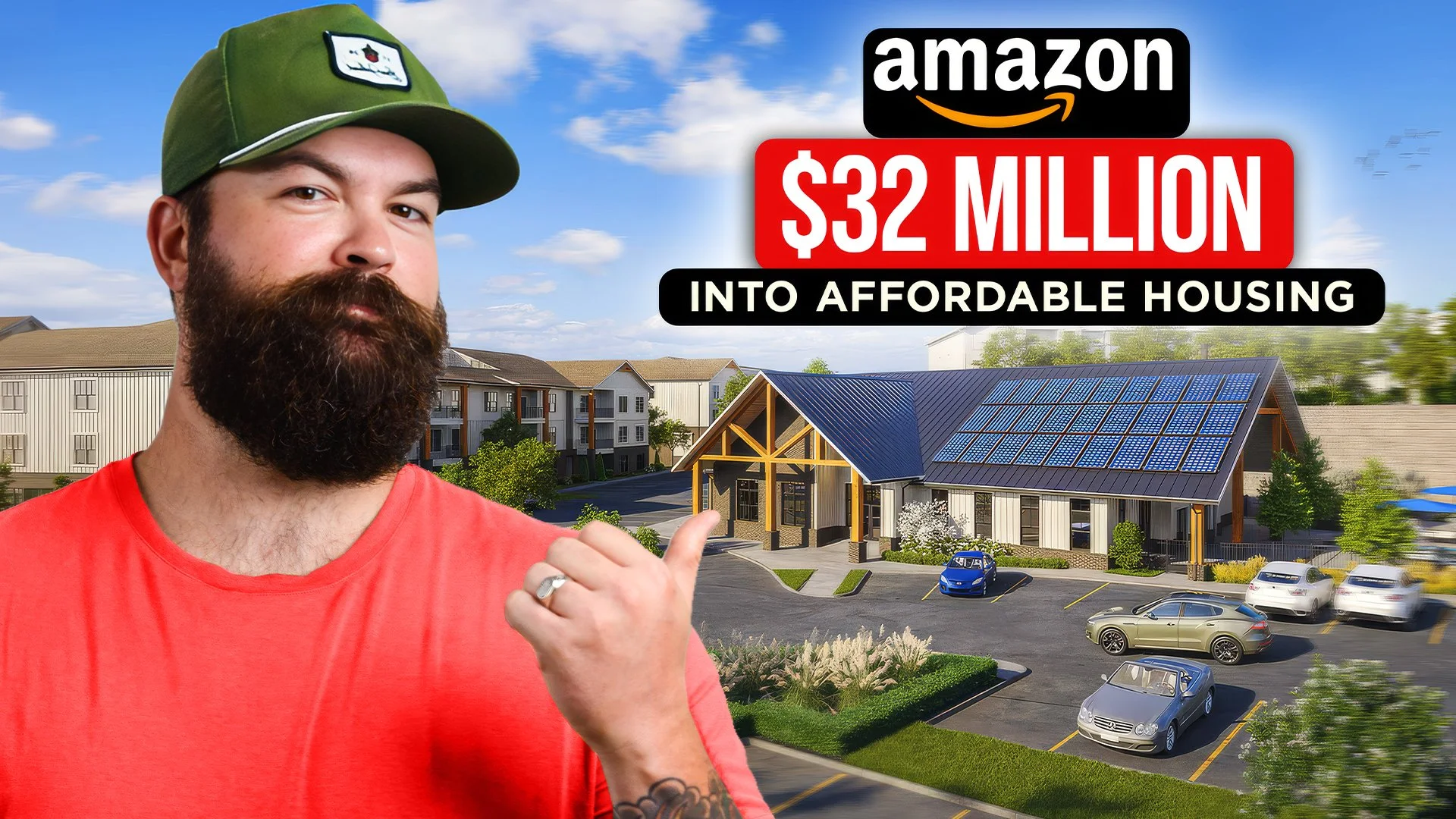
How Developers Build Affordable Housing
Everybody asks how developers make money on affordable housing, so I sat down with Evan Holladay of Holladay Ventures inside Stonebridge Lofts, his $70M, 311-unit community in Goodlettsville, to walk through the entire playbook.
We cover how 40% of the capital stack comes from selling tax credits at 80 cents on the dollar, how Amazon's $2 billion Housing Equity Fund ended up in the deal, the $8 million construction surprise that almost killed it, and the 4.5% rate lock that saved it, plus why he put 11,000 sq ft of retail under affordable apartments and built Tennessee's only 100% solar-powered clubhouse.
Interested in the ground-floor retail space at Stonebridge Lofts? It's listed with The Cauble Group — reach out here: https://www.thecaublegroup.com
Learn affordable development from Evan: https://affordabledevelopmentmastery.com
Get commercial real estate coaching, courses, and community to jumpstart your investment journey over at CRE Central: www.crecentral.com
Key Takeaways:
311-unit affordable community in Goodlettsville, TN with 1–3 bedroom units, 11,000+ SF of retail, and a 5,000 SF clubhouse.
Ground-floor retail used for placemaking, Main Street activation, and creating a live-work environment that adds value for residents and the city.
Capital stack: ~40% tax credit equity, ~50% favorable tax-exempt permanent debt, ~10% local soft funding; initial budget was ~$8M over and required heavy value engineering.
Amazon’s Housing Equity Fund was a key capital partner; locking a 4.5% construction and perm rate on a 40-year loan helped save the deal amid rising rates.
Clubhouse is 100% solar powered with Tesla Powerwalls; project uses sustainability and design to break old “affordable housing” stereotypes.
Business model: impact-focused but profitable by stacking tax credits, cheaper debt, and soft money instead of charging high rents.
Long-term mission: commit to up to 99 years of affordability, with recapitalization and upgrades after 15–20 years while keeping units affordable.
Core lessons: tell a compelling story and create a strong sense of place, and work with partners who can creatively problem-solve when costs and conditions change.

About Your Host:
Tyler Cauble, Founder & President of The Cauble Group, is a commercial real estate broker and investor based in East Nashville. He’s the best selling author of Open for Business: The Insider’s Guide to Leasing Commercial Real Estate and has focused his career on serving commercial real estate investors.
Episode Transcript:
Speaker 1 0:00
While we were already working on the pre-development for this project, Amazon announced their big housing equity fund. I saw Nashville on there, and I was like, "Holy moly, this is our opportunity to partner with them. We were hit with a massive surprise. Our construction budget, when it first came in, was about $8 million more than it needed to be to make the numbers work, and the deal pencil, and be able to close on all this.
Speaker 2 0:23
Come on, man, it's only $8 million
Speaker 1 0:25
Yeah, yeah, just 8 million. We'll find that under couch questions.
Speaker 2 0:28
Affordable housing is one of the most talked about subjects in real estate today. But how do developers pay market rate for land, market rate for development, market rate for construction, and still deliver a beautiful yet affordable product to the market. Well, today we're sitting down with Evan Holiday from Holiday Ventures, one of my good friends, going through Stone Bridge Lofts, his latest community in Goodlettsville, just 20 minutes north of downtown Nashville, where he built over 311 affordable apartment units and over 11,000 square feet of ground floor retail for small businesses,
Speaker 1 1:09
so we are in Stonebridge Lofts. It is a 311 unit community right here in Goodlettsville. It's maybe 1520 minutes north of Nashville, and it's really been exciting to see this community come to life. We've been working on it for years, from working with the City of Goodlettsville to crafting the vision of what it would look like, and then being, you know, spending years getting it built, but being able to create 311 units from one, two, and three bedroom, where families can call home, but not break the bank, and have it have retail right on the front, so we have over 11,000 square feet of commercial retail space, and on top of that, where we are sitting in right now, this is a 5000 square foot clubhouse, amenity space, leasing office, and so being able to combine all of that in one community is what made this so exciting and special. What made you want to put retail on the ground for the apartment complex? There's a couple different reasons, I think. One, because we believe that it is good quality development, it's place making, that was a big part of it, and then two, you know, part of our approval process, we worked with the City of Goodlettsville. They wanted to see activation here on Main Street, so this was our first foray into retail. When you can figure out the mixed-use component and be able to mix uses office retail mixed with living, you will create more value all around.
Speaker 2 2:40
If you approach it from this perspective, you're actually getting paid by these businesses, but it also gives you a way to tell your tenants, like, hey, you could live here and work
Speaker 1 2:46
here, you can really drive value for your residents and the property itself. That's what makes it fun, too. Like, you feel good about what you're developing, and you feel good about what you're delivering for your residents in the community. It actually ends up leading to better opportunities for the next deal,
Speaker 2 3:05
what does the process look like for creating a community like this? Because a lot of people don't understand, not only are you doing apartments, but you're doing affordable housing, so the approval process, the capital stack, everything looks entirely different here.
Speaker 1 3:19
Yeah, that's a good question. It's, you know, it depends on how long we have for this video. I would say really it boils down to with any community, and this one's no different. We had to make sure that we worked within the community's wants and needs, and so we looked at this site. We, we really found this site off market. We knew this was in a desirable location for where we were looking for, so we started from the very beginning and said we had talks with the council member, the city manager, the city planning commission, and figured out what did they want to see here that expanded the city services, the city ability to help families, and so looking at how do we provide attainable housing and retail all in the same community. When we're looking at any deal, we're looking at how do we leverage tax credits, how do we leverage local funding, and then how do we leverage private dollars. And so, going into this, we had planned on leveraging the 4% tax credit and local tax abatements and local grant funding, and and most of that was on track, and then really kind of out of the blue, we had a big announcement, while we were already working on the pre-development for this project, Amazon announced their big housing equity fund, a $2 billion fund between Seattle, Nashville, and Arlington, Virginia, and I saw Nashville on there, and I was like, holy moly, this is our opportunity to partner with them, and so we immediately reached out, connected with Amazon, built a strong relationship, and really helped them understand how does, how does Nashville work, how does affordable housing in Tennessee work, and I must have been on 20 calls with their consultant. And helping them educate them, and finally, after many conversations, we got them, they were excited about all the things that we love doing, so it was a great match, and really their capital helped get this project over the finish line, but even, even after their capital came in, we were, we were hit with a massive surprise, and that was our construction budget. Our construction budget, when it first came in, was about $8 million more than it needed to be to make the numbers work, and the deal pencil, and be able to close on all this. So, once our budget came back, we realized we had a big problem. We were like, okay, How do we fill this gap? How do we make this deal work? So, we started, of course, like any good developer, trying to figure out how do we value engineer our budget that still makes sense, still still delivers on the promises that we want to upkeep in our community and the quality that we want to deliver on, but still provides a budget that is closable, and so value working on value engineering, while also figuring out who are going to be our capital partners long term for both debt and equity, and so thankfully we had a group through all the relationships that we talked to and relationships we had built over time, we had one group that really wanted to be a part of this project, wanted to be part of the impact driven community we were building, and were able to commit to locking the rate three months before closing, and this was mid early 2022 So we knew we all saw the writing on the wall back then that rates were already starting to rise, and they were likely going to continue rising. And so as soon as I got that out of I was like, yep, we're signing this right now, we are locking in the rate. We locked in a four and a half percent construction rate and a four and a half percent perm rate on a 40 year amortization loan, and that financing helped us save the deal, along with the value engineering and adding in Amazon's amazing funding.
Speaker 1 6:58
Collectively, that is how we were able to finance an impact-driven community in the middle of rising construction costs, rising interest rates, and inflation, and all the craziness that was going on in 2022 to 2024 The highest and best use for this site, given the topography, and this is what we worked with the city and help them understand was it had to be residential, because no commercial industrial group was going to level out this massive hillside. We can't
Speaker 2 7:28
justify it,
Speaker 1 7:29
couldn't justify the cost, so the highest and best use was doing residential, which they did, and had a high need for attainably priced housing. So you were telling me that to your knowledge, this is the only clubhouse in Tennessee that is 100% solar powered. Yeah, as far as I know, there are no other clubhouses that are 100% solar powered. We also have three Tesla Powerwall batteries inside. I think, really, for us, one, sustainability is important. I believe in helping the environment through our work, and I think we wanted to use it as a test case to see, could we do it, and to be able to do that in 100% power one building was seemed like a small but big win.
Speaker 2 8:16
When you, when many people think of affordable housing, this is not what they think of, but you're on a mission to show people what affordable housing really is. Today, we talked earlier, if you drive past this, you would have no clue that this is affordable. Walk us through the design and how affordable housing has evolved over the past 3040, 50 years from that preconception that a lot of people have around
Speaker 1 8:43
it, yeah, yeah, I think a lot of people still have that misconception of what is affordable housing today, because they think of the barracks, the old public housing with no sense of place, no sense of community, no gathering places, no place for safety, and really I think we learned so much from that. Unfortunately, we're still paying the price for that bad design and bad setup for human growth and community growth, and it was like we were just trying to squeeze everybody in, and like a tin can, and it just didn't work, and we're now realizing with communities like this, like there are ways in which you can build a massively more uplifting community where we help residents, we change lives through our built environment, and we don't have to break the bank to do it.
Speaker 2 9:36
How do you make money in affordable housing? Because obviously you're not doing it for charity. You, as a developer, still have to make money, but you're.. if we're sitting here going, okay, you're paying market rate for land, you're paying market rate for construction, you're paying market rate for design and development, and you know clearly you didn't cut any corners on the finishes and the fixtures. How do you then go around and rent an apartment for $1,100 One, and make it either.
Speaker 1 10:02
Yeah, great question. So, right out of the gate, we have 40% of our capital stack is covered by tax credit equity, so we're getting tax credits, then we're selling those to investors like PNC or US Bank or other groups. They're giving us cash now, they're not giving us dollar for dollar because it's a time value of money equation for them, but we're right now we're getting like 80 cents on the dollar for each credit.
Speaker 2 10:25
Break that out for me on like a third grade level. So you're coming out here, you qualify for these tax credits, right? So you put the project together, you submit it to a government entity, and they say, yes, Evan, we are giving you these tax credits, and then you go and sell those on the secondary market to a PNC.
Speaker 1 10:44
That's right.
Speaker 2 10:45
Okay,
Speaker 1 10:45
so in essence, exactly what you just said. So, let's say an example: a project would qualify for, so about 40% of your cost of construction qualify for credits. They don't cover the whole thing, you get debt for the other part. So, of that 40% let's say you qualify for $10 million worth of credits, so of that you will get 80 cents on the dollar, so we'll take the $10 million in credits, go to PNC, we'll say PNC, here's 10 million in credits, it's really 1 million per year for 10 years, so you're getting basically an annuity of credits for 10 years, and for a total of 10 million in return they will give us 8 million of cash.
Speaker 2 11:26
It's interesting, so you're not syndicating this in a traditional sense, where you're just going out, passing the hat, getting an investor 100k 250k 500k but I would imagine there's a pretty, since it's over 10 years, there's a pretty big compliance piece to that, so that they kind of are an investor, so they're still along the ride.
Speaker 1 11:43
Oh yeah,
Speaker 2 11:43
with you making sure that you're keeping them in compliance, so they get their tax credit. That's
Speaker 1 11:47
exactly right. There's a very much a symbiotic relationship between us and our investor, and they are a lot more hands on than a normal syndication deal in commercial real estate, like they are very much a partner in the deal, because of exactly what you said, they're they are highly incentivized to ensure that we deliver on our promises, because they get credits based on our delivery of the community and delivery of the residents in the community.
Speaker 2 12:16
You said, let's say the $10 million for example, you said it was 40% of the capital stack, so what does that other 60% look like? Is it all senior debt? I mean, in the case of Amazon, that becomes a totally different looking capital stack, but what is it traditionally?
Speaker 1 12:30
Yeah, it's traditionally 50% your permanent debt, so that is a usually better terms than a typical mortgage that you're getting on a commercial real estate deal, because we have tax exempt debt, and so our whoever gives us the loan, they don't have to pay taxes on the interest income that they make, so we're typically about 100 basis points lower than a typical commercial mortgage, and we can usually on like our standard deals right now are 40 year amortization with a 115 DSCR, so we get better terms in a lot of ways than a typical commercial real estate loan, and then the last 10% is what we call the gap filler, that is like the hardest part of the entire capital stack to figure out, usually what you have to do is you have to figure out the 10% so you can get the 90, and the 90 usually comes from the public tools, come from the state agency, like we mentioned earlier, but they're really financed by your private capital, your banks, or your lender partners, but that last 10% that is your, your local soft funding that comes from the metro government, and they put on RFP, and you have to reply to that, and apply, apply, and compete against other groups that also need that funding for their capital stack. So, you have to figure out, how do I make a unique enough, compelling enough, and great story around the future impact of a community that's never been built before, and so we're always building relationships with communities, with metro governments, with housing authorities looking for where's our next gap filler to help get a deal over the finish line,
Speaker 2 14:06
so a project like this, 311 units, over 11,000 square feet of retail, 5000 square foot clubhouse, you've got a pool, you've got a playground, 40 million, 50 million, 60 million, somewhere in that range,
Speaker 1 14:18
6069, $70 million dollar development. Yeah,
Speaker 2 14:22
that makes sense. That's a lot of site work.
Speaker 1 14:24
Yeah,
Speaker 2 14:24
what's what's your strategy 1015 20 years from today?
Speaker 1 14:28
Our mission is around solving the housing crisis, and so we're committed to long-term affordability. Yes, the Amazon funding did come with some restrictions with the capital, so we're committed at this community to some form of affordability for 99 years, but even beyond that, our mission and our operating the way we do things is we're after 15 years we could potentially sell to somebody else, but really what we are focused in on, we're going to keep each of our communities affordable and we'll take it back into the program sometime 50. To 20 year 15 to 20, so that way we can extend affordability, we can update our communities, we can bring them up to whatever modern standards there are at the time, and we'd be able to pull out some money for us and our investors, but also be able to continue affordability all at the same time.
Speaker 2 15:15
What lessons did you take away from this project that you guys are going to implement on new deals going forward, either from like a positive experience doing it or from a negative experience.
Speaker 1 15:23
Yeah, I think I think two big takeaways would be we focused on a unique story here between the solar powered clubhouse and the retail, where like we talked about, like we didn't have to do retail, it didn't, it, you know, may not have a lot of other developers wouldn't have done that, but we went there, we tried it, we did it, and I think it's going to make this development better in the long term. And so I think that's one big lesson for me is how do we think about placemaking and storytelling in each of our communities. And then two is make sure you work with great partners who, when things don't go as planned, they are there for you. They, you work together to creatively problem solve. We overcame a lot of issues with the site work, the site contractor, and we were only able to overcome that because we had great partners who were able to problem solve with us and be partners with us in the deal.
Speaker 2 16:18
So, you've got the retail here listed with, from what I hear, is the best brokerage, and all of Nashville. Yeah, it's the Common Group, I believe it is. Yeah, no relation, of course. So, obviously, if you're interested in retail space in a project like this with Holiday Ventures, click the link below, reach out to me, let's have a conversation around it. We'd love to get you in this community, but Evan, you also teach people how to go out and develop communities like this. If somebody watching wants to learn how to build a project like this, or they want to follow you and see what you guys are up to, where can they find you?
Speaker 1 16:54
Yeah, on YouTube, Evan Holiday, or at Affordable Development mastery.com We teach A to Z. We're completely open book. Everything that we do at Holiday Ventures, we teach to individuals and companies all across the country, and our students have gone on to create hundreds of units of affordable housing, soon to be 1000s and
Transcribed by https://otter.ai