
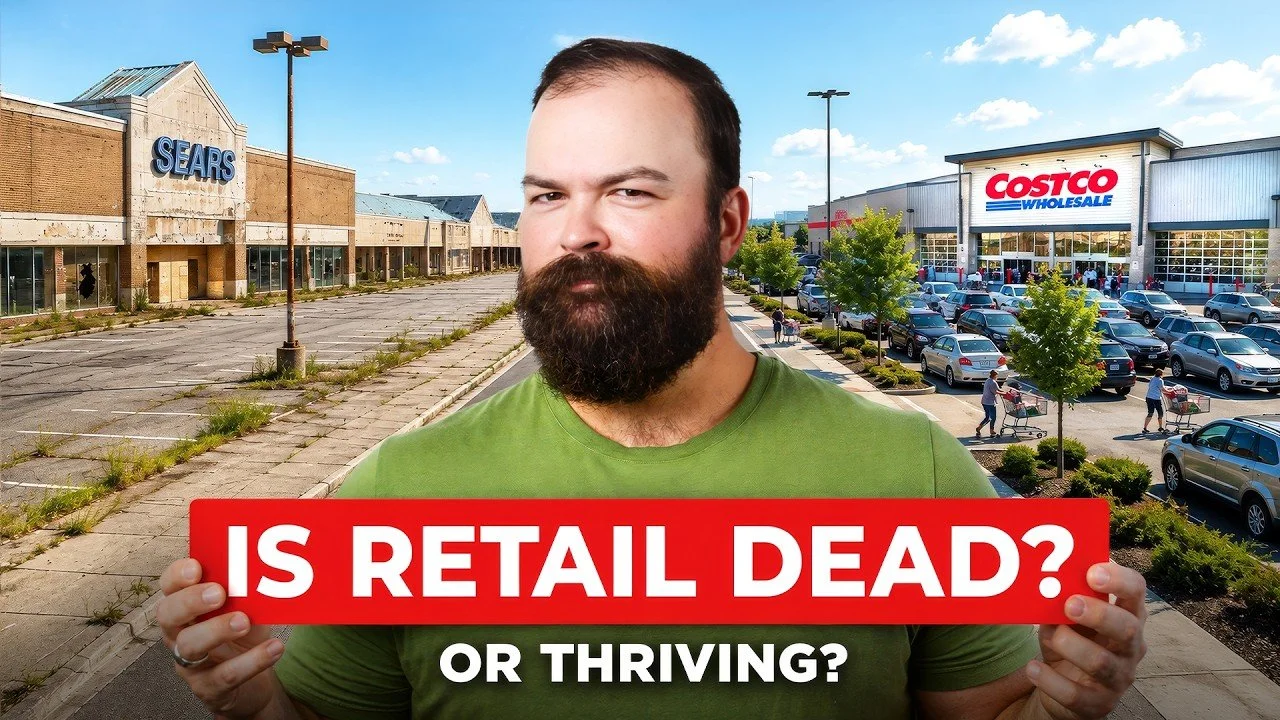
The Retail Apocalypse Is A Lie
Retail vacancy just hit 4.4% (almost as low as industrial) and nobody's built meaningful supply since 2008.
So why does everyone still believe Amazon killed retail? James Cook, who runs retail research for the Americas at JLL, brings the actual data: the barbell economy hollowing out the middle, the tenants that should scare you on a rent roll (and the ones that should make you pay more), Chick-fil-A's site-selection playbook, and the one number that tells us in 12 months who was right.
Plus: he grades the retail predictions I put on the record in January — brutally.
Follow James: The Where We Buy podcast: https://wherewebuy.show/
YouTube: Everything We Know About Retail: @everythingweknowaboutretail
Get commercial real estate coaching, courses, and community to jumpstart your investment journey over at CRE Central: www.crecentral.com
Key Takeaways:
Retail is strong, not dead: National retail vacancy is about 4.4%, near industrial levels; the pain is mostly in C–D class and weak B malls, not the whole sector.
Severe lack of new supply: Very little has been built since 2008; high construction and labor costs make new shopping centers hard to pencil, so existing well-located retail is structurally favored.
Barbell economy: Luxury and value/discount retailers are winning (Costco, Aldi, Dollar General, Walmart, TJX-type concepts), while middle-of-the-road retail is getting hollowed out.
Strips & daily-needs win: Unanchored neighborhood strips (10k–50k SF) with daily/weekly services (hair, laundry, tax prep, durable local restaurants) are attractive and still a strong small-investor play.
Tenant risk is operator + category: Be cautious with QSRs (inexperienced franchisees), pharmacies, home furnishings, and some jewelry, and scrutinize the operator’s track record, not just the brand.
Follow best-in-class site selectors: Locations near Chick-fil-A, Costco, strong discounters, or elite site-selection tenants are powerful signals; James even endorses “follow Chick-fil-A” as solid practical advice.



About Your Host:
Tyler Cauble, Founder & President of The Cauble Group, is a commercial real estate broker and investor based in East Nashville. He’s the best selling author of Open for Business: The Insider’s Guide to Leasing Commercial Real Estate and has focused his career on serving commercial real estate investors.
Speaker 1 0:00
It's insane. Vacancies are almost as low as industrial. It is currently at 4.4% vacancy. That is so flippin' low, dude. And somebody'll be like, "What do you do? You research retail real estate, but everybody buys everything online. And I'm like, "Oh, really? Like, where did you go last Saturday? Well, I went to Kroger. Then we had to go to Target, and of course we did our big Costco run.
Tyler Cauble 0:28
Unless you have been hiding under a rock for the last 1015, years, you've probably been told the same thing: real estate, especially retail real estate, is dead. Amazon killed it. The malls are dying. Strip centers are next, so don't touch it. Well, today I've got the guy who actually has the data. James Cook runs retail real estate research for the Americas at JOL. He's been quoted in the Wall Street Journal and the New York Times, and we're going to be diving into why almost everything that you believe about retail is wrong. James, welcome to the show, man. Let's start with the thing that everybody watching probably believes: Amazon has killed retail. The malls that we see throughout America are proving that, unless they're like Class AAA. So, I mean, give it to us straight, man. I mean, how dead is retail actually?
Speaker 1 1:19
It's so funny because, like, this is the conversation that I'll have at the family barbecue, and somebody'll be like, "What do you do? You research retail real estate, but everybody buys everything online. And I'm like, "Oh, really? Like where did you go last Saturday? Well, I went to Kroger. Then we had to go to Target, and of course we did our big Costco run. So it's true that there's more retail online than there was like 2030, years ago, but it's not like it's all gone away. A lot of it has shifted towards daily needs retail, so it is cheaper for me to go buy stuff at Walmart than have Amazon ship it to me. So a lot of shoppers really care about value and are shopping on a budget, so those are people who are going to continue to go places and pick things up themselves. And then you've got this whole other sector of people who just want to have fun in a retail environment, and that's where all of these Class A malls and lifestyle centers are popping up. Now it is true there is a type of retail that's dead, and that's like the class. We have these classes for your listeners, like A, B, C, D. Of basically, it's like grades in school. Like, how good is your shopping center? How good is your mall? And back in the day when we didn't have online retail, your online retail was going to your like your class B or C mall. Now we got online, so we don't need the B and C. Well, we could still get away with some of the B malls, but we don't need the C and D malls. So a lot of that stuff is going away. And if you see one of those dead malls in your town, chances are it's going to get torn down or redeveloped into something else. But most retail is is pretty strong when it comes to brick and mortar,
Tyler Cauble 3:02
what do the occupancy rates look like? I mean, office, for example, 15 to 20% vacancies across the board throughout the country. How's retail looking today?
Speaker 1 3:10
It's insane. Vacancies are almost as low as industrial. Okay, I should have this number memorized. I want to say it's 5% but just let me pull up my report. It is currently at 4.4% vacancy. That is so flippin' low, dude. Like, what happened? Okay, quick story. If you've been around as long as you meet, if you've been around as long as I have, you remember back before the Great Recession of 2008, 2009. People were building retail like crazy. I lived in Phoenix at the time, which was a real boom market. There was like new shopping centers, power centers popping up like every week. All this retail got built. Then the Great Recession hits. Nobody builds anything, and nobody has built significant amounts of new retail since then, so basically we're almost at like the same inventory levels we were almost 20 years ago, but we keep seeing retail expanding and leasing out that space. So vacancy has just kept going down, down, down, down, down. So we're at this point now where unfortunately construction costs and labor costs are so high, you can't. In many cases, you can't make it. Doesn't make economic sense to build a shopping center. The replacement cost is too high. So basically, we're kind of here with what we've got, and it keeps getting leased up, and it's just tougher and tougher for retailers and restaurants to find space.
Tyler Cauble 4:41
Yeah, it seems like a lot of what we have that is being constructed today is mixed use. Like it's the ground floor of an apartment complex or an office building or a hotel, and you know, 10,000 square feet of retail is nothing compared to those power centers you were talking about that used to be 345, 100,000 square feet at a time. Right, it's just a it's a crazy difference in in the supply. So, if if occupancy is that tight, I mean, 4.4% vacancy basically means people are moving. Like that, that's all that that means. There's a little bit of vacancy between when somebody is occupying it, the next guy occupies it. Where where did the apocalypse story come from? Like, what did everybody get wrong?
Speaker 1 5:19
I mean, you get these big announcements. Okay, let me back up. Retail is like fashion; it's cyclical, and you get these great brands that have you know 20, 3040-year, runs. Sometimes even more than that. You know, great brands that Sears. You know, is a great example of that, where they have their moment in the sun, and then one day, you know, it's like Party City. One day, we're closing all our locations. You know, Joann Fabrics. You know, we're we're closing, and people see these news stories of oftentimes mismanaged retail brands or just brands that are out of fashion. People are sick of, and they think that's indicative retail in general. When really, what it's indicative of is poorly run retail or just retailers that have gone out of fashion are no longer in favor by consumers.
Tyler Cauble 6:12
So, so five years ago, I mean, did your data say that this was coming? That like we were going to get to 4.4% or did this end up surprising JLL too?
Speaker 1 6:21
So it was going that way. It's been going that way for a while. The pandemic hit, and so vacancy did go up during the pandemic. But it was funny. It was like there was one quarter after the pandemic hit where everybody's like, "Oh man, retail's in trouble, and I was like, "No, no, wait, wait and see. People are going back, and like even before the lockdown started going away, retailers like quick service restaurants, you know, value retailers, they started leasing up again, and we actually kind of saw a mini boom, you know, kind of in the second half of the pandemic and coming out of then. So other than like that one quarter, you know, leasing activity has been steady going, you know, for like 15 years.
Tyler Cauble 7:09
So, so in January, and I'm a little bit nervous to do this. I think this will be kind of fun, though. In January, I did a live stream called "Will Retail Outperform Flex in 2026? and I and I put this thesis on record might just be hands down the best asset class to be buying in 2026. That's right, retail. So James, you've got the actual data. I'm going to read you some of my exact claims, and I want you to grade them one at a time, like A through F, and feel free to be brutal. Like I think, I think the audience will really enjoy this.
Speaker 1 7:45
All right.
Tyler Cauble 7:46
Okay. So, claim number one: retail development hits a record low in 2026. Only about 30 million square feet, and 70% of it is single tenant. So, almost no new multi-tenant strip supply.
Speaker 1 8:00
I'm going to give that. I don't have the exact numbers in front of me. I'm trying to click to the screen ads to whatever the sentiment. A you get an A. Yeah, absolutely right. Very little multi-tenant retail. You're in Nashville, right? Yes, sir. We've had a few. There's been a bit of new construction in Nashville. Another place is Texas. A lot of Texas Texas markets have seen some new construction. Same thing with Florida, but in most of the U.S. yeah, just very little. And what gets built is like a you know a freestanding build to suit for like $1 General or something like that.
Tyler Cauble 8:36
Awesome. Okay, next claim: unanchored neighborhood strip centers. We're talking like 10,000 to 50,000 square feet with no grocery anchor. Are the sleeper asset this year? What are your thoughts on that?
Speaker 1 8:49
So this is for 2026.
Tyler Cauble 8:52
Yes, sir.
Speaker 1 8:53
Okay, I think they were the sleeper asset last year.
Tyler Cauble 8:56
Okay,
Speaker 1 8:56
but I think they continue to be. I just say that because when I say sleeper asset, I mean it. That was kind of like the last year, 2025. Kind of the best kept secret was everybody was like, "Oh, unanchored strip. There's like this untapped value there, right? And you're starting to see institutional investors getting interested in it. I feel I still think it's a great opportunity because there's barriers for institutional investors because it's difficult. There's smaller deal values, and so it's difficult for them to amass the kind of volume they're looking for as institutional investors. So there's a great opportunity for a smaller investor to get in and do something good with it.
Tyler Cauble 9:39
Should we give that one a B, a C right probably no I'll give you a B I'll give you B plus all right
Speaker 1 9:44
you're doing great I'll take that
Tyler Cauble 9:45
man man hey this is better than any report card I got in school so this is great okay and then this one is a little bit maybe folksy so keep in mind my audience typically buying one to $5 million. Commercial properties. A lot of them are transitioning out of residential, like selling those 1031 exchanging, getting started in commercial real estate. So my my suggestion was don't hire an expensive, you know, analyst team to help you determine where to do your your next project or what you should be doing. Just figure out where the next Chick Fil A or In-N-Out is going and buy near it. What are your thoughts on that?
Speaker 1 10:24
I don't think that's bad advice. I think that if you're somebody who is the audience of you know this is your first time getting into you know a commercial investment, I'm pretty good actually. It's funny you mentioned Chick Fil A because I'm pretty good friends with their Research team, world class site selection team, the best team, the biggest team in the industry. If you follow Chick Fil A, you're not going to make a mistake. Totally agree with that. So I'll give you an A.
Tyler Cauble 10:55
Can we? Thank you, dude. I'm going to have to send this podcast to my mom and be like, "Look, here you go. Finally, a report card that looks good, right? That make you proud. Okay, I want to unpack that a little bit more because I we actually I just did another live stream on Chick Fil A versus Walgreens earlier this week, and and really the biggest differences between those two, right? Because Chick Fil A is trading at 4.5% cap rates, right? I mean they're just super low. Walgreens is now upwards of 8% which is which is pretty crazy. Talk to us. I mean, you're good friends with the Chick Fil A team. What is their process like? How do they actually go about the site selection process? Because it's it really is next level, and I think it'd be fascinating for people to understand what metrics they're really digging into in order to determine that a site is worth investing in,
Speaker 1 11:43
well, I think they have their. There's a little bit of secret sauce that I don't have visibility to, but a little Chick Fil A sauce,
Tyler Cauble 11:50
if you will.
Speaker 1 11:51
Yeah, right. I didn't even try that. Yeah, but like in general, I mean, Chick Fil A has got a couple of things going for it, as you know, one part of Chick Fil A is the model. They'll have, you know, you're a single operator. You know, maybe you have one or two locations. You're not going to be spread thin. Like you're a person who's really proven themselves. It's very difficult to be given a Chick Fil A store as an owner. So you're super committed. They're a little stingy with their markets. You know, I don't know. You know, you think about like McDonald's; they're all over the place. Chick Fil A is very selective about where they go. So they're selective about their operators. They're super selective about who they hire to work there, the quality of the food, all of that, the customer service is out of sight, so they do all this A plus work before they've even started site selection. And then when they're doing site selection, I mean, you know, it's not rocket science. You're looking for the best parts of town. You're looking for depending on what part of town you're in, you're looking for daytime population. If it's the suburbs, you know maybe it's more about the evenings. Although these days we've seen a big shift in that. You know, with so much more work from home, you've got a lot more crossover in areas where, you know, in the suburbs where there's a lot more daytime population than there used to be. But I mean, Chick Fil A really cares about ingress, egress, ease of which which that means just like the ease of access to the site, like what side of the road you're on when you're driving past them after work, for example. Is it easy to get into it? Is there a signal that allows you ease of getting out? They think a lot about the nitpicky logistical stuff that maybe some of their competitors will ignore in their speed to open locations. What's it's so funny the 135 that really was the standard for so long. Now we're really lucky. We have much better data than we did even 10 years ago, where we can draw actual trade areas, like true trade areas, of where the people are really coming from, where they live, where they work, all of that stuff. Because of there's a vendor called Placer that's very popular, but there's others too that have basically anonymized mobile phone data that you can use to figure out where people live, and where they work and where they shop and all that stuff, and it makes it a lot more accessible than it used to be to really figure out what your actual trade area is for a retail location.
Tyler Cauble 14:34
Yeah, Placer is really interesting because it's completely changed the approach. Will you will you talk about that a little bit more? Because I think that that's something that has really evolved in the last five years is the actual data around all of this stuff.
Speaker 1 14:48
Okay, so going back to old school, if you were like, let's say you owned a shopping center and you wanted to know like what your trade area was, you would pay people to hang out. In the shopping center, and stop people and say, "Where do you live? And you would go and like write down. Depending on the state, you could tell where people live based on their license plate registration. Now, because of this, basically the way it works is it's mobility data, so people on their cell phones are using different apps. Say it's a weather app, and I don't know if it is, but say that it is. In order to download the weather app, you're saying, "Oh well, I'll let you have some anonymized location data. So it's nothing specific to you. Nobody knows where you live, but they know that anonymized there's X percentage of people in this neighborhood that shop at that eat lunch at this Chick Fil A and then go work downtown over here, and you can take a point on a map and get just a detailed breakdown of the customer journeys of well oh well 10% of people who went to you know Subway for lunch worked at this office building, and then after that, they went to this Best Buy. And and again, it's not for any particular person, but you can see an aggregate where people are going, and it's given all of us in the business a much more sophisticated understanding of like who the customer
Tyler Cauble 16:19
is. Yeah, it's really interesting because, I mean, it seems like back in the day, the most high tech thing you could have was a credit card swipe because, like, then you're getting zip codes and stuff like that. But now, to actually be able to see, like, yeah, they probably went to Subway before they came here, and then here's where they went afterwards. Just the capability that retailers have to now try and capture more of that type of traffic is unbelievable, and that's that's what helps them honestly compete against the online stuff, right?
Speaker 1 16:48
Yeah.
Tyler Cauble 16:48
So let's let's talk about that same live stream. I underwrote a deal live. Like I went and found a random deal not far from Nashville. It was a a Walmart shadow anchored center up in Hopkinsville, Kentucky. This is saying purchase price reduction down to $2.8 million needed in order to actually hit the returns that we want. IRR is 1% Target is 15% It was listed at 5.6 million at a 9% cap rate. So like right off the bat, you're like, ah, that should that should work. Looks pretty interesting, and and I underwrote it at the asking price with normal leverage. I think it was probably 75% and it penciled at a 1% IRR against my 15% target. So my claim, which almost got debugged while we were alive, said, "Hey, buy retail, but the underwriting said, "Absolutely not. At least for this deal. So, so square this for us. Like, who's actually making retail numbers work at today's debt costs, and how? Because a 9% cap rate substantially higher than a four and a half percent Chick Fil A or a 567, percent institutional grade tenant. Who's behind that?
Speaker 1 17:58
Yeah. So, and again, this is most of my work. I work with on the tenant side with occupiers. So, what my understanding is that right now, and you know, a lot of the folks that we work with are at the institutional level. And right now, you've got you know this term dry powder, which means you got money to spend, you got a lot of very wealthy funds with a lot of dry powder, and at one point they were investing in office. They're not so hot on office anymore. Industrial's still pretty strong, but they've cooled a little bit on industrial, and so the idea and multifamily as well. And so it's like, oh, what are we going to invest in? Let's buy some shopping centers, and for example, a grocery anchored shopping center or like a Class A mall. These are still considered safe investments when you're at that kind of level. You know, and I don't again don't know the specifics, but you can probably get loans for much better returns. I'm sorry, but at much better rates, and so it makes sense to to make an investment like that at kind of like an institutional level.
Tyler Cauble 19:13
Yeah, you've got the cash. You got to spend it. It's not it's not doing anything for you sitting in a bank account.
Speaker 1 19:18
Yeah.
Tyler Cauble 19:19
So okay, well, retail is is clearly doing fine, but I know that retail is fine isn't the whole story. You have said in the past that the story is that retail is split in half. You've talked about a barbell economy, so let's let's dive into what what the barbell economy means, like my audience owns one strip center each because you know what happens to their tenants matters here, right? So let's let's take that approach.
Speaker 1 19:49
Okay, so if you want to think about the economy in terms of winners and losers right now, it's like top and bottom. So at the top, you've got. Have you ever heard the term HNWs, high net worth individuals? You've got a small group of wealthy people, and that group is increasing in wealth. So the wealthy have more wealth. So if you are a luxury retailer, if you're somebody that services, you know, maybe you sell financial services to high net worth individuals, things like that, you're doing fairly well right now. On the other side of things, you've got a lot of inflation and a lot of families that are shopping like on a budget. You know, they've got fixed amount of money to spend on groceries every week, and it seems like that money is worth less. Well, no, it was worth less than it was a year ago, and like way less than five years ago. So for all of those families, you've got this growing number of value discount retail in almost every category that is there to service them, and those are the guys that are really expanding right now, so Dollar General, Aldi in the grocery sector, Ross, Dress for Less, TJ Maxx, Burlington, anybody that has like a value proposition. So Walmart would fit into that too. Anybody who has a like a value proposition is finding a lot of consumer demand right now. We just ran. We do an annual survey of back to school shoppers, like parent survey, and one of the questions we always ask them is, "Where are you going to do your back to school shopping? And this year we saw about a 20% increase in people saying they were going to Walmart. So clearly, there's a huge value proposition there at Walmart that people are really focused on.
Tyler Cauble 21:45
Wow, good for Walmart.
Speaker 1 21:47
Yeah,
Tyler Cauble 21:48
they they really needed the boost. I know,
Speaker 1 21:50
right, right. As if they weren't doing well enough already.
Tyler Cauble 21:54
Yeah, that's crazy. 20% job. I mean, that's that's a massive change in consumer spending habits. Yeah, for
Speaker 1 22:01
sure.
Tyler Cauble 22:02
So, so value is booming, luxury is booming. Who's who's dying in the middle?
Speaker 1 22:08
It really is the middle. So, if you think back to like that old school before the internet, before online shopping, that middle of the road retail. So, it could be like an apparel retailer at the mall, you know, it could be a big department store like Macy's, Sears, you know, places like that. That is that is middle is kind of getting hollowed out right now, and it really is, you know, if you're not shooting high or shooting low as a retailer, you're kind of struggling. I'm trying to think of some of the big closing announcements we've had.
Tyler Cauble 22:48
Okay, so so like digging into that a little bit more with like pharmacy categories specifically, if somebody's reading a rent roll on a property that they're wanting to buy today, what tenants or categories should scare them. Like, what's a red flag in 2026?
Speaker 1 23:05
Hmm. You know, I'm trying to think if you're if I'm thinking about like a smaller shopping center, like your listeners are looking at. I would be wary of. Well, unfortunately, right now, so we're seeing a lot of expansion of quick service restaurants like fast food restaurants. So there's a lot of growth right now, but there's also a lot of un what's the word I'm looking for new franchisees that maybe don't have the experience they should have. A lot of new operators. We're seeing a lot of so we're seeing a lot of restaurants expand, but we're also seeing a lot of closures. So I would look very closely at quick service restaurants and look at who their operators are, how long they've been running, what their experience has been like, things like that. Electronics, other than you know Best Buy. We've seen a lot of electronics closures. Although, in the kind of centers we're talking about, those Fix My iPhone places are doing fairly well. So maybe I take that back. Fitness is strong. You might want to do if you've got a drugstore. You might want to double check that. Right now, we've seen increased closures in home furnishings because a lot of the residential sales, the residential sales have really slowed down. So that's like when people do a lot of that home spending is when they buy and sell a house, and so we've seen decreases in that. We've seen a number of jewelry stores close recently too. I think at the end of the day, it's as much about the operator as it is about whatever the retail category
Tyler Cauble 24:53
is. Yeah, it seemed like a lot of closures during COVID were convenient timing to be able to blame an exterior. Factor that had nothing to do with personal operations of the business, right? So I'm sure you're seeing some more of that today. Yeah. What about on the opposite? Like, what what about for somebody that could be on like what type of tenant or category could be on a rent roll that makes you go hell yeah? Let's that's a that's a great tenant to have in your in your shopping center.
Speaker 1 25:21
Yeah, I mean, if you think about like what's the point of the center, it's about daily needs. So, and it's about services that people need every week or every month. So, if you're hitting those targets, you know, if it's you know inexpensive haircuts, you know, something like that. If it's, you know, that that tax preparer, you know, that's been around forever and just keeps paying their rent. You know, dry cleaning, laundry services. You know, that Mexican restaurant that's been there forever. That stuff that just fits so well into kind of that daily or weekly visit category. That's the stuff that I think is really exciting when we're talking about you know like an unanchored strip center.
Tyler Cauble 26:08
Yeah, so I mean it seems to me like if we're if we're going to distill this down, if your tenants are selling to the middle class, your shopping center is probably at risk, right? Like if you're, it's very black and white. Either you need to be luxury, or you need to be value. Like, do you see any potential in between, or
Speaker 1 26:26
not? Like there used to be. There used to be, yeah. There used to be like the middle of the road. You know, you know the grocery store that's not the most expensive, but it's not super cheap either. Now we're seeing shopper habits where you'll have a middle class family that's now doing the majority of their grocery shopping at Costco or Aldi or some place that has a real value proposition, and when they want to do that, you know, get some nice piece of meat, they'll head over to Whole Foods, or they want to get something fun, they'll head over to Trader Joe's. But there's no, yeah, I would absolutely agree. I think that middle of the road retail, whatever it is, it's really struggling.
Tyler Cauble 27:09
Yeah, Costco as a as a tenant is very fascinating to me because their like average consumer household income is like over $100,000. Yeah, which I mean, there are very few brands like that out there, that have that.
Speaker 1 27:22
Costco is amazing. There's nobody else like Costco. Like the way they do it, the everything they do. I mean, I you can't even get started on Costco because it's like it's almost like you're not talking. Well, yeah, it's like you're not talking about any other retail, how they operate, how they get their customers to buy these memberships, and come back time and time again-it's all-it's all so cool.
Tyler Cauble 27:48
Okay, I would-I want to do some expanding or dying. Let's run through a few tenets, and you tell me whether they're expanding, they're dying, and and why. Okay, so Dollar General.
Speaker 1 28:00
Yeah, still expanding. And if you look at, you know, we talked about site selection. If you look at where Dollar General is going, their economics are such they can go to places that Walmart could never go, and so they have so much white space for expansion because of that. Every small town, every urban neighborhood can support $1 General, so yeah, a lot of growth there.
Tyler Cauble 28:24
Yeah, we're doing a video on Bucky's right now, and so we went up to to Kentucky to the nearest Bucky's, and my wife, while we were there, wanted to do like go to an Amish market, and we're in the middle of nowhere, and of course we round this corner, and there's $1 General. I'm like, of course there is like,
Speaker 1 28:42
yeah,
Tyler Cauble 28:42
makes no sense. Bucky's is
Speaker 1 28:45
great though. I love that category. the The super center,
Tyler Cauble 28:49
yeah. What? Well, what do you think about Bucky's expanding or dying?
Speaker 1 28:53
No, no, they're definitely expanding, and not only Bucky's, but you know, there's a growing number of competitors like Dolly Parton's getting in on that action. Wally's is just opened their third location. They're a growing Bucky's competitor. Yeah, I think there's a lot of space there.
Tyler Cauble 29:11
Yeah, Wally's seems interesting. It almost seems like somebody just took the Bucky's playlist and put a new mascot on it.
Speaker 1 29:18
It's a little. It's a little different. If you go and like the vibes are different, but the similarities are definitely there too. I mean, they both have the barbecue brisket sandwiches and the stuff like that.
Tyler Cauble 29:28
Yeah, Chick Fil A.
Speaker 1 29:31
Yeah, still growing. I mean, Chick Fil A is just a case study in just year over year growth for as long as you can grow, they've been very smart. It's so funny. Like you see a lot of chains, especially chains that get backed by private equity money, and they'll just expand super fast, super far, way overextend themselves, and then end up retracting. Chick Fil A doesn't make that mistake. They're. Very thoughtful, like I said, about their site selection, and it's kind of slow, smart growth. So definite growth in their future.
Tyler Cauble 30:08
What about Planet Fitness?
Speaker 1 30:10
Yeah, I mean the so fitness is strong right now, and then like I said, value is strong. Planet Fitness offers one of the best values around. So yeah, I think I think there's definitely growth for them as well.
Tyler Cauble 30:24
What about casual dining like Applebee's?
Speaker 1 30:28
So it depends on the category. Like a couple of years ago, I would have said, "Oh, casual dining is is really slowing down and it's quick service. But we've seen a real twist, and like the leader of that has been Chili's, which for whatever reason has been like picked up by social media and has had a real strong turnaround. And kind of on the heels of that, you're hearing about momentum growing and other casual dining chains like Applebee's and others. So it's not gangbusters growth, but it's definitely better than it was a few years ago.
Tyler Cauble 31:08
What about bank branches?
Speaker 1 31:11
So, couple of different trends on bank branches. It depends on the bank you're talking about. A lot of banks are saying, "Well, we're going to cut the overall number of branches, but we're going to do a nice flagship, and then we'll have some satellite branches around that. A great example is Capital One, like they'll do their Capital One cafes. Which, if you've been to those, they're coffee shops and bank branches in really nice either malls or urban retail settings. But a lot of chains are saying, "Yeah, we just don't need as many bank branches. We can put in some ATMs. We can have one branch, you know, that more people from more areas can come to visit. Which, I mean, you got to understand, like, you don't need to go to a bank to do your regular transaction. So overall, the number of branches has been falling.
Tyler Cauble 32:03
All right, everybody keeps saying that the comeback is real on this next one, and I I still have a hard time believing it. But I figured this would be a funny one to dive into. Chuck E. Cheese.
Speaker 1 32:15
Chuck E. Cheese. I'm trying to remember. I it's so the category. Well, I'll stay take a step back. This category of entertainment, family entertainment centers, growing. There's been a lot of growth in the entertainment category. We did a report on it, and like the the entire entertainment category, which includes like trampoline parks and fun houses and stuff, we counted almost 15 million square feet of new concepts coming online, like in the next two years. So that's really significant. Chuck E. Cheese. Last time I checked, they weren't really adding that many new locations. Yeah, I know the kind of the established family entertainment centers like Chuck E. Cheese and Dave and Buster's-they're kind of on, you know, kind of a stat. Like I think about it in just terms of like new location openings and closings. It's pretty static. Round one is opening up a bunch of new ones, so that's one that is kind of in expansion mode.
Tyler Cauble 33:17
Yeah, that's really interesting. I've started seeing billboards around Nashville for Chuck E. Cheese again. I'm like, man, okay, forgot about that brand. Yeah, I mean, they're going all in on it again.
Speaker 1 33:29
Yeah, they turn themselves. I don't know if you remember in the pandemic, they turned themselves into like a ghost kitchen for some virtual brands. I mean, that's all gone away. Yeah, I mean, the. I think the bottom line is people with kids have to do their birthday parties somewhere. That's right. Chuckie Cheese is always a good option.
Tyler Cauble 33:47
Yeah, it was it was always Chuck E. Cheese at the Brentwood Skate Center for me. Oh,
Speaker 1 33:52
I love it! I love it.
Tyler Cauble 33:54
Those were fun. Okay, so so let's let's start to close it out. I mean, what's what's one consensus take in retail research that you personally may think is wrong, or that everybody talks about too much.
Speaker 1 34:08
Well, stuff that people talk about too much. Well, a couple of things. One is you already brought it up-the idea. Oh, you know this this narrative that that there's retail suffering, which is absolutely not true. So I get it get sick of hearing about that from the general public. From within the retail world, we talk a lot about there's this term omni channel, which is you've got to be if you're going to be a successful retailer, you got to be good selling online. You got to be good selling in person. You got to do click and collect. You got to buy do ship from store, like it's like agnostic. You got to be good in every front. But I think what we're learning now is you just got to be good in one front. Like Aldi does not have a strong online game, but they're. Killing it, right? Same thing with Costco. Like you just have to be really good at what you do in one sector. Amazon, fantastic online retail, and they're killing it. So for me, like, and this term omni-channel within my world, people have been talking about it for a long time. I think it's overhyped, and I think it's not a requirement that you have to do good both online and brick and mortar. You just got to kind of pick and choose your battles and win at one of them,
Tyler Cauble 35:27
James. If we're looking back on this conversation 12 months from now, what is the one number that you could point to that would say that is exactly why retail is doing well? That's what I would have expected to see.
Speaker 1 35:41
Um. So, in the number I'm going to look at in 12 months.
Tyler Cauble 35:46
Yep. To see if if retail performed as we think it will.
Speaker 1 35:49
Yeah, I think that two things that I look at. We talked about vacancy and how low it is, and the other thing I look at is this number called absorption, and that's basically a measure of leasing activity, and all you do is you take the total amount of square feet that have been leased up, and you subtract out the total square feet that people have moved out of. And if you get a positive number, that means vacancies been going down because more people have been occupying space than moving out of it. So that absorption number-that's one I really look at closely for the health of the market. It was a little bit negative in Q1, but Q2 we're working on on our new market numbers right now. It's coming back really strong, and that's the number I'm going to continue to be looking at.
Tyler Cauble 36:36
Love it, James. This is a great conversation, man. Thanks for coming on the show and running us through the the retail data, the actual numbers behind everything, guys. If you're if you're listening, go follow James. He's got the Where We Buy podcast. His YouTube channel is Everything We Know About Retail. We'll make sure that you guys get those links in the description below as well. And look, James, thanks again, man. This was excellent. Appreciate you for coming on. Love it. Thank you. Such a big fan. Glad I could come on. Of course. All right, guys. Thanks for tuning in. We'll see you all in the next one. This episode of the Commercial Real Estate Investor Podcast is brought to you by my CRE Accelerator Mastermind, where you'll get access to my step-by-step investment blueprint, essentially a library of resources on how to invest in commercial real estate. You'll get connected to a supportive community of other commercial real estate investors that are doing projects just like you. You'll get personalized coaching and feedback from me every step of the way. Go to www.crecentral.com to learn more.
¿