
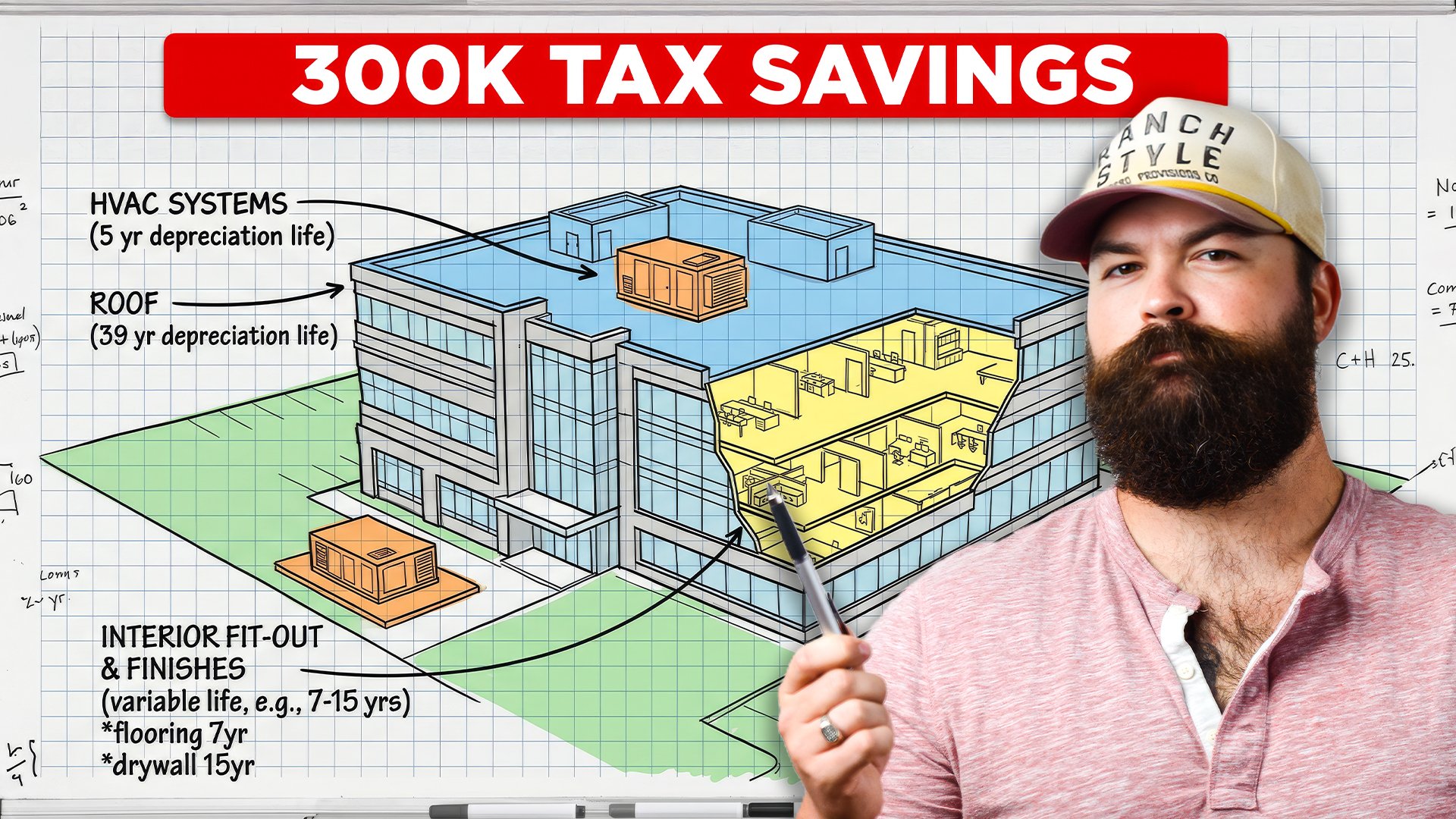
The Tax Strategy High-Earners Use to Offset Income With Real Estate
Most high earners don’t have an income problem.
They have a tax problem.
And commercial real estate investors play by a completely different set of rules.
In this week’s Office Hours, I break down one of the most powerful tax strategies in real estate: cost segregation. Not the surface-level version people throw around online, but how it actually works in practice and why investors use it to create massive first-year tax savings.
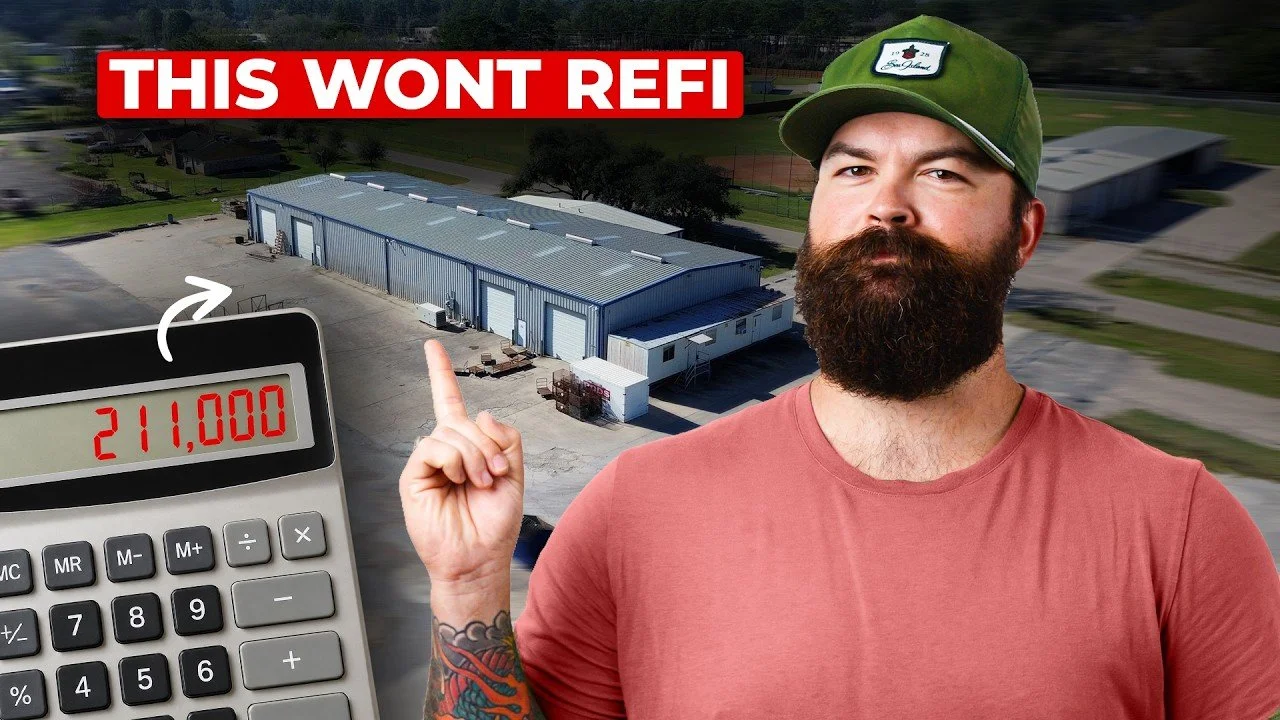
I walk through a real example from one of my own buildings: a $480K office property that generated over $141K in year-one tax write-offs from a single engineering study. That’s more than the original down payment.
Inside the episode:
→ How cost segregation actually works
→ Why depreciation schedules matter
→ How investors accelerate tax savings in year one
→ The role bonus depreciation plays
→ Common mistakes investors make
→ Who this strategy benefits most
If you’re a business owner, high-income earner, or commercial real estate investor, this is one of the most important concepts you can understand
Get commercial real estate coaching, courses, and community to jumpstart your investment journey over at CRE Central: www.crecentral.com
Key Takeaways:
Cost Segregation = Accelerated Depreciation
Engineering study reclassifies parts of a building into shorter lives (5, 7, 15 years).
Combined with 100% bonus depreciation on 5- and 15-year assets → huge year-one write-offs.
Impact vs. Regular Depreciation
Straight-line 39-year on a $1M building → $25K/yr deduction ($9.5K tax savings at 37%).
With cost seg + bonus → about $386K year-one deduction (~$143K tax savings).
Real Example
Tyler’s $480K office:
Cost seg study: $2,750.
Year-one tax savings: ~$141K (almost 30% of purchase price).
Who Benefits Most
High earners (especially 37% bracket) who:
Have passive income, or
Qualify (or spouse qualifies) as real estate professional, or
Own the building their business operates from.
Important Constraints
Depreciation is usually a passive loss:
Offsets passive income, not W-2, unless RE professional.
If no passive income, losses carry forward.
Recapture (~25%) when you sell; often managed via 1031 exchange.
Must use a cost seg engineer + savvy CPA; get a second opinion if your CPA dismisses it without nuance.







About Your Host:
Tyler Cauble, Founder & President of The Cauble Group, is a commercial real estate broker and investor based in East Nashville. He’s the best selling author of Open for Business: The Insider’s Guide to Leasing Commercial Real Estate and has focused his career on serving commercial real estate investors.
Episode Transcript:
Tyler Cauble 0:05
This episode of the Commercial Real Estate Investor Podcast is brought to you by my CRE Accelerator Mastermind, where you'll get access to my step-by-step investment blueprint, essentially a library of resources on how to invest in commercial real estate. You'll get connected to a supportive community of other commercial real estate investors that are doing projects just like you. You'll get personalized coaching and feedback from me every step of the way. Go to www.crecentral.com to learn more. I bought a $480,000 office building, not big, it's my own office where I work pretty much every day, and in year one I got a $141,000 tax write off on it for buying my own property, not from depreciation, not from the mortgage interest, but from a single engineering study that reclassified the components of the building and front loaded nearly 30% of its value as a deduction in the first 12 months, that is more than the down payment that I put down for this property. That strategy is called cost segregation. And today I'm going to show you exactly how it works, because if you're a high-earning individual, if you are buying commercial real estate and you haven't done this, you're almost certainly leaving six figures on the table in taxes you shouldn't be paying. Welcome back to the Commercial Real Estate Investor Podcast. My name is Tyler Cobble, I'm your host here live from the Cobble Group Studios today for office hours every Tuesday morning, 8:30am Central Standard Time. I go live, I teach you guys about commercial real estate and how you can leverage this to build wealth to build up your passive income to just have more fun impacting the community, and so, like I said, today we're diving into the tax strategy that high earners use to offset income with real estate. Let's get to
Speaker 1 1:58
it.
Tyler Cauble 1:59
So, most investors think about depreciation in this way, and that is, you buy a building, the IRS assigns it a 39 year depreciable life, right? If you're buying residential, maybe it's 27 and a half, a little bit different, you deduct 1/39 of the value every single year, very, very slow. All right, not really. Doesn't really make sense for the way that the majority of us actually invest in commercial real estate. If you buy a property and you let's say have an HVAC unit on that property, you're probably not going to have it for 39 years, so why are you depreciating it over a 39 year schedule? It just doesn't make sense. So, if you're buying a million dollar building, we're talking about roughly $25,000 a year, and you do that for 39 years, crazy. Then you offset that amount against your rental income, right? It's useful, but at $25,000 a year it's not really going to move that much the needle that much on a $500,000 income right and then you just continue to repeat that every single year for 39 years until the building is fully written off it's what I like to refer to as the w2 approach applied to real estate it's not the 1099 it's not the entrepreneurial way to actually approach your investments, right? So, the people paying almost nothing in taxes aren't using the 39 year schedule. We've talked about this before on this show. It is entirely possible for you to be netting seven figures a year and paying zero in taxes if you are utilizing commercial real estate properly in your tax strategy and in your portfolio. I have buddies that do it all the time. I've come pretty close to it a couple of times. The problem with the 39 year schedule is that, like I said, it barely moves the needle. If you're netting $500,000 a year in income, you're in the 37% tax bracket, you're probably paying around $185,000 in federal tax. Now, of course, that depends on your actual specific situation. I'm not a CPA. None of this is tax advice, all right. And I don't play a CPA on TV or on a podcast. If you're doing straight line depreciation, you're probably looking on a $1 million building, roughly $9,500 in tax savings a year. It's nothing, right? If you're paying almost $200,000 in taxes, and you can buy a building and save $9,500 it's not really going to move the needle that much, right? You either need to substantially scale what you're doing, hit the volume that will make straight line depreciation actually work for you in a meaningful way, but most high earners, most clients that I work with, you know, doctors that are, you know, making six, 700,000 $1,000,000.02 million dollars a year, they have 123, buildings, not 20, right? They're not typically doing this in a professional manner, they're doing it to help. Offset their income, build up a retirement fund, etc. So, the question isn't whether to depreciate, it's really how fast you can make it depreciate, and that's where cost segregation comes in. So, you've probably heard of this before as accelerated depreciation, as well. Cost segregation is the technical term for it, and it's the process where you reclassify different parts of your building, so that you can actually depreciate them faster. All right, so you'll have an engineering analysis performed on your property. I'm actually going to show you guys a cost segregation study that I actually had done, the one that I mentioned here at the beginning of the show, the $141,000 in savings, so you guys can see exactly how it actually broke it out on a real asset. Okay, a cost seg engineer will physically, or sometimes just virtually, inspect the building and its components. They're going to break the building out into individual pieces, right? Each component gets its own depreciation schedule. I mentioned HVAC units earlier, that's going to get a very different depreciation schedule than land improvements, which is going to get a different depreciation schedule than maybe your roof, right? It all comes down to what is the specific component of the property. Let's see, we've got Jason jumping in, he's saying, what's up, Tyler, new member here from Venice, Florida. Good to see you, Jason. Thanks for jumping in, my friend. Rich is saying, 'Hey, Tyler, for retail or flex, what is your minimum vehicle count, population, local area income? Rich, it's tough to say what minimums would be, because it depends on the actual area, but I would say you want something that is growing in population and income, not necessarily declining. Husny saying sup guys, what's up Husny? Okay, so the building is broken into several different buckets. All right, and we're going to continue looking at a typical $1 million commercial building, just because that's round easy numbers, that makes my life a lot easier. All right, so you've got five year, seven year, 15 year, and 39 year schedules, so the structural shell of the building falls into the 39 year schedule. All right, land improvements that falls into 15 year fixtures and systems that falls into a seven year schedule, so that could be your HVAC, that could be your dishwasher, right, whatever that is, and then personal property falls into the five year write off schedule, all right, so the five and 15 year buckets, which is roughly 22% of the building in this example, are where the cost seg really, really does its work, right, it really starts to benefit you in this way, so the nice thing is, too, on top of this, Nickram is saying, "Hey, Tyler, what's going on? Nickram, thanks for being here. Kevin's saying, "Hey, Tyler, Kevin, thanks for joining us, my friend. The nice thing is, bonus depreciation is back in 2017 to 22 We had it at 100% In 2023 it was 8020. 24 it was 60. Last year it was 40% and last year Congress passed a law that brought it back to 100% bonus depreciation. All right, so five year and 15 year components can be deducted 100% in year one. The section 179 limit was also raised to two and a half million dollars, it was about a million, I believe, which means that you just get more expensing with your bonus depreciation. Now, this does not apply retroactively to 23 or 24 purchases, right? So, this only applies to after a certain date in 2025 So, if you have a building that you bought before then, and you've already done a cost segregation on it, sorry, you're out of luck. You got to go buy another building. That's the nice thing about this. Just buy a building every year, get a whole bunch of depreciation. By the way, you're probably noticing, oh, five year schedule, seven year schedules. That's pretty interesting. That's why that's that almost lines up with how long commercial loans are and how long syndicators typically hold their assets. There is a reason for that. All right, in that five year period, that is when you can absolutely maximize the amount of value that you're going to get out of your tax write-offs, out of increasing the value of the property, and then selling it for the maximum hit. So that's why you typically see most commercial real estate owners buying and selling properties every five to seven years. If you did this, you, you bonus depreciate everything in year one. You take advantage of it for another five years or four years, you sell it, you do a 1031 exchange, you start to stack all of these tax strategy pillars that we've been talking about. That's how you really start to make the money work for you. That's where things really, really start to change. All right, so same building, same purchase price, same year. We're going to look at one without cost seg and one with cost seg and bonus depreciation. So, without cost seg, year one deduction. $25,641 All right, that is based on a, again, $1 million commercial building. Your tax savings at the 37% bracket is 9487 in that first year. So years to fully depreciates 39 and you know that's just going to take absolutely forever. So your year one tax savings are 9487 Congratulations, it's great. Look, better than nothing, better than nothing, for sure. But when you add in cost segregation and bonus depreciation, this is where things start to get insane. All right, personal property of 10% $100,000 at 100% bonus depreciation, land improvements 12% of the property value, $120,000 at 100% fixtures, which is 15% of the property value, $150,000 at 100% depreciation year one, structural components, which is 63% of the property, that's going to be deducted on a 39 year schedule, so that's only 16,154 so that's $386,000 deducted in year one. That's $143,000 in tax savings. That is a difference of over $130,000 which actually isn't far off from my, my actual example. I'm gonna show you guys here in a second. So, what does a cost segregation study cost, and what can it return you? Well, we kind of have an idea of what those returns are, but a study can cost anywhere from I'd say roughly five grand to 15 grand, depending on property size and complexity. The one that I'm about to show you, it was on a $480,000 office building, it was $2,750 and we saved 141,000 so absolutely worth it. Typically, what you'll be able to see now typically is a really tough thing to say in commercial real estate, because it depends. It depends on your situation, it depends on the building that you're buying. There's all sorts of different assets, like if you're going to go and buy a vacant warehouse that has zero fixtures, you're not going to have a lot to write off, as compared to a brand new car wash with all of the equipment, right? Remember, we saw, you know, personal property and furniture, fixtures, and equipment in the five and seven year write-off schedules. Okay, so that would give you a ton of bonus depreciation there. But the rule of thumb, properties under $500,000 in value may not necessarily pencil, but that's not always the case. I think it's always worth looking into, like I said, that what I'm about to show you actually is under that. All right, it was 480 and 100% worth it. This is done by a cost segregation engineer. This is not your CPA, okay? Your CPA then takes that study and they actually utilize it in your taxes, so two different professionals need to be involved in here. You can't just hire a CPA firm necessarily to go and do this, unless they are a qualified professional when it comes to doing cost segregation studies. The section 179 limit now is two and a half million dollars, like I mentioned earlier, under the One Big Beautiful Bill Act, which allows for additional expensing alongside the bonus depreciation, so you have some pretty powerful tools at your disposal here. Now, I do want to say there is a caveat, right? There are passive loss rules when it comes to this. Depreciation from real estate is a passive loss. Passive losses can only be offset, or they can only offset passive income, not your W-2 salary, unless you qualify for an exception. So, if you're a high earner, like I said earlier, if you're, if you are that medical professional, that doctor that is earning a million dollars a year, your W-2 only, you have no passive income necessarily. Your losses suspend until you have passive income to offset, or you sell the property, so the deduction is not lost, it just kind of sits there until you have enough passive income to actually write it off, which can be unfortunate, right? That makes it a little tough. It's like, okay, well, I can't actually take advantage of this unless I become a real estate professional, which is an actual designated status. If you spend 750 hours or more a year in real estate, and more than half of your working time in real estate, those losses become non-passive and can offset W-2 income. It's a very strong strategy for serious investors. That is why you will often see high-income earning individuals with spouses that are full-time real estate professionals, whether they are a residential agent, a commercial agent, they're in, you know, they're managing the portfolio full time, whatever that is. As you go out, you earn a million dollars a year, your spouse becomes a real estate professional, and you get to take advantage of all of the tax benefits, and you both, it is a massive win-win. The other thing that you could do if you are a business owner and you own your operating property, like if your business leases from an entity that you own, which is typically how I would structure it, right, you have the Propco and the Opco, all right, that depreciation can flow through, so it's one of the most underutilized strategies for business owners, so if you. Are a business owner, and you own your building, and you're not taking advantage of this, or your CPA hasn't mentioned it. You might want to ask them about it, and if they say, 'Oh, you shouldn't do that, it's probably not going to benefit you. I would go get a second and third opinion, because the reason, and we've talked about this on this show before, the reason that most CPAs - not most, but anytime a CPA will say you shouldn't do a cost segregation study, typically it is because they don't understand how it works, or they don't think that you can take advantage of it because you don't have real estate professional status. It's very important that you clarify that question and ask them that. If they're saying, "Oh, yeah, it's not going to matter for you because you don't qualify as a real estate professional, that's one thing. If they're just saying, "Well, I don't think you should do it, you should go find another CPA, 100% All right, so have that conversation with your CPA before you buy. It's a, it's a massive strategy. Okay, so here's, here's the actual deal that I was working on. So it's a single tenant office, all right. It's here in East Nashville. I bought it for $480,000 I'm in the 37% tax bracket. The study cost me only $2,750 super cheap, very small building, though. Right, like we said, $480,000 This is where it gets insane. I actually wrote this wrong on my slide. Year one deduction was closer to, I think, $440,000 give or take, without cost segregation, we were only able to depreciate about 11,002 66 in straight line depreciation. With cost segregation, we have $141,056 in savings, a difference of $130,000 So here is this is actually one of the exhibits from this is Exhibit A from the cost segregation study that we actually did on this property, right? You can see here, five year property, things that fall under the five year property, we're talking about wall coverings and blinds, shelving and paneling, ceiling fans, data and TV equipment, appliances, special plumbing, and sinks, electrical for personal property, counters, and cabinets comes in at $37,000 not huge, right, but not terrible. Seven year property, that's telephone and communications equipment, $601 Again, not really moving the needle. Here's where things start to change. 15 year property, exterior lighting landscaping, which is really grading, right? Land improvements, $96,165 And again, remember that that qualified for bonus depreciation, so that's how it got us to that $141,000 And, of course, 39 year property, which includes the building, plumbing, HVAC, electrical, and the roof all fell under straight line 39 year, it's pretty hard to argue. I mean, that's a pretty great little number, $141,000 My dad, that was that's almost 30% of the purchase price of this property. We put down 25 so like year one we got 105% essentially, of our money back through taxes. Pretty sweet. So that's the great thing about this. So that's why you, you really want to qualify for that real estate professional status in any way possible. It's either you or your spouse, right, especially if you have a stay-at-home spouse that helps take care of the kids, if they can just go sell a few houses a year and actually work seriously as a real estate professional, it's a total game changer. So this strategy is really for high earners that have passive income to offset, right? Maybe they've got a bunch of rental properties, they're trying to make sure that they're saving money on that, right? Maybe they don't qualify for real estate professional status, and that's a, that's a tragedy. Investors that are pursuing real estate professional status, if you hit that, oh my gosh, it unlocks a totally new world of how much money you can save by doing real estate. Business owners that are owning and operating their real estate, right, I mean, it just super powerful for business owners, but if you're a W-2 earner, you have no passive income, no path to real estate professional status. Those losses will just suspend. They'll hang out there until you've got it. And I hope you find a way to get into real estate professional status. It changes everything. All right, with that, I'm going to open it up for questions, because I have to jump here in just a second to do a webinar on LinkedIn. It'll be a lot of fun. Let's see, Richie's saying, "Hey, Tyler, we own two salon suites facilities and are looking to build our own for our third. We're releasing two now. Do you know, or do you know of, or have any experience in this space. Yeah, absolutely. We've developed a lot of property over the last 13 years. Charles is saying, how long after bonus depreciation do you have to hold to avoid recapture? I mean, there's not really a set amount of time to avoid recapture, no matter what. At some point, you're going to have to pay recapture, right? That is 25 That give or take, and the best way to avoid that is to do a 1031 exchange, so you're still only paying 25% back, right? So it still benefits you, but you just, you do want to be careful about that. Kevin is saying, do you have any templates online for info memorandums or building prospectuses? And do your templates usually consist of caustic studies. I'd like to see how this would be presented in a prospectus. Kevin, yes, we have all of that inside the CRE accelerator. We basically have an entire library of documents and templates that we give to all of our mastermind members. Jason is saying, "I just got tickets to Towers Mastermind. Who else is going to Nashville? Hell yeah, looking forward to seeing you, Jason. It's gonna be a lot of fun, guys. We have a live event. I forgot to tell you about this june 26 and 27th here in Nashville. I honestly don't know where I could send you to to go find tickets. I mean, if you're on our email list, you either got that last night or you're getting it today. Come hang out with us in Nashville, june 26 and 27th we're gonna be having a lot of fun. All right, Jason, if you sell in two to three years, is there a clawback on depreciation? Absolutely, there is. Yep, for sure. Hey, Tyler, do you have concerns? This is from Hanson. When doing a cost seg, that when the property is disposed of, this converts to real property to tangible personal property, uh I think you're just asking about recapture, Hanson, but yeah, I mean, not really. I mean, it's, it's 25% right, compared to 100% So it completely depends on your tax situation. It's a conversation worth having with your CPA, right, and making sure that this is all going to make sense for you, because there is a timing component to a lot of this as well, like just because we bought a, like, I have a property that we bought in 2022 that we haven't done a cost segregation study on, because it hasn't made sense for us yet, because of all of the other depreciation that we're getting on all of our other assets, we don't need it, right, and so there's going to be another time for us to absolutely maximize that, and so we're kind of playing the game, right? So you definitely want to think of that if you're planning on flipping a property in two years. Yeah, you may not necessarily want to do this, but I would say look into it, see if it's going to benefit you, have that conversation with your CPA, and do a 1031 exchange, that's how you avoid it. That's the best way to avoid it. Thank you, guys, for joining me on this week's office hours. We're diving into a lot of tax strategy for high-earning individuals on how to utilize commercial real estate to save your money. Right, you've got active income, you don't necessarily need more income, you need to protect the income that you have, and commercial real estate is a great way to do that. We talk about all sorts of things, commercial real estate investing on this channel. So, if you have not liked and subscribed, go ahead and do that. Join me every week, Tuesday mornings, 8:30am Central Standard Time. I go live, I answer your questions, I teach you guys how to do this. Appreciate you guys for joining me, and we'll see y'all in the next one. This episode of the Commercial Real Estate Investor Podcast is brought to you by my CRE Accelerator Mastermind, where you'll get access to my step-by-step investment blueprint, essentially a library of resources on how to invest in commercial real estate. You'll get connected to a supportive community of other commercial real estate investors that are doing projects just like you. You'll get personalized coaching and feedback from me every step of the way. Go to www.crecentral.com to learn more.