
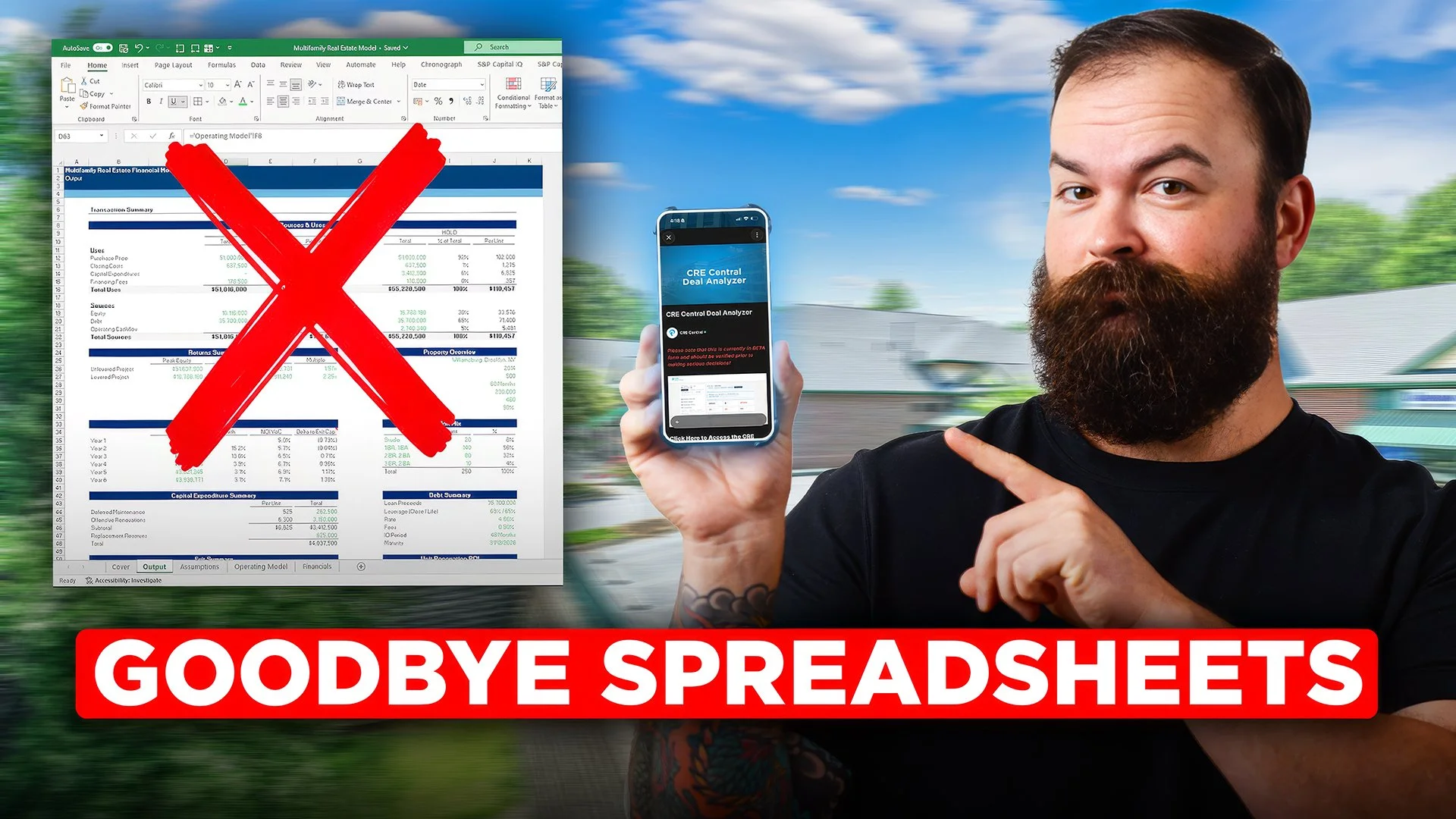
Analyzing Commercial Deals Isn't As Hard As You Think
For decades, if you wanted to analyze a commercial real estate deal, you needed Excel. Hours of formulas.
Tabs on top of tabs.
A model you probably didn't even build yourself and definitely don't fully trust.
That era is over.
In this live session, we show you how our Deal Analyzer is completely replacing the traditional spreadsheet model — live, on a real deal, in real time.
No broken formulas. No guessing if the numbers are right. No spending your weekend rebuilding someone else's model.
You'll see:
Why the spreadsheet model that's worked for 30 years is becoming obsolete
How the Deal Analyzer allows you to underwrite a full commercial deal in minutes, not hours
The hidden mistakes buried inside almost every Excel model
A live, real-deal walkthrough — start to finish, no spreadsheet in sigh
Whether you're closing your first deal or your fiftieth, the way you underwrite real estate is about to change forever. This session shows you how. Analyzing commercial deals isn't as hard as you think. It's just never been done this way before..
Get commercial real estate coaching, courses, and community to jumpstart your investment journey over at CRE Central: www.crecentral.com
Key Takeaways:
Commercial underwriting is conceptually simple but operationally complex with spreadsheets. Residential back-of-the-napkin math doesn’t translate well to commercial deals because you must track many variables (NOI, cap rate, DSCR, loan terms, rent escalations, etc.). Traditional Excel models work but are error‑prone, formula‑heavy, and intimidating for most new investors.
The new analyzer software replaces complex spreadsheets with guided, structured workflows. Instead of hunting through cells and formulas, users upload the offering memorandum, let AI pull in key deal data (price, NOI, cap rate, lease term, rent, square footage), and then move through clearly labeled tabs that walk them step by step through assumptions and scenarios.
A real industrial deal example shows that “easy to analyze” is not the same as “a good deal.” Tyler underwrites a $2.3M industrial, absolute net lease in Tupelo in under 10 minutes. Even with different down payment levels, rent assumptions, and price negotiations, the deal struggles due to high purchase cap rate vs. exit cap rate, limited growth, and weak equity multiple. The tool makes it fast to see that a stabilized, low‑yield asset often won’t hit aggressive return targets.
The software teaches users how to ‘read’ a deal, not just calculate outputs. The interface explains metrics (e.g., NOI, expense ratio, DSCR) and shows where numbers come from. It models lease structures (triple net vs. absolute net), rent bumps, vacancy, operating expenses, reserves, and exit assumptions so students learn how each lever affects cash flow and overall returns.
Tax strategy and capital structure are integral to evaluating returns. The tool includes cost segregation modeling to estimate year‑one tax deductions and potential savings, plus structures for ownership, GP/LP splits, waterfalls, and preferred returns. Tyler notes that many investors justify lower nominal returns on stabilized NNN deals when factoring in tax benefits and hands‑off management.
Integrated tools streamline the entire acquisitions workflow. Beyond the analyzer, the software includes a deal desk (pipeline management from lead to closing) and a cost estimator that adjusts renovation budgets by city and scope. This lets users quickly estimate renovation costs, attach them to deals, and track all documents, tasks, dates, and notes in one place.
Core mindset shift: underwriting speed and clarity unlock more deal flow and better decisions. By making underwriting faster, more visual, and less spreadsheet‑dependent, more members in Tyler’s mastermind are submitting and evaluating deals. The emphasis is on quickly determining whether a deal is worth deeper pursuit, rather than getting bogged down in technical modeling.




About Your Host:
Tyler Cauble, Founder & President of The Cauble Group, is a commercial real estate broker and investor based in East Nashville. He’s the best selling author of Open for Business: The Insider’s Guide to Leasing Commercial Real Estate and has focused his career on serving commercial real estate investors.
Tyler Cauble 0:00
Analyzing commercial deals isn't nearly as hard as you think. Yes, it's going to be far more difficult than residential real estate. It's not as easy to do the back of the napkin in your head math. You have to put these numbers down on paper or a spreadsheet to properly run everything and account for everything that you will encounter while you are doing these projects, it can get very, very complicated. So you want to make sure that you're keeping it all organized. And historically, how commercial real estate investors have done that, no matter how big or small you are as an investor, has been to keep track of those numbers in Excel spreadsheets. And these spreadsheets can get unbelievably complicated. They can be very simple, but they can also get very, very complicated. And you know, I've spent years utilizing spreadsheets to analyze my investments, and they've worked just fine. But it took me going to multiple underwriting classes, like courses, like full day, you know, multiple day sessions, and then a long time practicing and going through the spreadsheets with other people and learning how to properly do it. And I kind of took that for granted for a little while. You know, as as an investor, I just thought, hey, everybody, you know, does these spreadsheets? It's it's it's how the world works. Until we started the CRE Accelerator Mastermind, and I started having to teach other people how to utilize those spreadsheets to analyze their deals, and it was such a complex process. I started thinking to myself, there has to be a better way. There's got to be a better way than having to teach people who have never used spreadsheets like this before in their lives, how to actually utilize an underwriting spreadsheet properly. That's that's the big thing. Anybody can jump in and just start plugging in numbers, but you can make lots of errors in a spreadsheet, and you also have to understand how the formulas operate, what they're referencing. They just get far too complicated, and when I was trying to teach people that, it would take forever for them to really wrap their minds around how these Excel spreadsheets work, and then it's almost at such a daunting task that I found that a lot of investors, and maybe you're in this exact same spot, a lot of investors just don't bother going through either doing it properly or doing it at all, and so what we've been working on here for the last I don't know eight months, nine months, give or take, is a piece of software that helps you fully underwrite these deals in a far simpler manner. I'm going to show it to you guys today. You can get a free version of this at tylerkabble.com/analyzer. That is in the description. It is also in the pinned comments. You guys are welcome to go and try it out. The software is is amazing. It's far simpler. You can literally just click buttons instead of having to figure out which cells are referencing other cells and this and that and the other. So, let's go ahead and dive on in. If you joined me last fall for 30 deals in 30 days, which is a playlist that I have on my YouTube channel, if you want to go and watch how we used to underwrite with spreadsheets, you will see how long it used to take us to go through and properly underwrite those deals. We're talking. I think those sessions are all 45 to like 70 minutes long. I've been talking for three minutes already. I bet we could get a deal fully underwritten in less than 10 minutes, going out and finding a deal, and I will show you guys how we would approach that. So let's pull this up. We're on LoopNet right now. I'm, you know, what I was in Tupelo yesterday on site with a client, so I'm gonna pull up Tupelo, Mississippi, and let's see what investment opportunities they have out there. Let's see here. I'm gonna go to for sale. We're going to do. Let's see all filters. Let's see if we can just find like a triple net investment. Nope, apparently not. See how quickly we can do this. All right. Let's see. You know what? I wonder if I can come in here. Let's do. Let's see if we can do a minimum cap rate.
Tyler Cauble 4:33
Where are the cap rates? Clearly, you can tell I don't use LoopNet that much. I use Kxy more often. All right, we'll do a minimum of a 5% cap rate, just so that it'll pull some deals up. All right, got a flex building. We've got an industrial building. You know what? Let's look at this $2.3 million industrial building. I wonder. Okay, Premier countertops. Absolute net lease. Eight and a half years remaining on the term. Built-in growth of 2% annual rent escalations. Easy enough. They've got a data room. All right. So we just downloaded the offering memorandum. So this is what the tool looks like when you guys are going through the underwriting, and I'm actually going to let me adjust my camera real quick so that I can show you guys more of the actual screen because this is going to get a little bit complicated. Okay, so now you guys can see more of the tool. This is like when you go to tylerkable.com/analyzer. This is what you will find. Now most of these are going to be locked on here. You can just use the underwriting or the commercial tool. I like to go to full mode. So quick mode is like a back of napkin thing. And when you pull up full mode, you can do a smart import. So I'm actually going to import the offering memorandum into this analyzer. Now it's going to use AI to scan the document, and it'll pull a bunch of the information in. Okay, so here it's saying, all right, 2.4 5 million rentable square feet, 26,800 year built, 2006. Here's the address, cap rate 6.86 NOI occupancy. Now I'm just going to do a quick back of napkin check on this to make sure that it pulled in the right numbers. You always want to double check this kind of stuff anyway, right? But 2,450,000 times point 0686 gives us an NOI of 168.070, so close enough. 168.095 is the true NOI. So we will apply that to those fields, and then I'm going to expand the inputs. So look at that; it's already populated a lot of this information for us. Instead of me having to go through a crazy complicated spreadsheet, you just go through these tabs, all right, and you look at what you think that you're going to have. I even have recommendations. If the boxes are not blue in the software, it is not being utilized in the deal. I'm going to assume zero capitalized rehab because it's there's eight and a half years remaining on an absolute net lease. Assume 1% closing costs, down payment. Let's just say 35% because you know maybe I'm in a 1031 exchange or something. Interest rate we're seeing closer to mid sixes these days. 20-year amortization, five-year loan term, a 1% origination fee. I'm not going to do any lender, hold back, or reserves minimum target debt service coverage of 1.25. You could do a fixed capital reserve here if you wanted to. Let's see. I'm not going to do any lender-funded soft costs. I'm not going to do an interest-only period. I'm not going to model a refinance or do any subordinate debt. But if you wanted to, if you had a deal where any of this was appropriate, or it made sense. You just click on these tabs, and then you would add that to this calculator. Far far simpler than what we used to have to do inside of spreadsheets. It's crazy. You even have a master lease structure. Okay, so it's already accounted for us having one tenant, 28, 26,800 square feet, $6.27 per square foot, and look at this. It already pulled in the start date and term. So they started on one 320 23 with a 144 month lease term. Now we do need to fix the rent bumps. They need to be at 2% not 02. They are bumping every one year. There's no TI allowance, no leasing commissions, no free rent. I'm going to add a 5% baseline vacancy rate, even though it's 100 percent occupied, because your lender is going to do that anyway. Checking the time. All right, we're five minutes in. We've got another five minutes to go. See if we can get this deal analyzed. I'm not going to bother with a second gen rent assumption.
Tyler Cauble 8:57
I'm underwriting this on a five year time horizon, and the tenant's lease runs eight and a half years, so we should be good without having to worry about that. Now, it is an absolute net lease, which means that technically, in the underwriting, I don't have to account for any operating expenses whatsoever. So I'm actually just going to leave that out completely. Now, if you were going to properly do this, so that you have, you know, an accounting that balances, you would say triple net or tenant responsible leases, which is this toggle here, and then you would say you know 100% is reimbursable by tenants, and then you'd actually put in the operating expenses. So then, technically, in your accounting, they're paying you the operating expenses, and then you're paying them out, so it balances out. Non-operating expenses. This is if you're like raising capital for this type of deal. So I would have a 2% asset management fee if I syndicated this. So we'll just ignore that for now. Capital reserves of 15 cents a square foot is probably plenty. Considering it's an absolute net lease, that just basically means I'm setting aside 15 cents per square foot per year to have in reserve for anything that comes up. Now we are going to do a cost segregation study, so if I don't toggle that, I could just do a straight line depreciation over 39 years. There may be a tax reason as to why you do that going into this, I'm not going to do that. We're going to do a cost seg, and this will give us a pretty good idea. Go choose the property type, and it'll give you some ranges of what to expect. Now, obviously, this isn't going to be 100% accurate, but it's going to be pretty damn close. You're going to want to do a true cost seg study. So look at this: just by buying this building, year one deduction is $244,000, with an estimated tax savings of $90,000. Hard to beat. All right, when we go for the exit assumptions, we're buying this at a 6.86% cap rate, but we're only going to have three years remaining, so I'm going to assume a seven and a half percent cap rate. It's going to go up because you know the the incoming buyer is just not going to be willing to pay as much money for this. By the way, if you guys have any questions on this, we'll be done here in a couple of minutes. I will beat my 10 minutes that I gave myself to underwrite this deal, and I can answer y'all's questions, or we can go find another deal to underwrite. I'll show you guys how easy this is. So I select my primary exit year, which is going to be year five. Sole ownership. I could do all sorts of different structures. GPLP split. If I'm raising capital, if I'm raising capital, I'm doing a preferred return to the investors. I could do that. We could do a waterfall. JV developer with promote whatever. There's so much that we could do, and then you can actually even add your logo, put all of your information in here, so that you can share this with a lender, share this with your partners, whatever it is. And I'm just going to click Calculate Returns. Look at that terrible deal, which we could have expected, right? We're buying a 6.86% cap rate deal with only 35% down payment, and our debt is six and a half percent. It's just not going to pencil. But look at how pretty this is. All right, we can see much better numbers here, and a much better just display of how things are going to look. So it gives me a much better snapshot than a spreadsheet would. Problem with spreadsheets is that they just give you a bunch of outputs. They don't really, you know, walk you through this. The way that we design this software is that it teaches you how to actually read a deal, and it helps you account for everything. So with this highlighted in red, our interest carry reserve is $136,000.
Tyler Cauble 12:33
What that tells me, along with our debt service coverage ratio, I come over here to the cash flow tab, and we scroll down, and the reason it's telling me I have to bring all that money to the table is because it loses money every year. So it's saying, "Hey, you've got to make sure that you've got enough cash to pay for this. So right off the bat, probably not a good deal unless I go back to my inputs and we're able to negotiate the price down, or maybe I put 50% down. Let's try that. Let's let's see what it's like. Maybe I've got a bigger 1031 exchange, and I calculate my returns. Come back over here to the overview tab. It's getting better, but it's just not quite there. It's just not going to work for me now. If I look at, let's go back to our inputs. The tenant is paying $6.27 a square foot in rent. I probably am not going to be able to get a better rental rate than that in this market, especially with how big of a how big of a building this is. But what if I got this for 2,000,050. What if we were able to negotiate $400,000 off the asking price? Still doesn't work, but our debt service coverage ratio is better. Our equity multiple still isn't great, and so that's how I would come in here. Look at that, 10 minutes in. We've already fully underwritten this. We've gone through it, and you can see here your five exit net equity at sale not very high, but that's because with the cap rate, it's just it's losing money. It's just it's never going to cash flow. Like our NOI is pretty decent, you know. Of course it is. It's going up 2% every year, but our our total debt service is 91,000 a year out of the 112,000 NOI, when we take out capital reserves, yeah, we're cash flowing a little bit, but it's not a super attractive deal, right? So that's how we underwrite it, and then I can actually come over here to export this, and this is really cool. It'll give you a printout of the deal that you could share with your lenders, with your partners, that walks them through everything that you're looking at on this project. Now, obviously, you'd want to hope that you're you're finding a much better deal than what we've got going on here, and I can show you guys what that might look like as well. But let's see if. Any questions in the chat, real quick? Edwin is saying, "What's up, Tyler? Ready with my notebook. Edwin, good to see you, my friend. Trading for science. Good morning. Good morning. Good morning, Jason. Good morning from Wakefield, New Hampshire. Good morning, Jason. Hunter, what's going on, dude? Going out to Florida this weekend for Hunter's bachelor party. It's gonna be a lot of fun. Looking forward to it, buddy. Jerry said Tupelo, that's my hometown. Yeah, Tupelo is great. I really enjoyed being out there this weekend. It was it was a lot of fun. The Village Elders on day 21 of 30 deals in 30 days. It's been a game changer. I'm glad to hear that, Village Elder. If you are enjoying those underwriting videos, you're going to really love this tool. I mean, it's going to make your life so much simpler. That's for sure. Jason is asking: Is there any clawback of taxes if the property is sold in two years? If so, what percentage? That is regarding cost segregation. You will have a recapture rate. I think it's going to be around 25. So that is one thing that you're going to want to take into account and have a conversation with your CPA about if you are going to sell a property that quickly is to make sure that it's going to be worth doing it. If you're doing a 1031 exchange, chances are good it's still going to be worth it because you're just kicking that can down the road, so you're not going to have to worry about it. All right, okay. Let's get back into this spreadsheet and let's see what a deal would look like if it was actually a good deal. So let's assume we're buying the same building still, coming in with a 50-50.
Tyler Cauble 16:30
Let's say we get it at 2,000,050, and let's say that our rent is better. Let's just say that they're paying $8 a flood, annual bumps of 2% Let's see what this starts to look like. Now we're getting closer to what it could look like. All right, so our debt service coverage ratio is very strong. Our equity multiple is not that great. So when I go to our returns, you know we're getting a seven and a half percent exit, and it's just not quite getting us to where we need to be, which is unfortunate. On this deal, let's see, gross value is 2,150,000. Yeah, so look at that. The the cap rate is hitting us so hard that we're basically exiting in five years for about what we are paying for it, which means that it's just going to be a tough deal to make it make sense. Cash flows, you know, we're cash flowing okay. We cash flow about $282,000 over the five-year period. We get some pretty solid tax savings, which is nice. And you know, our calculator, our spreadsheet is not taking, you know, this into account because we don't actually we don't count our tax savings in as returns on the deal. So a deal could throw off a 5% cash on cash return, but if you take into account the actual tax savings you're getting out of it, it could be substantially higher. All right, let's see. Looking at our returns, yeah, we're getting an equity multiple of 1.33 times. This is why it's tough to buy like an already stabilized property. There's not a lot of room in this deal for growth. You know, typically when I'm underwriting a deal, we're going for a two times equity multiple, which means we're doubling our money in a five-year period, which ends up giving us an IRR of about I don't know 15 to 20% an annualized cash-on-cash closer to 20% It's just far more worth your time. But I mean, if you're in a 1031 exchange and you're paying all cash or close to it, you know, like if we went back and looked at this, even if it was you know 2,000,003 50, let's assume we're not paying much more than what it's worth. Let's say that our loan to value is only 25% We're barely taking on any debt at all for this, and then we're dropping our annual rent per square foot back down to what they originally had in it. Again, not going to be a huge cash cow. Oh, it looks like we actually lose money in this case. Yeah, the problem with that is the it's the exit with the NOI. That seven and a half percent, that seven and a half percent cap rate on exit is killing us. I wonder. So if we come back in here, actually, let's go look at our NOI in year five, and it gets up to a $126,000 year NOI. The nice thing is too, if you're if you're watching this on YouTube, you can see if you hover over any of these numbers, it will actually tell you where they come from, so you can literally learn how to read a deal. That's that's what I love about this so much. So much easier to understand where things are coming from. It's telling you your NOI is your total income minus operating expenses. Pretty obvious, but there's some things in here that you may not know, right? Like your expense ratio. And where that comes from, so 126,003 91 at 126,003 91 divided by a seven and a half percent cap rate gives us a value of 1,000,006 85. It's just not where it needs to be. Oh, we're getting operating expenses. Where are these coming from. All right, let's see where the operating expenses are coming from, because that could be hurting the deal where we don't need it to. Let's just do a triple net responsible lease, 100% reimbursable by the tenants, and let's just say the opex is 35% All right, now coming down. Okay, see we are okay. Let's see. So we've got our additional vacancy. That is what it is. Okay. Now we're getting our our our triple net expenses reimbursed 58,000 a year. See how that's green right there? That means it's a positive number coming in.
Tyler Cauble 21:13
And then down here we are paying those expenses out, so it's balancing out. This deal should actually look a lot better now. Again, 134 equity multiple not great. Okay, now let's come in here and look at if we were just going to do 100% Let's just say we had a 1031, and we figure we're just gonna put down 100% on this one. So 133 equity multiple again still not great, but you're getting a 6.7% cash on cash return. This is a completely hands off deal. Like that's one thing to keep in mind too. This is an absolute net deal, meaning the tenant is responsible for literally everything. Like if the roof leaks, it's their problem, not yours. So you don't have to worry about it. And so that's how people will justify this: is they'll get in there and they'll say, "Okay, well, I'll pay 2,000,350. I'll get 6.7% cash on cash return on my deal, which is better than Treasury bonds today. And I'm going to get $86,000 in year one of tax savings, which is kind of hard to argue, because you're putting down. You know, I mean that's going to help quite a bit on some other income that you're sheltering, and that's not being counted in your numbers whatsoever. So let's see how he's saying. Does this work for all asset types? Yes, it does. So we've got in this version, we will have a full software suite available for you guys here in the next few weeks that we will be releasing. It'll be 100 bucks a month, super super cheap, and it's not just going to be this deal analyzer. It will also have a cost estimator, which I'll show you guys here in a second. It's a pretty sweet tool. It'll have our deal desk, which we have used to replace our pipelines. I'll show you guys that here in a second too. But it'll do hotels, multifamily, self storage. We've got RV parks, commercial, and then development. Which development is its own beast, right? There's a lot that you have to take into account for that. David is saying, "What are you looking for to determine a good deal? David, it completely depends. You know, I mean, look, if you've got a billion dollars in cash and you just need to park it somewhere, a 6.7% cash on cash returns, great, right? Because you're you're you're parking the money. It's backed by something. But for me, like when I'm going out and I'm actively doing a deal. I'm a real estate professional, meaning I do this for a living. I'm going for 18 to 22% annualized cash-on-cash returns. Now, if you're like in the multifamily world, you might be happy with 12 to 15% today. You know, if you're doing your first deal, eight to 12% is is great today, right? You just want to make money on your first deal. So what's really cool? All of the software is integrated. So up here you'll see this deal desk. So if I open up the deal desk, well, actually just sent it to the deal desk. If I go and open it, it'll pull up all of the. I'll go over here to my pipeline. It'll show you all the deals that we're working on, right? And I can actually move them throughout the pipeline, we've got it in here. Skip it. Research LOI under contract due diligence closing closed. And what's cool is I can actually click on any of these deals and pull up all of the metrics because I've saved my underwriting to this. It'll pull up all of the tasks that I have in this stage to get ready for closing, like review the closing statement, final loan document, review and signing. I can add all of the key dates. I can add key contacts. I can add all of my documents for this deal in here. I can keep track of all of the notes. So it's just so much easier to keep track of everything that you are working on. We built this because we had never seen like there's nothing out there in the. Commercial real estate world that will actually solve these problems that we see as operators on a day-to-day basis, and if I come over here over to the tools, you can see the cost estimator, and this is really neat.
Tyler Cauble 25:12
So this is actually we we have plugged into a database of construction costs from around the country. So if you actually enter in your city. You will like Nashville will have different numbers than New York, based on the typical like the average cost. So let me just let's just do Nashville, and then I'm going to do a quick start. So I'm just going to say like a medium renovation. We're going to reconfigure some walls, do some ceilings, some mechanical, electrical, and plumbing updates. Oh, building size. Let's say this 120's 6800 square feet. All right. Now, when I click medium renovation, it's going to pull up all of these. You'll see how there's two selected under demo, two selected under flooring, five selected under wall and ceiling. You can come in here and add specific things like if you need to redo the the the roofing membrane or something like that, it'll actually give you estimated costs per unit of that over here as well, and then I can look at my demo and structural. Well, maybe we're not doing yeah we're doing interior selective demo, but we're not going to do like a full gut demo. All right, and you can actually come in here and customize this too if you're getting actual bids, but this is kind of just to give you a snapshot of what you might be looking at. If I look at this, I'll go. Actually, we're not going to do any carpet tower commercial, and we're only going to replace LVP on estimated 16,000 square feet. I'm only going to put LVP on let's see, 2500 square feet for the office. Do we need floor prep and leveling? Let's just say yes for this one. So it'll automatically select that for 2,500 square feet, so that you have that as well. Then I can come down here. I can select my property type. This is an industrial warehouse. Let's say that it was a 1980s building, and I just click calculate estimate, and it will give me an estimate and a range of what this is going to cost. Now, this isn't going to replace a contractor's bid by any means. But if you're trying to figure out how to underwrite a deal, this makes your life so much easier because you're not having to wait on a contractor to actually come up with those numbers to give to you, so that you can figure out if the deal works or not. You can run some pretty quick back of napkin stuff. You can see here the regional adjustment Nashville is at a .92. If I come up here, that's because Nashville is typically 92% of the typical cost that you're seeing across the country. If I set this to New York City, New York, and I come down here and I click Calculate Estimate, look at that. It goes up from 0.92 to 1.55, substantially more expensive in New York City, and look at that. It went from like 800,000 to 1.5. All right, so you can see there it will actually dynamically adjust depending on where your market is, and you can come in here and see like, okay, I would expect to spend about $10,000 on floor prep and leveling, and here's how much a ceiling grid system is going to cost for 9300 square feet, and you can customize all of this depending on how much of it you think that you're actually going to do, and then you can actually attach that to a deal in your deal desk in the deal pipeline, or send it to your underwriting so that use this you can use this when you are underwriting a deal as well, so this software suite will be available to you guys here in the next few weeks. It has completely changed the way that we were underwriting deals. I mean, as you guys just saw, I underwrote a deal in less than 10 minutes to get an idea of whether it was worth spending any time at all on being able to upload the offering memorandum, have it scrape a lot of that information into the underwriting for me made my life so much simpler, and you know, again, having the deal pipeline and the cost estimator.
Tyler Cauble 28:49
I mean, we we have since we started using this in the accelerator mastermind about six months ago, we have seen at least double, if not triple, the amount of deals submitted by our members, because it's so much easier to go through the underwriting process and figure that out. So there you have it. Analyzing commercial deals isn't as complicated as you think. We just did one in under 10 minutes. It's just that the tools that we've historically had have made it far more complicated than it really needed to be. If you want to get a free version of this, go to tylerkamal.com/analyzer. You can use it as often as you like, as many times as you like. Do whatever deals that you want. It's all free. If you want to upgrade, those those buttons will be on there. You can upgrade and get more access to more calculators or the full software suite that I just showed you. Like I said, here in the couple in the next couple weeks, we'll be announcing everything and letting you guys have that. Howie's saying, "I've been looking for something like this for years. Great job, I appreciate it, Howie. We're really excited for it, man. I think it's going to be a game changer for those of you that just don't want to spend the rest of your lives in spreadsheets. Thank you guys for joining us on this week's office hours. We go live every Tuesday, 8:30 a.m. Central Standard Time through. Answer your questions. I'll teach you guys a little bit about investing in commercial real estate, and I'll see you guys in the next one. This episode of the Commercial Real Estate Investor Podcast is brought to you by my CRE Accelerator Mastermind, where you'll get access to my step-by-step investment blueprint, essentially a library of resources on how to invest in commercial real estate. You'll get connected to a supportive community of other commercial real estate investors that are doing projects just like you. You'll get personalized coaching and feedback from me every step of the way. Go to www.crecentral.com to learn more.