
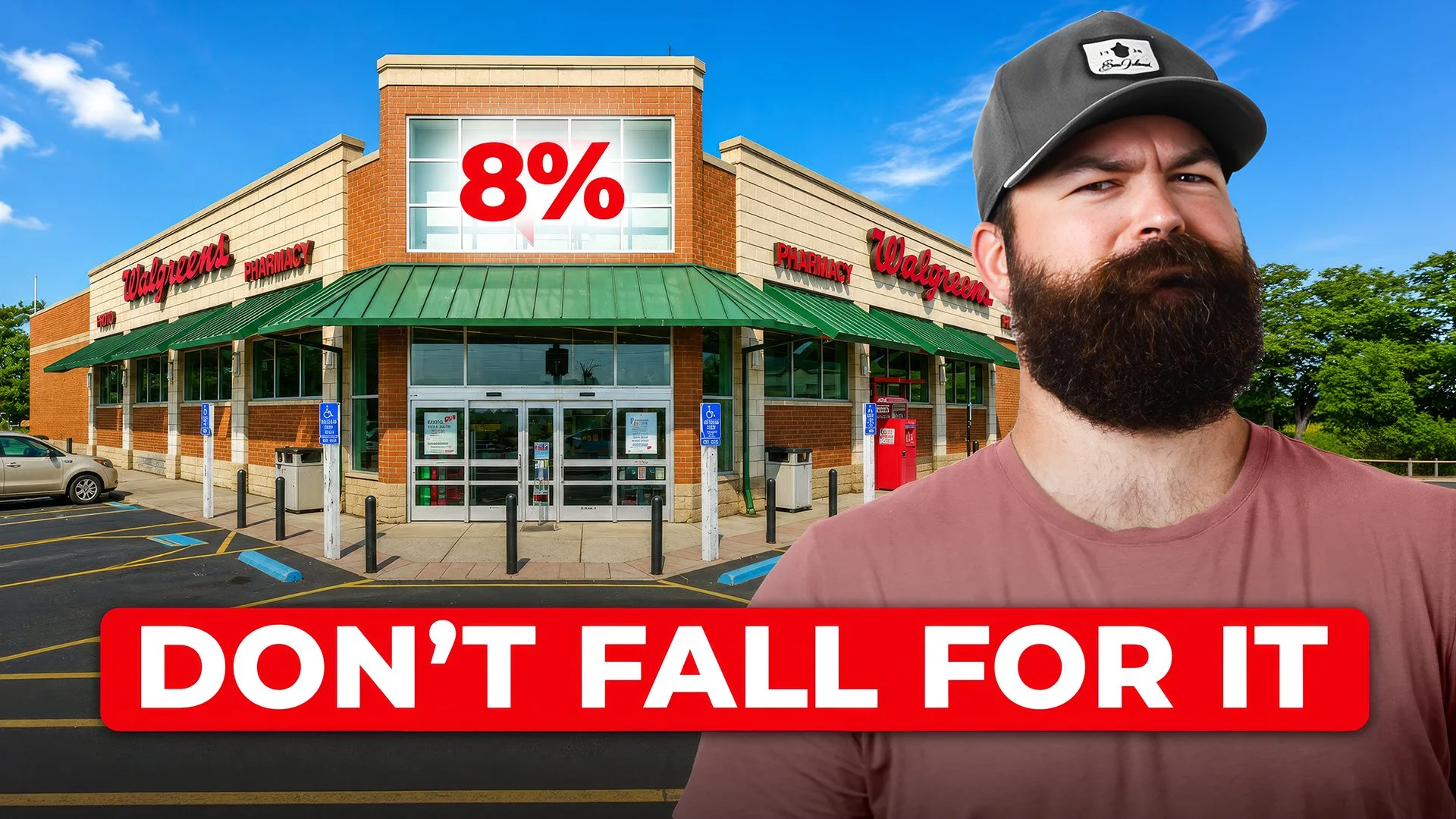
That 8% Cap Rate Is A Trap
Everyone wants the highest cap rate. But what if that 8% cap rate is actually a warning sign?
In this live session, we break down why experienced commercial real estate investors don't simply chase yield. Instead, they focus on understanding the risk behind the return and that's where most buyers get it wrong.
In this session, you'll learn:
Why cap rates measure risk, not value How to tell the difference between a great deal and a value trap
The real reason a Walgreens trades differently than a Chick-fil-A What the Rite Aid bankruptcy taught net lease investors
A simple framework for analyzing any NNN investment Live Q&A with real-world examples
If you're investing in single-tenant net lease properties—or thinking about buying your first NNN deal—this session will help you avoid expensive mistakes and make smarter investment decisions.
Get commercial real estate coaching, courses, and community to jumpstart your investment journey over at CRE Central: www.crecentral.com
Key Takeaways:
Cap rates price risk, not just return; higher cap rates signal more risk in the tenant, lease, building, or location.
The spread between Chick-fil-A (4.45%) and Walgreens (8.1%) is “danger pay”—extra yield you get because you’re taking on extra risk.
The real value is in the “box”: how desirable the dirt and building are if the tenant leaves, and how easily you can backfill.
Corporate guarantees aren’t bonds; sectors change, companies bankrupt, and leases can be rejected in court.
Use Tyler’s danger pay checklist: who signed the lease, what the sector is doing, how much term remains, and how current rent compares to market.
High cap rate deals can work if you underwrite conservatively, plan for vacancy and re-tenanting, and don’t pay today for income that may vanish tomorrow.



About Your Host:
Tyler Cauble, Founder & President of The Cauble Group, is a commercial real estate broker and investor based in East Nashville. He’s the best selling author of Open for Business: The Insider’s Guide to Leasing Commercial Real Estate and has focused his career on serving commercial real estate investors.
Tyler Cauble 0:02
So let's take a look at two different leases. We've got a Walgreens here and a Chick Fil A. And Walgreens used to be a trophy asset. They're both triple net. Let's assume you know tenants or their leases are relatively the same for both. They're both triple net. Tenants are paying for everything. You, as the landlord, are still responsible for the roof structure, unless it's an absolute net lease, which you know you don't always see that. The Walgreens is going for an 8.1% cap rate, while the Chick Fil A is going for a 4.45% cap rate. Again, the instinct is to look at that Walgreens and go, "Well, hell, that's the better deal. You know, it's a bigger, it's a, it's a big tenant. It's a better cap rate. You're getting, you know, almost twice the returns that you are of the Chick Fil A. So why wouldn't I pick the Walgreens over the 4.45? And there's actually a lot of reasons as to why you would do that. Here's how a lot of investors, your typical investors, you and me, right? Shop through these cap rate deals. You typically go on to LoopNet, Crexie, or brokers are sending you these opportunities, and you sort by cap rate, right? You look at what are the opportunities out there, and when you sort by cap rate, the higher yield reads as the better deal, right? Again, 8% sounds a hell of a lot better than 4.45% and that's really where the trap starts. Then you'll trust the guarantee. A corporate signature feels like a bond, and it is not, not necessarily. Walgreens does not have the same guarantee that Chick Fil A does not anymore. They probably used to, but look at brands like Macy's and Sears. At one time, they had a very strong corporate guarantee. It's not an ephemeral thing. It's it doesn't last forever. It is something that you have to constantly analyze and dig into and look at to make sure that you're approaching these things right, and then you buy the spreadsheet right. And I don't mean literally, but you're buying what the spreadsheet is selling you. If the pro forma, if what if the numbers in that spreadsheet tell you that the deal pencils today, it must be a good one, right? It must work, and with interest rates where they are, an 8% cap rate is a great deal because you're capturing a bit of a spread, right? And that's where things really start to go sideways. Let's talk about what cap rates actually price. They are pricing risk, right? And price and risk sit on the same seesaw. They cannot move separately. As risk goes up, price has to go down. As price goes up, risk has to go down. All right. The cap rate is not necessarily a reward, although of course you can look at it like that. It's really a price tag on the risk associated with that deal. You have to keep this in mind. If you were selling that property, and you could get a lower cap rate for it, don't you think you would list it for a lower cap rate? It's the same thing for the current seller. If the person that owns that Walgreens could sell it for a 6% cap rate. Don't you think that they would be doing it? They know that there is probably an issue with that tenant, with that lease, with that building, with that location. Something's going on to where they know that they couldn't achieve a 6% cap rate. If we look at several different national credit tenants right now, Chick-fil-A and McDonald's these are average according to the Boulder Group. These are average weighted asking cap rates. Chick-fil-A and McDonald's are pretty neck and neck right now, 4.45% CVS is at 5.74. Average retail across the country is 6.6. So keep that in mind. The average is 6.6% So sorry, the average is 6.6% So anything above that, again, they're pricing in more and more risk. Look at Walgreens there at 8.1% You've got Family Dollar at 8.75% and again, these are relatively similar leases, right? Now they can change, and every tenant has their own little nuances, but at the end of the day, they're pretty similar, right? Walgreens and Chick Fil A both like to be at nice corners, high visibility, often lighted intersections-they're good places, right?
Tyler Cauble 4:45
But the gap between the two is what I like to call the danger pay, all right? And let's talk about the anatomy of that four-point spread between these two. And I'm using these as an example just to really illustrate the point: Chick Fil A and Walgreens. But this really applies to any cap rate deal that you are looking at. All right, so if we're looking at comparing, let's talk about the signature, the guarantee, the 4.45% cap rate tenant. They're going for investment grade corporate. Come on, look at Chick Fil A. That is a hell of a signature to have right now. Same with maybe Amazon if you're in the industrial world, but Walgreens, they are leveraged. They are private equity owned now. They went private. I think the somebody the the private equity firm that owns them now took them private within the last few years. The category, are they still expanding? Well, Chick Fil A is still opening stores. Walgreens is closing stores every year, and we'll get into how many stores they were planning on closing, and how many they actually ended up closing. But the market is changing. You know, I mean, especially when you look at the pharmaceutical industry compared to fast food, you're not really getting a a nice chicken sandwich delivered to you to your door within 24 hours. The store economics, you know, Chick Fil A is having the best sales in a sector. I mean, in in terms of a price per square foot of sales per store, they outperform almost every single one, if not every single one, of their competitors. Walgreens is thin store level profits, right? And then the box. This is this is the big thing that I because you know we work with clients that are buying triple net deals all across the country. We've been doing that for years, and actually before cap rates rose, that was an overwhelming majority of my business. You know, back when or not cap rates, when interest rates rose back in 2022, over 50% of our volume here at the Cobble Group was single tenant net lease deals across the country. We were working with a bunch of people on that, and it's really it's a it's an interest rate cap rate arbitrage, right? So investors, when debt is cheap, they go buy these because you can get debt at 5% get you know a a take five oil at six and a quarter percent, and you capture that 1.25% spread, and it works out really well. But the most important thing to look at, despite the guarantee, despite how much rent is coming in, is what is the box that that tenant sits in? What is that worth? Empty, not full. Empty. The corner for Chick Fil A is worth most of the price, and chances are pretty good you're going to be able to backfill a Chick. I've very rarely seen a Chick-fil-A ever leave a location, by the way. But if they do, chances are good it's a good enough location. You could very easily get another QSR tenant in there. Walgreens, on the other hand, is a bit of a different beast, especially with the way that they structure their buildings, their parking lots. Like yes, they're at typically very high traffic, lighted intersections, but those buildings aren't always well suited to be adapted to something else. CVS probably isn't going to take a Walgreens today, at least not in my experience. They have, you know, that Walgreens has such a unique building structure, especially in the pharmaceutical space, that CVS doesn't want to look like they're in a Walgreens, right? They're going to want to change that up. It's been a lot of money changing the building, and so then it's is it just the value of the land, right? And so the market ends up grading the tenant. It's not actually the lease. And look at this in Chapter 11, a lease is not a guarantee. It is a suggestion. It's a hope. You know, Rite Aid rejected 168 corporate guaranteed leases in bankruptcy court. The second filing liquidated the entire company. Rejection damages are capped by statute, and landlords wait in line with every other creditor.
Tyler Cauble 8:56
So just because you have a high credit corporate tenant, or potentially high credit corporate tenant today, paying you rent doesn't mean that they couldn't file bankruptcy tomorrow, stop paying you rent, and then you're in line with all of their other creditors. Think about all of the other banks that they might own owe debt to for working lines of credit, you know, for lines of capital, whatever that is, so that they can run their operations, let alone then their leasing obligations. And Rite Aid had landlords with guarantees on their leases too. So here's here's the danger pay checklist. These are the four questions that I tell everybody to ask before you really jump in and start considering whether a cap rate deal is actually worth it, and we can get into another time how most of the deals we actually see out there are trading shouldn't even be trading on a cap rate, but that's a whole different story. So number one, who actually signed the lease? Who is guaranteeing it? Is it a. Corporate lease? Is it a franchisee with 12 stores? Is it a local credit tenant, and this is a startup, and this is their one location? You could have an identical building, identical rents, identical leases, no difference whatsoever. And the difference between what somebody's willing to pay for a corporate tenant on that exact same building, exact same lease versus a startup night and day. Because if if I'm signing a lease with Starbucks, which has 1000s of locations, and they're doing a corporate guarantee, I feel pretty good that Starbucks is probably not going to close tomorrow. But if I'm working with you know the local mom and pop burger shop, I have no idea if they'll be there tomorrow. I have to bake in that risk into my returns in the deal, which means either I've got to have a higher security deposit, I've got to get more rent out of it, I'm probably willing to put less tenant improvements into it. I just know that I'm taking more of a risk as an investor, I have to get a return for that. Number two, what is the sector doing? Is the tenant's whole category not just this tenant, but look at the category as a whole? Are they opening stores or are they closing them? QSRs, especially post 2020, they're still moving very quickly. In and out just opened up down the road. You see a lot of these. You know, I mean, Whataburger is expanding all throughout the southeast. They're doing well. They are still expanding and opening stores. How often are you seeing pharmacies opening up today? And again, like I said, I'm using these two tenets to illustrate the point. But this could apply for anything. These are the types of questions that you should be asking whenever you're reviewing these deals that will help you determine the credit. Because I get asked the question all the time: "Well, Tyler, how do I determine the credit of a tenant? Like, if they're not tracked by Moody's or you know one of the the big corporate groups that tracks corporate credit, how do do I understand what their credit's going to be? And there's a little bit of nuance there, but generally these are kind of the questions that you want to be diving into. Number three: How much term is left? How much term is left? Exact same lease, exact same building, but if you have 18 years remaining on one lease and four years remaining on another; those are entirely different planets, and that's one of those situations right there where, like I said earlier, I would argue that that shouldn't even necessarily be trading at a cap rate, because if you only have 234, years remaining on a lease, you're not actually buying income; you're buying a building that happens to be paying you today that won't be tomorrow. You really need to be paying attention to what that box will be worth empty, to make sure you are not overpaying for it. Make sure that the rent you are collecting is as close to market rate as it possibly can be, because it's going to go vacant and you're going to have to get market rate again.
Tyler Cauble 12:55
And that leads us into number four, which is basically what I was just saying: what is the rent that they are paying today versus the market rate? Above market rent means that the yield will evaporate at renewal. If somebody is paying 1020, 30% over market rate, which is not necessarily uncommon when you see a brand new single tenant net lease deal, where they are really you know paying based on a build to cap rate for the rent, right? But it's a completely brand new building for them. It works, so they can pay a little bit over market. But if you have to take that building back and then you've got to go rent it to the next group, they're probably not going to pay you a premium for that. They're going to pay you at or below market, depending on the condition of the space. So you want to make sure that, like, yes, it's great, and and look, if if somebody's got a 15-year lease, high corporate credit, I'm willing to overpay or accept an overpayment on market rents from the tenant, because I know chances are good I'm going to collect that for 1015, years, and then you know it'll reset. I've made enough money in that in that time to where I'm willing to sell the property at a loss because I still win, which I know is kind of funny to think about, but it happens all the time in in the triple net world or single tenant at least as especially, you can actually buy a building, cash flow it, sell it at a loss in 10 years, and still double your money, still do really well on it if you if you structure them right. So, something to keep in mind for sure as you're going through this, because if the box goes empty, you are going to have to deal with that now, and this is one of the reasons that I really don't. I'm not a fan of most Dollar Generals. For that reason, you have to think through. Like, okay, cool, great. It's paying today. What's going to happen tomorrow? Dollar Generals typically sign a 15-year lease with two to three five-year options, and last time I checked, all. On average, they stay about 17 years in a location, which means that as $1 General landlord, you have a 40% chance that they are going to renew. I don't like that chance, and especially with how often they are recalibrating their stores, they often will literally buy a lot across the street and build a brand new building and move across the street. Here's the problem with the Dollar General. You think, okay, well, it's a 10,000 square foot box that should be relatively easy to convert into literally anything else. And you're not wrong. The problem is, who's going to go lease that? Dollar Generals typically go out in the middle of nowhere. I drove with my wife this past weekend. We're we're doing a video on Bucky's, and you know, kind of their real estate play, which I think is going to be a really fascinating story. And we were driving through the middle of nowhere in Kentucky because she wanted to go to this to this Amish market. And of course, we're in the middle of nowhere. I mean, it's just farms everywhere. We haven't passed a single car, and all of a sudden, there's $1 General. And I looked at that. I was like, when that Dollar General leaves, they will probably never fill that building again. They're pretty high risk. So you want to make sure that you're accounting for that on the front end. That doesn't mean avoid the deal altogether. It just means hey, when that comes available, are you willing to accept half the rent that you are getting? A quarter of the rent that you are getting? Are you willing to accept two years of vacancy? So a high cap rate is fair. It's it's not a trap when the corner carries most of the value when it's empty.
Tyler Cauble 16:41
If the term is priced honestly, and and and you would happily run the release play yourself, but where I see a lot of brokers and sellers start to get greedy is that they try to price these deals that don't have enough term on them, they don't have high enough credit tenants at these, you know, relatively like close to average cap rates for that type of asset, right? So pay attention to that. Now, look, most of us are not going to be going out there and buying single tenant nelly steels. They make sense if you're in a 1031 exchange. They make sense if you're just looking to collect a very secure bond, right? That's what that's what singleton and LA Steels are. They are the bonds of commercial real estate. You're not going to make a ton of money on them. You're going to make decent cash flow if you pay cash, all right? And you're going to collect it every single month and not deal with problems. That's the nice thing about them. But let's talk about you know if you're if you're buying a three tenant strip center at an 8% cap rate. It is the same report card. You are using the exact same logic going into this. Your credit is a local LLC. The nail salon's personal guarantee is your corporate signature. Grade it the same way. Now the local nail salon is, of course, not going to get nearly the cap rate that Chick Fil A would right that local nail salon might get an 8% cap rate. That might be fair. It's not going to get a six unless it's like corporate and the shopping center is just you know class A or double A whatever people are calling them these days. When I first got started, everything was just class A, B, and C, and then all of a sudden, this-I swear-this was like five or six years ago. People started saying class double A, class triple A, making up new categories. But you get my point. You you have to bake in that credit risk because again, it seems attractive. You've got a tenant there, 1015, years. They're paying rent. They haven't been in default. Their financials look good, but they've got one location they could file for bankruptcy tomorrow. That Shell LLC could disappear, and you didn't account for the risk. Your term is also three to five years, not 15, right? Especially in these like smaller three tenant strip centers, chances are good you're not going to have a nail salon signing a 15-year lease, or a laundromat, or a corner bar, or a local boutique for that matter. They're typically going to be three to five years, and that rollover risk is going to show up on your rent roll every single year, which means you have to price in the tenant improvements and the downtime, and the leasing commissions and the attorneys' fees that you'll have to spend negotiating a new lease. You have to account for all of that. I what I typically tell like members of the CRE Accelerator Mastermind is, you know, we're not underwriting to see if a deal is good. We're underwriting to see if it's not bad, right? We want to be conservative going into these. There's so many deals out there. There's so many opportunities. We don't want to try and take the rosy approach to anything, because all it takes is one bad deal to sink you. But there's dozens and dozens and dozens of really. Really good ones out there, so don't ever try and just force one. Make sure that you are properly accounting for the realistic expenses that you will incur on these deals. And if sellers aren't willing to accept that, move on to the next one. They can sit there and they can hold that asset for a few more years. That's fine. That's their prerogative. Let it be their problem, not yours. And then when you've got a you know three tenant strip center, this is nice compared to a single tenant net lease. Like one vacancy is a 33% haircut. You could say, okay, well that's a good thing. I still have two tenants that are paying me rent, but also the nice thing about single tenant net leases, like yeah, you're gonna have 100% vacancy, but you know it for a while in advance.
Tyler Cauble 20:43
They're typically very desirable spots, and you can go and fill that relatively quickly. Three tenant strip centers can be a different a different beast, and and again, the three tenant strip center is just a an analogy or just an example. It could be a 20-tenant office building. Doesn't matter. Could be a five-tenant flex space. You lose one of your three tenants, and your 8% cap rate drops to a 5.3. Right? You might not be breaking even anymore on that. So you want to make sure that you are properly accounting that, and you're running your dark tests, making sure that if a suite goes dark, you are going to be okay. That danger pay has a bit of a local accent too. So here's here's the biggest takeaway that I want you guys to have with this: like high cap rates are fine, they're great if you know how to get in there and you know how to handle them. You are paying for the risk-that is what it is-or I guess you're not paying as much because of the risk, right? So danger pay is fine to accept. I'm fine taking that spread. You just have to know that that is what you are paying for. You don't want to think, oh, I'm getting into an 8% cap rate deal. I've got three five-year leases with local credit tenants. Everything's going to be fine for five years. I don't have to worry about this because there is an inherent risk that one or two or all three of those tenants could go out before that five years is up, and it's probably not going to be worth your taking them to court and getting any additional rent out of it. It's just not. So, with that being said, let's get into the comments section. I I think that high cap rates are good. They're good. They're they're fun, right? But again, you've got to know the risks that you're getting into and the work that it's going to take to to make those worth it. Edwin, what's going on, man? He's saying what up, Tyler? Ready with my notebooks for those gold nuggets. Glad to hear it, man. Cherry, what's going on? She's saying good morning. What rates are you seeing these days? And she said, I answered the question. Average is six. Cap rates are tough to to kind of understand, like where they actually are in the market. You know, when you and I mentioned this earlier, so let's talk about this too. Where do cap rates come from. Are they are they pulled out of thin air? Sometimes, honestly, they are. People just say, "Oh, they're pulled out of thin air. But here's here's how I like to kind of look at cap rates. Like sub 6% is really institutional grade investing. More often than not, you, me, almost everybody we know, we're not going to be buying sub 6% cap rates unless there's like a massive value add play to quickly get your like build to or invested to cap rate a lot higher. For example, I had a buddy that bought a 1% cap rate deal, but the tenants were paying $1 to $2 a square foot in rent when market was eight to 10, right? So like that's that's why I say like that's not really a cap rate. Like he's really buying it on a price per square foot basis. So you know there's there's some deals where it's just not really appropriate to throw a cap rate onto them. Luke is saying good morning, Tyler. Good morning, Luke. What's going on, my man? Christian is saying yes, but high price per square foot. Exactly, got to be careful with those with those boxes because I'll see this all the time. Like when it when it comes to these tenants that have signed these leases, market rate might be you know especially for like a QSR corner, like $120,000 a year, but this tenant might be paying 150 or $180,000 a year because they were willing to sign a 15 year lease. They wanted it built out that it included their FF and E in it, whatever that is, right?
Tyler Cauble 24:32
Because sometimes you'll see these landlords that will bake all the FF and E, they'll turnkey everything, and they'll just bake that back into the rent, and the tenants are fine with that because they don't have to pay for it in cash up front, and so it actually ends up inflating the rent payments that you're actually getting. So something to keep in mind there for sure. Shuban is saying found a medical complex in a pretty affluent area with a main road near it. There's a single unit triple net off. At about a seven and a half percent cap rate, with the lease expiring in 2034, I feel it can be easily released. Thoughts? Well, Siobhan, that's a it's it's very tough. I don't have enough data. I don't have enough information to be able to tell you if if it's good or not. It comes down to like it's good good term, right? You've got another eight years remaining on that lease, I like that. The problem with eight years, though, is you're kind of trapped into it, right? You couldn't hold it for four or five years and then flip it to the next guy because it's going to be worth even less. So, if a tenant has eight years remaining on it, you have to be prepared to take a haircut in five years, or you have to run it through the full eight and then get it released, and so what I would look at is what they are paying on a price per square foot for rent. What is going on in the area? If there's anything that's going to be continually driving more people to the area, like what's the population growth, what's the traffic density, how many vehicles per day are currently going down that road, all of that stuff really, really matters, but yeah, I mean, just initial blush sounds like it could be an interesting opportunity for you. Nasio is saying Dollar General are also very corporate, and people don't like dealing with them. I have Dollar General is one of my tenants, and they are notoriously difficult to deal with. Very great tenant. Like I will say this, they are a great tenant. But you know, if you want to go back and renegotiate a lease with them or do anything that they don't want, they just won't even respond to you. Lucas saying, "How do you handle a seller stuck on selling on a cap rate on a vacant building? I would ask him what he. I would say hell yeah, man. I'd gladly buy. What cap rate do you want? 5% All right. So 5% You know. So $0 of net operating income divided by 5% is $0. How about this? I'll give you $100 for it. I'll overpay for this asset if you want to sell it on a cap rate. Let's do that. You can't. I mean, you. You. If if there is no net operating income, you literally cannot buy on a cap rate because there's nothing to run the cap rate on. If the seller is trying to say, "Oh, well, once it's leased up, it'll be worth this cap rate, then you say to them, "Okay, I will pay you that cap rate after you get it leased up. How about that? I'm not going to pay you for all of the work and effort and risk that I'm going to have to take in order to get that. I'm not going to pay you for that today. You're asking me to pay you tomorrow's price today, and that makes no sense. So, if somebody is is genuinely like stuck on no, this is the value that I want, my my just have to walk away. Vacant buildings sell on a price per square foot basis. They they don't sell on a on a cap rate, but you will see that every now and then, Luke. It's it's wild. People are crazy. Josh is saying paying for the high cap rate risk can be great as long as you have killer game plan to value add. Love the show, Tyler. Thanks. Yeah, yeah. Anytime, Josh. Glad you're enjoying it. Exactly. You have to have a killer game plan. I'm fine with an eight, nine, 10% We've looked at 12% cap rate deals.
Tyler Cauble 28:05
Let me tell you this: a 12% cap rate deal is like you might as well have no income coming in on that, right? It is either the risk is unbelievably high or something is horrible with the property. But again, I'm fine with it if I know going into that. That's what I'm doing. This is a value add play. We're fixing it up. We're releasing it. We're starting all over, right? Nick is saying, "Do you find direct mail or cold calling as the more effective off-market lead gen channel right now? Yeah, I think it's pretty good. I think it's good. Honestly, the majority of my deals though come from people in my network and from other brokers, I mean brokers are great. I think focusing on broker relationships makes it substantially easier because they're going to be doing all the stuff that you should be doing anyway in order to go out there and find deals. And the great thing about brokers, you don't have to pay them. You know, I mean, they they get paid a commission by the seller at closing, so why not take advantage of that? Awesome guys. Well, thanks for diving into cap rates with me today. Hopefully, this was helpful in in allowing you guys to understand why higher cap rates may seem attractive at first, but we have to make sure that we're accounting for the risk. And as long as we know what that risk is going into it, that's totally fine. Let's get into it. Let's make a deal happen. But if you're not accounting for it, if you're trying to treat an 8% cap rate deal the same way you would treat a 4% cap rate deal, there could be problems. Appreciate you guys for joining me. We will be live again next Tuesday, 830 a.m. Central Standard Time for office hours, and I will see you guys in the next one. This episode of the Commercial Real Estate Investor Podcast is brought to you by my CRE Accelerator Mastermind, where you'll get access to my step-by-step investment blueprint, essentially a library of resources on how to invest in commercial real estate. You'll get connected to a supportive community of other commercial real estate investors that are doing projects just like you. You'll get personalized coaching. Feedback from me every step of the way. Go to www.crecentral.com to learn more.